Sunday, September 15, 2019

Guest Reviews by MADonnelly: MYSTERIES by Isabella Maldonado, Lilja Sigurðardóttir, Becky Clark. A. J. Mackenzie, Kirsten Weiss, Antti Tuomainen


MADonnelly is a published poet, a Vermonter, a good friend. As guest reviewer on this blog, she brings a hint of Irish delight to the space. And you know what the Irish say: May your home always be too small to hold all your friends. The same applies to a good review blog. Thanks for these pithy takes on six mysteries, Friend!


DEATH BLOW by Isabella Maldonado (A Veranda Cruz mystery, Midnight Ink)

If you like tough cop heroines and  chilling, gruesome hit jobs, this one’s for you.  Add a savagely cruel Mexican drug smuggling cartel, a violent family history, and fast paced, tense police work and you’re in for a wild ride.  The author, with over 20 years in law enforcement, joins intimate knowledge of criminality and  police procedures with considerable writing skills and  a gift for  creating some psychologically complex characters.   Occasionally some tender heartedness, devotion  or cop loyalty shine through rough exteriors to relieve the horrors and appear at the right time.


TRAP by Lilja Sigurðardóttir, trans. Quentin Bates (Orenda Books)

As if trying to get custody of her son away from an abusive and criminal husband weren’t enough, Sonja herself is part of an international drug smuggling operation and in an on-again off-again lesbian relationship with a money laundering cocaine addict.  As she realizes the connections between the  banking and  drug plots, she finds herself being drawn in deeper and deeper. The more she desperately wants to get out and live a normal life with her son, the more she finds herself with a target on her back and unable to extricate herself from the increasing corruption, danger and threats. (Note the translator, who's an Icelandic noir author himself.)


FOUL PLAY ON WORDS by Becky Clark (Midnight Ink)
Witty, self deprecating  and somewhat neurotic mystery writer Charlemagne Russo arrives in Portland  for a mystery writer’s conference thinking all she has to do is give a keynote speech, catch up with her best friend and fly home to her boyfriend.  Instead  she immediately discovers that she is in charge of the conference with no help, her friend’s daughter has been kidnapped and the conference hotel has  been double booked with a dog show. Her friend has told her to focus on the conference  but Charlee can’t let the kidnapping go.  She must find the daughter. Motive? Financial insolvency? drug addiction? family secrets? illicit romance?  Everything’s possible  with lots of barking dogs,  rendezvous in dark passageways under the hotel, suspicious looks and cryptic remarks by staff and attendees.  The  ransom, possible multiple murders and conference deadlines  are all looming.  A  frantic, comic tale.


THE BODY IN THE BOAT by A. J. Mackenzie (Hardcastle & Chaytor Mystery, Zaffre)

There are a number and variety of strong female characters in this mystery. Particularly astute and principled is Mrs. Chaytor, who with her close friend Reverend Hardcastle  have  not only multiple murders to solve  but  troubled parishioners and refugees to tend to.  They do so with fierce intelligence and relentlessness, while struggling with their own personal sorrows and demons..     
    Romney Marsh in Georgian England during a war with the French,  is the rough, gloomy setting for this story and   its smuggling and banking worlds — and the sinister ways they are connected. Mrs. Chaytor and the Reverend, with the help of a couple of the smugglers (there are both”good” and “ very bad” smugglers) keep going over  every angle and all take pretty daring risks to uncover the chain of complicated events, the slippery perpetrators, the mysterious contrabands.

CHOCOLATE À LA MURDER by Kirsten Weiss (Midnight Ink)

-->
  A Ghost Detecting resident cat  (named G.D.) and  a haunted Mexican molilnolo ( a stick for stirring chocolate) are just what you might expect in a “Perfectly Proper Paranormal Museum”.  But a  dead chocolatier, found covered in chocolate,  is probably not your  typical murder victim.  Museum owner Maddie Kosloski, a self appointed amateur detective wants desperately to solve the crime. She goes about it steadfastly and with wacky humor, much to the annoyance of friends, family, and the local police. There’s not as much assistance or interference from the paranormal as the name of the museum suggests, but Maddie does well without it.
  And maybe the chocolate shop, billing itself as  producing the most high end best chocolate ever, (“ hand crafted, ethically sourced, organically grown ingredients”) is not all it’s cracked up to be.


PALM BEACH FINLAND by Antti Tuomainen (Orenda Books)

Here’s a mystery that starts with a murder and the reader knows right away who did it, how and why. The real entertainment , sustained, deepened and embellished beautifully and sometimes hysterically, is in how the assortment of characters figure it out, react, compromise, diabolically pursue, bungle, cover up. There are big themes too: Life’s dreams and plans, failure, greed, friendship, revenge, brutality, love - and the ridiculous.  The author focuses masterfully on the characters’ eccentricities and inner lives.  Psychological complexity, wild humor, romance-  it’s a rich mix in the new, garish, plastic-palm-trees-and -all   Palm Beach Finland resort, “the hottest beach in Finland.”

PS:  Looking for more mystery reviews, from cozy to very dark? Browse the Kingdom Books mysteries review blog here.
-->

Saturday, September 07, 2019

Doubling Up on Edith Maxwell's Quaker Midwife Mysteries


Well-written historical mysteries offer the benefits of time travel, first class: With a trustworthy author who does plenty of research, diving into a "history mystery" reveals the nuances of a particular time and culture, through the eyes of a compelling character tackling risk, danger, and injustice.

That's one of the great pleasures of reading the Quaker Midwife Mystery series from Massachusetts author Edith Maxwell. Set in Amesbury, Massachusetts, in the 1880s, the books have probed class and gender, liberty for Black Americans and for women across the board, and the customs of the politically active worship units of the Quakers.

Maxwell's most recent book in this series was CHARITY'S BURDEN, released in April 2019. Protagonist Rose Carroll is a midwife who takes her religious customs with her to to family homes she visits -- addressing people by their first names, for instance, something that Quakers of her time did to indicate that all were of equal standing. As an activist on behalf of her clients, Rose confronts the inequities in their lives: poverty, abusive spouses, terribly long work hours.

In CHARITY'S BURDEN, Rose discovers, to her horror, that one of her clients may have experienced a botched abortion and died from the results. Rose certainly understands the need for family planning, and can sympathize with a woman's desire to end a pregnancy when conditions will make another birth dangerous or cruel. But she has no patience for people who knowingly injure women (pregnant or not).

So the hunt begins for who in Amesbury is quietly putting lives at risk. At the same time, while Rose collaborates with police detective Kevin Donovan (despite Donovan's new boss banning such teamwork), she longs for the chance to finally marry her own beloved David, a doctor who in fact may be of assistance in her search for justice:
It occurred to me that David might know of doctors who provided abortion services, as illegal as they were. "And I might need a bit of help from thee."

"Whatever I can do."

"We had a happy announcement here last night. Faith and Zeb are also to be wed, and it will be this First Day."

"My, so soon. You're correct, that's very happy news." He fell silent for a moment. "Did this make you wistful for our own vows, darling?"

"I confess it did."
However, since David's mother is adamantly opposed to her son marrying Rose -- her career, her values, even her clothing are not what's expected for such a marriage -- Rose's efforts to take care of her clients and stop the illegal procedures costing them health and even life may cost her dearly.

Series readers get an extra treat with the Quaker Midwife series this year: Mystery publisher Midnight Ink, which brought CHARITY'S BURDEN and the three earlier books of this series to print, has closed its doors. So the next in the Quaker Midwife series, JUDGE THEE NOT (involving a false accusation, class bias, a pregnant woman who's blind, and more) is coming out from Beyond the Page Publishing ... not next year, but next week!

So order both books through your local store or online retailer, and enjoy the double treat. Not much "on-stage violence" in these books, but wonderful information (instilled the way Barbara Cleverly brings us England between the wars, or Sujata Massey offers India of the 1920s) and a capable and loving sleuth -- well worth adding to the TBR stack and then the "read it again soon" shelves.

PS:  Looking for more mystery reviews, from cozy to very dark? Browse the Kingdom Books mysteries review blog here.

Tuesday, September 03, 2019

Crimesolving in the Trenches: WHEN HELL STRUCK TWELVE, James R. Benn

What do you value in a good mystery book? Pace? Character? Clues? A certain level of darkness but some restraint on gory moments?

I want all of those -- and a recognition that someone's got to take action against that darkness -- but I also want to respect the sleuth, feel challenged by watching for clues with the protagonist, and earn my satisfaction with the book's resolution. I may not "solve the crime" before the book's main character does (and I surely don't want to solve it in chapter 1 and then wait impatiently for him or her to catch up!), but I want to feel like I was somehow on the right track. I could have done it, if I'd had the good friend, or the moment of stress, or that head-knocking sudden new view of the people and their actions that have crowded around me in the book, right?

That sense of working toward satisfaction, coupled with the value of friendship and some good moral choices: Those are the components that make me a fan of the Billy Boyle mysteries. Or, as the covers now say, "A Billy Boyle World War II Mystery."

James R. Benn works with a well-defined stage of action and timeline. After all, World War II ended some 74 years ago, and we "know the ending." We won. So to speak.

But the details of the war years include many surprising twists and tales, and Benn's two most constant characters in this series, Lieutenant Billy Boyle (of the Boston cop Boyles) and his Polish military intelligence buddy, "Kaz," have already trudged through Spanish battlegrounds, across North African terrain, and among Roma Gypsies, while working for SHAEF, a special operations wing under General Eisenhower's personal direction.

Now in the 14th book of the series, WHEN HELL STRUCK TWELVE, Billy and Kaz undertake operations in northern France in August 1944. Back on the Allied line of action, they're caught at the opening of the book with a group of Free Poles stranded on a hill under vicious bombardment. "Every Polish soldier knew what surrender to the SS meant. Execution... There was only one choice—to fight to the death." For the Poles are all aware of the valiant Warsaw Uprising, crushed and massacred by Nazi SS troops. In Billy's grasp of the Polish situation, readers too bond with the valiant effort and with the exhilaration as the tide of battle turns: "In the midst of all the yelling, I heard a familiar voice, and saw Kaz join us. He chanted Warszawa with the rest of them, tears streaming through the dirt and dust on his cheeks."

So this isn't a "war book" -- it's an emotionally charged journey of friends under fire. And to this, Billy and Kaz's boss, Colonel Harding, adds a crime-solving mission: The team must find and isolate a traitor among the leaders of the French resistance groups, before General Patton moves into his final fierce maneuvers to retake Paris from the Nazi forces. Some of those resistance leaders aren't exactly nice people, even when gathered at an all-allies confab for final plans:
One of the bodyguards delivered a cup of coffee to Jarnac, who gave a slight nod, indicating they could relax and take their turn at the sugar bowl.

"It seems you may still be in danger," Kaz said, watching as the two hulks waited at the coffee urn.

"Simply a precaution," Jarnac said. "Old habits are hard to break. Look, even Louvet comes with his guard of honor!" ... Louvet had his own beefy men behind him, eyeing the crowded room with suspicion. No one had entered with rifles or machine guns, but there were enough revolvers and automatics in holsters, waistbands, and pockets to kick off our own gunfight at the O.K. Corral.
By the time the coffee-and-conference is over, murder's been committed, and since a coverup of the suspected traitor seems the likely motive, Billy and Kaz launch a risky and clock-racing investigation.

Fans of the series can expect other stars from earlier volumes to appear as the team gets closer to re-taking the City of Lights. Benn also hurls startling twists into the book's finale, promising an intense next book in the series.

If you're curious about the book title, here's the epigraph at the front: "O childhood, the grass, the rain, the lake water on stones, / oh moonlight when the hell struck twelve. ... / The devil's in the tower right now." From Hellish Night, by Arthur Rimbaud.

That's right. Every fiercely good mystery takes part in the battle of good and evil. Part of the suspense is in wondering how the good guys (whether at the O.K. Corral or in 1944 France) will muddle through, when (by choice) they're not using the nastiest weapons in the fight. And the other part -- which James Benn evokes so well -- is wondering ... at what cost??

PS:  Looking for more mystery reviews, from cozy to very dark? Browse the Kingdom Books mysteries review blog here.

Sunday, August 25, 2019

Anne Perry Addict? Good Choice! Here's Her 2019 Title ... TRIPLE JEOPARDY

[originally published in the New York Journal of Books]


Triple Jeopardy shows emphatically that Perry’s best writing exhumes the motives of the human heart.”

Last year Anne Perry introduced her third crime fiction series set in England, and Triple Jeopardy is its second title, set in 1910. The book features Daniel Pitt, the son of investigators Charlotte and Thomas Pitt from one of her earlier series. Acting as what Americans would call a defense attorney, Daniel’s caught up in an international scandal that involves his sister Jemima and her husband Patrick.

One of Jemima’s friends from her years in America suffered an attempted sexual assault there, and the theft of a personally important necklace. The blame falls on British diplomat Philip Sidney and migrates with all of the group to England. Daniel’s original plan, to yield to his sister’s wishes and defend Sidney only far enough to force revelation of the assault, goes out the window when one of the witnesses is murdered and an underlayer of profit and loss begins to be revealed.

Soon Daniel is compelled to seek direction from his direct superior, the estimable Mr. Kitteridge:

“‘The murder must be part of the whole business, but if Thorwood framed Sidney, and he’s innocent of the assault and the embezzlement, how does the murder of Morley Cross fit in with that?’

‘God, you’ve got a devious mind, and you want to understand everyone!’ Kitteridge said, but it was awe he expressed, not denial. ‘I see why you’re going all shades of pale,’ he went on. ‘What is Patrick Flannery’s part in this? … Could Morley Cross have attacked Rebecca?’ Kitteridge said with disbelief. ‘Then he set up Sidney with the embezzlement change?’

‘I hadn’t even thought of that,’ Daniel admitted, a wave of nausea coming over him.”

Perry’s adroit handling of matters of law and crime creates an intriguing skein of tangled motives and court case potential in this fast-paced and likeable novel. In addition, she spikes the action with a slowly growing attraction and daring whiff of romance between Pitt and his other boss’s brilliant daughter, forensic expert Miriam fforde Croft. When Pitt and fforde Croft follow a hint of evidence out to the Channel Islands, the entire set of available motives shifts in a heartbeat. All Daniel Pitt will have to do is maneuver the progress of the legal case to force the unlikely admission of the crimes involved.

“The judge looked exasperated. ‘Mr. Pitt, my patience is not endless, and you have tried it further than most. I hope you know what you are doing?’

‘Yes, sir,’ Daniel replied. He hoped more than anyone else that, indeed, he did. They all seemed to be here. His parents, Patrick and Jemima, Miriam, all those he cared about. This was going to be a triumph … or a disaster. He could feel his heart beating, as if it were trying to break out of his chest.”

Anne Perry’s long career has labeled her as an “English author of historical detective fiction.” But Triple Jeopardy shows emphatically that her best writing exhumes the motives of the human heart. This is, in the long run, the finest characteristic of well-written fiction, and sets readers looking for more from this promising new series.

PS:  Looking for more mystery reviews, from cozy to very dark? Browse the Kingdom Books mysteries review blog here.
-->

Espionage Thriller With Bioengineered Female Lead: Karen Robards Pulls It Off in THE FIFTH DOCTRINE

[Originally published in the New York Journal of Books]


"The trouble with being a sort of Wonder Woman is, once people know you exist, they either want to force you to do their jobs, or kill you. Or both."

Wonder Woman. Nancy Pelosi. Michelle Obama. Although Americans haven’t yet elected a woman as President, there’s a clear cultural curiosity about what a strong and powerful yet honest and enjoyable woman leader might be like.

Into this vacuum has stepped Karen Robards, taking the espionage thriller into the terrain of a bioengineered super-strong female lead: the determined and yet oddly vulnerable Bianca St. Ives. Aware that she’s a genetically modified creation of a government researc lab, and well past her due date for termination and destruction, Bianca’s hiding out in The Fifth Doctrine as a private security entrepreneur in Savannah, Georgia, assisted by just a couple of people she trusts—but who don’t know her dark secret. Robards ramps the threat level to red as Bianca confronts the only international spy who’s come close to penetrating her defenses (in every sense). And to escape the pressures that Colin Rogan’s immediately applying, Bianca may lose her business, her friends … and her privacy.

Because the trouble with being a sort of Wonder Woman is, once people know you exist, they either want to force you to do their jobs, or kill you. Or both.

Bianca’s determination to protect her allies leads her to contemplate just disappearing. But (as revealed in the two previous books in this series, The Ultimatum and The Moscow Deception) Bianca already knows that “they found her in Macau, they’d found her Moscow, and now they’d found her in Savannah.” While she works to revamp her own defenses, she’ll have to tackle Rogan’s mission for her, one that requires her to transform into another woman who’s already an international operative.

Rogan directs her, “By the time we leave for the airport in the morning, you will be Lynette Holbrook and Operation Fifth Doctrine will be up and running.” What’s the name stand for? Rogan explains that the US military has five domains of war, and this one, the fifth, is information. “Kind of gives that whole ‘war of words’ thing a brand new meaning,” Rogan cracks.

Hot topics from today’s news cycle hiss and crackle in The Fifth Doctrine: Korean treachery. The spread of atomic weapons. Terrorist attacks and traitors motivated by money or bizarre loyalties.

Robards writes with fast scenes and the equivalent of a car chase every couple of chapters. Her special seasoning is a pulse-racing tide of attraction between Bianca St. Ives and Colin—balanced with logical mistrust, physical assertiveness, and a strand of growing respect between two people who would have liked to be colleagues instead of enemies. But could that ever happen in their world?

Series readers be warned, Bianca’s past includes more threats than Colin, and some of them are even closer to her heart. Brace for an exhilarating ride, and a finale that assures the series is far from over.

PS:  Looking for more mystery reviews, from cozy to very dark? Browse the Kingdom Books mysteries review blog here.

Tuesday, August 20, 2019

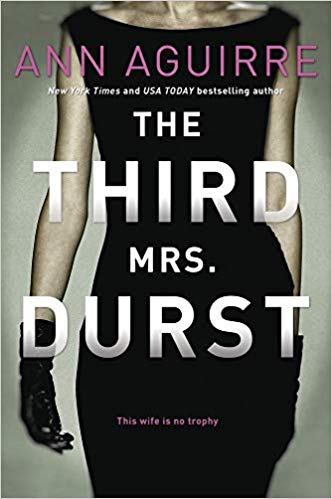
Victim or Murderer? A Tango of Turmoil in THE THIRD MRS. DURST, Ann Aguirre

Ann Aguirre leaves behind her twists of speculative fiction to craft a more straightforward "marriage to murder" plot in her new crime novel THE THIRD MRS. DURST, released today from Midnight Ink. A twisty and satisfying plot of teen model Marlena Altizer's rise to become the latest wife of a fabulously rich and powerful man, the book turns the classic "abused spouse" narrative upside down -- because Marlena is no wimp, and her intimate friendships on the side (carefully hidden from Michael Durst!) give her the strength and courage to take drastic steps and make a daring plan.

The book's opening is slow and not at all suspenseful. But when chapter 4 opens, Marlena warns readers clearly that, as in the best thrillers, all is not as it seems:
Maybe I'd end up doing real runway shows and get my face in Vogue. If anyone in Barrettville saw, they'd be so surprised. In retrospect, I can see now that was the turning point. If I'd said no, if I hadn't gone to Germany, my life would've been so different.

I chose the road that looked prettiest from a distance, but I didn't know then—sometimes the horizon is bright because it's on fire.
Marlena's rebellion starts its own fire, as soon as the bonds of spousal control begin to tighten around her. And the beating she suffers, the old life brutally severed, the cruelties of her new marriage only serve to enflame her determination further.

Aguirre tells the tale in first person, which shows off the book's two problems: Marlena doesn't actually change much, despite her circumstances, and the prices she pays along her way to crime don't wound her deeply. Although "Mr. Durst" commands her obedience and recovery, there's no leash on her spirit, so her actions don't pull her into growth. Yet this is a quickly spun and lively thriller after the opening chapters, and has the feel of a "Darkly Dreaming Dexter" in a slinky dress. Your kind of read? Enjoy!

PS:  Looking for more mystery reviews, from cozy to very dark? Browse the Kingdom Books mysteries review blog here.

Tuesday, July 23, 2019

David Downing's Stand-Alone Thriller, in 1938 Germany

[Originally published in the New York Journal of Books]


Retelling wartime history as spy fiction is Downing’s deeply grounded path; pointing out the power of love and family within it, however, is his aria.

The Cold War? History. The Red Menace? A comic-book phrase tossed around in period films. World-makers struggling to turn the globe into a folllw-up from the Russian revolution of 1917? Ridiculous.

Except, as the “Mueller Report” reveals, there is an ongoing and powerful effort of the Great Powers of the world to exert political will on each other, even if it’s just to distract leaders and hamper economies. David Downing’s series of haunting mysteries set in Berlin (the John Russell series) led to the Jack McColl series, thrillers positioned at the start of the First World War. With his 2019 “stand-alone” espionage adventure, Diary of a Dead Man on Leave, Downing puffs on what now seem like the long-dormant embers of the Communist Party—but they were far from dormant as Germany positioned itself to invade its neighbors in 1938.

Unlike his two earlier series, Downing does not center the emotion of Diary of a Dead Man on Leave on a couple falling in love or struggling to maintain a relationship through political upheaval. Instead, he fingers the tenderness that can grow unexpectedly between an isolated worker for a better world, and a child who needs his counsel and support.

To Josef Hoffman, struggling on behalf of Russia’s Kremlin to recruit a Communist cell within Nazi Germany five years after Adolf Hitler has seized control, the dream of a worker-led world with fairness and justice is worth every sacrifice. He’s already handled a hidden life in distant Argentina, among displaced Germans there. Now, infiltrating cautiously among the railroad men in Hamm, he knows his chances of a misstep are high … and his death unpredictably close. To quote a 1919 leader from the Soviet Union, “we Communists are all dead men on leave”—that is, only (at best) experiencing a brief respite from self-sacrifice at every level. Downing applies the quotation as a meme for the Communist agents working outside the Soviet Union.

But for a dead man, Josef has a lot of heart. Hiding out in a boardinghouse where the landlady struggles to raise her son safely amid men who want to take over her life and her child’s, Josef’s first intention is to do no harm: Be kind toward young Walter but insulate him from politics.

Yet he fails at this, repeatedly, as when the youngster asks his help on an assignment to provide proof of racial superiority of Nordic people in terms of speech and singing. “ ‘It can’t be true, can it?’ Walter asked doubtfully after he’d finished reading the passage. No, it couldn’t, I thought, but that’s what they rely on—that smidgen of doubt. Anyone who’d listened to a Negro gospel choir or an Italian opera diva would know such ideas for the rubbish they were, but few had been so lucky, especially in a place like Hamm.”

Can Josef answer Walter honestly, while at the same time teaching the youngster enough to protect him in a brutally propagandistic school system and devouring army? What about the rest of Walter’s family—the mother, the brother, the grandfather?

The dangers and sacrifices of Josef’s live create a dramatic and piercing counterpoint to the usual story of espionage. In Downing’s hands, they also create a call to action for our time. But set that aside and absorb the story instead. Retelling wartime history as spy fiction is Downing’s deeply grounded path; pointing out the power of love and family within it, however, is his aria.

PS:  Looking for more mystery reviews, from cozy to very dark? Browse the Kingdom Books mysteries review blog here.
-->

Provocative and Entertaining Dystopian Novel: EARLY RISER from Jasper Fforde

[Originally published in the New York Journal of Books]


Taking Early Riser into the summer reading stack will be surprisingly refreshing. Even though it arrives with both love, and a shiver of foreboding.

Dystopian fiction has become a necessary aspect to our politically unsettled and climate-challenged lives, and there’s a new longing for Joseph Campbell’s heroic figures to show us how to survive with honor and preserve a thriving planet.

As Jaspar Fforde leaps into the genre, an adult level of frustration and chaos appears: Early Riser, unlike Fforde’s long series of literary spoofs, lifts its curtain on despair and death, moderated by the equivalent of Big Pharma. Charlie Worthing, a novice “winter consul” allowed to stay awake for the frigid months of the new form of winter—while most people lie in a drug-induced sleep to save energy—seeks the source of viral dreams that are infecting sleepers and the awake. For Charlie, the dreams overlap the strange things going on around him: manipulations by two sides of the culture clash, and provoked disappearances of those who might be able to object.

What makes Early Riser unforgettable, though, is not the particular form of dystopia Fforde displays, but the affection and loyalty that Charlie and some of his new acquaintances turn into effective action against pharmaceutical giant HiberTech. Even as Charlie tackles his first assignment, taking a “soul-dead” individual named Mrs Tiffen to be parted out and recycled, the small details of humanity catch at him like “stick-tights” caught walking across a field of seeding plants: “Mrs Tiffen could play the bouzouki,” he notes at the opening of the book. “Not well, and only one tune: ‘Help Yourself’ by Tom Jones.  … She and I had not exchanged an intelligent word since we met five hours before, and the reason was readily explained: Mrs Tiffen was dead, and had been for several years.”

As Charlie confronts his first wakeful winter—where a mild day is around minus forty degrees—he also notes how hard he finds it to believe that a person who can play the bouzouki is no longer a person. Alive. Loving.

Affection becomes Charlie’s own melted area. His Morphenox-twisted dreams and the viral psychopathy infusing the people he meets mingle with an artifical affair he’s been dragged into—the highly attractive (but crazy?) Birgitta needs him to pretend to adore her. “‘The best relationships always begin like a bad rom-com in my experience. I’ll find a tartan travel rug and a picnic set for the Sno-Trac,’ she added, now quite enthused by the whole idea.”

Fforde sweeps the action forward briskly, unafraid of mythologizing as he goes along, complete with Villains with a capital V. He conflates Winter with the possibility of global evil, so that Charlie admits, “The citizenry didn’t know or care what the Consuls did during the cold to keep them safe, they just wanted to wake alive in the Spring, same as always. For many people, the Winter didn’t really exist except in an abstract sort of way, and by consequence, neither did we.”

The book couldn’t be further from a “beach book” in its details, yet the cover catches a bit of the viral dreaming from the story and offers a beach scene (sprinkled with snow). It’s a good hint for this season: Taking Early Riser into the summer reading stack will be surprisingly refreshing. Even though it arrives with both love, and a shiver of foreboding.

PS:  Looking for more mystery reviews, from cozy to very dark? Browse the Kingdom Books mysteries review blog here.
-->

Sunday, July 21, 2019

Fresh Espionage Fiction Set in 1992 Warsaw: Timothy Jay Smith, THE FOURTH COURIER

Suddenly 1992 and the end of the Soviet bloc and Communist era are practically historical fiction -- more than 25 years ago. In Timothy Jay Smith's fast-moving spy novel THE FOURTH COURIER, that's a moment fresh with possibilities: not just for nations but for an aging Russian who can't give up his dreams of ruling his own pocket of the world, even if it takes an atomic bomb to do so.

Brace for hot sex in surprising detail in this one, as FBI agent Jay Porter links up with a hot Polish airport worker with criminal connections, and Porter's CIA colleague Kurt Crawford turns the tables on the Russian general in a time when some sexual twists could mean far more danger and public shame than they do now.

The writing's sharp and quick, the plot laced with unusual twists. And the portrait of cash-starved, impoverished Poland at that point is poignant and salted with very human affection.

One of Jay's hosts reacts to provocation about the lack of freedom in Poland at that point:
"You cannot imagine the end of the war. The Germans were very thorough. Freedom. What good is freedom in this place at such a time? More than ninety percent of Warsaw was destroyed. We needed food, houses, protection—but not too much of any of them. If they thought we had enough of something, they took some of it away. They always wanted us to work harder. Their five-year plan was to have another five-year plan. It was enough to keep alive. I suppose it is different in America."

"It is different in America because we have freedom." ...

"Hopefully the women make more sense in America."
With flips of point of view, the reader soon knows far more than Jay about the flaws and cravings of the women on hand and the half-crazed Russian -- which ramps the tension effectively and leads to a book that's excellent summer reading. Smith's writing experience includes screenplays as well as novels, and his chapters are vibrant scenes with quick dialogue and swishes of the curtain. This won't quite reach the classics-of-espionage shelf, but it's definitely lively and surprising, a good addition to the genre. From Arcade, a division of Skyhorse Publishing.

PS:  Looking for more mystery reviews, from cozy to very dark? Browse the Kingdom Books mysteries review blog here.

Tuesday, March 05, 2019

Crime Novel from Calabria, Italy, BLACK SOULS, New from Soho Crime

[Originally published in the New York Journal of Books]


Across the decades of the narrator’s life, Black Souls becomes as mysterious as a set of cave paintings or yesterday’s “tags” on a building.

Nordic noir, French crime fiction, Japanese, South African—none of those are as surprising as the new crime novel from Calabria, Italy, Black Souls by Gioacchino Criaco. Deep and slow, it ranges over the youth, coming of age, and violent criminality of a nearly nameless narrator. His love for the landscape and the men in his family is a warm and restless ocean in which the crimes of the book roll, surge, and multiply. From early kidnappings and killings that balance the powers around the farming family, they ease toward urban connections and at last the cream of the crime crop, the drug trade.

But in Criaco’s hands, this becomes a literary exploration of a timeless land where fathers and sons form the ultimate bonds of the community. Calabria is one of the “oldest” occupied parts of Italy (today the label is for the “toe” of the nation’s “boot” shape), with some 700,000 years of human presence. Once redolent with many languages and histories, it has become both more Italian and more intensely occupied by the ‘Ndrangheta, a family-based crime network now darker and larger than the Mafia.

Criaco binds this criminal nature to the natural landscape and the eons of myths that permeate the consciousness of the peoples there. When the novel’s narrator slaughters a wild bull, he spends a harrowing night in and out of sleep:
I thought I could hear a mournful bellowing. I saw the bull’s head staring at me with that terrible, artificial eye in the middle of his forehead. … An immense pain overtook me, I was aware that I was trapped in a nightmare, I tried to wake up and couldn’t, I got up and fell back down, and only when the pain had traveled to my core could I shake myself awake.

I found myself sitting up in the dark. Bino tenderly pressed a cup of hot coffee into my hands. "Did you hear them? … We are a part of the mountains, not their masters. Sometimes practicing evil is necessary to survive. Taking a life is always wrong But if you don’t give your conscience an alibi or a decoy, it will scream at you every night. Come, we have to appease them."
This mythic connection to centuries of choregraphed murder and revenge echoes through the book. “Black souls” are not cleansed, but held in balance, and evil is negotiated. Some innocence is allowed to remain, protected, and begins to represent the reason to struggle to reach that balance in each new round of crime and punishment.

Across the decades of the narrator’s life, Black Souls becomes as mysterious as a set of cave paintings or yesterday’s “tags” on a building: The connections among people matter here more than anything else, even more than avoiding evil itself.

There are few comparable crime novels today. Stuart Neville’s haunted fiction set in the Troubles of Ireland may come close; so, however, does Dostoevsky with One Day in the Life of Ivan Denisovich. Make room for this book in the form of the “precious gift” that this criminal’s success is finally able to give to his father: “That money, even if it came late, too late for me, restored my father’s dignity.” 

PS:  Looking for more mystery reviews, from cozy to very dark? Browse the Kingdom Books mysteries review blog here.

Deep and Probing Novel from Charles Fergus, A STRANGER HERE BELOW

What makes an author choose to write a particular book? It's a topic that can lead to strange new worlds. For Charles Fergus, a Vermont author best known for his natural history, the death of his own mother many years before took him into writing A STRANGER HERE BELOW. Set in Pennsylvania not long after the nation's birth, it fingers both a historical culture and a lingering effect from his own life. I liked it.

[Originally published in the New York Journal of Books]


A slow, rich novel of a distant time and a man who is “Othered” in most aspects of his life.

In A Stranger Here Below, Gideon Stoltz, a Pennsyvania Dutchman (that is, from German settler stock), has become sheriff almost by accident in the growing town of Adamant, in 1835. Though the town is already making its mark economically with an iron foundry, and a range of wealth from ironmaster to thief, it’s only a hard day’s ride from frontier landscape and life. And some days, maybe not that far.

Through Gideon’s naive eyes, the layout of the town’s power structure begins to emerge. It’s based on force and violence as well as profit. And it has little of benefit for the women and children, whose voices mingle with old ways, as well as with the New World’s fresh forms of Christian worship. Gideon’s own marriage is a cross-cultural one, into a family of scoundrels and at least one sorcerous sort of grandmother. But it’s a heart’s truth marriage, and he clings to it as a series of deaths in the town slowly peel back the truth of two earlier deaths: murder for gain.

Underneath this, for Gideon, is the formative event of his young life: seeing his mother dead after an assault that’s never avenged. It haunts him even as he investigates crime for his town, and when he retreats to his much-loved wife to try to regain his footing, he stumbles into what he most fears: “I am thinking about how we are punished for loving,” he admits to her.
‘We fall in love, with life, with other people, with our kin. We love the land, and galloping on a horse, or singing hymns, or watching the clouds pile up in the sky, we love our dear wives and children …We love these things so much,’ he said, ‘that we can’t bear to think of being parted from them. When we see others torn away from life, by disease, or confusion of the mind, or the cruel actions of others …’ He stopped, could not go on.
His wife, named True, assures him that this pain requires belief in God’s plan and promises. She enquires about what’s upsetting him: the death of his friend the judge, who committed suicide, or a murdered boy he’s seen?
‘Both.’ And his memmi. Always his memmi. He saw for the thousandth time her ravaged body lying in its own blood.
Fergus’s first mystery follows more than a dozen books, including many explorations of the natural world. In this rural sheriff’s embrace of the world around him are the goodness and love that won’t allow a wrongful death to be covered up—and that in turn will disturb what peace he’s gained, at the deepest levels.

A slow, rich novel of a distant time and a man who is “Othered” in most aspects of his life, A Stranger Here Below is also an exploration of how a kind person can be drawn toward the dark revelations that crimesolving demands. For some, the book may be a bit too tender in places, yet this patina of affection can readily be crushed and scarred—as the sheriff’s investigation reveals.

Although the book is clearly crime fiction, it is equally an exploration of the soul in the presence of death and wrongdoing. Which is, after all, what a “stranger here below” can expect. 

PS:  Looking for more mystery reviews, from cozy to very dark? Browse the Kingdom Books mysteries review blog here.
-->

Sunday, February 24, 2019

New Series from Helene Tursten Opens, with HUNTING GAME

Helene Tursten's Irene Huss series, featuring a Swedish detective inspector, added a delightful holiday item with the short-story collection An Elderly Lady Is Up to No Good. Now Soho Press is releasing the first book of a new thriller series from Tursten, and again the investigator is an official crimefighter.

Embla Nyström, age 28, is a Detective Inspector in the mobile unit for Gothenburg, Sweden. A fitness fanatic and long-time hunter, she's due for vacation -- and plans to spend it hunting moose with family and friends, a long-time autumn tradition.

The real "beasts" in the book turn out to be human, of course. Embla's slow realization that the hunt has turned murderous involves a poisonous snake planted in the outhouse (live), a vicious leghold trap at the foot of her tree stand, and finally hunters who start dying and disappearing.

Running parallel to the suspense is a powerful attraction Embla feels for a new member of the hunting party, Peter Hansson:
Embla observed him in secret. She knew that he was thirty-eight years old, but he looked younger. Given his athletic build, it was clear that he worked out. And he was tall and good-looking with blue eyes and rather long, thick blond hair. The thin linen shirt he wore was just casual enough. The collar was unbuttoned and she could see a little gold cross at his throat. When he introduced himself a row of white teeth was exposed in a pleasant smile. Bleached? she thought automatically. She also noted the appreciative look she got from him.
But this attraction and the hot passions resulting are a dangerous distraction.

Tursten's skilled writing carries the action, which is rapid and increasingly threatening. Her grasp of hunting helps; she's also adept with police procedure, and the interactions in Embla's team become an excellent subplot.

Tursten has always written her female leads with family conflicts and with emotional turmoil that makes perfect sense in the context. This holds up well, although Embla's personality and reactions are a bit softer than found in a true noir. Call this one an intense police procedural, then, with fine pacing and significant losses. And yes, there's an echo of other human-hunting tales ... but considering the context, it works very well to heighten the thrill.

PS:  Looking for more mystery reviews, from cozy to very dark? Browse the Kingdom Books mysteries review blog here.

Tuesday, February 12, 2019

Ex-Detective Writes Terrific Crime Fiction, in THE MURDER BOOK by Lissa Marie Redmond

"A gritty dark edge that sparkles with a hint of possible redemption."
The cover's simple, even basic, but Lissa Marie Redmond's second Cold Case Investigation is traveling with blurbs from Reed Farrel Coleman and SJ Rozan. Make room on the shelf next to Karen Slaughter and Julia Spencer-Fleming and Julia Keller, too; this is a great new voice in crime fiction. I was hooked within the first chapter of THE MURDER BOOK.

Detective Lauren Riley, working late in the deserted police station on a cold case, sees just enough of the boots stamping her after someone's stabbed her: She knows the person who just attacked and left her for dead must work for the city of Buffalo, NY, probably as a detective or police officer. And it's got to be a man, from the force of the attack.

From here, she's mostly isolated in tracking down the would-be killer, because after all, who can she trust? But like Jeffrey Deaver's Lincoln Rhyme, she's got an unusual home situation -- and maybe two people on the force that can't have been the attacker. One is her partner Shane Reese, rock-solid reliable except when he's out "dating." An added problem: As a long-time cop, Lauren has old enemies who could come out of the woodwork. In fact, while she's laid up in the hospital from the stabbing, one of them does just that:
Lauren dropped the card on the floor and looked around. "When did these [flowers] get here?" Lauren demanded. Shooting her good arm out, she slapped her palm to the wall to steady herself. ...

Both Anna and Juan came around the nurses' station at the sudden change in her demeanor. "What? What's wrong?" Anna asked as Juan grabbed her on her good side and held her up, easing her to the station desk.

"Did you see who left these?" Lauren had Anna by the front of her scrubs with one hand.

"It was a kid," Anna told her, gently trying to break her grip. "I thought he might be one of your daughters' boyfriends ... He wanted to see you, but he wasn't on the list."
The card said "Get better soon" and was signed "David Spencer XOXO." And that's terrifying, because Lauren knows -- but hasn't much she can do about it -- that Spencer is a remorseless double murdered who's realized she knows he's guilty. And won't stand trial.

That means there are two forces threatening Lauren's safety: whoever wanted and took the "Murder Book" of notes on the cold cases, leaving her for dead; and Spencer, the frighteningly capable force of her own past.

When Lauren and her partner recruit a retired detective who used to take action against organized crime, they step across a couple of notable lines: They're outside approved channels; they'd tackling serious mob presence; and like it or not, they're waking Lauren's inner demons, the residue of the violence she's not only seen but experienced.

A pulse-racing pace, well-chosen details of Buffalo's mixed industrial landscape, and characters to bleed for make this a stunningly good second book. (Guess who's put the precursor, A Cold Day, onto her TBR list?) Moreover, Redmond's career with the city of Buffalo as both a police officer and detective provides extra assurance of underlying reality, along with a gritty dark edge that sparkles with a hint of possible redemption.

Highly recommended, and new this month from Midnight Ink.

PS:  Looking for more mystery reviews, from cozy to very dark? Browse the Kingdom Books mysteries review blog here.

Friday, February 08, 2019

The Anti-Sherlock Holmes, William Arrowood, Returns in THE MURDER PIT

Glasgow-born Mick Finlay has taken rough conditions to the extreme, including the condition of his detective, in his second Arrowood mystery, THE MURDER PIT. And it's a doozy. With twists, risks, extreme danger, and graphic descriptions of filth and poverty, it's an outrageous counter to the civilied Sherlock Holmes narratives supposedly being printed at the same time that Arrowood and his loyal sidekick Norman Barnett are scrambling to make a living. And there's a fierce rivalry between Arrowood, the "workingman's detective," and the pricey and elegant Holmes: one that's more than just the part of the city where they live, the amount they get paid, the gap between praise and vilification in the London newspapers.

For Arrowood, a man of enormous heart (and girth), opens the interior of crime by observing the personality and emotions of the person he's facing. He puzzles over Darwin, sort out early psychology, grieves for the lot of the people in the slums around him in an emotional stew quite foreign to the celebrated cerebral sleuth of Baker Street. As he warms up to a case involving a woman who can't seem to speak for herself -- she's severely learning disabled and has been married off in a suspicious financial transaction, to a disgusting farm far from home -- Arrowood depends on Barnett's initial survey of the possibly forced bride:
"So Birdie looked in low spirits in train?" he asked, shoving the last piece of warm muffin in his gob.

"That's what it looked like to me. And I felt she wanted to show me too. But I couldn't swear by it. It was dark, and she only looked up quick."

"We ca all recognize grief," he said. "Mr. Darwin says it's universal: raised inner eyebrows, furrowed forehead, lowered mouth corners. The Hindoos, the Malays, the ancient Greeks—all the same. If we couldn't recognize sadness in others we couldn't sympathize. And what would society be like without sympathy, Barnett?"

"Like London sometimes, sir."
Brace for filth, and description of disgusting conditions, from the reek of Arrowood himself, to the pig manure and malicious violence that follow when the pair dig into what's going on in a very unscrupulous medical practice. It's often ugly in Arrowood's London.

But it's also a city of passion and surprising tenderness, and Barnett himself will finally reveal the sorry state of his life to his employer, whose caring is direct and honest. (Just don't get close enough to let Arrowood enfold you in an embrace, an action that again the posh Sherlock Holmes would not condone.)

The devil may be in the details. Walking with this unusual detection team may turn your stomach every few pages. Yet the plot twists are agile, the discoveries worth the work, and yes, I'd read another in this series. I liked the first one, too (Arrowood.) Brought from the UK by the Mira imprint of HarperCollins.

PS:  Looking for more mystery reviews, from cozy to very dark? Browse the Kingdom Books mysteries review blog here.

Monday, February 04, 2019

Irresistible New Flavia de Luce from Alan Bradley, The Golden Tresses of the Dead

[Originally published in the New York Journal of Books]


“It’s a foregone conclusion that adults picking up The Golden Tresses of the Dead are sneakily opening up the book on their own, under the covers at night.”
Flavia de Luce is insatiably curious about science, especially chemistry, and in her exquisitely uncomfortable British home where half her family’s dead and the other half make fun of her, no wonder she turns to detection instead. In this tenth in Allan Bradley’s irresistible series, Flavia faces a new loss: Her sister Feely (for Ophelia), who maybe sometimes likes her, gets married in a gorgeous ceremony and is about to depart on a honeymoon trip.  Just as Flavia begins to realize what a loss this will be, distraction erupts with Feely’s horrified discovery of a severed human finger in the wedding cake.

It’s the best possible distraction for Flavia, though. Once Feely leaves, Flavia digs into investigating the finger’s origin—and of course the purpose of being in the wedding cake—with the one person she can trust in her home: Dogger, long ago rescued in wartime by Flavia’s father, and now Flavia’s own partner in discrete investigations. Picture it: Arthur W. Dogger & Associates. Maybe being an “associate” will keep Flavia from getting into more trouble with the local constabulary.

In many other books featuring adolescent protagonists, dead bodies would be something to avoid. The Golden Tresses of the Dead (the line is from a Shakespeare sonnet) refers, of course, to those stinky, decomposing corpses. For Flavia, they are a source of fascination, with their parts and their processes. (She does have some dreadful moments when she sees them as human, but not often.) With Dogger, she now has reason to visit cemeteries, probe the processes of embalming and bleeding out, and test for various poisons.

Bradley can’t keep Flavia endlessly young, which is starting to strain the series a bit. Flavia suspects her newly emotional self as having “glandular” issues; grapples with odd feelings about the bodies and smiles of young men; and can’t get away with excusing her adventures as “childish.”

On the other hand, her growing knowledge of chemical reactions opens fresh insight for her in solving crimes:
Someone had put the ordeal beans of Calabar into Mrs. Prill’s coffee maker.
I couldn’t wait to tell Dogger.

It was too late tonight. He needed his rest. And so, to think of it, did I.

I switched off the lights and went back to my bedroom. I sat on the edge of my bed reviewing the events of a hectic day.

But even before I reached the London Necropolis Railway, sleep fell on my head like a sackful of anvils, and I did not move until morning.
What wakes Flavia from this impressive torpor is the loud and slightly malicious teasing of her unwanted younger cousin, Undine. Although Flavia dislikes the loud-mouthed “little swine,” Undine’s insistence on being heard awakens another “glandular” emotion in Flavia: compassion for this child who’s competing for Flavia’s position in the family, and in the investigation.

When Bradley sees Flavia through to the closing of two cases at once, he leaves a door open to the next book in the series—which, almost surely, will aim Undine and Flavia on a collision course with the next murder.

Purchase the book ostensibly for the “young person” in your life, if you like; it’s a foregone conclusion that adults picking up The Golden Tresses of the Dead are sneakily opening up the book on their own, under the covers at night.

PS:  Looking for more mystery reviews, from cozy to very dark? Browse the Kingdom Books mysteries review blog here.

Mossad Espionage and Counterterrorism from Jonathan de Shalit

[Originally published in the New York Journal of Books]


“It’s stylish to portray Mossad as the least likeable and most dangerous of all the secret mission forces in the Western world.”
Ejected Mossad agent Ya'ara Stein is tapped by Israel’s prime minister to create a secret, un-acknowledgeable task force that can strike at will, without publicity, and without compunction. If it’s necessary to kill for Israel, this task force should be able to do exactly that.

Stein is brilliant and deadly, a combination that probably should go with some form of psychopathy. Or is that a normal result of training with Mossad and appreciating the horrors that antisemitism and global warfare commit against Israel daily? Because author Jonathan de Shalit (a pen name for a former Israeli intelligence agent) never clears that up, a terrible ambiguity lingers, and even deepens, around this highly connected woman. Her love affairs are riven by treachery than she’s willing and able to conceal. Her friendships shiver with regrets and past violent actions. She is, in fact, the title’s embodiment: A Spy in Exile.

But the truly likeable side of Ya’ara Stein is the tender care, planning, and acuity she invests in training her team of “cadets.” With her partner Aslan, as she lists the credentials their newbies should have, she asserts, “We’ll look for people who are missing a part of their soul.” Aslan, in protest, says, “And yet they must still be trustworthy, stable, cool-headed, and all that.” “Yes.”

Because of a sudden need from “above,” Ya-ara and Aslan opt to train their team in live action, taking down a Russian terrorist plot. There’s little hidden from the reader, who looks over the shoulder of the Russian planners, the terrorists in the field, and the possible bed-partner of Ya’ara’s who is accidentally tangled in the mess. de Shalit’s adroit plotting and description of weapons and their effects makes the action scenes lively and compelling, with highly believable terrorist aims.
Ya’ara hadn’t believed to begin with that the sloppy occupants of the farm could be running the show all on their own.

“’Do you know what these are?’ Ya’ara asked Aslan.

‘Of course. Field dossiers.’

… an operation—information on their residences, their vehicles, the roads in and out of the respective areas, the security measures in place in the vicinities. All at once, the pieces of the puzzle slipped into place. Ya’ara looked at Aslan. The blood had drained from her face. She felt as if she was seeing ghosts. History never remains in the past, and here it was, coming back to haunt again.
Yet Ya’ara is labeling more than her team when she talks about “missing a part of their soul.” Her clarity of mission allows her to take finely honed extreme risks for herself, and to betray as needed, in order to complete the task. It’s not a comfortable situation to observe. de Shalit’s first book, Traitor, won acclaim and in particular was praised for the author having learned from John Le Carré. If that is indeed the case, then the author has learned to portray a female and still employable version of Le Carré’s less than lovable traitors. Oh, Ya’ara won’t betray Israel, that’s clear – but don’t expect her to regret any other option for more than a day or so. She’s not made for high principles other than doing her job.

It’s stylish to portray Mossad as the least likeable and most dangerous of all the secret mission forces in the Western world. A question that lingers long after reading this fast-paced modern espionage novel is, Where’s the moral gap? In the agency–or the author–or just the character in place? Or, more likely, in exile.

-->PS:  Looking for more mystery reviews, from cozy to very dark? Browse the Kingdom Books mysteries review blog here.

Charles Todd, THE BLACK ASCOT, British Post World War I, Richly Detailed and Memorable

[Originally published in the New York Journal of Books]


“It’s the taint of a shell-shock diagnosis, something considered so offensive and humiliating in postwar society that it can terminate Rutledge’s career almost as quickly as a bullet to the head.”
Charles Todd’s Inspector Ian Rutledge series opens its 21st title with a tip of the hat to a 1910 event well known in England, but perhaps not to American readers: the “Black Ascot,” when the traditional glittering social occasion of the royally established horse race faced a catastrophe of timing. King Edward VII died, and the royal house was in deep mourning, with the nation hardly less so. In a brilliant adaptation, the “glitterati” attended in mourning dress: clad entirely in black.

In a death related to the race are the seeds of the tragedy and linked crimes than Inspector Ian Rutledge finds himself investigating eleven years later, in his postwar resumed post with Scotland Yard. Not that the case is obvious to start with—in fact, Rutledge simply responds to a village crisis, an overwrought man on a church roof, holding a girl hostage with a shotgun.

Fans of the series will give a quiet “hoorah” for the immediate presence of Rutledge’s haunting inner voice, that of his wartime colleague Hamish, warning Ian of the perils in the rescue he attempts. There’s an unexpected gift to Rutledge when he resolves things: word of an observation of a “most wanted” murderer from that 1910 event, Alan Barrington.

The information offered at the start of The Black Ascot positions Rutledge on dubious ground (as usual) with his superior:
Rutledge made good time back to London. And for most of the drive, he mulled over Danny’s sighting of Alan Barrington, and whether or not to mention it to Chief Superintendent Jameson. … If the sighting proved true, and the Yard wasn’t informed then he would be derelict in his duty.

Hamish, stirring in the back of his mind, said, ‘He’ll be more fashed if you send him chasing after wild geese.’
Of course, since the Chief Superintendent heartily despises Rutledge, the hunt for a near-vanished deadly criminal is also a possible way to humiliate the inspector with that wild goose chase, and possibly even to fire him. So the hunt is on.

Charles Todd is a master plot tangler, and in the hands of this mother-son author team, Rutledge must comb apart society’s powerful connections, apparent love matches that turn abusive, and more. Because he’s hunting Alan Barrington, he’s pitting his wits and emotional understanding against some passionate defenders of the accused—people who will do almost anything to prevent Barrington’s capture and trial. He’ll also pry into a family’s desperate efforts to protect an outcast and a hidden set of long-ago crimes.

The enduring appeal of this series is its subtle and poignant probing of the damage done by the Great War: to Ian Rutledge, to England’s upper classes and villages alike, and to a nation’s concept of itself as gracious and lovely. At front and center this time is not the struggle between Ian and the part of himself that speaks with Hamish’s voice. Instead, it’s the taint of a shell-shock diagnosis, something considered so offensive and humiliating in postwar society that it can terminate Rutledge’s career almost as quickly as a bullet to the head.

So solving the Barrington case, and capturing the killer, becomes Rutledge’s only hope for his self-respect and his job. As the pages fly past, Charles Todd takes this investigator into tangled boundaries and razor-sharp fences. The best kind of suspense is generated: believing that somehow the inspector will come through, but not knowing, from one moment to the next, how on earth he and his fragile network of support will find a way out of the war-torn darkness.

PS:  Looking for more mystery reviews, from cozy to very dark? Browse the Kingdom Books mysteries review blog here.
-->