Showing posts with label Charles Fergus. Show all posts

Friday, April 14, 2023

The Living, Lasting Legacy of Author Anne Perry (1938-2023)

(Author Anne Perry in 2012. Credit: Wikimedia Commons.)

Dave and I met one of the great mystery authors of our lifetime at a reader/writer conference, Bouchercon, when it was held in Albany, New York. We'd prepared for months —even years—for this, collecting the books written by Anne Perry. Others in line around us clutched to their chests one or two books to be signed; some, like us, had more. We toted ours in big canvas book bags.

I recall how awestruck I felt when I reached the front of the line and stood in front of this British author. There wasn't time for conversation: Maybe another hundred people waited behind us. Briskly, in our practiced rhythm, Dave and I opened each lovely hardcover book to the title page for this author's bold signature, then the next, and the next, as one of us put away signed copies and the other lifted more books to the table.

In minutes, it was over; I felt breathless, truly amazed that life could include such a moment.

Historical mystery author author Charles Fergus, however, made much different use of his time with Anne Perry. I love his story of that moment and its lasting legacy in his writing. Here you are (the original is published on his blog, https://charlesfergus.com/blog-posts):

Anne Perry's Advice to Me: Make True a Major Character

Anne Perry, who died recently at age 84, wrote dozens of popular mysteries set in Victorian-era England. According to her website, more than 26 million copies of her novels have been sold since the first one was published in 1979.


Perry wrote 32 William and Charlotte Pitt mysteries; they feature a police officer in late 19th-century London and his wife, an unconventional aristocrat. Perry also wrote a 24-book series about a detective named William Monk, who loses his memory after a carriage crash, and Hester Latterly, a former Crimean War nurse who ultimately becomes William’s wife and helps him adjust to his brain injury and solve crimes. 


I met Anne Perry in 2013 at a conference of the Historical Novel Society, which was held in an old hotel in St. Petersburg, Florida. I had completed a manuscript for the first Gideon Stoltz mystery, A Stranger Here Below, and was looking for a literary agent. I’d also signed up for a course on how to craft effective pitches – both a longish description of a novel, and a shorter one, sometimes called an “elevator pitch” from the notion that you can deliver this near-breathless summary during a brief elevator ride. 


Perry gave the keynote speech on the conference’s first evening. The next morning when I came down to breakfast, I saw her sitting there by herself. I asked if she wanted company, expecting her to say no, but she was delighted to share the meal and some conversation. 


She asked where I was from and what I was writing about. I said with a laugh that I’d just give her my brand-new elevator pitch: “In 1835 in the Pennsylvania backcountry, a young sheriff unearths disturbing links among a judge’s suicide, a trial and hanging 30 years ago, and a recent murder. To conduct his investigation, he must relive his own mother’s murder, a crime that remains unsolved.” 


I also mentioned that one reason I’d written a murder mystery was because I had lost my own mother to a murder, and I wanted to write a story that did not trivialize the horrific, life-swerving effects that a murder leaves in its wake. 


Years later, I would find out that Anne Perry had committed murder herself. In 1954, in Christchurch, New Zealand, at the age of 15, she and a pathologically close 16-year-old female friend killed the friend’s mother by bludgeoning her using a sock with half a brick in it. They somehow thought that killing the woman would prevent the friend’s parents from leaving New Zealand, which would have forced the two adolescent girls to separate.


Ms. Perry’s criminal past had been revealed in 1994 when Peter Jackson told her story in his film Heavenly Creatures, starring Kate Winslet as the confident, conniving teenager Juliet Hulme – who, after serving five years in prison, would be given a new name and ultimately would become the bestselling mystery author Anne Perry.


That morning in St. Petersburg, after hearing about my planned mystery series, Perry urged me to develop Gideon’s wife, True Burns Stoltz, into a major character. Perry said that in writing her novels, she felt that having both male and female main characters helped her examine situations, relationships, and crimes from two very different perspectives. She felt that readers liked that approach. And she said that writing from those differing viewpoints was fun. 


By then I’d begun working on my second mystery, Nighthawk’s Wing. In it, True hauls herself out of a deep and nearly suicidal depression brought on by the death of her and Gideon’s infant son. And in the third mystery, Lay This Body Down, True blossoms into a quirky, tough, determined heroine whose way of looking at the world differs from – and complements in an important way – that of her rational, thoughtful, sometimes almost plodding sheriff husband. 


Perry’s obituary in the New York Times noted that she never married; friends felt she ended romantic relationships because she didn’t know what to say about her past. It also quoted some things she’d said in a 2017 documentary film about her life: “In a sense it’s not a matter – at the end – of judging,” she said. “I did this much good and that much bad. Which is the greater?” 


She continued: “In the end, Who am I? Am I somebody that can be trusted? Am I someone that is compassionate, gentle, patient, strong?” She mentioned other traits, including bravery, honesty, and caring. “If you’re that kind of person,” she said, “if you’ve done something bad in the past, you’ve obviously changed.”


Anne Perry offered me encouragement and spot-on writing advice. I’m glad to think of my character True as one of the things she gave to the world.


 PS:  Looking for more mystery reviews, from cozy to very dark? Browse the Kingdom Books mysteries review blog here

Tuesday, February 14, 2023

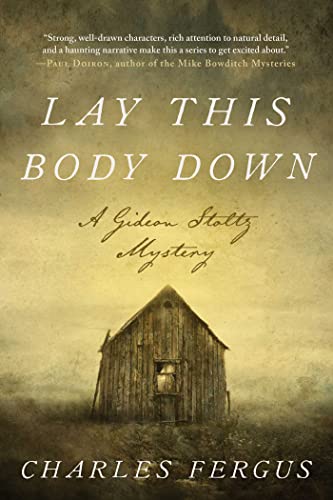
Third Crime Novel for Sheriff Gideon Stoltz, LAY THIS BODY DOWN, by Charles Fergus


 [Originally published at New York Journal of Books]

“Fergus’s writing lays out both the struggles of a new nation, and the pains of growing into determined manhood with its allegiances, regrets, and consolations. If murder and kidnapping can be halted, why not enslavement, also?”


The lines of good and evil are firm in this third antebellum mystery from Charles Fergus: Enslavement is brutal, and deprives the 1837 American nation of honor. Immediate emancipation could restore that honor—but in Sheriff Gideon Stoltz’s industrial Pennsylvanian town of Adamant, a rough crowd jeers at a visiting speaker advancing such an argument, and Gideon’s role as lawman is keeping the peace. Not advancing abolition.


However, Fergus positions Gideon as an outsider himself, with a strong “Pennyslvania Dutch” German accent that marks his difference in the hardscrabble Scotch-Irish town. Young and inexperienced for his job and without training, supported by his wife and a few friends, Gideon identifies with runaways and victims. It’s a dangerous position when there’s a national law requiring that he enforce “property ownership” toward Black fugitives. Although his state backs away from that position, the town is just 80 miles from Maryland, and his neighbors, a mostly rough crew, could inform on a runaway and expect Gideon to jail that person.


“What if the right thing—whatever it is—and what the law requires turn out to be two different things?” Gideon asks his wife True. Her answer: “I hope you would do the right thing.”


Chapters of Lay This Body Down open with excerpts from historically real reward notices seeking fugitives. When slave hunters turn up in Adamant, seeking a Black youth who’s helped Gideon in the past, what he’ll choose is never in doubt: He owes a debt, and servicing it fits with his growing belief that enslavement is cruel and wrong. Instead, the rapidly ramped-up tension in the book comes from the prevalence of malice among those hunting fugitives and those who already despise Gideon as not one of them, neither by heritage nor by attitude. As he struggles to find and protect this and other runaways, he plunges into personal danger.


In that sense, this is an intimate novel of connection among working men with opposing worldviews. Gideon will only succeed and survive if he can find enough allies to defend his choices and actions. It’s soon clear he’s even being betrayed within his own office. His own superior in law enforcement doesn’t even have his back. But his wife does.


Readers of the earlier two titles in this series (A Stranger Here Below; Nighthawk’s Wing) will not find much of the mystical and supernatural that appeared in those books, although True Burn Stoltz, finding her way out of her long depression over the loss of the couple’s child to illness, clearly relies on a related set of beliefs. Instead, the conflict in this novel foreshadows what was already erupting across the nation’s frontier at the time: ardent beliefs in independence and the sanctity of property, playing against philosophical and humanist efforts to impose a better form of civilization.


Gideon’s weaknesses, part psychological from his own mother’s murder, part physical as a residue of concussion (alas for the results of horse accidents and human beatings!), hold potential to transform into powerful incentives to action. As he prunes away the rot around him, he finds himself able to say to a stranger, “Maybe you can help me.”


Fergus’s writing lays out both the struggles of a new nation, and the pains of growing into determined manhood with its allegiances, regrets, and consolations. If murder and kidnapping can be halted, why not enslavement, also? The author’s meticulous historical portrayal offers a potent integrity, to ground the growth of Gideon Stoltz into a man who’s certain of the right thing to do, after all.


 PS:  Looking for more mystery reviews, from cozy to very dark? Browse the Kingdom Books mysteries review blog here

Monday, March 01, 2021

Guilt Stalks the Sheriff, in NIGHTHAWK'S WING from Charles Fergus


In the second Gideon Stolz mystery, set in Pennsylvania Dutch terrain in 1836, the young sheriff is acutely aware of how different he is from many of the people he's supposed to protect and serve. There's his accent, of course, and his personal legacy of loss and violence, yet equally important are his beliefs about justice and worship, strands that are vital in a community still very much built as a set of frontier settlements.

But as NIGHTHAWK'S WING takes off, Gideon has far more to worry about than just feeling awkward among others. He hasn't recovered from striking his head in a fall from a horse, and the ongoing physical effects and memory loss threaten his job, his reputation, even his marriage and his liberty. As he realizes he's not even keeping up with routine tasks, his questions turn frightening:

Gideon asked himself why he hadn't remembered the horse as soon as he smelled the stench. Or before he went out for his walk. Or maybe he had remembered it and had gone out from the jail to check on whether the horse had been removed, and then forgotten why he'd ventured out in the first place.

Why couldn't he remember such things? ... Why couldn't he remember anything about his own accident, getting thrown off Maude or otherwise falling off her, striking his head on the ground, and (so he'd been told) lying insensible on the road?

He worried about the gap in his memory. He didn't know how far back it went.

Charles Fergus delicately draws out the differences in pioneer culture—the absence of medical knowledge, the fragmented communities from different European roots who knew just enough to be suspicious of each other, the fierce expectations of gender and age—as Gideon investigates a violent death on a farm some distance from the town where he lives. Has there been accidental poisoning? Are there implications of witchcraft, and of punishment for such deviation? Worst of all, he discovers incontrovertible evidence of having played a role in the tensions on the farm, before the death: With no reliable memories of what had taken him there at the time and of what had taken place, must he now suspect himself of abuse or violence?

Even Pastor Nolf in the farming community represents strangeness to Gideon. As sheriff, he needs to grasp how this German offshoot of religion functions here:

Nolf continued, "You asked earlier if I thought that Rebecca Kreidler had a disturbed mind. I told you yes, I did sense that. I also sensed in her a deep anger and a black despair. As Neigeboren, we work to purge from our lives that which would not be pleasing to the One we serve, including anger and despair. One thing I have been considering since her body was found: I think it's very possible that Frau Kreidler took her own life. That she purposely ate a plant she knew would kill her, and in a way that would inflict severe pain."

Meanwhile, Gideon's double distraction—over the dead woman's cause of death, and over his own possible enmeshment in the case—results in his effectively abandoning his gravely depressed young wife. Each of them, Gideon and True, is still in deep pain over the death, from illness, of their small child. And neither seems able to give the other what's needed. There's a chance that the marriage may be damaged beyond repair, despite Gideon's love for True. She reminds him: "You only believe in what's standing in front of you and nothing else. There's other ways of seeing, other ways of knowing. Maybe someday you'll figure that out."

Fergus's measured pace, rich with the feel of the raw, unsettled landscape and its fragile human bonds, provides a depth to the double mystery: the crime, and how to reinvent a marriage after a child's death. Not until the very end of the book will the answers become clear—and the pain and loss along the way are vivid and visceral. In the tradition of Jeffrey Lent's In the Fall, Erik Larson's The Devil in the White City, and even Nathaniel Hawthorne's early American novels, NIGHTHAWK'S WING melds human frailty and strength into the very texture of the place and time, creating a mystery that will call for multiple readings that savor its layers and revelations.

PS: Looking for more mystery reviews, from cozy to very dark? Browse the Kingdom Books mysteries review blog here.

Tuesday, March 05, 2019

Deep and Probing Novel from Charles Fergus, A STRANGER HERE BELOW

What makes an author choose to write a particular book? It's a topic that can lead to strange new worlds. For Charles Fergus, a Vermont author best known for his natural history, the death of his own mother many years before took him into writing A STRANGER HERE BELOW. Set in Pennsylvania not long after the nation's birth, it fingers both a historical culture and a lingering effect from his own life. I liked it.

[Originally published in the New York Journal of Books]


A slow, rich novel of a distant time and a man who is “Othered” in most aspects of his life.

In A Stranger Here Below, Gideon Stoltz, a Pennsyvania Dutchman (that is, from German settler stock), has become sheriff almost by accident in the growing town of Adamant, in 1835. Though the town is already making its mark economically with an iron foundry, and a range of wealth from ironmaster to thief, it’s only a hard day’s ride from frontier landscape and life. And some days, maybe not that far.

Through Gideon’s naive eyes, the layout of the town’s power structure begins to emerge. It’s based on force and violence as well as profit. And it has little of benefit for the women and children, whose voices mingle with old ways, as well as with the New World’s fresh forms of Christian worship. Gideon’s own marriage is a cross-cultural one, into a family of scoundrels and at least one sorcerous sort of grandmother. But it’s a heart’s truth marriage, and he clings to it as a series of deaths in the town slowly peel back the truth of two earlier deaths: murder for gain.

Underneath this, for Gideon, is the formative event of his young life: seeing his mother dead after an assault that’s never avenged. It haunts him even as he investigates crime for his town, and when he retreats to his much-loved wife to try to regain his footing, he stumbles into what he most fears: “I am thinking about how we are punished for loving,” he admits to her.
‘We fall in love, with life, with other people, with our kin. We love the land, and galloping on a horse, or singing hymns, or watching the clouds pile up in the sky, we love our dear wives and children …We love these things so much,’ he said, ‘that we can’t bear to think of being parted from them. When we see others torn away from life, by disease, or confusion of the mind, or the cruel actions of others …’ He stopped, could not go on.
His wife, named True, assures him that this pain requires belief in God’s plan and promises. She enquires about what’s upsetting him: the death of his friend the judge, who committed suicide, or a murdered boy he’s seen?
‘Both.’ And his memmi. Always his memmi. He saw for the thousandth time her ravaged body lying in its own blood.
Fergus’s first mystery follows more than a dozen books, including many explorations of the natural world. In this rural sheriff’s embrace of the world around him are the goodness and love that won’t allow a wrongful death to be covered up—and that in turn will disturb what peace he’s gained, at the deepest levels.

A slow, rich novel of a distant time and a man who is “Othered” in most aspects of his life, A Stranger Here Below is also an exploration of how a kind person can be drawn toward the dark revelations that crimesolving demands. For some, the book may be a bit too tender in places, yet this patina of affection can readily be crushed and scarred—as the sheriff’s investigation reveals.

Although the book is clearly crime fiction, it is equally an exploration of the soul in the presence of death and wrongdoing. Which is, after all, what a “stranger here below” can expect. 

PS:  Looking for more mystery reviews, from cozy to very dark? Browse the Kingdom Books mysteries review blog here.
-->