Showing posts with label mystery. Show all posts

Monday, April 20, 2026

Sujata Massey Provides Fifth India Mystery, A STAR FROM CALCUTTA, with Perveen Mistry


For the only female lawyer in Bombay in 1922, it seems every situation offers a new challenge. Can Perveen maintain her dignity in a culture that's suspicious of women in new roles? Will her father allow her to tackle important cases, or will his natural tendency to protect her always diminish her role? 

And, for those who've been following this Soho Press series that began with The Widows of Malabar Hill, will Perveen and her (very much forbidden) European heartthrob be able to keep their relationship adequately hidden?

On the monsoon-soaked morning that opens A STAR FROM CALCUTTA, Perveen's father announces that their day is already committed to a new client: Champa Films, owned by Subhas Ghoshal and his actress wife from Calcutta. Perveen quickly says, "No introduction needed! I'm familiar with his films and the Calcutta star he's married."

And it's the star that has caught Perveen's attention -- "Rochana's involved in sword fights and riding runaway horses and car chases. She's quite famous for being the best at it."

This isn't reassuring for her father, who prefers the formality of Parsi theater. But to Perveen's surprise, he already has a plan to place her as lead counsel in the case, which is about Rochana the actress. At the film studio Jamshedji tells the producer, "I will always be available, but I believe it would be more appropriate for my eminently qualified daughter to be your chief counsel."

Soon the case takes on fresh complications -- a death, a disappearance, roaming film animals (all too real), and a labor strike. Is the film company too broke to pay properly? Why has Rochana vanished? And where is the girlfriend Perveen's brought with her, who should be helping to maintain propriety in this wild compound of scantily garbed and possibly cocaine-high performers?

How will Perveen handle a court appearance, a coroner's results, and the complications of culture classes? With Massey's smooth writing and clever plot twists, this is a delightful page-turner rich with details of a nation entering global modernity ... and with the often difficult changes in expectations for women and the people who care about them.

Well paced and satisfying, with nearly 400 pages, this sequel shows Massey taking firm hold of her material and well aware of the expectations of the genre. It's a good change from the standard American legal thriller, a comfortable "read," and offers insight into the divided cultural landscape of one of today's Great Powers. More on the author, here: sujatamassey.com.  And for reviews of earlier titles in the series, click here.


Friday, August 22, 2025

Scottish Noir, THE DIARY OF LIES by Philip Miller (3rd Shona Sandison Book)

Beach reading is wrapping up -- it's time for substantial and satisfying crime fiction to go with the hints of autumn rolling in. And the newest investigative reporter novel from Edinburgh's Philip Miller is perfect for the task.

THE DIARY OF LIES picks up with Shona Sandison, whose necessary walking cane (an injury sustained in The Golden Acre; more about it in The Hollow Tree) disguises her determination to get the scoop for her newspaper, no matter the risks. The promotional material for the book calls it a "paranoid political thriller." That would almost qualify it for nonfiction at this point, wouldn't it? Shona takes the situation seriously and angrily (a good definition of Shona herself), making it frustrating when her investigation takes her into what feels briefly like some adult-level fairy-tale crossover between Britain's "Green Man" and the mythic Robin Hood. Yet violence keeps erupting around her, and her narrow escapes are far from amusing. 

When a sketchy woman armed with a shotgun opts to let Shona past the gateway to a hidden Internet guru, she's still stunned from her sudden morning tumble into blood and threat. "Her path had been disarranged. Now, she barely knew her way forward." Plus, she's a city worker — how can she handle a situation that's taking her away from paved roads and GPS and all? Her abrupt passage comes with instructions from a rough woman leading her further off road:

"Over the stile and through the trees," the woman said. "Keep going straight ahead ... you'll come to a large house. The manor. The curtains will be drawn. You'll find Robin in there."

"Robin?"

"Loxley.  You'll be entering the back of the house. Wait at the curtained window — you'll hear the radio. Don't go in, love—he's armed. Wait to be let in."

Shona looked at the woman, calmly exhaling smoke. She was warning of deadly violence, yes she seemed serene.

"Okay. This way?" Shona pointed to the fence.

"I'm not repeating myself, sunshine."

What she discovers at the crumbling old mansion is a far cry from an upscale data farm, yet it offers access to the information she needs to make sense of the political corruption she's discovered. 

Shona looked at the data loading, the entwined wires, the blinking lights. This was not the journalism she'd grown up with, in which she had made her way. This was about systems, codes, data and access. Arcane technologies. ... She felt uneasy. Aware of how afraid she might be. 

It won't be easy to run, when the time comes. Not with her cane, and not without it. But bullets will soon fly.

One of the delights of this dark and well-twisted novel is the steady echo of Britain's older cultures beneath the action. There's no need to read the two preceding novels, but those who have will notice right away that the sense of ancient mythos and of a universe that's not automatically friendly is still throbbing in Miller's version of Edinburgh and its surroundings. 

Watch for the threads that tie Shona, however reluctantly, to her uncertain allies. If she's going to both survive the threats and provide a top-notch and substantiated journalistic exposé, she'll need every connection she can summon.

Soho Press describes this new release as a good fit for "for fans of Ian Rankin, John le Carré, and Denise Mina." I'd extend the list to work by Paul Doiron, Lee Child, Ruth Rendell, Jaqueline Winspear, and Charles Todd. If "political paranoia" is getting to you, racing against it with Shona Sandison may bring a sense of relief and capability, as well as the satisfaction of a soundly constructed and resonant crime novel.

Saturday, August 09, 2025

New Billy Boyle World War II Mystery, A BITTER WIND, by James Benn


About six weeks from now, the latest World War II mystery featuring Captain Billy Boyle comes out. That seems like a long time in terms of what's happening in my garden in the meantime ... but this may also be a perfect moment for a heads-up about an enthralling new adventure that you could want to pre-order, or at least place on your autumn reading list, or even reserve at the local library.

A BITTER WIND (the title's from a Sherlock Holmes quote) is the 20th in this lively series. James R. Benn adeptly reintroduces Boyle and his allies for those new to the group: Billy works in a special task force for General Eisenhower, solving crimes in the Allied forces and behind the lines of battle. Who would guess that on Christmas Day 1944, as the war seems closer to ending and Germany is in retreat in many locations, England's own shores would be unsafe?

Yet Billy and his girlfriend Diana, a leader in the Special Operations Executive ("dangerous work in occupied Europe"), literally stumble upon a murdered officer on a seacoast cliff on one of their few days off together. When Billy locates top-secret documents in the dead man's pocket, it's clear that espionage is underway. Unexpectedly, Diana is the senior officer in the investigation. So a pressing question is, can Billy and his own best friend Kaz, short for Lieutenant Piotr Kazimierz, keep to an agreement that Diana and the other women in this coastal secret base will take the lead?

Like Billy and Diana, readers will find almost no quiet time in this rapid-action adventure. Deaths multiply, and savvy women hold many of the threads of information that Billy needs to pull. Series fans who bonded with Kaz's sister Angelika, a recovering concentration camp victim, will see her come into her own in this book: How could she not be of value to the British, with her many languages, analytical skills, and determination to defeat the Germans?

What fun it is to discover the daughter of Sherlock Holmes author Arthur Conan Doyle as a character in this history-hugging novel! As Billy agrees not to ask officer Jean Conan Doyle about her father and she offers not to quiz him about Eisenhower, she admits, "So it seems we are bound by our more famous relatives, are we not?"

Conan Doyle decides to send Billy into occupied Yugoslavia, to connect with partisans there and track down the strands of espionage and murder, as well as prisoners who've escaped the Germans. It will be dangerous. She explains:

The north is crawling with armed bands, some young men seeking to avoid conscription by Mussolini's army or forced labor for the Germans. I imagine the SOE is actively aiding them, but that's not my department. Our job is to intercept the information and pass it on. ... While the Croatian fascists are savage, they understand how to obey their masters. The German transmissions make it clear they want the escapees captured and returned.

Billy's already aware that Yugoslavians are a conflicted bunch:

I was aware that Josip Broz Tito led the Partisans, and that they were giving the Germans a run for their money. Tito's bunch were Communists, which didn't seem to trouble anyone as long as they kept killing Germans. The Serbian Chetniks supported the former king and didn't like Communism.

Confused yet? So is Billy, but the bottom line is, once he's back in an active war area, all of those forces are coming after him. Whether he and his team can rescue the witness they need for their British murder investigation will depend on being able to dodge ammo, ride horses, and forge alliances with the "right" people.

Ties to an earlier European murder investigation will take series readers back to "the criminal who got away," with Benn supplying enough reminders or quick explanations for old and new fans to realize how the danger to Billy Boyle swiftly ramps up. We know it's a series—he's got to survive—but for a while, the outcome looks chancy.

Crime solvers won't get a full workout in A BITTER WIND because the explanations for the murder twists tumble together near the end in a set of hasty connections. But maybe Billy's got no other way to absorb them, considering the risky and challenging adventure underway. 

This is a true page-turner. Watch especially for Angelika's actions. Benn's sleight of hand reveals wartime as a season of heroes of all genders. That's part of the results of his consistently solid and astounding research, once again.

Sunday, August 03, 2025

Suicide or Murder? Frankie and Her Allies Hunt Answers in FINE YOUNG PEOPLE by Anna Bruno


High school suicide destroys much more than the student who dies — it marks an entire community with grief, anger, and questions. In her last term at a high-end Catholic prep school, Frankie may look like she's got everything she wanted: acceptance into the college she most wanted, her best friend Shivani for life, and a mom who loves her, knows how to let go when needed, and is slowly starting to treat her as an adult.

But she isn't getting over the effects of Kyle's suicide -- and it's the third at her school in her family's history. When Frankie and Shiv opt to dig into one of the other suicides, that of Woolf Whiting, as their community journalism project, the revelations in the community, and even at home, push Frankie through anguish and the kind of fury that can feed a person's growing maturity, too.

Bruno takes a risk in this "crime fiction" by letting loose a literary streak that slows the pace and deepens the emotions. And this author's risk pays off. Maybe it's the kind of approach that suicide deserves: questioning the values of life, from love to religion to forms of truth.

Father Michael had called us "fine young people." How a priest could know what was hidden in the recesses of our teenage hearts was beyond me, but I had no doubts about our collective character.

What troubles me now ... is not that he was wrong about us, but that he was right. We were fine young people. But one day, in the not-so-distant future, we might find ourselves in the midst of some business transaction or political maneuver, in service of someone or some profit, only to find that we have quietly, and perhaps unknowingly, turn a corner and become the adults we had once dismissed with contempt. 

So, what are the biggest pitfalls of high school, besides the frictions that can happen between the closest friends? Drugs has to be number one, right? And sex, the kind you fall into when you think you're in love, or when you're more drunk than you realize. The deeper their investigation goes, the more Frankie and Shiv find that high school heroes can be broken, damaged — and at risk of death. But was Woolf's death at his own hand or someone else's? For most of this compelling and emotionally revealing novel, it looks like the answer will never be found. Be a savvy crime-fiction reader, though: Watch for the tiny threads that Frankie overlooks. See whether you can reach the real answer before she does.

That competition for reader versus sleuth may be the heart of the modern mystery genre, and it's where the author's skills are fiercely tested. Anna Bruno gets an A on this one ... maybe even an A-plus, if they're still giving those in Frankie's high-school world.

The book, published by Algonquin, is newly available this week. It will make a terrific book-group book, and raises powerful questions about religion and community as well. 

Wednesday, May 31, 2023

Adventure, Murder, and Twists of Bookstore Merriment from Tamara Berry, in MURDER OFF THE BOOKS


Tamara Berry's wicked sense of humor is a great match for her neatly twisted plots in her "By the Book Mysteries," set in the Big Woods country of the Northwest. Crime novelist Tess Harrow's family legacy in this timber-centric town isn't as wild as her best-selling status, but it does include a former hardware stores (see the earlier books of the series) that she's turning into a bookshop of her own, with of course a stack of her newest release on the counter.

But Grand Opening plans run awry when (of course!) murder sweeps into town once again. This time, a top-selling podcaster arrives at the same time, and starts to paint Tess's recurring corpse discoveries as possible indications that she herself is a criminal!

Perish the thought, or even better, perish the podcaster. Except that's not going to happen. Tess's daughter is thrilled by the visitor. Her definitely difficult mother sweeps into town at the same time -- and the corpse turns out to be Tess's mother's boyfriend of the moment, the notorious Levi Parker, who might have tried something deadly if he hadn't been killed first. And oh yes, Tess and the sheriff may or may not be an item. Complications.

Is your head spinning yet? Jump into this lively bibliomystery laden with smart sassy women and to-die-for dialogue, as well as a plot that gets more crazy and more likely at the same time, page by page. MURDER OFF THE BOOKS is the fun mystery your summer reading stack has been waiting for. 

[The earlier books in the series are Buried in a Good Book and On Spine of Death -- treat yourself!]

PS: Looking for more mystery reviews, from cozy to very dark? Browse the Kingdom Books mysteries review blog here.

Tuesday, May 30, 2023

Nordic Noir in 13th Harry Hole Crime Novel from Jo Nesbø, KILLING MOON


 [Originally published at New York Journal of Books]

“Nesbø never releases the heartstrings through an otherwise classic dark police procedural.”


Harry Hole, depressed Norwegian detective, has fled to California as the 13th book in this “Nordic noir” detective series opens. It takes one to know one, they say, and an aging actress and gambling addict named Lucille, hanging out in the bar with him, nails Harry as running as running away from something—his wife? No, she’s dead. “Ah. You’re running from grief,” Lucille readily assesses.


For Harry, that could be both the sum and his ending, since he’s ready to give up on everything. But (with plenty of Leonard Cohen lyrics along the way) it turns out that seeing Lucille assaulted because of her gambling debts wakes up the protective side of this aging police detective. And that, in turn, readies him to accept a return to Norway to solve a crime, provided he can get a big enough fee to pay off Lucille’s life.


It's a poignant and emotional way to pull Harry Hole back into action, and Nesbø never releases the heartstrings through an otherwise classic dark police procedural. DNA analysis, cocaine trafficking, violent crime—it all piles up across nearly 500 pages of detection. Alternating points of view bring in forensic sleuth Alexandra Sturdza, as well as a highly unpleasant set of manipulative criminals. Sturdza, despite her first gray hairs, is glad to recall once being told “her body was a cross between a tiger and a Lamborghini” and her wry comments and quirky expertise add fun to the narrative.


As detective novels go, this one is on the edge of being a thriller, since there’s a “ticking clock” for Harry Hole to discover and arrest a serial killer. Technically, he’s only got to prove his client didn’t do the crime, in order to have the needed funds wired to his bar buddy Lucille’s account and get her released. But of course, proving innocence is much more direct if someone else is clearly guilty. Because he’s on a short time leash, Hole takes bigger risks and cuts more legal corners than might be wise. It makes sense, in the context, and it ramps up the suspense.


Fans of the series will find this sleuth’s grief and loss powerful, and will appreciate how life forces Harry back into the work he does so well. Newcomers to Nesbø’s well-established investigations won’t struggle for context, though; Harry Hole’s sense of blame for his wife’s death and his overwhelming need to accept responsibility for another life are quickly established and push the plot.


At the core of Killing Moon is the painful reawakening of attachment in Harry’s life, through reconnecting with an old flame and her child. It’s a terrific contrast to the self-centered menace of criminals, and lets Nesbø dip into more classic tunes, beyond Leonard Cohen. The most satisfying lullaby Harry can offer to a child turns out to be “a low, slow chanting in a rough voice that now and then hit the notes of an old blues song about the perils of cocaine.” Truth seems to be the best currency with this child. For Harry, that in itself offers more risk and pain.


At the same time, it provides another hostage to keep Harry Hole investigating, as a new kidnapper invites Harry to check out the night’s moon: “You can see the eclipse is under way. When the moon is completely covered,” the villain offers, he’s going to slit the throat of someone Harry loves.


Running away from grief? Rephrase that: Once again, Harry Hole is running for the sake of love.


PS:  Looking for more mystery reviews, from cozy to very dark? Browse the Kingdom Books mysteries review blog here

Tuesday, May 23, 2023

Fresh and Lively Summer Reading, THE PRESIDENT'S DAUGHTER, by Bill Clinton and James Patterson


[Originally published at New York Journal of Books]

“How could a former US President finally be able to take over an action-hero team? And what might the costs of that effort become? Or even, dare we imagine, the rewards?”


A fresh release of this lively thriller from master author James Patterson and presidential expert Bill Clinton comes just in time to add gusto to the summer reading stack. The President’s Daughter offers a quick and believable trip into the lives of a former President and his family, tucked into a secure compound in the White Mountains of New Hampshire—but no longer protected the way a serving President’s home would be, in any sense.


Bill Clinton’s humor and persistence peek through the narrative every couple of pages, making double-takes common all the way. For example, Matthew Keating is far from resigned to a quiet post-importance life, despite losing his slot to the maneuvering of the woman he’d brought in as vice president: “Unfortunately, I went into a tough presidential campaign with more experience as a Navy SEAL in battles overseas than in political wars at home. And I was still angry about it, so angry I was tempted a couple of times to resign and let her have the d*** office before she rode to victory in the November election. But I couldn’t do it. No current or former SEAL would ever give up before the job is one. And no president should, either.”


Between the pithy statements of a former President commenting on his own role, and the page-turning plot with James Patterson’s quintessential crime threats and villains, there’s barely room for the “President’s daughter” of the title to exert her own leadership. Off for a romantic hike with Tim, a possible long-term partner, Melanie Keating no longer has any Secret Service coverage—and a Muslim terrorist with a personal vendetta against Mel’s father can access other resentful global allies as he aims to torment the Keating family.


Still, Patterson knows the drill, and when Mel can finally take the lead in this action thriller, she does so from her own form of strength, having practiced and prepared in advance in case she was ever taken hostage: “Me feels the SUV stay on a dirt road for a good length of time, and she resumes counting one more time, going one thousand one, one thousand two, and keeping focused. The tears have stopped. No time for tears. Her legs and arms are cramped, her mouth is dry-raw with the cloth stuck inside, and she’s wondering how long it will be before Tim’s body is found.”


One of the delights of this partnership of authors is their expertise—there’s no moment of doubt about a proposed weapon or strategy, because Patterson is an established pro. And the insights into POTUS emotions and actions are surely as authentic. In The President’s Daughter the former President takes opportunities to spring into action himself (“former SEAL” = “always SEAL,” right?), which is worth a few chuckles, imagining that Clinton couldn’t resist putting himself into a landing party. In fact, much of the plotting for this exhilarating novel must have put that aspect front-and-center: How could a former US President finally be able to take over an action-hero team? And what might the costs of that effort become? Or even, dare we imagine, the rewards?


One small flaw to all this imagining is the way the book’s villains are painted as vulnerable in terms of emotion, intelligence, and insufficient planning. That’s the part that shouldn’t be taken as a portrait of the real world of global threat. War isn’t a game when real lives are engaged.


But that’s a minor complaint, compared the skillful and well-paced plot of this entertaining thriller. An easy and enjoyable summer read, this book from a pair of clever and often humorous authors makes a great addition to the summer reading menu, and leaves a bright lemony aftertaste. May every President’s daughter get to be the hero of a global interchange and family survival, despite the often soiled politics of American life.


PS:  Looking for more mystery reviews, from cozy to very dark? Browse the Kingdom Books mysteries review blog here.  

Genre-Busting Irish Crime Fiction from John Banville, THE LOCK-UP


[Originally posted at New York Journal of Books]

“What neither can say aloud is, Strafford failed to save Quirke’s wife in a shooting the year before, and there’s no forgiveness on the table.”


Crime may be impulsive, launched by a forgotten set of car keys dangling from a sports car’s ignition or an easily hacked online account. On the other hand, it can root deep in the history of grievance, violence, prejudice, and war—which makes a far more complex narrative and is, of course, how John Banville situates The Lock-Up. War and its profits, going back to an escape from Germany during the Second World War, mean an excuse for a twisted soul to take revenge via markets and manipulation. 


The death of youthful historian Rosa Jacobs, found murdered in her car in Dublin, provides the entryway for investigating both the “not yet past” past and today’s market rewards. It will take dedicated research (and a bit of provocation) to untangle the threads of motive for this crime, and in the process, two of Banville’s noted characters of previous novels, Detective Inspector St John Strafford and police pathologist Quirke, collude. This isn’t new to Banville’s work—the pair, originally introduced in separate books to probe different Irish issues, appeared together in April in Spain (2021)—but because each is enduring a personal crisis, their conversations cut deeper this time around.


For instance, Quirke (gulping whiskey, of course) abruptly offers an awful description of an autopsy on a child, to which Strafford struggles to make a sympathetic response. Quirke next asks Strafford, “What was your first death?” Strafford takes the question as meant, and briefly tells of shooting an IRA man who’d pointed a tommy gun at him. And what neither can say aloud is, Strafford failed to save Quirke’s wife in a shooting the year before, and there’s no forgiveness on the table.


“Do you dream about him, the IRA man?” Quirke asked.


“No. Do you? Dream about the child?”


“I remember him, that’s all … All that, and the plume of steam coming off the child’s brain.”


The novel won’t get much more graphic than that, although the clumsy dance of intimacy between these two aging men continues painfully throughout. As is the case for the Troubles that background the book, and the Second World War yet further back, there seems to be no calm resolution for the long-term effects of trauma when nurtured today.


Still, with Banville’s Irish home terrain in mind, it’s startling as the action begins to tilt toward distant Israel. Perhaps the ongoing presence of war and violence there provides an apt counter to the fumbled efforts to make peace in Ireland. Or between Quirke and Strafford, a matter that becomes increasingly urgent as the walls separating their private lives are pierced. Loneliness followed by attraction may force the stones of resentment to move, like water that’s been frozen, then thaws, leaving gaps where it’s been.


For some years, Banville separated his literary fiction from his genre work in crime by using the pen name Benjamin Black for the genre books. But The Lock-Up comes out under his own name, and stitches together the two forms of narrative, the way Quirke and Strafford also become painfully connected. The death of Rosa Jacobs? Yes, of course, the investigation brings a solution, even resolution.


But what about the pain of Ireland and its besetting illnesses, alcohol abuse and divisive religion?


“We know a great deal,” Strafford lied. “We have all the pieces, we just need to put them together. You can help us.”


“Why should I?” one likely murderer replies to him. Which is, when you think about it, a very sensible response, one that pierces the walls of genre and makes reading this crime novel a haunting and memorable experience.


PS:  Looking for more mystery reviews, from cozy to very dark? Browse the Kingdom Books mysteries review blog here


Saturday, April 29, 2023

Dr Ruth Galloway (Archaeologist) Mystery 15, THE LAST REMAINS by Elly Griffiths—Oh Yes!!


[Originally published at New York Journal of Books]

“By positioning a vital threat to Cathbad, the most mysterious and loyal and honorable person in the series, Griffiths creates heart-wrenching power within what might otherwise be a relatively routine investigation for Ruth Galloway.”


The Golden Age of British crime fiction is marked with authors Agatha Christie, Dorothy L. Sayers,  John Dickson Carr, and Josephine Tey, among others. Today, American readers benefit from quick cross-Atlantic publication of British work, as well as masterful translation of Nordic, French, German, and Spanish work, and from authors in African and Asian nations.


The “special relationship” of America and Britain reinforces the power of top-notch British mysteries and espionage today. With the fifteenth title in the Dr. Ruth Galloway series from Elly Griffiths, the continued growth and deepening of both Griffiths and her characters enhance a thoroughly satisfying mystery: The Last Remains.


Ruth Galloway is an archaeologist who’s developed a forensic side-specialty, thanks in part to being the primary researcher in the field for her area of Britain, one rich with artifacts from the ever-fascinating Druids. Her efforts for the police have also grown in significance because of her personal relationship with the local investigator, DCI Nelson.


So when builders renovating a café find a skeleton hidden behind a wall of bricks, Dr. Ruth Galloway gets an immediate summons to the scene—and it only takes her a few minutes to declare it a crime scene and don her forensics hat, along with involving Nelson and his team.


At the core of this series, beyond Ruth’s complicated relationship with DCI Nelson, has been her friend and ally Cathbad, a modern Druid opening up ancient ways and bringing both tenderness and wisdom into the circle of friendship that includes Ruth and Nelson. Cathbad’s allegiance to both the pagan past and the children he and Ruth nurture parallels his dual nature of ferocity and caregiving.


The Last Remains amps up the tension when Cathbad becomes a person of interest in the teen’s death, then vanishes without warning. However, he has written a farewell and a will, a terrifying aspect that suggests the time to find and save him could be very short, or even nonexistent. His life partner Judy is a police officer but can’t investigate because she’s too close. Desperately she suggests, “Maybe he decided to go on a pilgrimage? The only things is …” her face crumbles, “why wouldn’t he tell me?” DCI Nelson hopes Cathbad, suffering the blurring effects of “Long Covid,” may have amnesia and will turn up. Ruth, however, has increasing reason to doubt such a happy result.


By positioning a vital threat to Cathbad, the most mysterious and loyal and honorable person in the series, Griffiths creates heart-wrenching power within what might otherwise be a relatively routine investigation for Ruth Galloway. There will be no putting down this compelling mystery until Cathbad’s disappearance can be solved. And in classic heroic manner, to get to that point will require Ruth to risk her own life, even as she struggles to define her future nd her daughter’s.


It's remarkable to realize that The Last Remains is the fifteenth book in this series, which began with The Crossing Places. Where Griffiths’ early books offered quirky and lightly twisted plots, this latest one suggests that, a century after the original Golden Age, British crime fiction exhibits a second surge of development underway.


PS:  Looking for more mystery reviews, from cozy to very dark? Browse the Kingdom Books mysteries review blog here
 

Monday, April 17, 2023

Missing Westlake's Richard Stark Crime Novels? Try Charles Salzberg, MAN ON THE RUN


[Originally posted at New York Journal of Books]

“Crime fiction readers may think they know what’s ahead, based on other noir work. But Salzberg is way funnier and more unpredictable himself, and the ride with the podcaster and the master thief—and the obsessed cop—takes great twists.”


How do you like your noir crime fiction served? If you mark the checkboxes for unpredictable, twisty, fast-paced, wry, mocking, and “with a side of dark humor,” by all means order up Charles Salzberg’s mystery Man on the Run.


If fact, the humor is much more than a “side” for this seasoned author. Even the premise, revealed in alternating points of view, comes with a feeling of “how come nobody thought of this sooner?” And there you have it—even the review begins to sound like Francis Hoyt, an expert in burglary and pressing the “scary psycho” buttons when he wants to spook someone and get them to leave him.


But that’s not really his motive in ambushing a true-crime podcaster as she’s coming out of a California coffee shop. Francis is turned on by the off-beat confidence he sees in Dakota Richards (and her lack of a bra, her pixie features, that hint of a previously broken nose). Francis Hoyt is a predator at heart, but his decision to tease this would-be journalist means he gets a new kind of attention, and frankly, he wants it.


What about Dakota? Sure, she recognizes the mythically capable criminal and fugitive. It’s her business! But she knows enough to play it cool. Besides, she’s already fascinated by what he’s like in person. Small, neat, compact. And she should be careful:


“He’s also got this palpable sense of danger thing about him. And it’s not because I know who he is and what he’d done. He’s just, like, like dangerous looking. And there’s something else. It’s in his eyes. Intelligence. … There’s something going on behind those eyes, something that only adds to this sense of danger that surrounds him.”


If that sounds like a classic tough-girl-lusts-after-bad-boy plot opening, you’re underestimating Salzberg: He’s in here for the darkness, the quirkiness. And how do you ramp that up? First, add a job, a bank to rob where even thinking about the task could get you into the crosshairs of the mob bosses who own it. Next, in the tradition of pushing your protagonists to their limits, Salzberg drops a retired state investigator, Charlie Floyd, into the middle of it all.


Actually, credit Dakota with both appearances, since she deliberately involved the two antagonists in her plans for a compelling podcast: She trailed hints about doing a piece on Francis, to the point where she knew he’d want to get into the reality show. Plus, she tracked down Charlie Floyd with every intention of aiming him at Hoyt. And as her own fascination with Francis Hoyt balloons, she clear-sightedly scolds herself for becoming “that sad, pathetic, desperate woman who falls for the guy in prison.” Except she’s actually fallen for risk and danger, the ultimate comeback to her mother’s snarky criticisms. She knows she’s got a hot podcast already: “I was stalked by Francis Hoyt and lived to tell the tale. How’s that for a show-stopping teaser?”


Crime fiction readers may think they know what’s ahead, based on other noir work. But Salzberg is way funnier and more unpredictable himself, and the ride with the podcaster and the master thief—and the obsessed cop—takes great twists, all the way to the very delightful finale. 


PS:  Looking for more mystery reviews, from cozy to very dark? Browse the Kingdom Books mysteries review blog here
 

Saturday, April 15, 2023

Brief Mention: Light-Hearted French-Countryside Cozy, DEATH AND CROISSANTS by Ian Moore


Did you seriously consider turning part of your home into an Air-type bed-and-breakfast right before the pandemic? Are you still longing to jump into the short-term rental market to make some cash on the side? Or (confess now) have you always pictured yourself baking marvelous muffins and serving them to international guests who leave glowing comments on your Yelp listing?

DEATH AND CROISSANTS by Ian Moore will save you a lot of trouble (and apron laundry). Set in France and written with a clever and light touch by British stand-up comedian Ian Moore, it offers all the complications of running a bed & breakfast, complete with complaints, crabby clients, fraud and failed payments, and most of all, apparent murder.

Richard Aisworth is still not sure what's going on with his marriage, since both his wife and his daughter have left him to manage the B&B, and both seem to cordially despise him and his passion for old films. At least his chickens (their fresh eggs are a feature of his inn) don't disappoint ... until  they begin to vanish, and one is clearly killed as a message.

His personal complications with his guest Valérie, well-intentioned though they may be, tangle quickly with the bloody handprints, mysterious messages, and multi-village chase scenes. So if you're ready for a fun and deliciously French addition to your summer TBR stack, fix yourself a pitcher of something fresh and cold, open up the hammock or lawn chair, and settle in with your copy. 

[This is Moore's American debut, but there are more titles in his series; cross your fingers that they will soon come "across the pond."]

PS:  Looking for more mystery reviews, from cozy to very dark? Browse the Kingdom Books mysteries review blog here

Tuesday, April 11, 2023

Cuban-American Romantic Suspense from Chanel Cleeton, THE CUBAN HEIRESS


[Originally published at New York Journal of Books]

“A tenderness for Cuban life and the way the island draws people back to their roots colors the determined women of this novel and the men who assist them. Cleeton’s characters offer a beautiful pairing of tenderness and passion, anger and revenge, courage and resolution.”


This lively and twisty suspense novel from Chanel Cleeton pairs the glamour and desperation of women’s survival in the Great Depression, highlighted with a delicious Cuban American flair. Occupying different parts of the magnificent luxury liner S.S. Morro Castle are two women whose secrets intertwine, and two determined thieves, one charming, and the other a clear menace. Cruise-ship entertainment may hide the dangers during daylight, but on the night decks, murder knows few bounds.


Elena Reyes, say one woman’s false documents. Her first mission on the boat is to retrieve a pistol that’s been smuggled aboard for her, thanks to other Cuban American allies. Her justofied rage is more than sufficient for the pistol’s use—but are her other skills enough to protect her?


New York heiress Catherine Dohan can flash emerald earrings and a massive diamond engagement ring while traveling with her wealthy fiancé and his small child from an earlier marriage, with whom she’s not supposed to interact. But when the earrings turn out to be as false as her persona, that’s another revelation about the supposedly wealthy man she’s engaged to.


When the charming and insightful Harry pays too much attention to Catherine, her hunger for romance and real affection flares into an uncontrollable response. And even though she can see the hard-scrabble career of seduction and theft that Harry juggles, the complications of the deception she is working mean she needs an alliance with this mysterious rogue.


She’s done her best to size him up: “Perhaps he’s hunting for a wealthy spouse as well … While I shouldn’t fault him, given my own ambitions, I won’t countenance anyone jeopardizing mine.” Prodded, though, she spits out her reality: “I like seeing people get what’s coming to them.” With Harry’s widened eyes, she instantly knows she’s made a mistake and revealed that she’s not the spoiled and pampered heiress she’s working so hard to portray.


Cleeton deftly alternates points of view between these two crafty, scheming women, and only gradually is the connection between them revealed: a fire, an abusive man, an escape. A false death certificate. And something about Raymond, the man Catherine’s engaged to.


As Harry becomes a more trusted ally, he shares his criminal insight with her: “There’s something about Raymond—a disregard for others, disdain for anyone he views as beneath him. … Whatever your game is, don’t think he doesn’t have one of his own.”


Cleeton, a Florida native with Cuban roots of her own, shows the skills she’s honed in four earlier romantic historical novels as she whips between the two women’s deceptions and risks. A tenderness for Cuban life and the way the island draws people back to their roots colors the determined women of this novel and the men who assist them. Cleeton’s characters offer a beautiful pairing of tenderness and passion, anger and revenge, courage and resolution. Not until the poignant final chapters will all the twists be satisfyingly revealed, with Catherine’s wish fulfilled: that people “get what’s coming to them.” And that includes the possibility of love, after all.


PS:  Looking for more mystery reviews, from cozy to very dark? Browse the Kingdom Books mysteries review blog here


Tuesday, February 14, 2023

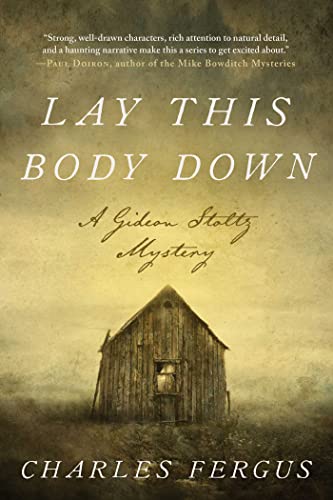
Third Crime Novel for Sheriff Gideon Stoltz, LAY THIS BODY DOWN, by Charles Fergus


 [Originally published at New York Journal of Books]

“Fergus’s writing lays out both the struggles of a new nation, and the pains of growing into determined manhood with its allegiances, regrets, and consolations. If murder and kidnapping can be halted, why not enslavement, also?”


The lines of good and evil are firm in this third antebellum mystery from Charles Fergus: Enslavement is brutal, and deprives the 1837 American nation of honor. Immediate emancipation could restore that honor—but in Sheriff Gideon Stoltz’s industrial Pennsylvanian town of Adamant, a rough crowd jeers at a visiting speaker advancing such an argument, and Gideon’s role as lawman is keeping the peace. Not advancing abolition.


However, Fergus positions Gideon as an outsider himself, with a strong “Pennyslvania Dutch” German accent that marks his difference in the hardscrabble Scotch-Irish town. Young and inexperienced for his job and without training, supported by his wife and a few friends, Gideon identifies with runaways and victims. It’s a dangerous position when there’s a national law requiring that he enforce “property ownership” toward Black fugitives. Although his state backs away from that position, the town is just 80 miles from Maryland, and his neighbors, a mostly rough crew, could inform on a runaway and expect Gideon to jail that person.


“What if the right thing—whatever it is—and what the law requires turn out to be two different things?” Gideon asks his wife True. Her answer: “I hope you would do the right thing.”


Chapters of Lay This Body Down open with excerpts from historically real reward notices seeking fugitives. When slave hunters turn up in Adamant, seeking a Black youth who’s helped Gideon in the past, what he’ll choose is never in doubt: He owes a debt, and servicing it fits with his growing belief that enslavement is cruel and wrong. Instead, the rapidly ramped-up tension in the book comes from the prevalence of malice among those hunting fugitives and those who already despise Gideon as not one of them, neither by heritage nor by attitude. As he struggles to find and protect this and other runaways, he plunges into personal danger.


In that sense, this is an intimate novel of connection among working men with opposing worldviews. Gideon will only succeed and survive if he can find enough allies to defend his choices and actions. It’s soon clear he’s even being betrayed within his own office. His own superior in law enforcement doesn’t even have his back. But his wife does.


Readers of the earlier two titles in this series (A Stranger Here Below; Nighthawk’s Wing) will not find much of the mystical and supernatural that appeared in those books, although True Burn Stoltz, finding her way out of her long depression over the loss of the couple’s child to illness, clearly relies on a related set of beliefs. Instead, the conflict in this novel foreshadows what was already erupting across the nation’s frontier at the time: ardent beliefs in independence and the sanctity of property, playing against philosophical and humanist efforts to impose a better form of civilization.


Gideon’s weaknesses, part psychological from his own mother’s murder, part physical as a residue of concussion (alas for the results of horse accidents and human beatings!), hold potential to transform into powerful incentives to action. As he prunes away the rot around him, he finds himself able to say to a stranger, “Maybe you can help me.”


Fergus’s writing lays out both the struggles of a new nation, and the pains of growing into determined manhood with its allegiances, regrets, and consolations. If murder and kidnapping can be halted, why not enslavement, also? The author’s meticulous historical portrayal offers a potent integrity, to ground the growth of Gideon Stoltz into a man who’s certain of the right thing to do, after all.


 PS:  Looking for more mystery reviews, from cozy to very dark? Browse the Kingdom Books mysteries review blog here

Tuesday, February 07, 2023

Engaging Mystery from J. D. Robb, ENCORE IN DEATH


[Originally published at New York Journal of Books]

“It’s unusual to find a crime page-turner that’s this compelling while also probing affection and loyalty, without gore or grotesque maneuvers. Motive, means, opportunity—Encore in Death is classic crime fiction at its best.”


Setting the Eve Dallas crime thrillers ahead in time, with a few more technological advances, doesn’t really give this homicide detective any more of an edge than today’s savvy sleuths. After all, even if test results come more quickly and communication is fine-tuned, solving a crime still comes down to getting inside the minds and emotions of potential suspects.


So when theatrical stars Eliza Lane and her husband Brant Fitzhugh throw an A-lister gala for patrons of their work, just as Eliza’s new Broadway show is about to open in the year 2036, it turns out that Brant’s sudden death is from cyanide, that well-known almond-scented poison. And the roster of suspects is no different than today’s would be: friends true or false, family, lovers, and competitors for the spotlight and awards.


But really, who could want to hurt Brant? His wife, a much edgier and sharp-tongued person, can’t imagine any reason. “Brant didn’t like conflict, and found ways to avoid it,” Eliza sums him up. Generous as an actor, a friend, a spouse, and even philanthropist, his death comes from toasting his wife with a sip from her specially prepared champagne cocktail. So who was the intended victim—husband or wife?


J. D. Robb’s polished and well-paced writing, honed in more than 200 novels so far, keeps the narrative on the move. Its second line of action takes place between Eve and her own husband, the wealthy Irish entrepreneur Roarke—who, whether by contagion or interest, is starting to “think like a cop” and lending a hand to Eve and her investigation. Eve spots this even before Roarke’s willing to admit he’s caught up in puzzle and how to solve it, as she outlines the need to follow the money here, and says she’ll take a look. Roarke steps right into her trap:


“I could do that for you while you dig down on the cast and crew. You may find it’s not the person who didn’t get the part, but a friend—as you were looking at Sylvie—a relative, a lover. Someone who’d do the deed for someone else.”


Roarke’s ability to quickly deep-dive into financials adds power to the investigation; his deft and determined efforts to support Eve’s work and the couple’s gentle jockeying in support of each other add charm and passion (and some lovely teasing) to the story, too.


As Robb lays out the plot with her quick professional skills, she paints solid marriages just as effectively. It’s unusual to find a crime page-turner that’s this compelling while also probing affection and loyalty, without gore or grotesque maneuvers. Motive, means, opportunity—Encore in Death is classic crime fiction at its best.


PS:  Looking for more mystery reviews, from cozy to very dark? Browse the Kingdom Books mysteries review blog here