Showing posts with label woman protagonist. Show all posts

Friday, August 22, 2025

Scottish Noir, THE DIARY OF LIES by Philip Miller (3rd Shona Sandison Book)

Beach reading is wrapping up -- it's time for substantial and satisfying crime fiction to go with the hints of autumn rolling in. And the newest investigative reporter novel from Edinburgh's Philip Miller is perfect for the task.

THE DIARY OF LIES picks up with Shona Sandison, whose necessary walking cane (an injury sustained in The Golden Acre; more about it in The Hollow Tree) disguises her determination to get the scoop for her newspaper, no matter the risks. The promotional material for the book calls it a "paranoid political thriller." That would almost qualify it for nonfiction at this point, wouldn't it? Shona takes the situation seriously and angrily (a good definition of Shona herself), making it frustrating when her investigation takes her into what feels briefly like some adult-level fairy-tale crossover between Britain's "Green Man" and the mythic Robin Hood. Yet violence keeps erupting around her, and her narrow escapes are far from amusing. 

When a sketchy woman armed with a shotgun opts to let Shona past the gateway to a hidden Internet guru, she's still stunned from her sudden morning tumble into blood and threat. "Her path had been disarranged. Now, she barely knew her way forward." Plus, she's a city worker — how can she handle a situation that's taking her away from paved roads and GPS and all? Her abrupt passage comes with instructions from a rough woman leading her further off road:

"Over the stile and through the trees," the woman said. "Keep going straight ahead ... you'll come to a large house. The manor. The curtains will be drawn. You'll find Robin in there."

"Robin?"

"Loxley.  You'll be entering the back of the house. Wait at the curtained window — you'll hear the radio. Don't go in, love—he's armed. Wait to be let in."

Shona looked at the woman, calmly exhaling smoke. She was warning of deadly violence, yes she seemed serene.

"Okay. This way?" Shona pointed to the fence.

"I'm not repeating myself, sunshine."

What she discovers at the crumbling old mansion is a far cry from an upscale data farm, yet it offers access to the information she needs to make sense of the political corruption she's discovered. 

Shona looked at the data loading, the entwined wires, the blinking lights. This was not the journalism she'd grown up with, in which she had made her way. This was about systems, codes, data and access. Arcane technologies. ... She felt uneasy. Aware of how afraid she might be. 

It won't be easy to run, when the time comes. Not with her cane, and not without it. But bullets will soon fly.

One of the delights of this dark and well-twisted novel is the steady echo of Britain's older cultures beneath the action. There's no need to read the two preceding novels, but those who have will notice right away that the sense of ancient mythos and of a universe that's not automatically friendly is still throbbing in Miller's version of Edinburgh and its surroundings. 

Watch for the threads that tie Shona, however reluctantly, to her uncertain allies. If she's going to both survive the threats and provide a top-notch and substantiated journalistic exposé, she'll need every connection she can summon.

Soho Press describes this new release as a good fit for "for fans of Ian Rankin, John le Carré, and Denise Mina." I'd extend the list to work by Paul Doiron, Lee Child, Ruth Rendell, Jaqueline Winspear, and Charles Todd. If "political paranoia" is getting to you, racing against it with Shona Sandison may bring a sense of relief and capability, as well as the satisfaction of a soundly constructed and resonant crime novel.

Tuesday, May 25, 2021

Exhilarating New 1920s India Mystery from Sujata Massey, THE BOMBAY PRINCE


Half the fun of of reading really good historical fiction is the pain-free way a book can take you into another time, "experiencing" the differences almost as if you were there. International fiction offers the same advantage in terms of location instead of time travel.

So in the third "Mystery of 1920s India" from Sujata Massey, THE BOMBAY PRINCE, you get double the delight in one smoothly written adventure.

Plus, Massey's protagonist, female lawyer Perveen Mistry, is breaking barriers for the women of her time, the first in her career in Bombay. She's compassionate, smart, and rarely makes mistakes in judgment. That means a Massey mystery can focus on crime and detection, instead of on rescuing the amateur sleuth.

It's November 1921 as THE BOMBAY PRINCE opens, and an independence movement is roiling India's political landscape. Long ruled from afar by Great Britain, India's people have paid the usual prices of the colonized: marginalizing minorities (like the Parsi culture that Perveen Mistry has grown up with), skimming revenue, and refusing to let the national leaders actually lead. A visit from the Prince of Wales fans the flames of Gandhi's otherwise peace-centered movement, street protests break out, even shop looting, and Perveen struggles to get appropriate treatment for the body of a murdered Parsi college student, Freny, who'd recently sought Perveen's legal advice. The timing puts Perveen herself into danger—it's easy for men around her to assume that a woman walking alone out in the city is asking for the worst kind of trouble, and impossible for them to see her as a professional, or worth respecting at all. When she tries to stop the looting of a shop where she knows the staff, she becomes a target, attacked with both scorn and sexual threat.

Fortunately for Perveen, some Parsi men spot the trouble and tackle her assailants, telling her to run, and she actually gets a ride from a solicitor known to her family, who delivers her to the family's driver.

"You are returned, Alhamdulillah!" As Mustafa invoked thanks to Allah, his voice cracked with emotion. "Violence has swept the city ... You sari is torn. What happened?"

Perveen pulled the sari closer around her. "There were so many people. I was rushing in the street, and it must have happened then." ... All she wanted was to wash herself at home, to erase the memory of the brutal men. And hide under her own covers. ...

Mustafa's voice was firm. "Your father said on no account will you go anywhere but that hotel. And I'm coming in the car with you for protection."

What none of them could predict is that the European man who's caught Perveen's affection in an earlier book in the series might be at the same hotel. Even in her professional duties in the days ahead, what Perveen struggles to offer her family firm's legal clients puts her at further risk—especially when she probes the student's death further and begins to guess who's responsible.

Massey writes in swift, colorful scenes that sweep the action and danger along, drenched with period manners and struggles. If the dialogue is at times a bit stilted because of such formality, the pace never wavers, and Perveen's battle for self-determination is driven as powerfully as India's. 

No need to have read the earlier two books of this series (The Widows of Malabar Hill, The Satapur Moonstone)—just plunge into this new release from Soho Crime, an imprint of Soho Press (publication June 1). Massey's skills are strengthening with each book, and this is definitely her best yet. But if THE BOMBAY PRINCE wakes you to wanting to know more about India's modern history, you'll want the other two titles for your shelf as well. 

This promises to be a continued series well worth savoring!

PS: Looking for more mystery reviews, from cozy to very dark? Browse the Kingdom Books mysteries review blog here.


Tuesday, August 20, 2019

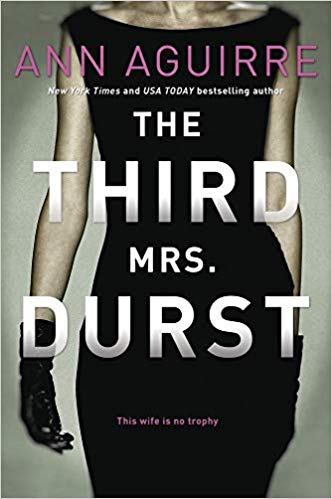
Victim or Murderer? A Tango of Turmoil in THE THIRD MRS. DURST, Ann Aguirre

Ann Aguirre leaves behind her twists of speculative fiction to craft a more straightforward "marriage to murder" plot in her new crime novel THE THIRD MRS. DURST, released today from Midnight Ink. A twisty and satisfying plot of teen model Marlena Altizer's rise to become the latest wife of a fabulously rich and powerful man, the book turns the classic "abused spouse" narrative upside down -- because Marlena is no wimp, and her intimate friendships on the side (carefully hidden from Michael Durst!) give her the strength and courage to take drastic steps and make a daring plan.

The book's opening is slow and not at all suspenseful. But when chapter 4 opens, Marlena warns readers clearly that, as in the best thrillers, all is not as it seems:
Maybe I'd end up doing real runway shows and get my face in Vogue. If anyone in Barrettville saw, they'd be so surprised. In retrospect, I can see now that was the turning point. If I'd said no, if I hadn't gone to Germany, my life would've been so different.

I chose the road that looked prettiest from a distance, but I didn't know then—sometimes the horizon is bright because it's on fire.
Marlena's rebellion starts its own fire, as soon as the bonds of spousal control begin to tighten around her. And the beating she suffers, the old life brutally severed, the cruelties of her new marriage only serve to enflame her determination further.

Aguirre tells the tale in first person, which shows off the book's two problems: Marlena doesn't actually change much, despite her circumstances, and the prices she pays along her way to crime don't wound her deeply. Although "Mr. Durst" commands her obedience and recovery, there's no leash on her spirit, so her actions don't pull her into growth. Yet this is a quickly spun and lively thriller after the opening chapters, and has the feel of a "Darkly Dreaming Dexter" in a slinky dress. Your kind of read? Enjoy!

PS:  Looking for more mystery reviews, from cozy to very dark? Browse the Kingdom Books mysteries review blog here.