Showing posts with label fiction. Show all posts

Tuesday, July 23, 2019

David Downing's Stand-Alone Thriller, in 1938 Germany

[Originally published in the New York Journal of Books]


Retelling wartime history as spy fiction is Downing’s deeply grounded path; pointing out the power of love and family within it, however, is his aria.

The Cold War? History. The Red Menace? A comic-book phrase tossed around in period films. World-makers struggling to turn the globe into a folllw-up from the Russian revolution of 1917? Ridiculous.

Except, as the “Mueller Report” reveals, there is an ongoing and powerful effort of the Great Powers of the world to exert political will on each other, even if it’s just to distract leaders and hamper economies. David Downing’s series of haunting mysteries set in Berlin (the John Russell series) led to the Jack McColl series, thrillers positioned at the start of the First World War. With his 2019 “stand-alone” espionage adventure, Diary of a Dead Man on Leave, Downing puffs on what now seem like the long-dormant embers of the Communist Party—but they were far from dormant as Germany positioned itself to invade its neighbors in 1938.

Unlike his two earlier series, Downing does not center the emotion of Diary of a Dead Man on Leave on a couple falling in love or struggling to maintain a relationship through political upheaval. Instead, he fingers the tenderness that can grow unexpectedly between an isolated worker for a better world, and a child who needs his counsel and support.

To Josef Hoffman, struggling on behalf of Russia’s Kremlin to recruit a Communist cell within Nazi Germany five years after Adolf Hitler has seized control, the dream of a worker-led world with fairness and justice is worth every sacrifice. He’s already handled a hidden life in distant Argentina, among displaced Germans there. Now, infiltrating cautiously among the railroad men in Hamm, he knows his chances of a misstep are high … and his death unpredictably close. To quote a 1919 leader from the Soviet Union, “we Communists are all dead men on leave”—that is, only (at best) experiencing a brief respite from self-sacrifice at every level. Downing applies the quotation as a meme for the Communist agents working outside the Soviet Union.

But for a dead man, Josef has a lot of heart. Hiding out in a boardinghouse where the landlady struggles to raise her son safely amid men who want to take over her life and her child’s, Josef’s first intention is to do no harm: Be kind toward young Walter but insulate him from politics.

Yet he fails at this, repeatedly, as when the youngster asks his help on an assignment to provide proof of racial superiority of Nordic people in terms of speech and singing. “ ‘It can’t be true, can it?’ Walter asked doubtfully after he’d finished reading the passage. No, it couldn’t, I thought, but that’s what they rely on—that smidgen of doubt. Anyone who’d listened to a Negro gospel choir or an Italian opera diva would know such ideas for the rubbish they were, but few had been so lucky, especially in a place like Hamm.”

Can Josef answer Walter honestly, while at the same time teaching the youngster enough to protect him in a brutally propagandistic school system and devouring army? What about the rest of Walter’s family—the mother, the brother, the grandfather?

The dangers and sacrifices of Josef’s live create a dramatic and piercing counterpoint to the usual story of espionage. In Downing’s hands, they also create a call to action for our time. But set that aside and absorb the story instead. Retelling wartime history as spy fiction is Downing’s deeply grounded path; pointing out the power of love and family within it, however, is his aria.

PS:  Looking for more mystery reviews, from cozy to very dark? Browse the Kingdom Books mysteries review blog here.
-->

Provocative and Entertaining Dystopian Novel: EARLY RISER from Jasper Fforde

[Originally published in the New York Journal of Books]


Taking Early Riser into the summer reading stack will be surprisingly refreshing. Even though it arrives with both love, and a shiver of foreboding.

Dystopian fiction has become a necessary aspect to our politically unsettled and climate-challenged lives, and there’s a new longing for Joseph Campbell’s heroic figures to show us how to survive with honor and preserve a thriving planet.

As Jaspar Fforde leaps into the genre, an adult level of frustration and chaos appears: Early Riser, unlike Fforde’s long series of literary spoofs, lifts its curtain on despair and death, moderated by the equivalent of Big Pharma. Charlie Worthing, a novice “winter consul” allowed to stay awake for the frigid months of the new form of winter—while most people lie in a drug-induced sleep to save energy—seeks the source of viral dreams that are infecting sleepers and the awake. For Charlie, the dreams overlap the strange things going on around him: manipulations by two sides of the culture clash, and provoked disappearances of those who might be able to object.

What makes Early Riser unforgettable, though, is not the particular form of dystopia Fforde displays, but the affection and loyalty that Charlie and some of his new acquaintances turn into effective action against pharmaceutical giant HiberTech. Even as Charlie tackles his first assignment, taking a “soul-dead” individual named Mrs Tiffen to be parted out and recycled, the small details of humanity catch at him like “stick-tights” caught walking across a field of seeding plants: “Mrs Tiffen could play the bouzouki,” he notes at the opening of the book. “Not well, and only one tune: ‘Help Yourself’ by Tom Jones.  … She and I had not exchanged an intelligent word since we met five hours before, and the reason was readily explained: Mrs Tiffen was dead, and had been for several years.”

As Charlie confronts his first wakeful winter—where a mild day is around minus forty degrees—he also notes how hard he finds it to believe that a person who can play the bouzouki is no longer a person. Alive. Loving.

Affection becomes Charlie’s own melted area. His Morphenox-twisted dreams and the viral psychopathy infusing the people he meets mingle with an artifical affair he’s been dragged into—the highly attractive (but crazy?) Birgitta needs him to pretend to adore her. “‘The best relationships always begin like a bad rom-com in my experience. I’ll find a tartan travel rug and a picnic set for the Sno-Trac,’ she added, now quite enthused by the whole idea.”

Fforde sweeps the action forward briskly, unafraid of mythologizing as he goes along, complete with Villains with a capital V. He conflates Winter with the possibility of global evil, so that Charlie admits, “The citizenry didn’t know or care what the Consuls did during the cold to keep them safe, they just wanted to wake alive in the Spring, same as always. For many people, the Winter didn’t really exist except in an abstract sort of way, and by consequence, neither did we.”

The book couldn’t be further from a “beach book” in its details, yet the cover catches a bit of the viral dreaming from the story and offers a beach scene (sprinkled with snow). It’s a good hint for this season: Taking Early Riser into the summer reading stack will be surprisingly refreshing. Even though it arrives with both love, and a shiver of foreboding.

PS:  Looking for more mystery reviews, from cozy to very dark? Browse the Kingdom Books mysteries review blog here.
-->

Tuesday, November 13, 2018

Always Knew There'd Be a Mystery for This Massachusetts City -- New, from Liz Rosenberg

Worcester, Massachusetts: Drive into this bigger-than-expected urban enclave, with the second highest population of the Bay State's cities, and new buildings for the arts and commerce shine from the downtown. But the traffic patterns, the neighborhoods, the twists of roads re-made over the years and not quite up to the number of cars on them, even when it's not rush hour ... all these speak most eloquently of the years when manufacturing made up the life energy of Worcester.

In the powerful new novel from Liz Rosenberg, INDIGO HILL, time shifts dramatically backward a lifetime, after Michelle and Louisa's elderly mother dies quickly of pancreatic cancer. For one brief moment, Alma Johansson, hard-working widow of a hard-working good man, considers trying to tell her secrets to her grown daughters. But as usual, 43-year-old Louisa's brusque comment jams up the conversation, and after that, there's no time left to confide anything. Well, what could it have been anyway? Her daughters know all about Alma's life.

But when their mother's will is presented, they discover how wrong they've been. And the shocking process of allowing an unexpected beneficiary to come to their mother's house and sort through its contents spins Louisa, an outwardly bitter woman with a soft core shown only at her workplace (she's a much-valued mental health counselor), back into her own net of secrets, losses, and terrible trade-offs.
She'd known it for a long time. People disappointed you. They let you down, they went away or died. They seldom turned out the way you thought.

But not, whispered the secret voice in her head, not your mother. ...Her mother at least could be counted on; Alma Johansson was rock solid -- or so Louisa had always believed. ... No. No way, She just couldn't do it. Louisa stuck the key into the ignition, and before she knew it she had parked the Chevy in the lot behind the hardware store belonging to her oldest school friend, Flick Bergstrom.

The sight of the old familiar brick building made her breathing a little easier, the pain at the center of her chest less intense.
Flick, it turns out, bears outward scars of a fire they'd experienced as teens. Louisa's are inward. And to make sense of her own past, as well as her mother's, she'll have to open those wounds again.

A fire that changed her teen community is at the heart of what Louisa must exhume. It's a long, painful, yet achingly lovely process, something like peeling away the collapsed roof and walls to rediscover something precious and unburnt within. Rosenberg's pace is steady, relentless as time itself, as she walks Louisa toward the truths that shimmer beyond her matter-of-fact family, her compromising in love, and her community.

Is it a mystery? Hmm. The pace is deceptive; the secrets are deep and burning. I felt as though INDIGO HILL solved something vital, and something that could perhaps only exist in the layered maufacturing city of Worcester. Even when the author's Afterword reveals the "facts" beyond the story (a real fire in 1968; lives lost), there's a magical sense of revelation as well -- as if all the bok-length uncovering had created also somehow the answer to how to live with the past and how to bless it. And that may be the deepest mystery of all.

PS:  Looking for more mystery reviews, from cozy to very dark? Browse the Kingdom Books mysteries review blog here.

Saturday, June 09, 2018

Delightful and Unusual Western, TIMBERLINE, from Maine Athor Matthew P. Mayo

In the same way that the "two for a quarter" steamy romance novels at the yard sale can all seem alike after a while, "Westerns" can seem pretty similar -- horses, tough men, women in long dresses and bonnets, and an unfortunate past abusive angle that diminished Native Americans to painful stereotypes.

You'll have to say goodbye to those past impressions in order to pick up the newest release from Maine author (and Lyndon State College, VT, graduate) Matthew P. Mayo. Third in the series featuring Roamer, a homely (even scary-looking) frontiersman, TIMBERLINE offers a winter adventure in crime-solving, chasing across a blizzard-swept landscape, and reliance on friendship.

Let's start with Roamer, whose appearance keeps most people away from him and deceives others into thinking anyone who's obviously suffered so many attacks from nature and humankind must be weak-minded. Actually, Roamer reads the classics, treasures his books, and is hauling a sack of them along on a short train trip that should end in meeting up with his mountain-man friend Maple Jack -- a raconteur of the first order.

On the railroad platform, ready to board, Roamer catches sight of an amazingly lovely young woman:
Faint purple smudges rested beneath her bright, wide eyes, a blue nearly as rich as her cloak, and wreathed by long lashes. She looked to be a young woman getting over a sickness that had somehow enhanced her beauty. At least that's the fanciful line of though I caught myself trailing. I averted my gaze as she turned and made her way through the little crowd, which parted before her as if she were a magical being.
Absorbed in contemplating this wonder, Roamer neglects to turn aside in time, and the young woman catches a full view of his own face: "She looked into my eyes and her mirth was replaced with the inevitable fear and pity. Revulsion would be next."

Yet because the young woman doesn't completely ignore him on board the train, and because the obvious criminal types on board who laugh at Roamer's book passion also seem determined to humiliate the young woman, Roamer unthinkingly takes her side, and soon finds himself battling the worst of an early blizzard in an effort to rescue her from villains.

There are worse aspects in play, besides his homely appearance, and unless someone as skilled and loyal as Roamer's friend Maple Jack can make an unexpected appearance, things look grim for the oversized if courageous frontiersman.

Swift twists of plot in Mayo's experienced hands turn Roamer's assumptions inside out. And though the scenes are soon piled deep with murdered men and horses, what will shape Roamer's success or failure has more to do with his own skills and his ability to read both the Western landscape and the outrageous greed of many an arrival on the scene.

Almost 200 pages long, TIMBERLINE (from Five Star/Cengage) represents one branch of the "new" Western -- nurturing courage and determination as the land becomes better understood -- and provides a glance into the soul of the person struggling to survive there.

Oh, I'm not suggesting this is a mystery -- there's little doubt about the murders that take place, and while Roamer needs to figure out what's going on under the surface, he won't do it by any mystery genre route -- but it's from a New England author carving a wide swath of good writing, and I want to tip a hat to it. Tuck a copy into your summer reading stack for a bit of diversity; see what the teens in your life think of its approach, too (nothing in here that will harm them). And no, there is nothing racist in this book, perhaps marking the slow, steady turn of the Western genre to a more honest (if still romantic) appraisal of our nation's Westward expansion. Open to enjoyment across genders, too.

PS:  Looking for more mystery reviews, from cozy to very dark? Browse the Kingdom Books mysteries review blog here.

Thursday, October 06, 2016

Diversion: David Budbill, Katherine Paterson, and Young Adult Collection

Every now and then, we realize how far we've strayed from our mission of gathering the best (and mostly signed) mysteries to present here. Today was one of those days, as I prowled through the section of "children's books we couldn't resist," and recalled when the authors signed each one.

One of my favorites as a Vermont classic is David Budbill's picturebook Christmas Tree Farm. With its Donald Carrick illustrations, it captures a slice of Vermont that's rarely pictured. This week the tributes to Budbill's life continue to pile up in various publications; it's good to recall his versatility as we look at this book again. (Yes, it's available -- click here.)

While I was looking at David's book, I also noticed that we still have eleven (yes, eleven!) books signed by the amazing Katherine Paterson. Although we no longer have her most noted title, Bridge to Terabithia, we have quite a few others -- the list is here. I hope some of them will move to "good homes" as holiday gifts. In fact, if you decide to order one or more, mention this blog post and we'll take the shipping cost down to a penny, just for the fun of seeing these travel outward. Ten of them are here; the eleventh, edited by Amy Ehrlich and also signed by Ehrlich and by Reeve Lindbergh, is here.

And of course, I ended up going through our entire "young adult" collection while I was sitting on the floor by the shelves. Most are mysteries -- a few are just darned good writing, like The Impossible Knife of Memory by Laurie Halse Anderson that I sort of wish my grandson were old enough to read, because it captured me so intensely. (It isn't signed -- but it's here.) Or the signed copy of softcover copy of Jeanne Birdsall's The Penderwicks that I was thrilled to find in a bookshop a couple of days after I'd missed seeing her in person there. But there are also good dark mysteries and suspense by Joelle Charbonneau and many others (even a delightful book by Robert B. Parker). As you can tell, we range quite a distance when we're seeking an author's signature! And although we remind each other that our mission is mysteries, a well-written story always gets our attention.

Well, that's enough "chitchat" -- I'm going to go read another exciting book.

Tuesday, January 05, 2016

Vermont Fiction With Life's Painful Mystery, HIDDEN VIEW, Brett Ann Stanciu

When I read The Girl With the Dragon Tattoo and then its two sequels, there were plenty of times when I said "No way, this couldn't happen" -- but they didn't add up to much, compared to the amount of truth in Stieg Larsson's dark Swedish trilogy. The first book's original title on publication in Sweden was "Men Who Hate Women" and this noted crime series paid attention to the inevitable results of such brutality: shattered families, increased darkness and evil, and a young woman adept in opening up puzzles as if they were infected wounds, and coolly and professionally removing the diseased portions of the body.

Now Brett Ann Stanciu, in a debut novel published by tiny Green Writers Press of West Brattleboro, Vermont, has shown that an American woman can meet the same high bar, in painting the reality and the consequences of domestic violence.

Young, sheltered, and completely convinced by an older man's wooing, Fern has married in haste and taken on the enormous task of being the wife of a hard-luck farmer with big dreams, on an isolated Vermont hill farm. HIDDEN VIEW is also the name of the farm itself. Stony soil, trees whose hearts have rotted, a barn crumpling and a house that hasn't been maintained -- for Fern, these are hidden aspects that she can ignore. She defines her world in terms of her own possession of it: "my husband Hal," and "dear darling baby girl" Tansy, and her view of herself:
a young mother and woman, in love with her husband, a farm spread out around us with a thousand different potentials.

He bent toward me and kissed my lips, his mouth laced with coffee. "Ah," he whispered. Then he drew back and with his free hand waved grandiosely.  ... In the warm weather, the fields sprouted green corn and alfalfa. A bat swooped over the garden's center, a dark darting blur, feeding, and then vanished. Tree frogs chorused, alive. I found myself nodding, yes, yes,  my daughter's minute hand tugging at my shirt collar.

Perhaps that yes was simply the song that carried me along through those early days of our marriage. All around me I saw nothing but possibility, never a hand held up to say stop, stop.
Stanciu shows, through Fern's eager eyes, the verdant beauty and potential of the hill farm. Beyond her thriving vegetable gardens and her brave kitchen efforts and her committed and marvelous mothering of Tansy as baby and toddler, though, a dark shadow is spreading. At first she defines it in terms of Hal's drinking -- the bourbon poured with abundance into a jam jar and consumed in a way that fuels his angers and his insistence. To Hal that garden doesn't count, the child's a distraction costing work hours, and the cows in the barn stink and remind Hal of his father; only making maple syrup matters, the amassing of Vermont "liquid gold" for the rising market. And the accidents that go with the process, whether his burned foot or the scorched sugaring pans that Fern doggedly scrubs and labors to save, are nothing compared to the flame of Hal's own obsession with remaking the farm in his own image.

Early in the novel, we're blindingly aware, in a way that Fern can't afford to be, that Hal is a menace, someone putting Fern's life at risk and demanding that she give up hope of being happy -- including the nurturing of their daughter. Fern's stubborn resistance protects Tansy, for the most part, although the little girl's imaginary rabbit friends begin to utter loud protests. How much will it take before Fern admits the situation can't be saved? Isolated, friendless, cut off by her own distant mother, she's not seeing any way off the farm. And like spring itself, pressing the maple sugaring season into frantic action, then washing the days away into the melt and greening of the world, Fern clings to the possibility of her original dream of marriage and home.

Just as it seems it all must tumble down, and Fern must finally admit it's time to go -- somehow, anywhere -- the careful balance of forces turns untenable, with the arrival at the farm of Hal's long-vanished brother Lucien, who has some amount of hold on the farm itself, and a tenderness with baby Tansy that completely undoes Fern's defenses. Yet she can't quite let go:
I believed Hal and I would come back to each other, this rift between us a rainy season that would, eventually, disperse and clear. I believed we would grow old together. ... I believed to get there, I had to endure through here. All things in due course. Hands to the shovel. Lean into your work. Persevere.
Early in the book, I was swept by a certainty of truths in HIDDEN VIEW: that Stanciu knew the bizarre and fragile construction that people's self-deceptions can frame. And that she was telling, out in public, against all the rules, the heartbreaking story of far too many women I've known, at one time or another, who struggled to make their dreams come to reality in situations where any detached observer would have said instead, "Leave! Get out while you can!"

This isn't crime fiction in the classic sense, but the mystery of Lucien's life and disappearances turns out to circle Fern's struggle. And the questions of loyalty to person, commitment to dreams, and betrayal of the helpless are as vivid as the flames in the sugarhouse, as sweet and dangerous as the hot boiling maple sap on its way to becoming valuable syrup.

There's so much truth in this book that at some point, it stops being "fiction" and stands instead as a portrait, layered, complex, and wise. The Vermont that we love, the farms that we treasure, the children we nurture are fully present.

And so is the darkness, and despair. What is the value of a view that's hidden, even from the viewer? Fern, Hal, Lucien, Tansy: their lives depend on the answer.

Sunday, November 15, 2015

Katherine Paterson (Signed) Collection, Re-Priced and Available

We really do work hard to stay focused on first-edition mysteries here, mostly signed. But we've had some other specialties in the past, including Vermont authors of fine children's books -- so last week I pulled out our Katherine Paterson collection and asked The Chief (that's Dave) to review prices and make it all extra accessible.

And that's what he's done. If you're a fan of this author's work (and if you've read her, you're probably a fan; think Bridge to Terabithia, which unfortunately we've already sold, but all the books in the photo are here today), this is your chance. And if you're friends with a fan, these are the ultimate holiday gift treat for that person, signed by the author, who lives about an hour away from us. You can see the list here. (You can order there, too.)

Wishing you joy in these, and in the season ahead.

Sunday, February 22, 2015

Vermont Author Don Bredes, POLLY AND THE ONE AND ONLY WORLD

There's a lot to discuss in terms of the new book from Vermont author Don Bredes, POLLY AND THE ONE AND ONLY WORLD. Fortunately, for readers who emerge from this dystopian novel eager to talk with someone about some of the pressing aspects, Bredes is hosting passionate discussions; check in at his website http://donbredes.com, and click through to the topics that burn for you.

But first you'll need to read the book (of course). It's not a mystery, yet I want to write about it here because (a) the author's local (yeah, we do that at Kingdom Books), (b) the topics embedded in the tale are hot ones, and (c) the book has been described as YA (young adult) fantasy.

Let's get to the plot: Fifteen-year-old Polly Lightfoot, a gifted "natural" witch whose magic still benefits from the words found in spells, is supposed to be hiding her talents while living with an aunt and uncle in New Florida. Her father's trying to keep her safer than she would be in their original home up where New England once was -- the area's been taken over by the post-nuclear-war forces that insist on complete Christianity, and even burn witches alive.

But living with her relatives includes obeying them and their pastor, and Polly can't do it. With the unexpected arrival of her animal familiar, the raven Balthazar, who can communicate with her directly, she's motivated to run away, head north, try to get home to where people accept her for herself.

Thus begins an epic journey through areas of environmental collapse, radiation danger, clusters of "frenemies" who will assist Polly under some conditions, then turn her in under others. It's a Pilgrim's Progress in dystopian attire, and I would toss away the "fantasy" label and replace it with "magical realism" -- parallel to Howard Frank Mosher's Walking to Gatlinburg  and Disappearances. (Not coincidentally, Mosher and Bredes are long-time friends.)

Classic analysis of genre novels -- those that submit to such genre conventions as having an ending that somehow mirrors and fulfills the opening, and a main character whose strengths and weaknesses interact with situations and eventually justify the good or sad ending -- often consider two arcs that define the book: an arc of plot, and an arc of character. Powerful novels often make the two interdependent. As a simple example (since we're talking teenaged protagonists), Harry Potter becomes courageous and moral through his choices in frightening and distressing conflicts. At one point in the noted seven-book series, the very wise wizard Albus Dumbledore shows Harry that even a mythic sort of situation can't force a person to be a particular way; it's one's choices that create the path.

Looking at POLLY AND THE ONE AND ONLY WORLD in these terms, the plot arc -- escaping oppression, traveling a long distance with little support, evade enemies, reaching (we hope) safety -- is straightforward, and Bredes enables its forward motion through Polly's friend on the road, Leon, as well as the short-phrased guidance of Balthazar flying ahead and above. The character arc is set in motion through Polly's age, 15: We may assume she is naive in many ways, unskilled in wilderness survival, semi-skilled in the magic that makes her a witch, and is going to deepen as a person while she remedies these "not-yet" factors of herself. Classic "YA" direction also assumes Polly will move from teenager status to something more adult, by experiencing loss, making uncomfortable decisions, and following her longing to connect with her father and her "people" in the north.

Some of this does in fact take place; there are also character changes in Polly's friend Leon that are interesting to look back on. It was intriguing to me, though, that I could have replaced Polly with an adult (say, someone in her twenties or thirties) in much of the book. In other words, the ways the plot arc and character arc connect have less to do with the drama of entering adulthood, and more to do with a determination to keep moving north, across the obstacles.

Also at play in the book is a "mission." This idea is introduced in the first chapter, when we learn that Polly's father has a mission for her to tackle in Florida, as well as wanting to keep her safe there. I felt that the mission rarely took on definition, though, as Polly showed little personal commitment to it -- just suddenly accusing herself of failing it, and at another point, being assisted to regain an item she's lost possession of, but neither moment takes up many pages or much room in her emotions. I would have liked to see the mission fleshed out more -- which may come in part from my enjoyment of the way mission and mythic are often bound together in "fantasy" genre books.

I'll be interested in following the path of this novel in the wide world; will teens read it, or will it become largely a book that adults seek out, looking for how Bredes handles the "cli-fi" theme (social collapse melding with climate collapse) and appreciating the connections also to the Salem witch trials of New England and Arthur Miller's The Crucible? For me, the book also reawakens an urge to re-read Margaret Atwood's The Handmaid's Tale, another grim look at where dogma and destruction can lead.

Last but not least, a word to those who may have strong religious frameworks: Don't look for them in POLLY AND THE ONE AND ONLY WORLD, where Christians are fanatics, and witches are mostly born that way. But do take a look at this recent New York Times blog post, which I think is worth considering in terms of how this book, and others moving into the YA field, are constructed: Childhood Heroes ... by Rachel Kadish.

Thanks, Don Bredes, for stepping forward to promote discussion of our pressing issues as a culture and as an ecosystem.  And a warm thank you to Green Writers Press, publisher, for daring to step into controversial fiction in its Vermont and national profile.

Sunday, December 28, 2014

Diversion: STATION ELEVEN, Emily St. John Mandel -- Not a Mystery, but Mysterious

Mysterious and wonderful. Deeply satisfying. A book to remember and share.

Emily St. John Mandel's much-promoted novel STATION ELEVEN begins in the middle -- not just in the middle of stage, in the middle of a performance of King Lear, where actor Arthur Leander is about to die. But in the middle of the timeline of this dystopian novel. And whether the dystopia is defined by the Hollywood of our century, or the survivalist mode that follows a dramatic plague outburst upon the earth, is open to question.

But there's never a moment in the entire adventure when there's any doubt about the integrity and passion of Kirsten Raymonde, once a child actor, later a performer on the edge of the known world. And for all the desperation and violence of her new world, Kirsten's one of several people well worth liking in this tapestry of rediscovery.

Renewed. Refreshed. Bathed in an unearthly light that sings. That's where my "take a holiday" plunge into this non-mystery landed me. I am so glad.

[PS -- like graphic novels? you may be amazed at how Mandel's fictionalized one takes life in the center of this book.]

Sunday, May 11, 2014

Local Fiction: THE STARLING GOD, Tanya Sousa


Not a mystery! But a local book that I'm glad to mention:

It's been a month or so since I finished reading THE STARLING GOD, by Coventry, Vermont, author (and sometimes publisher) Tanya Sousa. And I've read so many books since that one ... but every time I go outside, something from Sousa's novel comes to the foreground. I can't listen to a songbird, watch hawks and vultures hunt, or even see an empty bird's nest without realizing that my way of responding to all of these has shifted.

And that is an amazing effect for one novel.

Way back in 1972, Richard Adams brought out a similar novel, Watership Down, which became a huge hit. Here's the Wikipedia plot summary of that book from a generation ago:
In the Sandleford [rabbit] warren, Fiver, a young runt rabbit who is a seer, receives a frightening vision of his warren's imminent destruction. When he and his brother Hazel fail to convince their chief rabbit of the need to evacuate, they set out on their own with a small band of rabbits to search for a new home, barely eluding the Owsla, the warren's military caste.

The travelling group of rabbits finds itself following the leadership of Hazel, previously an unimportant member of the warren. They travel through dangerous territory, with Bigwig and Silver, both former Owsla, as the strongest rabbits among them. Eventually they meet a rabbit named Cowslip, who invites them to join his warren. However, when Bigwig is nearly killed in a snare, the rabbits realize the residents of the new warren are simply using them to increase their own odds of survival, and they continue on their journey.
Sousa's tale of starlings, doves, and even seagulls begins with a situation that has some parallels: A nestling is rescued by a kind woman whom most of the local birds revere as a god (she can rearrange plants, provide food, sometimes mend a broken wing, and lives in a way the birds can't comprehend). When she returns the bird to the yard, able to fly but clueless about seeking food or companions, the frightened little one meets ample assistance from a generous pair of doves -- who decide that this fledgeling is a "Chosen One" of the gods. Uplifted by such news, the new resident chooses the name SL'an for himself, a name that proclaims he will be both a Teller (i.e., news teller but also perhaps prophet) and a Seeker of knowledge.

But SL'an is a starling, not a dove, and when he attempts to join his own kind, the early persuasions of the doves (and his courteous nature) turn out to make him a poor fit for the local flock. Danger comes in several forms, and soon the bird is on his own quest to discover whether the "Gods" are truly all-knowing and wise, and whether there's a mission for his life.

Sousa's plotting and dialogue reveal a gifted storyteller who's embraced her own message of Seeking and Telling. The path of the Starling God -- if that's what he is! -- doesn't require quite as much terror as the Watership Down rabbits endure, but the sense of flock and community is strong and vibrant. The book comes through on all of its promises, and is a welcome addition to the parables of our time.

Available online from the usual marketers, and also directly from the publisher: http://www.forestrypressproducts.com/the-starling-god-by-tanya-sousa

Sunday, February 23, 2014

Diversion: Poetry and Middle Grades Fiction -- Robin Herrera, HOPE IS A FERRIS WHEEL

Middle-grade readers and the people who choose books for them -- librarians, parents, teachers -- have a new treat with Robin Herrera's first book, HOPE IS A FERRIS WHEEL. For 10-year-old Star Mackie, struggling in school in a new town where she's the only kid who comes to class from a trailer park, life is jammed with confusing mysteries. Why does her teacher hate her? How can she find a friend in this group of kids who range from weird to mean? And when is her father going to start sending her things, like the birthday card her older sister Winter received, or the old truck Winter now has?

This isn't a mystery, but it's a darned good novel, and Star is heart-warming and courageous. She won my applause over and over for how she handles ordinary but painful crises. And I'm particularly mentioning it today because we're just five weeks away from National Poetry Month -- and what eventually turns Star's life around is poetry, from reading Emily Dickinson to grappling with a Shel Silverstein poem to grasping what metaphor brings to her situation. I'd recommend this for middle grades as an encouraging and enjoyable novel, but also to high school classrooms where the story and the clear, smart writing can carry skeptical teens into realizing how poetry works and why it's worth their time.

Wednesday, June 12, 2013

Strong, Savvy, Sensitive, and Yes, Very Scary: Vanessa Michael Munroe Returns in THE DOLL by Taylor Stevens

I'm one of the gazillions of female readers who look forward to a new thriller from Lee Child, or an intense espionage investigation from Olen Steinauer or Alan Furst, and of course a regional police procedural from Archer Mayor or Craig Johnson ... and in fact, it wasn't until a few years ago that I realized that all the characters I identified with for years in the Lord of the Rings trilogy were guys. Honestly, I think it's easy for most of us to connect with a protagonist who makes emotional sense for us, no matter the gender.

And there's something about Vanessa Michael Munroe -- better known just as Michael to her friends -- that catches me at the heart level and makes me enormously proud of her. She's an information specialist (Taylor Stevens's earlier books in the series are The Informationist and The Innocent), a born linguist, and a wealthy business co-owner. Her work takes her all over the world, and as a single and slender woman in the realms of power, she's got to be able to defend herself with more than just words. She knows how.

But along with Munroe's strength, defensive skills, and fancy knife work come the weight and horror of a past rife with abuse, where she learned to fight off abusers in order to survive. Keep her busy and she's tops in her field; let things slow down, and the darkness of the past can knock her into deep and crippling depression. (Can you relate?)

THE DOLL opens with a shockingly impossible moment: Michael's partner Miles Bradford, watching from the office window, witnesses the highly unlikely -- and therefore impeccably choreographed -- kidnapping of Munroe right in front of him. Horrified and at first scrambling against a glassy surface of lack of information, Bradford has little chance of racing to Munroe's rescue; only if she finds a way to contact him will he know what to do.

Meanwhile, the kidnap team is having second thoughts, and the thoughts are that whoever lined this up has a bunch of ridiculous rules about Vanessa Michael Munroe:
Do not let her hear your language, the source had said, she will use language as a weapon. Keep the area around her free of objects, everything will be used as a weapon. Stay clear of her reach, she doesn't need a weapon to kill you. Don't use restraints, she will find a way out of them, and they will only give a false sense of safety. Do not touch her, the source said. Leave her in peace, and treat her respectfully, only then will the violence stay muted. Disrespect these and make no mistake, she will kill you.
It's easy to assume Munroe's fragile and frightenable; she's female and small and pretty. But that's not who she is on the inside. Inside, she's a tornado, an earthquake, an irresistible force with brilliance of mind and a compulsion to solve problems.

Soon enough, Munroe meets the depraved but highly intelligent and well-informed person behind her capture: the Doll Man, a merchant who feeds the hunger of collectors of real women, through turning them into dolls who can then be abused, abased, kept in captivity. Can he keep Munroe? It doesn't seem likely, but he's come up with carrots and sticks that involve the people she loves -- and soon she'll take his orders, in order to save her friends and family. Wouldn't you?

And there is the catch, the hook, the way that Taylor Stevens binds us to this protagonist unforgettably. What we value most -- our commitment to the people we care about -- is what Vanessa Michael Munroe can't escape. How hard can she fight, and how much can she risk, in order to bring the global criminals around her to justice?

I'm not always comfortable with Munroe -- just the way I stop to ask myself whether I'd let Lee Child's Jack Reacher into the house. Stevens twists this intense thriller so effectively that Munroe's questions become the ones the reader faces, too.

Oh, you don't need to read the two preceding books in the series before reading THE DOLL. But I'd recommend it, because then you'll notice how Munroe is growing, in the hands of a powerful novelist. Be sure to check out the author's website, but not until you've read at least one of the books: http://www.taylorstevensbooks.com/index.php.  Or, if you've got to peek first, remember Leonard Nimoy telling Star Trek fans, "I am not Spock." Taylor Stevens is not the same as her protagonist; if you have a moment, add your comments here, and give this author the gift of seeing her fiction as creative work, far beyond the pain of her own past. Come to think of it ... that's what she asks us to believe of Vanessa Michael Munroe, too.

Tuesday, March 26, 2013

Ellen Larson Creates Epic Mystery: IN RETROSPECT


Unless you've carefully sorted through both the awards lists (her story "When the Apricots Bloom" was a Barry Award finalist) and the publishing news (she's the editor for the new "young adult" imprint from Poisoned Pen Press, the Poisoned Pencil), or been edited by her already (25 years of substantive editing!), you may not have crossed paths with Ellen Larson.

We'll all have the chance to enjoy her work later this year, when her own mystery IN RETROSPECT reaches publication from Five Star in November. But Larson goes well beyond crafting a mystery -- a time-travel murder mystery! -- by drawing from powerful science fiction traditions and breaking ground under conditions firmly her own. We're excited to welcome her here for a thoughtful journey into her world. (Make sure you read all the way to the end, for more news and a way to participate!)

Me, Myself, and the Other

I first heard about the Other as a character type in fiction as a kid in college, studying comparative literature and learning how to write. At first I thought it was strange that characters who were by definition alienated from society would work in a medium that depends so much on reader identification. Until, of course, I realized how many readers identify with the sense of alienation. Me included.

At thirty-three, my sense of Otherness in combination with my love of science fiction led me to the conclusion that I should live on Mars, where clearly I would feel more at home. The urge turned out to be surprisingly inescapable, so I left my beloved upstate New York home, eventually landing in Cairo, Egypt. Which was as close as I could get to Mars.

In Cairo I was, of course, still the Other. With my clothing, my culture, my experiences, my eye color, my goals in life I was never going to be confused as an average member of Egyptian society. Which turned out to be unexpectedly liberating, because no one even bothered to try to get me to conform (a main source of conflict for fictional and real Others). I was a different type of Other, and it was wonderful. The society I had been so at odds with was far away, so the sense of alienation disappeared. Fifteen invaluable years in Egypt (shokran, Misreen) allowed me to develop a life-long passion for differences, for Otherness, because it allowed me to understand that underneath our differences, we are all the Same.

Because of my real-life experiences, my writing often features societies that are not my own. Writing science fiction allows me to imagine a society that is out of my own time, one that provides the background I need to tell the story I want to tell. My personal approach as a writer involves getting rid of whatever prejudices and limitations present my own society that I don’t want to be bothered by, so that I can free up my protagonist to battle what I perceive to be those underlying and universal challenges of being human. Which is why I’m not so interested in writing the kind of science fiction that focuses on alien beings and intergalactic conflicts.

My upcoming science fiction murder mystery, IN RETROSPECT (Nov. 2013 Five Star - Gale Cengage), is set in post-apocalyptic Turkey far in the future. For this book I not only changed societal norms, but I literally sank North America and twisted Europe into a pretzel. I intermingled such races and cultures that remained and built a new one. I changed the climate. Thus the literary decks are clear to say anything about any topic I wish, without the need to bow to history or transient social conventions. So I built a world with a simple set of political norms; where science is advanced beyond our 21st century experience; and where certain young women of petite stature can time travel.

Merit, my protagonist, is a 30th century Other. With her working-class roots, she feels inferior and out-of-place when, as a child, she is chosen to be attuned for time travel. Even though she succeeds in becoming an elite Retrospector, she overcompensates for her underlying sense of inadequacy and becomes arrogance. As the book begins, Merit is most assuredly alienated—from her enemies, the Rasakans, for whom she is forced to work, and from her own people, the Oku, who, exhausted by the war they lost, just want to find a way to peacefully reconstruct their lives. But Merit cannot forget and she will not conform. So she exists, ghost-like on the fringes of society—until she is faced with the dilemma of having to investigate the murder of the Oku general who surrendered to the Rasakans; a murder she would gladly have committed herself. 
Temporary cover image

Beth adds: I am already haunted by Merit, from an advance read of Ellen Larson's book. Her choice of concept artist Mike Sissons for the book trailer ... well, you've got to see it. And you can!  Larson is currently running a Kickstarter project to fund the making of the book trailer for IN RETROSPECT. Take a look at this exciting project -- there's still time to take part, too.

Monday, July 02, 2012

ROUND MOUNTAIN by Castle Freeman Jr.

We grow from where our wounds are -- I'm convinced of this. And after reading ROUND MOUNTAIN by Castle Freeman Jr., I'm ready to apply the same idea to small, rural communities. In this case, the community includes second constable Homer Patch and his gently, sadly, tenderly confused life. Married to a woman who acts out sexually, parent to a child who can't stand, talk, embrace ... Homer carries more losses than seems fair. And yet, so do the others around him. And like Homer, the other people in his circle -- the Captain, Alva, Clay, Raymond -- have reasons to mourn, but also reasons to feel very much at home, with people who more or less understand them.

As a second constable -- a Vermont town position that usually has very little clout, other than being often called on to come collect stray dogs -- Homer's intervention in crises depends on who is willing to call him, who want to listen to him. With the same sense that knows whether a deer will come closer or spook and run, with the same dedication that tills the garden patch year after year, Homer's neighbors realize that calling him will bring more than just a badge into the situation. Here's Homer addressing one for a woman who wants a vagrant arrested or even shot, for the crime of sleeping in her barn:
"See, what it is you're asking me," he said. "You want me to come here and, what, shoot some kid for using your shed to get in out of the rain. That's what it comes to. You want to make a lot of trouble here that needn't be. My advice to you is what I said: lock the door. He will move on, and you won't be bothered. There's no need to bring an army out here for something like this."

"I don't want an army, Mr. Patch," Gretel said. "I only want you."

Homer sighed. "Could I get a glass of water?" he asked.
It is, of course, a mild ruse. Homer knows how to handle the situation, but he can't do it with Gretel looking over his shoulder.

Still, as Homer contributes his quiet "handling" to local matters, there are deep currents swirling. Among the twelve stories in ROUND MOUNTAIN, Castle Freeman Jr. unfolds the silken threads and Kevlar ropes that bind community and the heart. I expect to re-read this whenever I can't quite make sense of life. Like calling Homer, re-reading the collection won't necessarily make things better. But it may provide a calm reassurance that's very much needed.

Interested in a copy of the book? As of today, its publisher, Concord Free Press, is still willing to send you a copy, for FREE, anywhere. Check the details (and your reciprocal obligation) here.http://www.concordfreepress.com/roundmountain/

Monday, May 21, 2012

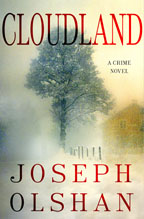
Slow, Moody, Penetrating: The Spring Mystery by Joseph Olshan, CLOUDLAND

Looking at a list of Joseph Olshan's novels and their publishers, it's clear this Cambridge, Mass., author has long been associated with literary fiction -- the kind that slowly eats its way into you, through the tenaciousness of ordinary people grappling with extraordinary stresses. Here are the titles that preceded this spring's publication of CLOUDLAND:
  • The Conversion (St. Martin's Press, 2008)
  • In Clara's Hands (Bloomsbury, 2003)
  • Vanitas (Simon & Schuster, 1998)
  • Nightswimmer (Simon & Schuster, 1994)
  • The Sound of Heaven (Bloomsbury, 1992)
  • The Waterline (Doubleday, 1989)
  • A Warmer Season (Bloomsbury/McGraw-Hill, co-pub, 1987)
  • Clara's Heart (Arbor House, 1985)
At first glance, that's the genre for CLOUDLAND, too, with its epigraph in French that translates as "The first love is the only love" (we know that's not true), and its opening chapter that's rich in description of the grainy snow of late March. But it is in fact a corpse that's discovered in this opening -- the corpse of Angela Parker -- and our protagonist, journalist Catherine Winslow, may be writing household hints these days, but she was once a major news reporter with crime knowledge of her own.

I sank into the book with something of the same discomfort as tramping in a Vermont early spring, one moment in wet, icy snow, the next in sticky mud or a cow pie. Catherine's life now isn't much different from what she once described as she waited for her daughter's precarious mental health to perhaps turn toward something better: "I lived from day to day in a stupor of anxiety, hardly eating anything myself, waiting for bulletins that were never very promising ... What they didn't tell me, couldn't tell me, wouldn't dare to tell me was, 'She wants to kill herself.'"

Nor is she the most reliable detective. She admits to us, in this first-person narrative, that the absence of a book from its familiar spot on her shelf confuses her. "I began to worry that I'd somehow lent it out and completely forgotten to whom. Perhaps my memory wasn't so good after all."

Yet these twinges of doubt are equally clues to what's gone wrong on the mountain ridge known as "Cloudland," where Catherine and her sparse neighbors barely speak, yet attempt to still be neighborly somehow. Drawing from some of Vermont's unsolved and unfinished murder cases, Olshan crafts a haunted -- and haunting -- progression from unease to risk to deadly danger.

This is a a book that requires readerly attentiveness and patience. But the rewards are powerful and unforgettable. CLOUDLAND will last on the shelf.