Showing posts with label series. Show all posts

Thursday, November 20, 2025

Two Memorable Crime Novels for Winter Reading: Con Lehane's THE RED SCARE and Cara Black's HUGUETTE (December Releases)


New York City in 1950 held neighborhoods far more separate than they are today: From Hell's Kitchen, where Mick Mulligan is starting his new chapter as a private investigator (PI), to the neighborhood where a black cab driver's family lives, means Mick's white Irish self steps into danger, threat, and abuse. But this isn't just his first case—it's his only case, dangled in front of him by organized labor leaders, which Mick's already aware means just a doorway away from organized crime. 

Besides, Mick can't work his own trade any longer, thanks to the anti-Communist rage sweeping the nation:

This was the reasoning—I went to meetings with Communists, I ate lunch with Communists, I agreed with Communists on certain things—that got me fired from my job as a cartoonist (we liked to call ourselves animators) at the Disney studio, won me a place on the Hollywood blacklist, and brought me back to New York City, where I hung out my shingle as a private investigator.

Mick's investigation and his own safety are tangled with union politics and high-powered maneuvering by men ready for serious power. He's not a serious "Red" himself, although he believes every working person should get a fair deal. But that's enough to paint a label on him, leading into what author Con Lehane calls THE RED SCARE MURDERS (release delayed to Dec. 16). 

And the label can swipe in all directions, as his taxi driver, an old friend of the man on death row that Mick's trying to exonerate, makes clear:

"You one of them fellas who go out and save the guy the cops thought done it? ... That's what Harold needs. Harold didn't kill no one. ... Maybe it was them Communists he got himself mixed up with."

Lehane's language is perfect for this page-turner crime novel, with phrases like "his tone as sincere as a priest in a pulpit," and plenty of Irish immigrant heritage tossed in.  One of Mick's helpful allies even mentions Hollywood detective fiction author Dashiell Hammett, in an effort to encourage the would-be PI: "I guess he told me this because Hammett had been Red-baited too."

Swing along for the smart and sometimes devious women, the men puzzling out the politics of the time, the darkness of urban angers and the gentle efforts of friendship. THE RED SCARE is a classic of the urban noir genre, with plenty of quick twists and not much gore. Besides, there are such strong parallels in the social politics of Lehane's 1950s and our own 2025 that you could imagine this feisty crime novel was just written last month. Great fun and good reading.

THE RED SCARE is one of the November releases from Soho Crime, an imprint of Soho Press, and definitely has a place on the winter to-be-read (TBR) stack, for both nostalgia and good feelings.


Another December release from Soho Crime, HUGUETTE by Cara Black (Dec. 2), might qualify for some "trigger warnings." Set in Paris at the end of World War II, it's jammed with rape, everyday sexual and physical abuse, and messy violent deaths of nice people. 

But for any reader of Black's excellent Aimée Leduc Paris PI series, this is a must-read. The first few chapters flip back and forth between 1947 and 1945, not always smoothly. About a third of the way into this 300-page historical police and crime novel, the name Leduc comes up, and Cara Black fans know we're on our way into a significant "back-story" to the popular series. How much trust can Huguette Faure place in the "flic" (cop) who offers to help her? Who murdered her father and stole the family business? What are the secrets behind the grown children who now surround her, and who don't know what was stolen -- or, more poignantly, WHO was stolen -- from this attractive, determined, and impoverished young woman who'd been given such a bad hand by history and crime as a pair?

"These cocky soldiers needed to be shown they couldn't treat her like a kid," Huguette thinks as she puts herself in fresh danger with more questions. "Establish authority, her father would say, when dealing with black marketers."

But Black's double epigraph to the book includes a quote from Benito Mussolini's foreign minister Count Galeazzo Ciano, and it's one Huguette should keep in mind: "Victory finds a hundred fathers but defeat is an orphan."

If you can keep reading, with hope, through Huguette's grievous losses, Black's portrait of postwar Paris and her backstory to Aimée Leduc will be a gift to your mystery-loving soul. Buy two copies: one for a friend's holiday gift, and one to treat yourself to some willing Parisian distraction as you keep checking your lists. 

Sunday, November 02, 2025

Three Kinds of Crime Fiction/Mystery, 3 Settings: Hamburg, Fiji, Maine

Catching up a bit ...


I picked up HAMBURG NOIR over the summer, as it had an August release date. Part of the top-notch and provocative Akashic Noir series, it's edited by Jan Karsten and mostly translated -- 11 out of the 14 stories -- by Noah Harley. The book's presented in three sections: Water & Schnapps, Dream & Reality, Power & Oblivion. The 10-page introduction is extraordinary in itself, an introduction to the German city from a lover's lips.

When I opened the book, I expected to taste something of the city where my father was born, in 1925, to parents "just Jewish enough" to need to leave their homeland. But that Hamburg is not in the book, and the reason's clear in looking at the author biographies: Most of the authors were born in the 1960s, long after war had changed their landscape. I was eager to read what Zoë Beck would contribute ("Abreast Schwartzonnensand"), as I'd read some of her other fiction. Hers turned out to be a courtroom scene shaped as a play, all dialogue, one of the most interesting works of crime fiction I've read. Other stories, more conventional in form, range from a handful of pages to a story of almost 30 pages by Matthias Wittekindt. And all of them, as expected, are dark, often twisted, even malicious.

I liked this passage from Katrin Seddig's tale, set in the Altona district:

I wasn't Miles Davis. The world wasn't a film noir, the world was gloomy and foolish, it had no beauty. That was the difficulty: to track down the beauty in it all. Wasn't that the essence? Everything always looked like something else to me—that, or I was left searching for it something that I already knew and hoped to find in what I was seeing.

If Hamburg is one of your love languages, pull this onto your bookshelf. If noir is how you wrestle with the world, ditto. And if you just want to play tourist -- well, this book will prevent you from going to Hamburg. So maybe take a pass, unless perhaps you're longing to feel better about New York by contrast.

Nilima Rao's second Fiji mystery featuring Sergeant Akal Singh came out in June. SHIPWRECK IN FIJI (Soho Crime), set in 1915, with the Great War echoing from the other side of the world, is indeed (as its press release claims) "brimming with warmth and humor." The Indian-born police officer is way out of his comfort zone, still struggling to grasp the culture in which he's been pinned. Chasing down possible Germans on a nearby island should seem familiar, but instead Akal lands in more confusion as he meets native villagers whose tribal customs may prevent pursuit of the criminals he's after. For the sake of his friend Taviti, ready to translate the local customs, Akal takes on a mentor's role in policing, and learns a great deal about the "true stories" that men tell each other. I couldn't put this one down. (And you don't need to have read the first in the series, A Disappearance in Fiji, but you'll probably want to catch up with it after Akal has you applauding his efforts.)


I didn't realize at first that Scott Carson was the pseudonym of Michael Koryta --  if I'd known, I might not have tried the new title under the Carson authorship, DEPARTURE 37, for fear it would be "too terrifying" for my taste. That would have been my loss! It's rare that an author can provide underpinnings to time travel as part of a crime novel or thriller and have it all make sense. This book, set in coastal northern Maine, takes 16-year-old Charlie through a naval experiment that tears open her life, starting with the moment when her deceased mother's voice speaks to her from the cockpit of a wrecked plane, saying what hundreds of pilots across the country are also hearing in the voices of people they love: Don't fly today. I refuse to offer any spoilers ... that should be enough to let you know whether this is your kind of good read. To my delight, it was one of my best treats of the season, and goes onto my "let's read this again" shelf, for sure, with its attachment to "the most famous moment in the history of artificial intelligence."

More reviews soon, as I'm now writing them for two other publications, just figuring out my footing. Or pagination.


Wednesday, July 09, 2025

Crime Fiction, or Science Fiction? Eric Rickstad's REMOTE: THE FIVE (The Remote Series Book 2)


It's rare that a publisher and author can dance their calendars so well that book 2 in a series is published before you've lost the stinging memories of book 1 -- but Eric Rickstad and Blackstone Publishing have made it work, just in time for some properly creepy summer reading.

Book 1 in the series, called Remote: The Six, released on April 8; this week, book 2, REMOTE: THE FIVE, is available. Although it's an author's job to give enough scaffolding so you can jump into a later book in a series and not feel lost, the double premises behind Rickstad's plotting mean you'll appreciate this new volume more if you've read the first one; I'll paste that review below, since the publication where it appeared abruptly vanished this spring (alas).

Premise 1: Serial killings of entire families are taking place, with FBI Special Agent Lukas Stark assigned to identify the murderer and stop him. Means and opportunity aren't hard to pull together, but motive depends on this next part --

Premise 2: Gilles Garnier, also known as X, is one of six people raised with a new-to-humans ability: They can "remote view," that is, see and hear what's happening in some other location. The killings are his part of his psychotic effort to find or create other remote viewers.

 Hold on -- before you discard the notion as too far from reality, bear in mind that the author's "discussion topics" from the first book reveal that he's based this on a CIA research program, historically real. He's clearly spent major effort on the FBI procedures involved in Agent Stark's efforts, too. In effect, Rickstad is shifting a dark crime novel just a bit further along into what the future could bring -- so in that sense, park this book in the "dystopian" genre, too. And who isn't grimly interested in dystopian fiction just now, in an effort to understand what's going on in our scary global situations??

As REMOTE: THE FIVE opens, it seems another of the remote viewers, S, is turning to murder: 

This woman, suspected of the murders of two MIT researchers in the field of bioengineering and genome modification, had the same strange scar on the back of her neck that Garnier and Q had. This woman whom Garnier suspected of being manipulated by the program, as was Q, into murdering a list of individuals in the hope of maintaining or strengthening their fading remote-viewing abilities. Of course, it might really have been only a test by the program to see how far the two would go to maintain their ability—to determine how strong their addiction to that power really was. 

There's that dystopian note: "addiction to power."

Stark and Garnier head in separate directions, each pursuing a persistent hunch about the ongoing murders. The FBI agent has his own twist: He seems unable to let go of pursing the case, even when his own wife and small child are in enormous danger. And Garnier appears to be dying. So, will the case be solved before Garnier can't even walk and wake, or before Stark carries his own trauma from childhood into another generation?

If you like all threads neatly tidied by the end of a book, don't try this one -- there are quite a few strands left dangling at the end, and there's little resolution of the threats that seem only to deepen. But for those hooked on the estrangement and bitterness of noir (or related dystopia), this is a prime candidate for book of the summer. Of course, the sequence of titles and the rough-edged ending to REMOTE: THE FIVE make it clear there are more books ahead in the series, so it's understandable that threads dangle. Rickstad has left more of them unresolved than is usual, so book 3 will need to carry a lot of power.

Let's see how soon the next book will come to the shelves!


BOOK 1 review, originally published in the New York Journal of Books:

Remote: The Six, The Remote Series Book 1 by Eric Rickstad 

Kudos to Blackstone for opting to release both of the first two books in Eric Rickstad’s new Remote Series within the same year: book 1 now, and book 2 in July. The suspense raised by this new thriller, Remote: The Six, could otherwise be close to unbearable—because Rickstad is a master of suspense and quickly ramps up both tension and personal threat for FBI Special Agent Lukas Stark. On the road, constantly falling behind the attacks of a brutal serial killer, Stark is all too aware that this man is deliberately assaulting families. Like his own, his wife and eight-year-old son, whom he hasn’t seen in literally months, thanks to his job.


Stark appears to be mostly a lone hunter, with support from forensic teams wherever he lands to assess the latest deaths. “The FBI had not been brought in until the third murdered family … made it clear through MO—victims bound to chairs, wife’s throat cut, father and children bludgeoned—that there was likely a single killer working across state lines.” So he’s doing his own assessments, asking creative questions, probing behavioral and psychological patterns. Rickstad doesn’t hold back on the twists from the start: Just a few pages in, Stark reflects that he knows “all too well the bloody fingerprint a father’s violence left on a son’s soul.”


So in many ways, Stark’s solo hunting for the serial killer is a perfect fit for his own damaged self. Alas, he’s got less than one chapter of the book to hunt that way, as his superior, an FBI Special Agent in Charge, arrives without warning on the latest crime scene, with a very strange civilian in tow. Stark is expected to take on as a partner this peculiar and intrusive man, who reminds him of “a secretary bird, which takes flight only when pressed by imminent danger.”


Yet this is also the moment when Rickstad’s ground-shaking crime novel crosses over into speculative fiction (what used to be only called sci fi), because Gilles Garnier has his own way of searching for the perpetrator: something called remote viewing, which lets him see what someone else is looking at.


Stark’s very unhappy with the notion, which reminds him of course of all the fraudulent or at best useless psychics he’s already seen in action. Rickstad then cleverly braids together several long processes: of Stark revealing only to himself his own internal damage, of the frustrations of the serial killer, and of Gilles Garnier confessing what he’s actually doing, and how he’s gained the capacity to do it. (For those who hate crawling inside the minds of gruesome killers and their terrified victims, this book’s a good thriller for you, because those aspects don’t take up a lot of the narrative.) The pacing is impressive, the dialogue and twists highly satisfying, and by the time Stark himself is unraveling, it’s all too clear why.


Equally intriguing is Stark’s own theory of the killer, which involves a biochemical form of addiction to arousal. He’s aware that the theory makes him an outsider, and even Gilles Garnier agrees it will put off the other professionals: “Addiction implies a lack of free will, of personal responsibility.” But might this be the case anyway?


This is indeed book 1, so there are a couple of scary dangling threads at the end. (Not long to wait until they’re back in play, with July 8 the predicted release date for book 2, Remote: The Five.) But Rickstad also offers some startling information in his promotional “discussion topics,” which include the presence of historically real serial killers in his home state, and a CIA research program, also historically real, on remote viewing. Maybe the sci-fi side of the book is actually a view into something scary and very possible, after all.


Sunday, June 22, 2025

Crime Fiction from Nicola Griffith, June's Nebula Grand Master

 Nicola Griffith at center, with her award.


The Nebula Award is for science fiction, not mystery -- but author Nicola Griffith has been able to excel in both genres, so it's a thrill to see her named Grand Master by the sci-fi world this summer. Her acceptance speech is well worth reading, as she talks about "world building" ... something that's also common to crime fiction and historical fiction, not just speculative or sci fi work.

Summer's a great season for discovering a new author and barreling through a series. Thanks to Picador, Griffith's three crime novels featuring Aug Torvingen are newly released in softcover in the US: THE BLUE PLACE (which I just devoured), STAY, and ALWAYS. Check out a long description of Aud (Norwegian born, American by choice, a former police detective now taking specialized private work. In THE BLUE PLACE she agrees to track down a case of art fraud, murder, and a red herring of drugs connected to a Mexican cartel. Why? 

"It's the adrenaline," Aud admits to her new and very close friend Julia. "When everything slows down and my muscles are hot and strong and the blood beats in my veins like champagne I feel this vast delight. Everything is beautiful and precious, and so clear. Light gets this bluish tinge and I feel like a hummingbird among elephants, untouchable."

But that elation and "untouchable" sensation can lead her astray, and does, with nearly unbearable costs. Maybe you'll connect to that part of Aud. Or maybe to the gorgeous descriptive passages of her adopted home area, Atlanta, Georgia, or the home she revisits as a safety location during the crime hunt, Norway, with its mystical winters, stunning landscape, and pervasive legends.

My dad used to say, "Do as I say, not as I do." Let me pass that along to you also: Take Griffith's Aud Torvingen crime novels slowly and luxuriously. Don't devour ... instead, savor. That's what summer was made for.

And here's a postscript from Griffith, to remind you that you may not have heard of her books (especially if you're not reading sci-fi), but you've heard of the authors who praise this sleuthing series: Dennis Lehane, Val McDermid, Dorothy Allison, Lee Child, Manda Scott, Francis Spufford, Laurie King, Ivy Pochoda, Robert Crais, Elizabeth Hand, James Sallis and more.


Wednesday, May 31, 2023

Adventure, Murder, and Twists of Bookstore Merriment from Tamara Berry, in MURDER OFF THE BOOKS


Tamara Berry's wicked sense of humor is a great match for her neatly twisted plots in her "By the Book Mysteries," set in the Big Woods country of the Northwest. Crime novelist Tess Harrow's family legacy in this timber-centric town isn't as wild as her best-selling status, but it does include a former hardware stores (see the earlier books of the series) that she's turning into a bookshop of her own, with of course a stack of her newest release on the counter.

But Grand Opening plans run awry when (of course!) murder sweeps into town once again. This time, a top-selling podcaster arrives at the same time, and starts to paint Tess's recurring corpse discoveries as possible indications that she herself is a criminal!

Perish the thought, or even better, perish the podcaster. Except that's not going to happen. Tess's daughter is thrilled by the visitor. Her definitely difficult mother sweeps into town at the same time -- and the corpse turns out to be Tess's mother's boyfriend of the moment, the notorious Levi Parker, who might have tried something deadly if he hadn't been killed first. And oh yes, Tess and the sheriff may or may not be an item. Complications.

Is your head spinning yet? Jump into this lively bibliomystery laden with smart sassy women and to-die-for dialogue, as well as a plot that gets more crazy and more likely at the same time, page by page. MURDER OFF THE BOOKS is the fun mystery your summer reading stack has been waiting for. 

[The earlier books in the series are Buried in a Good Book and On Spine of Death -- treat yourself!]

PS: Looking for more mystery reviews, from cozy to very dark? Browse the Kingdom Books mysteries review blog here.

Tuesday, May 30, 2023

Nordic Noir in 13th Harry Hole Crime Novel from Jo Nesbø, KILLING MOON


 [Originally published at New York Journal of Books]

“Nesbø never releases the heartstrings through an otherwise classic dark police procedural.”


Harry Hole, depressed Norwegian detective, has fled to California as the 13th book in this “Nordic noir” detective series opens. It takes one to know one, they say, and an aging actress and gambling addict named Lucille, hanging out in the bar with him, nails Harry as running as running away from something—his wife? No, she’s dead. “Ah. You’re running from grief,” Lucille readily assesses.


For Harry, that could be both the sum and his ending, since he’s ready to give up on everything. But (with plenty of Leonard Cohen lyrics along the way) it turns out that seeing Lucille assaulted because of her gambling debts wakes up the protective side of this aging police detective. And that, in turn, readies him to accept a return to Norway to solve a crime, provided he can get a big enough fee to pay off Lucille’s life.


It's a poignant and emotional way to pull Harry Hole back into action, and Nesbø never releases the heartstrings through an otherwise classic dark police procedural. DNA analysis, cocaine trafficking, violent crime—it all piles up across nearly 500 pages of detection. Alternating points of view bring in forensic sleuth Alexandra Sturdza, as well as a highly unpleasant set of manipulative criminals. Sturdza, despite her first gray hairs, is glad to recall once being told “her body was a cross between a tiger and a Lamborghini” and her wry comments and quirky expertise add fun to the narrative.


As detective novels go, this one is on the edge of being a thriller, since there’s a “ticking clock” for Harry Hole to discover and arrest a serial killer. Technically, he’s only got to prove his client didn’t do the crime, in order to have the needed funds wired to his bar buddy Lucille’s account and get her released. But of course, proving innocence is much more direct if someone else is clearly guilty. Because he’s on a short time leash, Hole takes bigger risks and cuts more legal corners than might be wise. It makes sense, in the context, and it ramps up the suspense.


Fans of the series will find this sleuth’s grief and loss powerful, and will appreciate how life forces Harry back into the work he does so well. Newcomers to Nesbø’s well-established investigations won’t struggle for context, though; Harry Hole’s sense of blame for his wife’s death and his overwhelming need to accept responsibility for another life are quickly established and push the plot.


At the core of Killing Moon is the painful reawakening of attachment in Harry’s life, through reconnecting with an old flame and her child. It’s a terrific contrast to the self-centered menace of criminals, and lets Nesbø dip into more classic tunes, beyond Leonard Cohen. The most satisfying lullaby Harry can offer to a child turns out to be “a low, slow chanting in a rough voice that now and then hit the notes of an old blues song about the perils of cocaine.” Truth seems to be the best currency with this child. For Harry, that in itself offers more risk and pain.


At the same time, it provides another hostage to keep Harry Hole investigating, as a new kidnapper invites Harry to check out the night’s moon: “You can see the eclipse is under way. When the moon is completely covered,” the villain offers, he’s going to slit the throat of someone Harry loves.


Running away from grief? Rephrase that: Once again, Harry Hole is running for the sake of love.


PS:  Looking for more mystery reviews, from cozy to very dark? Browse the Kingdom Books mysteries review blog here

Sunday, May 21, 2023

Next from Mick Herron, THE SECRET HOURS, in September


I generally review books pretty close to the publication date -- so if the review intrigues you, you'll be able to get the book soon afterward. As a result, I won't post a full review of THE SECRET HOURS  until later this summer.

But not only are there exceptions to waiting for the right moment. There are reasons for exceptions to self-imposed rules like this one. 

Mick Herron's new book, THE SECRET HOURS, will be released in September. Layered, rich, flavored with political insight, wry humor, espionage of course, and above all, love and loyalty, it's being promoted as a stand-alone spy thriller.

However, this book unfolds many of the secrets that have been lurking in Herron's Slough House series. And it's going to resonate more deeply for you if you've already devoured and at least partly remember what happens to which characters in the series.

So this is your book alert: Buy Mick Herron's series now, or borrow it, or dust off your own copies and spend the summer refreshing your attention to the quirkiest, bravest, most ordinary, most-difficult-to-share-an-office-with spies of Herron's disastrous failure side of MI5. 

You will thus guarantee yourself an astonishingly good time in September.

Which in turn causes me to suggest: Get your spouse and/or best friend reading these, too. Then you'll have the ultimate pleasure of sharing a fantastic book with the person you most like. Couldn't get much better than that.

Oh yes, the books you are about to buy, borrow, or dust off (lucky you!) are:

1. Slow Horses (2010)
2. Deal Lions (2013)
3. Real Tigers (2016)
4. Spook Street (2017)
5. London Rules (2018)
6. Joe Country (2019)
7. Slough House (2021) 
8. Bad Actors (2022) 

And you can see a lot of them reviewed on this site by clicking here

PS:  Looking for more mystery reviews, from cozy to very dark? Browse the Kingdom Books mysteries review blog here.

Saturday, April 29, 2023

Cold War Espionage, MOSCOW EXILE from John Lawton (Both Joe Wilderness and Lord Troy)


 [Originally published at New York Journal of Books]

“Lawton’s approach to espionage lacks the multiplying deaths and poignant self-blame of a Le Carré novel. But the resilience and determination of his Charlie, Coky, and eventually Joe Wilderness provide a strong portrait of Lawton’s real-life sense of espionage.”


Moscow Exile is offered as a “Joe Wilderness Novel,” the fourth in John Lawton’s international espionage series. Aside from a cryptic prologue set in 1969, though, Joe Wilderness is conspicuously absent from this lush historic novel until nearly 300 pages in.


That still gives Joe plenty of work space, though, since Lawton’s model for this work might as well have been a classic Russian novel, lengthy and rich with generations of conflict, wealth, and fractured loyalties. And there’s no need to rush: Moscow Exile offers a bitter promenade through the Red Scare years of American politics and the malicious maneuvering of the Senator who in real life was Joseph McCarthy —here, Robert Redmaine, sleazy and powerful, tearing apart Hollywood’s professionals with accusations of anti-American affiliations.


Making the novel even more delicious for fans of Lawton’s British Inspector Troy investigation thrillers, Troy and his politically potent brother slide directly into the story, as the British leadership—especially via MI5 and MI6—attempts to shape its Iron Curtain diplomacy.


The heart of Moscow Exile is an alliance between a British spy who’s actually working for Moscow—the elegant Charlie Leigh-Hunt—and a far cleverer and beautiful woman, Charlotte (aka Cokey) Shumacher, also working for “the Reds,” for different reasons. Lawton provides many sexual liaisons for the pair (such a relief to read untwisted sexuality, despite the international betrayal going on) and demonstrates how direct international espionage can be. It would be nice to think that the America of the 1950s and 1960s wasn’t really infiltrated this way. But for Charlie and Charlotte, with specific reasons to prefer “anyone but Britain” handling world leadership, spying comes easily and with lower risks than expected.


An ”ordinary” espionage novel would make sure that those betraying America and Britain to Russia/the Soviet Union would pay a deadly price. Lawton offers a mirror inversion instead: Secrets, seduction, and certainty fuel a path to safety behind the Iron Curtain. Only Joe Wilderness, with the Troy brothers oddly interconnected to him, sees clearly what Soviet ideology means for Moscow.


Oddly, Moscow Exile lays out reasons that people chose on behalf of global Communism and active socialism, and those characters who sustain their loyalty to related ideals somehow manage to escape deadly failure. This “Russian novel” hosts an unusual morality that places loyalty—to whatever cause—and generous friendship together as allies, so that even a politically crooked philanderer can become heroic in his or her way.


That allows Joe Wilderness, with his plain British loyalty and willingness to be used as a pawn in a spy swap, to sit on the outskirts of this hefty book. Instead, Coky Schumacher demonstrates how an unsuspected wife of a half-mad politician can protect the Soviet side. She spells it out for Charlie: “Why, you think it happenstance that Bob chooses the innocent and harmless to grill? I steer him away from the real Communists.” She also details the moral quagmire of creepy politicos like her Senator husband: “The amazing thing about Red-baiting is that he’s stuck with it. I think he was on a quest to find out what would win, and if it turned out to be right-wing, racist, paranoid bigotry, so be it. That is the mask he has adopted,” she explains. And when Charlie gets her point and suggests, “We might become what we pretend to be,” Coky provides a blunt summary: “We are what we pretend to be … and in that is a lesson for us both, Charlie-boy.”


Lawton’s approach to espionage lacks the multiplying deaths and poignant self-blame of a Le Carré novel. But the resilience and determination of his Charlie, Coky, and eventually Joe Wilderness provide a strong portrait of Lawton’s real-life sense of espionage: calculating, well-armed, self-defined. The irony of Moscow Exile is that those with undivided loyalty in the novel—the Troy brothers, Lord Troy’s wife Anna, and Joe himself—occupy only “bit parts” that require swift decisions and able allies.


On the other hand, the true villain of the book, Senator Redmaine, bears a strong resemblance to some of today’s political rising stars. “And that is a lesson for us both,” as Coky would point out.


PS:  Looking for more mystery reviews, from cozy to very dark? Browse the Kingdom Books mysteries review blog here

Dr Ruth Galloway (Archaeologist) Mystery 15, THE LAST REMAINS by Elly Griffiths—Oh Yes!!


[Originally published at New York Journal of Books]

“By positioning a vital threat to Cathbad, the most mysterious and loyal and honorable person in the series, Griffiths creates heart-wrenching power within what might otherwise be a relatively routine investigation for Ruth Galloway.”


The Golden Age of British crime fiction is marked with authors Agatha Christie, Dorothy L. Sayers,  John Dickson Carr, and Josephine Tey, among others. Today, American readers benefit from quick cross-Atlantic publication of British work, as well as masterful translation of Nordic, French, German, and Spanish work, and from authors in African and Asian nations.


The “special relationship” of America and Britain reinforces the power of top-notch British mysteries and espionage today. With the fifteenth title in the Dr. Ruth Galloway series from Elly Griffiths, the continued growth and deepening of both Griffiths and her characters enhance a thoroughly satisfying mystery: The Last Remains.


Ruth Galloway is an archaeologist who’s developed a forensic side-specialty, thanks in part to being the primary researcher in the field for her area of Britain, one rich with artifacts from the ever-fascinating Druids. Her efforts for the police have also grown in significance because of her personal relationship with the local investigator, DCI Nelson.


So when builders renovating a café find a skeleton hidden behind a wall of bricks, Dr. Ruth Galloway gets an immediate summons to the scene—and it only takes her a few minutes to declare it a crime scene and don her forensics hat, along with involving Nelson and his team.


At the core of this series, beyond Ruth’s complicated relationship with DCI Nelson, has been her friend and ally Cathbad, a modern Druid opening up ancient ways and bringing both tenderness and wisdom into the circle of friendship that includes Ruth and Nelson. Cathbad’s allegiance to both the pagan past and the children he and Ruth nurture parallels his dual nature of ferocity and caregiving.


The Last Remains amps up the tension when Cathbad becomes a person of interest in the teen’s death, then vanishes without warning. However, he has written a farewell and a will, a terrifying aspect that suggests the time to find and save him could be very short, or even nonexistent. His life partner Judy is a police officer but can’t investigate because she’s too close. Desperately she suggests, “Maybe he decided to go on a pilgrimage? The only things is …” her face crumbles, “why wouldn’t he tell me?” DCI Nelson hopes Cathbad, suffering the blurring effects of “Long Covid,” may have amnesia and will turn up. Ruth, however, has increasing reason to doubt such a happy result.


By positioning a vital threat to Cathbad, the most mysterious and loyal and honorable person in the series, Griffiths creates heart-wrenching power within what might otherwise be a relatively routine investigation for Ruth Galloway. There will be no putting down this compelling mystery until Cathbad’s disappearance can be solved. And in classic heroic manner, to get to that point will require Ruth to risk her own life, even as she struggles to define her future nd her daughter’s.


It's remarkable to realize that The Last Remains is the fifteenth book in this series, which began with The Crossing Places. Where Griffiths’ early books offered quirky and lightly twisted plots, this latest one suggests that, a century after the original Golden Age, British crime fiction exhibits a second surge of development underway.


PS:  Looking for more mystery reviews, from cozy to very dark? Browse the Kingdom Books mysteries review blog here
 

Friday, April 14, 2023

The Living, Lasting Legacy of Author Anne Perry (1938-2023)

(Author Anne Perry in 2012. Credit: Wikimedia Commons.)

Dave and I met one of the great mystery authors of our lifetime at a reader/writer conference, Bouchercon, when it was held in Albany, New York. We'd prepared for months —even years—for this, collecting the books written by Anne Perry. Others in line around us clutched to their chests one or two books to be signed; some, like us, had more. We toted ours in big canvas book bags.

I recall how awestruck I felt when I reached the front of the line and stood in front of this British author. There wasn't time for conversation: Maybe another hundred people waited behind us. Briskly, in our practiced rhythm, Dave and I opened each lovely hardcover book to the title page for this author's bold signature, then the next, and the next, as one of us put away signed copies and the other lifted more books to the table.

In minutes, it was over; I felt breathless, truly amazed that life could include such a moment.

Historical mystery author author Charles Fergus, however, made much different use of his time with Anne Perry. I love his story of that moment and its lasting legacy in his writing. Here you are (the original is published on his blog, https://charlesfergus.com/blog-posts):

Anne Perry's Advice to Me: Make True a Major Character

Anne Perry, who died recently at age 84, wrote dozens of popular mysteries set in Victorian-era England. According to her website, more than 26 million copies of her novels have been sold since the first one was published in 1979.


Perry wrote 32 William and Charlotte Pitt mysteries; they feature a police officer in late 19th-century London and his wife, an unconventional aristocrat. Perry also wrote a 24-book series about a detective named William Monk, who loses his memory after a carriage crash, and Hester Latterly, a former Crimean War nurse who ultimately becomes William’s wife and helps him adjust to his brain injury and solve crimes. 


I met Anne Perry in 2013 at a conference of the Historical Novel Society, which was held in an old hotel in St. Petersburg, Florida. I had completed a manuscript for the first Gideon Stoltz mystery, A Stranger Here Below, and was looking for a literary agent. I’d also signed up for a course on how to craft effective pitches – both a longish description of a novel, and a shorter one, sometimes called an “elevator pitch” from the notion that you can deliver this near-breathless summary during a brief elevator ride. 


Perry gave the keynote speech on the conference’s first evening. The next morning when I came down to breakfast, I saw her sitting there by herself. I asked if she wanted company, expecting her to say no, but she was delighted to share the meal and some conversation. 


She asked where I was from and what I was writing about. I said with a laugh that I’d just give her my brand-new elevator pitch: “In 1835 in the Pennsylvania backcountry, a young sheriff unearths disturbing links among a judge’s suicide, a trial and hanging 30 years ago, and a recent murder. To conduct his investigation, he must relive his own mother’s murder, a crime that remains unsolved.” 


I also mentioned that one reason I’d written a murder mystery was because I had lost my own mother to a murder, and I wanted to write a story that did not trivialize the horrific, life-swerving effects that a murder leaves in its wake. 


Years later, I would find out that Anne Perry had committed murder herself. In 1954, in Christchurch, New Zealand, at the age of 15, she and a pathologically close 16-year-old female friend killed the friend’s mother by bludgeoning her using a sock with half a brick in it. They somehow thought that killing the woman would prevent the friend’s parents from leaving New Zealand, which would have forced the two adolescent girls to separate.


Ms. Perry’s criminal past had been revealed in 1994 when Peter Jackson told her story in his film Heavenly Creatures, starring Kate Winslet as the confident, conniving teenager Juliet Hulme – who, after serving five years in prison, would be given a new name and ultimately would become the bestselling mystery author Anne Perry.


That morning in St. Petersburg, after hearing about my planned mystery series, Perry urged me to develop Gideon’s wife, True Burns Stoltz, into a major character. Perry said that in writing her novels, she felt that having both male and female main characters helped her examine situations, relationships, and crimes from two very different perspectives. She felt that readers liked that approach. And she said that writing from those differing viewpoints was fun. 


By then I’d begun working on my second mystery, Nighthawk’s Wing. In it, True hauls herself out of a deep and nearly suicidal depression brought on by the death of her and Gideon’s infant son. And in the third mystery, Lay This Body Down, True blossoms into a quirky, tough, determined heroine whose way of looking at the world differs from – and complements in an important way – that of her rational, thoughtful, sometimes almost plodding sheriff husband. 


Perry’s obituary in the New York Times noted that she never married; friends felt she ended romantic relationships because she didn’t know what to say about her past. It also quoted some things she’d said in a 2017 documentary film about her life: “In a sense it’s not a matter – at the end – of judging,” she said. “I did this much good and that much bad. Which is the greater?” 


She continued: “In the end, Who am I? Am I somebody that can be trusted? Am I someone that is compassionate, gentle, patient, strong?” She mentioned other traits, including bravery, honesty, and caring. “If you’re that kind of person,” she said, “if you’ve done something bad in the past, you’ve obviously changed.”


Anne Perry offered me encouragement and spot-on writing advice. I’m glad to think of my character True as one of the things she gave to the world.


 PS:  Looking for more mystery reviews, from cozy to very dark? Browse the Kingdom Books mysteries review blog here

Friday, February 24, 2023

Brief Mention: LAST SEEN IN LAPAZ, by Kwei Quartey


Collecting international crime fiction? Ghana-born physician and author Kwei Quartey's Darko Dawson series, set mostly in Ghana, has been a pleasure; Quartey's current series is a spinoff that features Emma Djan, a private detective always alert to gender discrimination as she works her way up in a local agency (the police force dumped her, early in the series).

LAST SEE IN LAPAZ opens with the disappearance of a young Nigerian woman, daughter of a friend of the agency owner. (Lapaz is a town in the Accra Metropolitan District -- not related at all to La Paz, New Mexico.)  The attractive and hard-working Ngozi seems to have run away from home, across the national border, and might be in Accra. If, that is, she's alive.

Emma Djan isn't yet authorized to do a lot of investigation on her own, but she has an advantage here, because she can perform a flirtatious role with the greedy (in every sense) hotel owners who seem linked to the disappearance. When one hotel turns out to be supplying female companions, perhaps forced into this upscale prostitution, Emma's both horrified and fascinated. Anything to avoid the boredom of routine PI work!

Her insight into women's lives also gives her an advantage as she investigates with Boateng, the local DI (inspector on the police force):

Boateng grunted. "You seem to be studying this room closely, Djan. What do you see?"

"No disorder, no chaos. It has a controlled feeling. Someone who has been in this room was trying to gain control over the other, but couldn't quite do it. ... This entire house is a clue."

Despite his California location, Quartey's writing continues to have the choppy feel of translated material, possibly an intentional effect to suggest the movement among local languages and dialects. The book suffers somewhat from quick changes in point of view, among investigators and criminals. But it's still a revelatory experience of urban life in Ghana, and neatly plotted, with caste and related attitudes deftly portrayed. 

Collect it for your African mystery shelf, as well as for the diverse spread of Soho Crime's continued global outreach.

PS:  Looking for more mystery reviews, from cozy to very dark? Browse the Kingdom Books mysteries review blog here


Tuesday, February 14, 2023

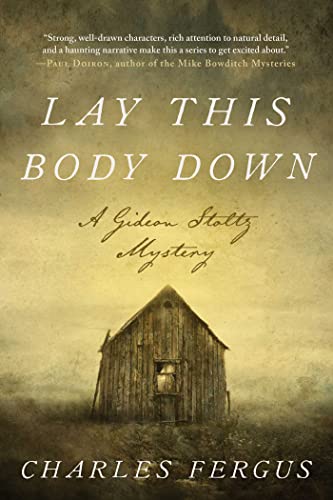
Third Crime Novel for Sheriff Gideon Stoltz, LAY THIS BODY DOWN, by Charles Fergus


 [Originally published at New York Journal of Books]

“Fergus’s writing lays out both the struggles of a new nation, and the pains of growing into determined manhood with its allegiances, regrets, and consolations. If murder and kidnapping can be halted, why not enslavement, also?”


The lines of good and evil are firm in this third antebellum mystery from Charles Fergus: Enslavement is brutal, and deprives the 1837 American nation of honor. Immediate emancipation could restore that honor—but in Sheriff Gideon Stoltz’s industrial Pennsylvanian town of Adamant, a rough crowd jeers at a visiting speaker advancing such an argument, and Gideon’s role as lawman is keeping the peace. Not advancing abolition.


However, Fergus positions Gideon as an outsider himself, with a strong “Pennyslvania Dutch” German accent that marks his difference in the hardscrabble Scotch-Irish town. Young and inexperienced for his job and without training, supported by his wife and a few friends, Gideon identifies with runaways and victims. It’s a dangerous position when there’s a national law requiring that he enforce “property ownership” toward Black fugitives. Although his state backs away from that position, the town is just 80 miles from Maryland, and his neighbors, a mostly rough crew, could inform on a runaway and expect Gideon to jail that person.


“What if the right thing—whatever it is—and what the law requires turn out to be two different things?” Gideon asks his wife True. Her answer: “I hope you would do the right thing.”


Chapters of Lay This Body Down open with excerpts from historically real reward notices seeking fugitives. When slave hunters turn up in Adamant, seeking a Black youth who’s helped Gideon in the past, what he’ll choose is never in doubt: He owes a debt, and servicing it fits with his growing belief that enslavement is cruel and wrong. Instead, the rapidly ramped-up tension in the book comes from the prevalence of malice among those hunting fugitives and those who already despise Gideon as not one of them, neither by heritage nor by attitude. As he struggles to find and protect this and other runaways, he plunges into personal danger.


In that sense, this is an intimate novel of connection among working men with opposing worldviews. Gideon will only succeed and survive if he can find enough allies to defend his choices and actions. It’s soon clear he’s even being betrayed within his own office. His own superior in law enforcement doesn’t even have his back. But his wife does.


Readers of the earlier two titles in this series (A Stranger Here Below; Nighthawk’s Wing) will not find much of the mystical and supernatural that appeared in those books, although True Burn Stoltz, finding her way out of her long depression over the loss of the couple’s child to illness, clearly relies on a related set of beliefs. Instead, the conflict in this novel foreshadows what was already erupting across the nation’s frontier at the time: ardent beliefs in independence and the sanctity of property, playing against philosophical and humanist efforts to impose a better form of civilization.


Gideon’s weaknesses, part psychological from his own mother’s murder, part physical as a residue of concussion (alas for the results of horse accidents and human beatings!), hold potential to transform into powerful incentives to action. As he prunes away the rot around him, he finds himself able to say to a stranger, “Maybe you can help me.”


Fergus’s writing lays out both the struggles of a new nation, and the pains of growing into determined manhood with its allegiances, regrets, and consolations. If murder and kidnapping can be halted, why not enslavement, also? The author’s meticulous historical portrayal offers a potent integrity, to ground the growth of Gideon Stoltz into a man who’s certain of the right thing to do, after all.


 PS:  Looking for more mystery reviews, from cozy to very dark? Browse the Kingdom Books mysteries review blog here

Tuesday, February 07, 2023

Engaging Mystery from J. D. Robb, ENCORE IN DEATH


[Originally published at New York Journal of Books]

“It’s unusual to find a crime page-turner that’s this compelling while also probing affection and loyalty, without gore or grotesque maneuvers. Motive, means, opportunity—Encore in Death is classic crime fiction at its best.”


Setting the Eve Dallas crime thrillers ahead in time, with a few more technological advances, doesn’t really give this homicide detective any more of an edge than today’s savvy sleuths. After all, even if test results come more quickly and communication is fine-tuned, solving a crime still comes down to getting inside the minds and emotions of potential suspects.


So when theatrical stars Eliza Lane and her husband Brant Fitzhugh throw an A-lister gala for patrons of their work, just as Eliza’s new Broadway show is about to open in the year 2036, it turns out that Brant’s sudden death is from cyanide, that well-known almond-scented poison. And the roster of suspects is no different than today’s would be: friends true or false, family, lovers, and competitors for the spotlight and awards.


But really, who could want to hurt Brant? His wife, a much edgier and sharp-tongued person, can’t imagine any reason. “Brant didn’t like conflict, and found ways to avoid it,” Eliza sums him up. Generous as an actor, a friend, a spouse, and even philanthropist, his death comes from toasting his wife with a sip from her specially prepared champagne cocktail. So who was the intended victim—husband or wife?


J. D. Robb’s polished and well-paced writing, honed in more than 200 novels so far, keeps the narrative on the move. Its second line of action takes place between Eve and her own husband, the wealthy Irish entrepreneur Roarke—who, whether by contagion or interest, is starting to “think like a cop” and lending a hand to Eve and her investigation. Eve spots this even before Roarke’s willing to admit he’s caught up in puzzle and how to solve it, as she outlines the need to follow the money here, and says she’ll take a look. Roarke steps right into her trap:


“I could do that for you while you dig down on the cast and crew. You may find it’s not the person who didn’t get the part, but a friend—as you were looking at Sylvie—a relative, a lover. Someone who’d do the deed for someone else.”


Roarke’s ability to quickly deep-dive into financials adds power to the investigation; his deft and determined efforts to support Eve’s work and the couple’s gentle jockeying in support of each other add charm and passion (and some lovely teasing) to the story, too.


As Robb lays out the plot with her quick professional skills, she paints solid marriages just as effectively. It’s unusual to find a crime page-turner that’s this compelling while also probing affection and loyalty, without gore or grotesque maneuvers. Motive, means, opportunity—Encore in Death is classic crime fiction at its best.


PS:  Looking for more mystery reviews, from cozy to very dark? Browse the Kingdom Books mysteries review blog here