Showing posts with label Massachusetts. Show all posts

Monday, August 03, 2020

New Crime Fiction from Hank Phillippi Ryan, THE FIRST TO LIE


This thriller should raise more than goosebumps—it’s a raceway of red flags signaling the possible connections of corrupt officials and money-hungry drug developers.”

The warning is right up front in this wild-ride thriller from TV investigative journalist Hank Phillippi Ryan: “If you could start your adult life over as someone else, would you do it? … To get what you always wanted? Sure, you would. All you have to do is lie.”

And it’s obvious that Nora Quinn at the start of The First to Lie is faking a lot of things. Out on a carefully choreographed date—her own choreography—with a doctor whose clinic promises fertility miracles, she’s tracking possible misuse of a dangerous pharmaceutical. Then there’s a quick switch of narrator, to Ellie Berensen, whose new neighbor in her apartment building seems way too pushy and invasive. If Ellie’s hiding something too, new neighbor Meg Weest seems determined to find it. Maybe Meg is even getting into Ellie’s place when she’s not home. Who’s lying the most, and what are the stakes?

Ryan’s tight-twist plot careens forward, ramping up suspense every couple of pages and putting everyone in danger. When it looks like Meg intends to steal Ellie’s news job as well, the tension grows almost unbearable.

And at that pont, Ryan introduces yet another woman with something at stake: Lacey Vanderwald, marrying into Big Pharma. And her new about-to-be sister-in-law Brooke, victim of the magic drugs her family is marketing. Just how intentionally evil can one profit-motivated family become?

For a while, this thriller switches characters in flashes like a Shakespearean drama, storms and treachery rattling off stage. Then, as the dangers move to center action, the characters spin: All of these women are performing, with deep compelling motives, and none of them is who she pretends to be. “The first to lie”? It’s hard to tell who hasn’t been lying. The motives are life, death, and major money.  Never mind love. By a third of the way into Ryan’s pulse-pounding crime novel, even terror steps forward:

“Ellie stared at the coffee table, at the coffee cup, at the yellow pad and the pencils. What a reporter would use. What she would use. Did use, in fact. The cup, one from the kitchen supplies that came with her apartment, she drank from every morning. … She felt her fingers tingle, and a clench in her chest as if a vise were closing around her lungs. ‘Offi—Officer? I didn’t put that stuff there. I didn’t.’

A siren screamed by outside, the sound fading as it passed.

‘You didn’t?’ Adomako narrowed his eyes at her. ‘Then who did?’”

To anyone watching the scandals of Big Pharma over the past few years, every twist feels like it could have been reported in last week’s news. And in a world now dependent on pharmaceutical companies to develop, spread, and administer a vaccine against the pandemic disease COVID-19, this thriller should raise more than goosebumps—it’s a raceway of red flags signaling the possible connections of corrupt officials and money-hungry drug developers.

Ryan provides an extra tang of satisfaction as all the most potent characters in The First to Lie are tough, savvy, scientifically sharp women with skills that could slide effectively into the original James Bond series. Watch for the money. And then keep a close eye on who’s lying to whom. Because it’s all performance, and it’s all deadly serious.

PS:  Looking for more mystery reviews, from cozy to very dark? Browse the Kingdom Books mysteries review blog here.

Saturday, September 07, 2019

Doubling Up on Edith Maxwell's Quaker Midwife Mysteries


Well-written historical mysteries offer the benefits of time travel, first class: With a trustworthy author who does plenty of research, diving into a "history mystery" reveals the nuances of a particular time and culture, through the eyes of a compelling character tackling risk, danger, and injustice.

That's one of the great pleasures of reading the Quaker Midwife Mystery series from Massachusetts author Edith Maxwell. Set in Amesbury, Massachusetts, in the 1880s, the books have probed class and gender, liberty for Black Americans and for women across the board, and the customs of the politically active worship units of the Quakers.

Maxwell's most recent book in this series was CHARITY'S BURDEN, released in April 2019. Protagonist Rose Carroll is a midwife who takes her religious customs with her to to family homes she visits -- addressing people by their first names, for instance, something that Quakers of her time did to indicate that all were of equal standing. As an activist on behalf of her clients, Rose confronts the inequities in their lives: poverty, abusive spouses, terribly long work hours.

In CHARITY'S BURDEN, Rose discovers, to her horror, that one of her clients may have experienced a botched abortion and died from the results. Rose certainly understands the need for family planning, and can sympathize with a woman's desire to end a pregnancy when conditions will make another birth dangerous or cruel. But she has no patience for people who knowingly injure women (pregnant or not).

So the hunt begins for who in Amesbury is quietly putting lives at risk. At the same time, while Rose collaborates with police detective Kevin Donovan (despite Donovan's new boss banning such teamwork), she longs for the chance to finally marry her own beloved David, a doctor who in fact may be of assistance in her search for justice:
It occurred to me that David might know of doctors who provided abortion services, as illegal as they were. "And I might need a bit of help from thee."

"Whatever I can do."

"We had a happy announcement here last night. Faith and Zeb are also to be wed, and it will be this First Day."

"My, so soon. You're correct, that's very happy news." He fell silent for a moment. "Did this make you wistful for our own vows, darling?"

"I confess it did."
However, since David's mother is adamantly opposed to her son marrying Rose -- her career, her values, even her clothing are not what's expected for such a marriage -- Rose's efforts to take care of her clients and stop the illegal procedures costing them health and even life may cost her dearly.

Series readers get an extra treat with the Quaker Midwife series this year: Mystery publisher Midnight Ink, which brought CHARITY'S BURDEN and the three earlier books of this series to print, has closed its doors. So the next in the Quaker Midwife series, JUDGE THEE NOT (involving a false accusation, class bias, a pregnant woman who's blind, and more) is coming out from Beyond the Page Publishing ... not next year, but next week!

So order both books through your local store or online retailer, and enjoy the double treat. Not much "on-stage violence" in these books, but wonderful information (instilled the way Barbara Cleverly brings us England between the wars, or Sujata Massey offers India of the 1920s) and a capable and loving sleuth -- well worth adding to the TBR stack and then the "read it again soon" shelves.

PS:  Looking for more mystery reviews, from cozy to very dark? Browse the Kingdom Books mysteries review blog here.

Tuesday, November 13, 2018

Always Knew There'd Be a Mystery for This Massachusetts City -- New, from Liz Rosenberg

Worcester, Massachusetts: Drive into this bigger-than-expected urban enclave, with the second highest population of the Bay State's cities, and new buildings for the arts and commerce shine from the downtown. But the traffic patterns, the neighborhoods, the twists of roads re-made over the years and not quite up to the number of cars on them, even when it's not rush hour ... all these speak most eloquently of the years when manufacturing made up the life energy of Worcester.

In the powerful new novel from Liz Rosenberg, INDIGO HILL, time shifts dramatically backward a lifetime, after Michelle and Louisa's elderly mother dies quickly of pancreatic cancer. For one brief moment, Alma Johansson, hard-working widow of a hard-working good man, considers trying to tell her secrets to her grown daughters. But as usual, 43-year-old Louisa's brusque comment jams up the conversation, and after that, there's no time left to confide anything. Well, what could it have been anyway? Her daughters know all about Alma's life.

But when their mother's will is presented, they discover how wrong they've been. And the shocking process of allowing an unexpected beneficiary to come to their mother's house and sort through its contents spins Louisa, an outwardly bitter woman with a soft core shown only at her workplace (she's a much-valued mental health counselor), back into her own net of secrets, losses, and terrible trade-offs.
She'd known it for a long time. People disappointed you. They let you down, they went away or died. They seldom turned out the way you thought.

But not, whispered the secret voice in her head, not your mother. ...Her mother at least could be counted on; Alma Johansson was rock solid -- or so Louisa had always believed. ... No. No way, She just couldn't do it. Louisa stuck the key into the ignition, and before she knew it she had parked the Chevy in the lot behind the hardware store belonging to her oldest school friend, Flick Bergstrom.

The sight of the old familiar brick building made her breathing a little easier, the pain at the center of her chest less intense.
Flick, it turns out, bears outward scars of a fire they'd experienced as teens. Louisa's are inward. And to make sense of her own past, as well as her mother's, she'll have to open those wounds again.

A fire that changed her teen community is at the heart of what Louisa must exhume. It's a long, painful, yet achingly lovely process, something like peeling away the collapsed roof and walls to rediscover something precious and unburnt within. Rosenberg's pace is steady, relentless as time itself, as she walks Louisa toward the truths that shimmer beyond her matter-of-fact family, her compromising in love, and her community.

Is it a mystery? Hmm. The pace is deceptive; the secrets are deep and burning. I felt as though INDIGO HILL solved something vital, and something that could perhaps only exist in the layered maufacturing city of Worcester. Even when the author's Afterword reveals the "facts" beyond the story (a real fire in 1968; lives lost), there's a magical sense of revelation as well -- as if all the bok-length uncovering had created also somehow the answer to how to live with the past and how to bless it. And that may be the deepest mystery of all.

PS:  Looking for more mystery reviews, from cozy to very dark? Browse the Kingdom Books mysteries review blog here.

Monday, September 03, 2018

Trees Worth Killing For? Pioneer Valley Mystery BELOW THE TREE LINE from Susan Oleksiw

Susan Oleksiw writes in eastern Massachusetts, has set her two earlier mystery series in India and the New England Coast, and with BELOW THE TREE LINE returns to the farming communities of the Pioneer Valley of Massachusetts (along the Connecticut River). The first sentence of the book gives fair warning of what's to come: "On the third night Felicity lifted the shotgun from its place in the cabinet, and this time she loaded it."

A single woman working out how to financially sustain an old farm (lease space to sheep that belong to fibre artists; charge fees to artists who want to paint the scene; a roadside stand of veggies), Felicity's far from prepared for the land scams and nighttime disturbances that take over her life. A shockingly large offer for the family farm triggers suspicion. But like a similar offer for her boyfriend's farm nearby, the money involved makes no sense. Except, of course, to hint that someone wants her off that land, fast.

Does that connect with the two local women, cousins, who've met sudden death nearby? When Felicity tries to find out whether one woman's car had been tampered with, she visits Kevin, the police investigator, at his home -- because of course, in this kind of community, he's a friend. Her visit gets a direct response:
"It's police business, Felicity. I'm not going to tell you anything."

"Okay, I won't ask. I rebuilt my farmstand this afternoon," Felicity said.

"You got it set up, too," Kevin said. "I saw it on my way home." ...

"What were you doing out my way?" Felicity asked.

"Police business," Kevin said.

"Oh, tell her, Kevin. She has a right to know," [Kevin's wife] Natalie said.
And with shock, Felicity learns that one of the murdered women already had a domestic violence complaint on file. Red herring? Or actual reason for her death?

A forest hermit who abruptly starts visiting national parks, a nasty neighbor or two among the good ones, a bobcat hanging out near her home -- there are a lot of distractions for Felicity as she struggles to uncover why death and threats are suddenly part of her daily life. Eventually they form a pattern that she almost understands.

Readers of traditional mysteries will appreciate Oleksiw's careful laying out of plot and clues, as they will indeed have a chance to get close to who the murderer is and why, through paying attention. And though the very last twist is pulled out abruptly, it's a clever one, worth appreciating.

Plot and pace are well done, in a workmanlike "amateur sleuth" form that's comfortable and satisfying. It's good to see the Pioneer Valley feature in this debut to a series, too -- lots of possibilities for future books.

One intriguing twist to BELOW THE TREE LINE is Felicity's gift of healing hands, something she applies to diagnosing whether an animal is healthy, and assisting her boyfriend. Counter to expectations, though, there's no explanation of the gift and it plays no role in unraveling the murders. And the final scenes are a bit hasty, compared to the rest of the book. But these are small gripes, considering the overall pleasure of this mystery. Add it to the reading stack for relaxation and a chance to solve a well-posed puzzle of crime and motive.

The book releases September 8, from Midnight Ink.

PS:  Looking for more mystery reviews, from cozy to very dark? Browse the Kingdom Books mysteries review blog here.

Monday, May 29, 2017

Summer Reading Starts Today: Memorial Day 2017, with CALLED TO JUSTICE, Edith Maxwell

The parade. The picnic. In New England, the visit to the cemetery to trim around the family plot and set some flowers or flowering plants by the resting places of family members -- and perhaps a flag or two, at the same time.

Or do you spend your Memorial Day struggling to catch up with the suddenly green grass, the garden plots, the gas grill that needs assembling before supper?

Good news: In addition to all of that, Memorial Day is the start of the summer reading season. And I have some great candidates for the stack.

CALLED TO JUSTICE is the second in Edith Maxwell's Quaker Midwife mystery series. So far, the books take place in Amesbury, Massachusetts, about 20 years after the Civil War. The town's status as a carriage center involves multiple mills making all the parts -- wood, leather, and more -- for horse-drawn carriages of varying levels of elegance. Thriving, prospering, the town therefore holds a significant number of people ... and various houses of worship, including a Friends (Quaker) Meetinghouse attended by the great Quaker poet John Greenleaf Whittier. To Rose Carroll, a skilled but definitely blue-collar midwife in the town (and also a Quaker, or "Friend"), Whittier is a mentor for ethical decisions. And her calling, to assist women in the most dangerous (and joyous!) passage most of them will endure, takes her often to visit this semi-reclusive leader in her neighborhood.

As the book opens, Rose's feet ache from standing for the Independence Day speeches at the town center, including a volunteer reading aloud one of Whittier's poems written for a nearby statue of a signed of the Declaration of Independence, and saying:
And thou, O Land he loved, rejoice
That in the countless years to come,
Whenever Freedom needs a voice,
These sculptured lips shall not be dumb!
Rose herself takes on the responsibility to speak for freedom and justice a few hours later, when attending Fourth of July fireworks with her beau, a doctor -- they are called to try to save a gunshot victim, a 17-year-old girl, and then to speak up for one of the area's few African American residents, a former slave now a business owner, who is quickly accused of having something to do with the shooting.

The girl can't be saved -- and Rose is further burdened with the knowledge that this teenage mill worker was pregnant, perhaps as a result of rape. Is the girl's condition connected with her death? Was the gunshot an accident, or was it murder?

Maxwell's lively mystery explores Rose's sense of what's right and just in her community and her spiritual home. Readers who read the first book (Delivering the Truth) will enjoy discovering that Rose's romantic life blossoms amid the investigation and attending childbirths, whether simple or risky. But Maxwell provides plenty of grounding to hold those who missed the first book (you may want to pick it up later). She also smoothly introduces Quaker customs, from the mostly silent meetings, to how decisions are made in the group, to private decision making and prayer -- as well as how a marriage takes place, something that may come to fruition later in the series!

Most importantly for mystery readers, the clues, twists, red herrings, and solutions in this historical crime novel are neatly assembled and intriguing. And, in the spirit of a season of patriotism that thrives during Memorial Day and again at Independence Day, midwife Rose Carroll takes her stand here for diverse types of justice: racial, gendered, and the human rights of the poor and less powerful.

A good read, and a delightful reward for a summer interlude, whether on a rainy afternoon or a sunny beach. Let me know your guesses for where Maxwell will take this series (from Midnight Ink) in the future -- I can hardly wait to discover more!

PS:  Looking for more mystery reviews, from cozy to very dark? Browse the Kingdom Books mysteries review blog here.

Friday, June 10, 2016

New England Author Edith Maxwell and Two Fresh Mysteries


One of the most remarkable mystery authors in New England is Edith Maxwell, who brought out THREE books in the past few weeks.

Maxwell lives in coastal Massachusetts, north of Boston, and began her mystery-writing career with several manuscripts at once. The first to be published, in 2012, was Speaking of Murder, featuring linguist Lauren Rousseau and released under a pen name, Tace Baker. Her "Local Foods Mysteries" began seeing print in 2013, starting with A Tine to Live, a Tine to Die, under her own name, Edith Maxwell. Maxwell's "Country Store Mysteries" started in 2015 with the nom de plume Maddie Day, and a fourth (!) series, her "Quaker Midwife Mysteries," launched this past April, again under the name Edith Maxwell. It's a challenge to keep up with her (reviews here!), and a delight.

I just devoured her two newest titles, GRILLED FOR MURDER (Country Store, protagonist Roberta -- better known as Robbie -- Jordon; author name Maddie Day), and MURDER MOST FOWL (Local Foods, protagonist Cam Flaherty, author name Edith Maxwell). What a treat on a chilly gray day, with the gardens finally planted and a hot bowl of shepherd's pie and some tea (my beverage of choice). I raced through them, realizing the plant-the-garden weeks had put me a bit behind Maxwell's schedule, and I wanted to get word out especially today, for those of you close enough to consider a trip to Manchester, Vt., tomorrow.

The Local Foods series has been going longer, so MURDER MOST FOWL is the fourth -- and amateur sleuth and market gardener Cam Flaherty is well developed, with characters around her who have also deepened across the series. No problem reading this one cold, without the previous three, although it's fun to enjoy them in sequence and see how it all fits together.

This time, Cam's starting seedlings and her first batch of home-raised chicks for her eastern Massachusetts farm, which is in the second year of the three-year process of getting organic certification. Her warm and steady relationship with local police detective Pete Pappas keeps her balanced, but the murder of a neighboring chicken farmer spins her into action -- the kind she's supposed to stay out of and let the police handle! A group of animal rights activists imposing their own form of terror on local farms may have targeted the now-deceased Wayne Laitenen, but one of the young women involved is the sister of a close friend of Cam's, and the determination to keep young Katie out of any unjust consequences tugs Cam more deeply into the investigation. Plenty to think about here, from the roles of animals on farms, to the shape of modern community and the roller-coaster of land values that can push farmers out of business.

GRILLED FOR MURDER takes place in small-town Indiana, "Hoosier" country, and even though country store and restaurant owner Robbie Jordan grew up mostly in California, she has emotional reasons to make her home in South Lick, where her aunt Adele lives. With her carpentry and kitchen skills, her newly rehabbed country store Pans 'N Pancakes is already a local hit, just a month and a half into its first season. So the last thing Robbie needs is notoriety, which is exactly what she gets on the morning after her first catered party ... when the body of one of the guests lies on her dining-area floor, very dead, and very clearly dumped there, after someone smashed the front door during the night. Robbie never heard a thing -- she has trouble sleeping, so she wears silicone ear stoppers -- but will the townspeople believe she had nothing to do with the death of Erica Shermer, who'd been aggressively flirting with Robbie's boyfriend at the catered event?

Maxwell deals straightforwardly with the most essential aspect of "cozy" or "amateur sleuth" mysteries: showing why her business owners feel they have to add their own snooping to the police investigations of untimely death. Both books are totally convincing on this score, and I like in particular these bit from GRILLED FOR MURDER that show the effect of the death and how close it comes:
I kept picturing Erica. Wondering who'd killed her, who'd broken into my store. I'd never seen a dead body before. It'd been an upsetting, terrible sight. ...

[Later, after making grilled cheese sandwiches for her assistant Phil and herself] "Grilled sandwiches. Yesterday morning I realized my sandwich press was missing from the wall over there." I pointed.

Phil swiped a thread of cheese off his cheek. "So?"

"It's heavy. It has long handles. I'm afraid it was used to bash in Erica's head. And these sandwiches reminded me of it."

"Ick." He made a face.

"Agree." I took a deep breath and let it out. "This whole mess is like trying to work a crossword puzzle and having only half the clues. And it's not even my puzzle to work."
Ah, but it soon is, and for both of these amateur sleuths, their skills, smarts, and friendships create their value as investigators of what the police may overlook or just be slow in seeing. Good puzzle solving, and good people -- and good reading!

Hope you can meet the author soon. A member of Sisters in Crime, she also gives intriguing talks on the books and her skills. Meanwhile, enjoy dipping into all four series -- I like them all, am fascinated by their differences, and also keep thinking about this marvelous era when women fill all the roles in Maxwell's books ... as well as writing them!

Tuesday, June 07, 2016

Excellent Boston Investigation, DARK HORSE, Rory Flynn

Rory Flynn's second Boston crime novel was released today, DARK HORSE -- and it is at least as good as his amazing debut book Third Rail, which came out two years ago. What a delight! And the great impressario of Boston-based crime lit, Dennis Lehane, has even added his "hurrah" to the promotions.

If you missed Third Rail, don't feel too bad; not many people realized at first what a gem it was. The buzz built very slowly. And you have time to still pick up a hardcover copy, which I definitely recommend. It's a twisty, semi-noir, Boston-drenched tale of Detective Eddy Harkness, who at the book's opening has lost his premier position among the big-city drug police, banished to emptying parking meters in his fractured but still very "historic" hometown of Nagog. Eddy's issues with substance abuse and bad choices in "dating" have really messed up his life, and for most of the book, it's anybody's guess how he'll end up.

So in a sense, if you go directly into DARK HORSE, you've already spoiled some of the suspense of the first book, because you know Eddy's lived to tell the tale, and is working back in Boston. But it's OK -- go ahead and read DARK HORSE now, and then catch up with the earlier book. The flavors of the pair are so different that you'll still be surprised at almost every situation Eddy falls (or climbs) into.

At any rate, as DARK HORSE opens, Eddy -- more often called Harkness, by himself as the point-of-view character and by many of the cops and criminals in his life -- is making a real difference in Boston, working in the Narco-Intel team of the Boston Police Department with a pair of, hmm, let's say eccentric partners. He lives with Candace and her little daughter May, and he stays out of trouble. Mostly. In fact, an unpredicted hurricane's just swamped the Lower South End of Boston and the extra push that Harkness gives to doing his job turns him into an instant hero for one of the rescues he manages. The trouble is, he's a good enough cop (with trained nose for drug traffic) that he realizes he's stumbled across the influence of a rash of drug marketing in a single region of the city -- with a really strange form of heroin called Dark Horse, where the packets even include nifty labeling that includes the horse image.

Tracking the unusual pattern of the drug's spread, as well as its puzzling composition, takes Harkness into a confrontation with a secretive cabal that's manipulating real estate in the wake of the storm. At the same time, a bunch of displaced residents from the Lower South End are invading Eddy Harkness's home town of Nagog and the situation smells of advance planning and coordination. Plus an old colleague from the town phones him with bad news:
"Eddy, it's me." It's the voice of Captain Watt out at Nagog police headquarters. "Got a big problem out here."

"What's going on?"

"Got a pissed-off guy cuffed and screaming in the back of my squad car."

"What'd he do?"

"Attempted B and E."

"Sound like you got your man. What's the problem?"

"It's your brother, Eddy. It's George."
If you're a Boston fan, you'll get extra enjoyment from DARK HORSE, because you'll know the streets, the significant buildings, the feel of that downtown rush of energy contrasted with the leafy suburbs that think they're better off somehow. And if you don't know Boston at all, the version of it that Eddy Harkness knows -- from his "bad-boy" past, to his passion for unraveling criminality, to his dream of living peacefully (even as a cop) with Candace and May -- is so convincing, you'll probably feel at home when you finally visit "Beantown."

Buckle up for a fast ride through complications, fistfights, a few (not too gory) murders, and an inside look at urban power brokers versus Occupy-type activists. It's the world of Eddy Harkness. And it's a great, great read.

Friday, April 08, 2016

DELIVERING THE TRUTH, Edith Maxwell, A Clever Mystery With Insight

Quaker life, and the tender mysteries of childbirth: In DELIVERING THE TRUTH, Massachusetts author Edith Maxwell selects two areas that are intensely private, and in that choice she promises us secrets ... secrets to witness, to explore, and to reveal the human failings that lead to crime.

There have been other Quaker mysteries, of course, but Maxwell sets her new series (she has three others already spinning!) in the 1880s in the close-knit and prosperous town of Amesbury, Massachusetts, where several businesses manufacture carriages. Those complicated creations -- wheels, springs, issues of comfort for traveler and horse, and above all, stylish decor -- fuel the town's growth and keep its families well fed. So when sudden flames destroys a large carriage factory, also killing a dozen men trapped there, it's hard to find anyone untouched by the disaster.

Midwife Rose Carroll, slowly growing her one-woman business with integrity, medical care for mother and baby, and wisdom gained day by day, collides with this wave of grief and loss at a painful level. Although her own small family -- the brother-in-law and nieces and nephews, whose home includes an office that she uses for her midwifery, as she also assists with her dead sister's children -- takes no direct hit from the fire, their closest friends lose work and even loved ones. And Rose herself is still hurting from her own sister's recent death.

Almost immediately, Rose realizes she has observations that may assist the investigation into what's soon declared arson. She's seen a possible suspect right before the fire; she knows, because of her woman-centered work, at least one of the illicit ties in town that involve married men; and soon the police are even asking her to quietly seek answers and report to them on the inner workings of family in the town.

And it's not just her midwifery that makes her a candidate for a careful and observant sleuth: It's also her religious identity as a Quaker -- one of the Society of Friends -- where integrity matters as much as a willingness to wait for divine direction and guidance, and where silence is more common than gossip.

Maxwell's mystery has the hallmarks of a classic in historical fiction, and the softer side of crime investigation that is braided along with such a setting. As in many a "cozy," when death arrives, it does so discreetly, without graphic gore or agony, other than the emotional forces of grief, envy, despair -- the aspects that are seen via the insight and "Light" for which Rose Carroll wishes to be known. But to her shock, one of the deaths in this small-town catastrophe is linked to an item from her own bag that she carries to births: an item shown to her with dried blood on it.
"Is that your knitting needle, Rose Carroll?"

"Yes. It's one of a pair my mother painted for me as a birthday present." I closed my mouth and sat with my hands clenched in my lap. This was the murder weapon ... This was too awful to contemplate. But I had to. I forced myself to unclench my hands.

Kevin regarding me say in silence, as well. I'd read of this tactic in a serial novel, this silent treatment that was usually effective to prod guilty parties to talk. But I was a Quaker. I'd had a lifetime of sitting in silence. And I was guilty of nothing.
Rose's ability to sustain silence, along with her stiff backbone and refusal to bend away from the teachings of her religion, make her a prickly character. She's being courted by a doctor, and open to the courting, although the religious difference involved is rapidly becoming an issue. She's tough, and resolute, and clever.

All of this makes her sleuthing effective and often, for her, very painful emotionally. The cost of looking with clear eyes at the failings of others is high. And her self-judgment is at least as painful.

So DELIVERING THE TRUTH doesn't have the sweet side that many a cozy provides. Moving steadily from one clue to the next, one hypothesis to another, and seeking advice from Quaker leader and noted poet John Greenleaf Whittier, as well as from an older midwife who'd trained her, Rose epitomizes the calm and unyielding focus of, say, Agatha Christie's Hercule Poirot, but with more personal cost and risk.

Maxwell has already shown her skill in building series characters and confrontations, so that her Local Foods series is deepening nicely and her Country Store mysteries provide another lively and warm community; DELIVERING THE TRUTH is subtitled "A Quaker Midwife Mystery" but also is signaled on her website as a "Carriagetown Mystery." So that makes three strong reasons to pick up a copy of this new mystery, released today in bookstores and online: (1) for the intrigue of learning about life within the 1880s Quaker community (Maxwell herself is also a member of the Society of Friends, in a nearby town); (2) for the persistent sense of awe and discovery and human risk that midwife stories by their nature enfold; and (3) to be able to follow this series in its debut and growth.

From the profound magic of childbirth to the personal horror of discovering a death and a killer, midwife Rose Carroll offers a clear-eyed gaze at the complicated lives we sustain. I think this is going to be a series that's both clever and insightful -- and DELIVERING THE TRUTH is a strong and enjoyable start.

[From mystery specialty publisher Midnight Ink.]

Saturday, July 04, 2015

Perfect for Beach Reading: THE LONGEST YARD SALE, Sherry Harris

The second tag sale/yard sale mystery from Sherry Harris just came out, and it's a terrific summer read! THE LONGEST YARD SALE follows up on Sarah Winston's debut crime-solving effort in Tagged for Death. Glad to say right away that you don't need to read these in sequence -- because Sherry Harris is a gifted storyteller, with plenty of twists and adventures for her smart and stubborn protagonist.

Sarah Winston has one of those jobs that could provide access to things people wish you didn't know -- she's a newspaper columnist. But instead of investigating crimes in her Massachusetts neighborhood, she gives advice on organizing yard sales, and her column's popular enough to run in both the local paper and some of the others around. Of course she checks out plenty of sales herself. Her eagle eyes catch some great bargains, as well as solid fixer-uppers; she's been a cash-strapped military wife, and now she's cash-strapped and divorced, so she's well motivated to make the most of her expertise, even consulting for a fee for those who want the best sales.

As THE LONGEST YARD SALE opens, Sarah's donning an earpiece and microphone to keep her in touch with her boss-for-the-day, town manager Nancy Elder. Sarah's own casual suggestion about a way to draw tourist attention to the town of Ellington, Mass., by throwing a record-breaking "New England's Longest Yard Sale," not only caught on with Nancy and the town leaders -- it got Sarah the job of coaching the sale into existence. Now it's time to see how the town's already narrow roads will handle the influx of shoppers for the day!

And that's raising the tension for Sarah too, because the police force struggling to manage the surge of traffic and tourists is headed by her ex, now the police chief -- and he's willing to blame her for problems, while at the same time expecting her to get back together with him, since in the previous book (no, I won't spoil it!) she's had to admit he's not as bad as she thought. And she clearly still cares about him.  Still, she's got other possibilities, very pleasant ones, if also confusing!

If you're a fan of "cozy" mysteries -- the traditional small-town ones where the characters usually have known each other for a while, and life's frictions begin to add up to "I wish that person were dead" -- the quick piling up of suspicious circumstances in the first few chapters here will be like a candy store of goodies to choose from: the demanding and sometimes missing-in-action town manager Nancy Elder; Sarah's two suitors; the wealthy town resident who asks Sarah to appraise her things for an estate-type sale but also is clearly hiding things and circumstances; and the small but dangerous crimes that arrive during the yard sale itself, from arson to theft to threat.

Turn off the phone, make a tall cold pitcher of iced tea, put your feet up -- or if you indeed pack this one for the beach, take a good swim BEFORE you open the book. It's lively, quickly paced, tense and twisty enough to keep the pages turning eagerly, while being very much about women, their friendships and life paths, and how they work out problems that are scary and intense. There wasn't a single point in the book where I felt like putting it down!

Harris proves that her first good book was the start of a strong series, by adding THE LONGEST YARD SALE. Sarah Winston is starting to feel like a friend "from away" who just can't stay away from investigating for her neighbors and trying to find justice for them. I can hardly wait for the next book -- Sherry Harris (with Kensington Publishing) clearly will give us more good reads for summer and other vacations to come!

***
A little local note: Last summer my neighbor Marsha and I collaborated with some of Marsha's friends to hold a fund-raising yard sale for her dog Abby, who needed help to resume walking after an accident. This year Abby's doing well -- thank you all! -- but Marsha's loyal laying hens are in trouble for liberating themselves into the garden, and a couple hundred dollars of more secure fencing are needed, to prevent "the girls" from being turned into Sunday supper. So ... you guessed it ... we're prepping for another yard sale. I'm keeping track of the tips that Harris's books offer in the text and at the end. Onward!

Monday, May 25, 2015

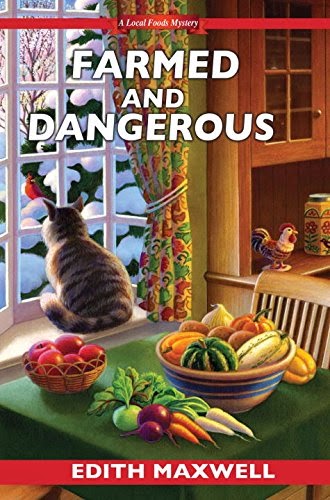
FARMED AND DANGEROUS, Edith Maxwell: Third "Local Foods Mystery"

Packing and stacking: that's the way to enter summer. Packing a beach bag with books you've waited for months to have time to open ... and stacking more of them next to the deck chair, hammock, or (fan above it, of course) summery lounging spot inside, for those buggy or rainy moments best endured with iced tea and a good mystery.

FARMED AND DANGEROUS could go into the bag or onto the stack -- but since it's being released May 26 as a hardcover (yay, Kensington Books!), I suggest the stack. Then put the two earlier titles in Edith Maxwell's Massachusetts adventure series into the beach bag, as a compromise. You can catch up on 'Til Dirt Do Us Part and A Tine to Live, a Tine to Die in between plunges into the water, right?

But it's not necessary -- or even important -- to read these in order. Market garden farmer Cameron Flaherty took over her farm recently from her great-uncle, Albert St. Pierre. She's built up steady clients in spite of the crimes that have struck her acreage (ah, these "amateur sleuths" always have a problem justifying the way murder seems to follow them around!). And the customers for her year-round veggie subscription, in the mode called CSA (community-supported agriculture), have also become friends, sometimes assistants, and most importantly her advisors on what to grow and sell. As this third book opens, Cam's hoping she can enlist the assisted living home where her great-uncle now lives, to purchase her produce on a regular basis. And because it's "New England spring" -- the kind where snow keeps coming back at you -- she's resorting to padding out her CSA baskets for customers with other locally grown and harvested treats, like heritage apple varieties and cheeses.

Maxwell's made a clever choice in bringing along, from the earlier two books, some startling characters. One of them, the very unfriendly Bev Montgomery, is a recent addition to Great-Uncle Albert's assisted living home at Moran Manor. And Bev is still accusing Cam of stealing chickens, and more. "I'm going to kill that woman," one of the staff aides declares, and Cam knows just what he means.

Still, it's a shock when actual death stalks the halls of the assisted living facility. Did it arrive because Cam's spending time here? What's the threat level to her great-uncle ... and is it her fault? What if something were to happen to trap her within the residence with the seniors and, most likely, a killer? Cam already knows enough to be scared. Very scared.

Maxwell proves again that a "cozy mystery" with an amateur sleuth can have edge and taut suspense, and a highly believable set of plot twists (although up here in Vermont, we're less likely to allow a snowstorm to keep us in one place, hmm?). Deft touches of potential romance and stress between the local police investigator and the hard-working farmer add to the fun of the book, and make it an even better "beach read." Cam urges her boyfriend to let her help solve the case:
"Tell me what you found at Moran." Cam reached a hand across the table to him. When he kept his arms folded, she pulled hers back, stung.

"She was murdered," he said.

"That's awful. How?"

The expression on his face changed from fatigue to steel. "I'm afraid you've become a person of interest."
And that, of course, nails it -- now Cam's got to step in and solve this crime, if only to prove that her boyfriend has the wrong direction in his sleuthing. Not to mention protecting Great-Uncle Albert. And oh yes, to keep her local farm in business!


Saturday, March 07, 2015

Gothic Thriller: THE SEEKER, R. B. Chesterton (Carolyn Haines)

R. B. Chesterton is one of many pen names for Carolyn Haines -- and the author says she uses this one to probe the dark side of crime. THE SEEKER came out in 2014, and the softcover became available from Pegasus Crime a couple of weeks ago. So if you haven't tried this author under her noir-ish nom de plume yet, here's a good opportunity.

THE SEEKER is not just dark -- it's creepy. Aine Cahill's graduate studies at Boston's Brandeis University have taken her in two deliberately opposite directions: away from her Irish immigrant family and its "curse" that's migrated with the family to the South, erupting in Kentucky whiskey-running followed by a modern specialty in OxyContin ("hillbilly heroin"); and toward her great-great-great-great aunt Bonnie Cahill, who may have been Henry David Thoreau's lover during his retreat at Walden Pond.

But the further Aine reaches in on-site research in Massachusetts, the more strongly she finds her stay by Thoreau's pond haunted, by terrifying shreds of a past that she never dreamed of when she figured she'd track an unknown literary love affair. Two suitors also pursue her -- and even as she yields to the promised attention, a particularly nasty haunting occupies the same space and time:
No matter that Mischa was not in the cabin. She was in my head, and I had no clue how to exorcise her. Tomorrow, though, I would explore that option. There were plenty of Catholic churches in Concord, and through I'd left the pomp and ritual of the church far behind me, I knew where to find a priest.

I drifted into sleep, and found myself floating ... Struggle as I might, I couldn't break the thrall of the whale.

When no land was visible on the horizon, the whale surfaced. One blurry eye pinned me, and a rush of red blood shot from its blowhole. "You've met your destiny, Aine Cahill."
Think Nathaniel Hawthorne crossed with Steven King, and you're close to what R. B. Chesterton provides here. Keep the lights on, and the doors locked, while you read.

Sunday, February 22, 2015

Pub Date March 3: KITTENS CAN KILL, Clea Simon

Here's a title to reserve for March reading, a classic traditional mystery with plenty of twists and memorable characters -- several of them on four legs.

Those familiar with Massachusetts author Clea Simon's "pet noir" series are already accustomed to the wild premise of this amateur sleuth series: Pru Marlowe, an "animal behaviorist" who works via referrals through the local vet, animal shelter, and even the town, specializes in changing how critters behave. But her methods go beyond the standard reward and reliability systems -- because Pru is also an animal psychic, someone who "hears" words from the cats, squirrels, dogs, and even a ferret around her.

Although that's obviously a great tool in her work (because she can find out, for example, exactly why a dog is barking so much), it's a personal handicap of increasing proportions. Earlier titles in the series showed Pru's hesitation about getting involved with the local police detective, Jim Creighton, KITTENS CAN KILL finds Pru routinely allowing Creighton into her home at various hours, and the couple is working out what they can and can't ask each other. But above all, since even Pru initially thought the animal voices she heard showed she was crazy, she's desperate not to reveal her talent to the police officer.
My next call was to Creighton.

"Hey, Jim. Just a heads-up." He was driving -- I could hear the road.  That as fine. I planned on keeping it short. "I'm going to bring the Canadays' kitten back after the funeral. Jill, the youngest daughter, just okayed that."

"That's fine, Pru. Turns out we don't need him for any testing."

"No death by kitten?" I was joking. ...

"Look, Pru, you know I can't give you details, but I think it's fairly safe to say that the lab won't need the kitten. They've got enough to work with without it.."

"So, you do suspect something?"
Creighton may not intend to give Pru a hand (or any information), but he's not good enough to prevent her insight. And he has his own about her. Pru's secret -- shared only with her loyal but often sardonic and stand-offish cat Wallis -- gets increasingly hard to protect. After all, it looks pretty irrational that Pru is insisting on keeping and protecting the life of a 6-week-old white kitten found next to the body of a local lawyer. Who would believe her if she said the kitten had witnessed a killing? In fact, among the lawyer's three competitive daughters, there's even some notion that the kitten's arrival caused the (accidental) death of their dad. One daughter is even pushing to euthanize the wee ball of fluff, out of anger at the death.

But Pru and her resident four-footed ally, Wallis, know better. Still, sorting out the few phrases that the inexperienced kitten conveys isn't easy, especially as time presses -- there's a will being read, a controversy over who controls the kitten, and more wickedness that Pru barely guesses at, before it's not just the kitten who is in danger.

Skeptics, relax: The solving of the crime and Pru's revelations about the people involved come through hard, traditional investigative work. Consider the pet psychic aspect to be scene music, if you like, and plunge on into this well-constructed and intriguing mystery. Clea Simon knows what she's doing with those three sisters, as well as Pru Marlowe's eccentric support team. It's a good read, and a great distraction for the in-between season of March, coming up.


Sunday, January 04, 2015

That "Spring Will Come" Feeling: TAGGED FOR DEATH, Sherry Harris

Here at Kingdom Books, we're celebrating winter -- and that includes hoeing out a few more things for the spring yard sale that's already in the planning stages. I mean, if we don't do it now, how on earth could we fit that tough decision-making into the garden-digging, seed-planting season that will follow the snow?

So I had a lot of fun reading one of the December "Killer Cozies" books from Kensington Books: TAGGED FOR DEATH, the lively and enjoyable debut of Sherry Harris's "Sarah Winston Garage Sale Series." From the gunshot on page 1, to the tangled twists of Sarah's marital issues -- she and her ex-husband were living on a military base, and now he's got a civilian police job and, it seems, a wandering eye -- this mystery keeps things moving. It's set in small-city Massachusetts, pizza and all.

Sarah's negotiations at "tag sales" are part of how she's supporting herself. And among her purchases are bloody items that could implicate entirely the wrong people. Her slide into trouble has is speedy, irresistible, and entirely understandable!

If you have one of those cars that insists on stopping at each promising yard sale, or even just a yard sale fantasy life, you'll get a kick out of TAGGED FOR DEATH. But it's also a good mystery for relaxing into the long evenings that make winter such a great season for reading. Sarah Winston's struggles as a military and ex-military spouse add extra levels of interest (Sherry Harris know that part from her own life). And when you've finished, you may want to check out Sherry Harris's website, as well as her posts on the Wicked Cozy Authors blog. What a way to celebrate winter!

Saturday, November 08, 2014

Massachusetts Murder, Memorable Quaker Sleuth: Tace Baker's BLUFFING IS MURDER

Back in the 1990s I enjoyed a Quaker mystery series from Irene Allen, but it looks like the four books ended around 2001 and the author has retired -- including perhaps retiring from her "day job" as a geology professor and author in that field, under her "real" name, Dr. E. Kirsten Peters.

While looking back at those, I also ran across mention of another book that I'd never regarded as "Quaker" (that marvelous back-to-basics worship community formally known as the Society of Friends): The Witch of Blackbird Pond, one of my favorite "young adult" historical mysteries,

Now, with the November 11 release of BLUFFING IS MURDER from Tace Baker, we have the second in a fresh energetic series featuring amateur sleuth Lauren Rousseau. Like the author herself, Lauren is a linguist, and expects to be addressed as "Dr. Rousseau." But when the book opens, she's just headed into her first real summer break, the one that follows gaining tenure, when the career track makes some breathing space. And Lauren has extra flexibility because her habitual boyfriend Zac, who's been offering more commitment than she wanted, is flying out to Haiti for a family emergency. Lauren's on her own, and testing the he–she waters in her walkably cozy coastal Massachusetts town.

So it's tough luck that one of her first summer adventures leads to her discovering the body of Charles Heard, a Trustee of the local land trust. Lauren's been more involved with her college than her town (where she's a relatively recent transplant), but she quickly learns multiple reasons for bad feeling against Charles Heard -- including the way the land trust where he's so influential has been holding back money slated to improve the town's school, so the kids aren't getting their fair share of programs. Even the language program's being cut, a blow that especially hits hard for Lauren, with her fondness for many languages.

Author Tace Baker -- a pen name for Edith Maxwell, Massachusetts author of this series, a second one involving the "locavore" movement, and branching into an upcoming third under the pen name Maddie Day -- brings a good background to the book, with her own doctoral dissertation in linguistics, as well as many other writing hats. But what I enjoyed in particular is her sense of the emotional life of a smart, savvy, and single woman of a certain age -- mid thirties, here -- who's very, very work-capable but who's somewhat insecure about whether she is in or out of the dating game, and as a result, doesn't really check into or trust her own misgivings about some of the men who admire her. Because it's Lauren's casual acceptance of what her martial arts teacher Dan Talbot tells her, and the invitations he provides, that makes her vulnerable. And that's what takes her further into sleuthing than is wise ... and puts her under threat repeatedly.

Doubling the plot thread (and Lauren's emotional vulnerability) is the long-past death of this sleuth's father -- something she hasn't had time to look into until now. Is her hunt for that truth also putting her at risk?

Last but not least, what does Lauren bring to the sleuthing skills table as a result of being a lifelong Quaker, with a tradition of silent meditation and a search for divine guidance?

If, like me, you enjoyed that earlier series by Irene Allen, or you're curious about Quakers in fiction, or you enjoy a strong and vibrant amateur sleuth with an occasional but very human slip of judgment, check out this series. Book one is called Speaking of Murder (2012).  The series is from Barking Rain Press -- which offers the first four chapters of BLUFFING IS MURDER  free, in exchange for your contact info (click here) --  and the author will have a few touring events (see her website), as well as a number of online interviews. Thanks, Edith/Tace (and Maddie!) for this enjoyable traditional mystery!

Wednesday, June 04, 2014

Community Mystery, Amateur Sleuth: 'TIL DIRT DO US PART, Edith Maxwell

Summer reading -- what a great season to indulge in mysteries that balance plot and character and an intense sense of location ... in this case, Massachusetts, not far from the coast. Hmm, that puts me in a summer vacation mood, just thinking about it! Skip the traffic jams by heading out early with your own selection of books for the beach or the mountain cabin. Here's another good one:

In the second of her "Local Foods Mystery" series, Edith Maxwell proves she's on for the long haul -- writing mysteries that tap into her own New England vegetable gardening "roots," and her tech systems know-how. But most of all, Maxwell works from on two well-polished strengths: a fine sense of how to pace the plot of a traditional mystery, and an Agatha Christie-like understanding of how people come to threaten and sometimes actually do bad things.

Market gardener Cam Flaherty kept her mostly organic farm on target through Maxwell's first in the series, A Tine to Live, a Tine to Die. At the opening of 'TIL DIRT DO US PART, she's hosting a dinner to celebrate the achievements of her first farm season. A pair of long tables with white cloths on them, a menu of local tasty offerings,  a professional chef preparing the dishes -- even this is one of Cam's great results, as Jake, the chef, is her current flame and clearly appreciates her.

But there's trouble afoot on the first page, as wealthy and irritable customer Irene Burr challenges Cam and then proves she can get into an argument with almost anyone at the dinner, from her own son to a local hog farmer. By the end of the first chapter, Irene's clearly in hot water of her own making. Even the energetic young woman mechanic attending the dinner on the arm of carpenter Bobby Burr -- Irene's son, and another of Cam's flirtable interests -- seems caught up in the whirlwind of nastiness that Irene creates. Cam witnsesses this final flurry:
"Listen, Mrs. Burr." Sim's voice boiled. ... "Your Jaguar runs like a real wildcat, and it's all my doing."

"You're not a Jaguar-trained technician is my only point." Irene raised her eyebrows and crossed her arms. ...

"It's an engine. A foreign engine. I speak its language. That's all I need to know. Oh, and by the way? Ever hear of computers? Anything I don't know, I have at my fingertips." Sim planted her feet in a wide stance and folded her arms. "If you don't like my work, feel free to drive twenty miles down to the dealership and let them take your money."

Bobby pulled at Sim's sleeve. "We gotta run. Good night, everybody."

Irene nodded and turned away. Sim stared after Irene. Her face was so red, Cam thought she could see flames coming from her ears.

"I'm going to get her, one way or the other," Sim muttered.

As Wes walked by, he snorted. "Take a number, honey."
So it's not really a surprise when the next chapter reveals Irene's been killed. (I won't say how; it could put you off your breakfast.) As police attention veers from one of Cam's customers to the next and the next, Cam can't help trying to find out the truth: If everyone had a reason to dislike Irene Burr, was there one person with "means, opportunity, and motive" to invoke the worst reaction?

Of course, trying to solve a crime while keeping a fragile community-centered business going and while trying to sort out one's love life gets complicated quickly. Especially when the police interest in Cam appears to turn personal (triple complicated!). And threats multiply. Cam's got to solve the case or risk everything.

Maxwell's clever blend of farm and garden knowledge with crisp scene-after-scene pacing makes a great update to the classic village mystery style. Her deft portraits of community members like Irene and Alexandra, Cam's most particular customer, remind me of the reason village mysteries have always appealed: We love the insight and the revelation that a thoughtful person, well motivated, can bring to her community. Count on Maxwell to continue the series, too; even if Cam solves this murder, she's sure to have threads still dangling from her life as a single woman with her own creative labor and the energy of her relationships.

Speaking of Cam's relationships -- Maxwell adds at the end of the book a pair of recipes from Chef Jake's exquisite preparation of Cam's veggies. What else is heating up besides dinner? Cam needs to make some decisions!

Check in with Edith Maxwell at her author website, http://www.edithmaxwell.com, where the events schedule shows she won't be tied down to her own garden too much this summer -- hope you can make it to one of these, to ask her how she balances writing with all the rest!

Tuesday, May 28, 2013

Bite into a Locavore Mystery: Edith Maxwell, A TINE TO LIVE, A TINE TO DIE

Think quickly, which of your gardening implements could make a murder weapon? Yep, that one, too ... Edith Maxwell, no stranger to shopping at farmers markets and caring for organic veggie plots, picked the vicious multi-tined pitchfork (think American Gothic, but stronger), for her first "Local Foods Mystery," A TINE TO LIVE, A TINE TO DIE.

Cam Flaherty is a new farmer -- her great-uncle Albert St. Pierre has turned over the operation to her, and she's hoping the cachet of organic, fresh, and local will help her make a good living from her new country life, quite a change from Cambridge, Mass. But it's always the people that complicate life, right? And the whole point of a CSA -- that is, community-supported agriculture, or farm shares -- is people being regular purchasers of everything you grow. Among Cam's group of purchasers is Alexandra, "a Viking princess. If princesses wore cutoff overalls and hiking boots with red socks." And there's Felicity, whose long gray braid hangs down her back; the also gray-haired Wes, the silent type; and perhaps most importantly, Brazilian immigrant Lucinda DaSilva, president of the Westbury Locavore Club but otherwise mysterious and not exactly the sharing type.

But Cam's plans for orderly operations are brought swiftly to catastrophe when the hired man she's just fired (for almost destroying her organic operation!) turns up dead in a greenhouse structure, lying bloodily between the trays of seedlings.

Even worse (can there be worse?), someone else is sabotaging the gardens, even with Mike already dead. And the eye of the Press is on Cam:
The reporter stood ten yards away in Tully's meadow, what passed for her neighbor's quarter-mile-long front yard. Cam doubted if Tully had given the woman permission. She looked uncomfortable standing in weedy grass up to the knees of her expensive-looking black pants. Her cameraperson appeared to be focusing on Cam. How long had they been there? And now the poisoned rhubarb was going to be on television.

"We want to hear your side of the murder in the greenhouse." The drama in the woman's voice could have landed her on Masterpiece Theater. She walked toward Cam, extending a microphone attached to a black shoulder bag.
Maxwell paints the trials and tribulations -- and rewards -- of a small farm in bright detail, based on her own experience as part owner of a certified-organic farm herself years ago. Most important for this cozy-with-dark-edges mystery, she tags the motivations that take Cam Flaherty into investigating the crime, when it would be safe (and easier) to leave the detection to the police. Even in the countryside, the blackest dangers are those provided by criminals who don't care what or who they damage.

Whether Cam can catch the murderer is one pressing question. The other one is, will she still have a working community-focused farm and a group of willing locavores by the time the crime is solved?

This is Maxwell's first detective fiction under her own name, but she also recently started a series under her pen name, Tace Baker. I don't expect she'll have much time for weeding this summer, with two series to write and a lot of twists and turns ahead! I look forward to getting to know Cam Flaherty better as Maxwell's Local Foods Mystery series continues.


Wednesday, April 17, 2013

New England Mysteries: Lea Wait, Steve Ulfelder, J.P. Choquette


Maine author Lea Wait's newest title, SHADOWS ON A CAPE COD WEDDING, slipped into print a week or so ago while I was navigating through major editing deadlines ... but the workload here made me all the more pleased to have read this neatly constructed Cape Cod autumn small-town mystery. It was the perfect antidote, keeping me interested, intrigued, and cheerful.

Wait's "Shadows" series has mostly been set in Maine (this is the sixth; http://www.leawait.com), but this time Maggie Summer, a dealer in antique prints, has an October wedding to attend on the Cape. She's the maid of honor for her dear friend Gussie, owner of local antique shop Aunt Augusta's Attic. And it would all be perfect -- except that before Maggie even has a chance to find Gussie, she finds a dead body on the beach. That's rough news all around: Maggie's record of stumbling over violent death is long enough to work against her by now, complications could affect the wedding plans, and Maggie's own sweetheart, Will, is definitely not going to appreciate Maggie's instant commitment to helping solve the crime.

Stormy weather and threats of violence lead to a far-from-cozy situation -- and if Maggie can actually solve the issues for her friends and for the family of the dead man, there's no guarantee it will solve her own. A good read, sweet with a smoky edge of intrigue and suspense.

I was very excited to latch onto an advance copy of Steve Ulfelder's third Conway Sax thriller, SHOTGUN LULLABY. Ulfelder is making the most of the socioeconomic fracture lines of the rest of Massachusetts (off the Cape) -- wealthy industrialists and hard-hitting criminals practically next door to blue-collar clusters of folks to scrape by on hard work and sometimes hard drinking. But Conway Sax is done with the drinking part, and done with getting in trouble with the law: An "oldtimer" in the local Alcoholics Anonymous group, he's trying to figure out ordinary domestic life (the kind that comes with rocky finances and confused stepdaughters) while also committing to straightening out the newly sober when they need a mature hand (or a boot in the seat) to get their lives back on track.

Sax even has a friend on the police force, as well as his AA buddies. But "sponsoring" young Gus Biletnikov has complications that the 12-step program doesn't address: the strong likeness between Gus and Sax's much-loved son who won't speak to him anymore, and Gus's own mixed-up family where money and love get misdirected, time after time. Before he's had time to say the Serenity Prayer, Sax is dodging hard-core criminals and psychopaths, while trying to redeem Gus's short life and make sense of his own family's needs. Taut, believable, layered, SHOTGUN LULLABY bears witness to life on life's terms: sometimes sweet, more often hard to handle, and occasionally downright dangerous.

Ulfelder's earlier work -- Purgatory Chasm and The Whole Lie -- brought him an Edgar Award nomination and a lot of fans. This third Conway Sax crime and detection novel is going to win more acclaim, more readers ... and earn a heck of a lot of appreciation. Release date is May 14; visit Ulfelder's website, http://www.ulfelder.com.

Add a second New England state to this crime fiction list with a debut thriller from J. P. Choquette of Vermont -- EPIDEMIC is a medical thriller set in the hardscrabble town of St. Albans, less than an hour away from urban Burlington. Choquette forms her own take on the medical thriller style of Michael Crichton and pulls it home to small-town life, where people's connections both complicate and comfort.  Ava Morely, a relatively new nurse confronting a rapidly spreading deadly virus, finds her life moving into reverse as she runs into journalist Everett James. He's not just a prying reporter -- he's also someone she last saw next to the altar on her wedding day. The two quickly align in both a medical battle to save lives, and a web of threats that connect to the epidemic around them. Self-published by its "Vermont independent" author, the book's small flaws (alas for the lack of a pro editor) are easy to overlook, and the pace and deft characterizations convince me that Choquette's second thriller -- already in process -- will be at least as good.


A great chance to catch a fine debut while Choquette's still less well known than she deserves! Order online, and visit the author's enjoyable website: http://www.scaredecat.com.


Tuesday, April 02, 2013

Clea Simon, PARROTS PROVE DEADLY: Pet Noir #3

Clea Simon's companion feline is named Musetta -- and there's a photo on Simon's blog of this canny cat, staring into the computer screen. Whether Musetta can guide Simon in plotting, who knows? But the years of companionship show up wonderfully in Simon's newest mystery, PARROTS PROVE DEADLY.

Cat mysteries have a long and honorable tradition, with the most recognizable being the series by Lilian Jackson Braun: the "Cat Who" books center around the life of former newspaper reporter James Qwilleran, and his two Siamese cats KoKo and Yum-Yum. But Braun's series was relatively light-hearted, and Simon's is ... well, you've got the message about "pet noir," right? And "deadly"? There are dangers and risks for animal behaviorist Pru Marlowe, and most of them come from the owners, not their pets.

More than dark and deadly, the Marlowe mysteries wrestle with what humans believe about other species, and why they could be dead wrong. For instance, the African grey parrot that's causing an emergency call from the local senior complex keeps repeating a frightening sequence of sounds. Is it a replay of the death of the parrot's "person," aging and infirm Polly Larkin? An accident being voiced over and over, due to the bird's own trauma? Or could there be a hint from the parrot that murder took place right in front of the bird?

Pru Marlowe isn't sure -- and that's one of the most enjoyable aspects of this hard-working and determined sleuth: Pru questions just about everything. She has to. Her very bright cat Wallis turns out to be able to "speak" to Pru through a sort of interspecies telepathy, and Wallis has scornfully made it clear to Pru that all creatures do something of the same. But not as well as Wallis can! A lot of cats are fluffy-minded, dogs are obsessed by their noses announce, the ferret that Pru sometimes consults is more bite than bright, and don't start on what squirrels and pigeons have in mind. If she's not going to consider herself crazy, then Pru's got to pay close attention to grasp this strange world of messages around her.

The thing is, parrots live a long, long time -- but they're not bright the way Pru's tabby is. So ... what exactly did the bird witness, and what does it mean about operations at the LiveWell complex, and between Polly Larkin's rather unusual grown children? Also worrying is the relative silence of guide dog that's been living next door to the deceased  -- and who seems traumatized. Pru's worrying about it all while taking time for one of her regular assignments, walking a tough little dog whose self-chosen name is Growler:
He lifted his leg and then with a sigh that carried a wave of resignation, he plowed ahead toward his inhospitable home. "Women." That I got, loud and clear. "Don't see what's right in front of them."

"What, Growler?" I stopped, and since I held the other end of the leash, he had to, as well. He turned and eyed me, his button eyes cold.

"The guide dog -- the one you call 'Buster'?" he broke his silence. "She's more concerned with her person than with anyone else -- and with good reason. People die there. She smells it, and I can smell it on her."

 I nodded, grateful for that damp black nose. ... It was an old folks' home, no matter what anyone called it. Death's waiting room.  Did he -- or did Buster -- mean there were suspicious deaths? Deaths that shouldn't have happened -- what the coroner would cal misadventure? Or even murder?

"Watch what happens to that bird," Growler said, barking once as we came up to his door. "Nobody likes a blabbermouth."
Nobody likes a snoop, either, but that's what Pru becomes, unable to let the circumstances rest until she knows the truth. In Simon's quick-paced narrative, there's plenty of suspense and a very real sense of struggle to translate what's important in the "speech" of companion animals into something Pru can make sense of.

I enjoyed the first two of Simon's pet noir series, Cat's Can't Shoot and Dogs Don't Lie; this one is at least as good, and a great diversion from the gritty urban thrillers I've also been considering this month.  You don't need to have read the others in order to enjoy PARROTS PROVE DEADLY, although they build nicely in terms of Pru's discovery of her ability to receive animal voices and the stresses and fractures in her life. Great series -- thanks, Clea Simon, for this third title!

PS -- Okay, if you've read your mystery classics, you already see the coincidence of Pru's surname in a book of noir: Marlowe, right? Now, can you place Wallis? Hint: Don't let the spelling trap you. And think about a noted Boston writer, one who shared the Bay State with Clea Simon until his passing, just a couple of years back. Come on, you can do it!

Monday, October 01, 2012

Archer Mayor, PARADISE CITY: Home Is Where Your Characters Solve Crimes

PARADISE CITY is the 23rd Joe Gunther investigation from Vermont author (and EMT and part-time law office and sometimes full-time cop/detective, as well as death examiner for Vermont’s Office of the Chief Medical Examiner) Archer Mayor. It's a treat for long-time fans of the series, because it features Joe himself, lots of time spent with that challenging curmudgeon of crime-solving Willie Kunkle (Nam vet and pretty screwed up), Sammie Martens (still loving Willie -- and even though back on the job, she's the mom to their baby), and cameo appearances by people Joe loves and hates. Yes, you'll want to read at least a few earlier books in the series to make the most of this one.

But maybe not.

Actually, the action starts on Beacon Hill in Boston and mostly takes place in Northampton, Mass., a gritty arts locale and gay-friendly, politically active city. Sure, there's a quick visit to Tucker Peak in Vermont (scene of an earlier J. G. investigation), but the crime there is quickly tied to action of the earlier chapters. And by the time the team is assembled in Northampton -- nicknamed Paradise City, as in its annual real-life Paradise City arts fair -- the team has meshed as smoothly as it ever does. The glitches are coming from the criminals, whose choices are far from smart. And before you know it, this becomes a classic combination of burglary caper (high tech version), global criminality, and steady police work. Only Willy's itchy PTSD renders that action a bit chancy!

So you can read this one alone, actually. The thing is, those who've followed the series will resonate much more deeply with paragraphs like this one, at the star of Chapter Three:
Joe Gunther paused before reaching for the phone, blinking at the darkened ceiling of the bedroom, clearing his head of sleep. Increasingly these days, when he was jarred awake, he found himself wondering less about what lay behind a call, and more about how it might come back to haunt him. He'd been finding the toll of his profession to be mounting fast and costing him dearly as of late.
Archer Mayor has taken Joe through a lot of solved crimes, but also a lot of losses, from family to lover to police force position. Joe's confronted fires and motorcycle gangs, drug barons and sinister sneaky creeps, high-tech wizards and porn princes victimizing both the rich and the homeless, and a lot of drug users at all levels of the economic spectrum. When Joe aches from those losses, we readers ache in empathy.

Mayor also does two things in PARADISE CITY that mesh with what Canadian crime fiction phenomenon Louise Penny has demonstrated: (1) rotates an investigator who "belongs" in a specific location -- in this case, Brattleboro, Vermont -- into a fresh setting, through the connections of crime across the landscape; and (2) foreshadows more personal and professional pain for Joe, which will take place in the next book (Penny is today's master of an arc of narrative that climbs through the disturbing back story of title after title; Mayor does it more delicately).

In PARADISE CITY, the linking theme among the criminals and their actions is jewelry heists. But who is behind them, and how are the highly recognizable antique items being liquidated? Joe forms a team with his nearby police associates across the Vermont/Massachusetts border. Then Willie finds a way to screw up the plans. Or does he?

There are some loose ends in this that don't quite get knitted in, like Sam's un-motherly return to duty, and an uneasy feeling that Joe doesn't quite have control of his own career, just as he's wishing he could maybe walk away from it. But then again, Mayor has shown us, time and again, that those strands will reappear in the next book as essential strands of the continued investigations.

And with that, I suppose, I've come full circle: You can read an Archer Mayor book on its own with plenty of enjoyment. But with the extra value that comes from reading all 23 in a row, why miss out on any of them? I'm marking my calendar already for fall of 2013, and number 24.

PS: If you're a Joe Gunther series reader already, you may especially enjoy -- as I do -- taking a look at the "bio" of this character, on Archer Mayor's website: http://www.archermayor.com/joe-gunther-bio/