Showing posts with label Pennsylvania. Show all posts

Tuesday, February 14, 2023

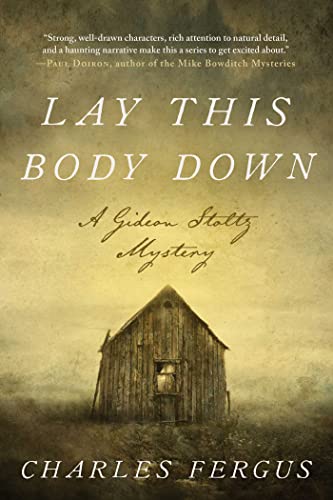
Third Crime Novel for Sheriff Gideon Stoltz, LAY THIS BODY DOWN, by Charles Fergus


 [Originally published at New York Journal of Books]

“Fergus’s writing lays out both the struggles of a new nation, and the pains of growing into determined manhood with its allegiances, regrets, and consolations. If murder and kidnapping can be halted, why not enslavement, also?”


The lines of good and evil are firm in this third antebellum mystery from Charles Fergus: Enslavement is brutal, and deprives the 1837 American nation of honor. Immediate emancipation could restore that honor—but in Sheriff Gideon Stoltz’s industrial Pennsylvanian town of Adamant, a rough crowd jeers at a visiting speaker advancing such an argument, and Gideon’s role as lawman is keeping the peace. Not advancing abolition.


However, Fergus positions Gideon as an outsider himself, with a strong “Pennyslvania Dutch” German accent that marks his difference in the hardscrabble Scotch-Irish town. Young and inexperienced for his job and without training, supported by his wife and a few friends, Gideon identifies with runaways and victims. It’s a dangerous position when there’s a national law requiring that he enforce “property ownership” toward Black fugitives. Although his state backs away from that position, the town is just 80 miles from Maryland, and his neighbors, a mostly rough crew, could inform on a runaway and expect Gideon to jail that person.


“What if the right thing—whatever it is—and what the law requires turn out to be two different things?” Gideon asks his wife True. Her answer: “I hope you would do the right thing.”


Chapters of Lay This Body Down open with excerpts from historically real reward notices seeking fugitives. When slave hunters turn up in Adamant, seeking a Black youth who’s helped Gideon in the past, what he’ll choose is never in doubt: He owes a debt, and servicing it fits with his growing belief that enslavement is cruel and wrong. Instead, the rapidly ramped-up tension in the book comes from the prevalence of malice among those hunting fugitives and those who already despise Gideon as not one of them, neither by heritage nor by attitude. As he struggles to find and protect this and other runaways, he plunges into personal danger.


In that sense, this is an intimate novel of connection among working men with opposing worldviews. Gideon will only succeed and survive if he can find enough allies to defend his choices and actions. It’s soon clear he’s even being betrayed within his own office. His own superior in law enforcement doesn’t even have his back. But his wife does.


Readers of the earlier two titles in this series (A Stranger Here Below; Nighthawk’s Wing) will not find much of the mystical and supernatural that appeared in those books, although True Burn Stoltz, finding her way out of her long depression over the loss of the couple’s child to illness, clearly relies on a related set of beliefs. Instead, the conflict in this novel foreshadows what was already erupting across the nation’s frontier at the time: ardent beliefs in independence and the sanctity of property, playing against philosophical and humanist efforts to impose a better form of civilization.


Gideon’s weaknesses, part psychological from his own mother’s murder, part physical as a residue of concussion (alas for the results of horse accidents and human beatings!), hold potential to transform into powerful incentives to action. As he prunes away the rot around him, he finds himself able to say to a stranger, “Maybe you can help me.”


Fergus’s writing lays out both the struggles of a new nation, and the pains of growing into determined manhood with its allegiances, regrets, and consolations. If murder and kidnapping can be halted, why not enslavement, also? The author’s meticulous historical portrayal offers a potent integrity, to ground the growth of Gideon Stoltz into a man who’s certain of the right thing to do, after all.


 PS:  Looking for more mystery reviews, from cozy to very dark? Browse the Kingdom Books mysteries review blog here

Monday, March 01, 2021

Guilt Stalks the Sheriff, in NIGHTHAWK'S WING from Charles Fergus


In the second Gideon Stolz mystery, set in Pennsylvania Dutch terrain in 1836, the young sheriff is acutely aware of how different he is from many of the people he's supposed to protect and serve. There's his accent, of course, and his personal legacy of loss and violence, yet equally important are his beliefs about justice and worship, strands that are vital in a community still very much built as a set of frontier settlements.

But as NIGHTHAWK'S WING takes off, Gideon has far more to worry about than just feeling awkward among others. He hasn't recovered from striking his head in a fall from a horse, and the ongoing physical effects and memory loss threaten his job, his reputation, even his marriage and his liberty. As he realizes he's not even keeping up with routine tasks, his questions turn frightening:

Gideon asked himself why he hadn't remembered the horse as soon as he smelled the stench. Or before he went out for his walk. Or maybe he had remembered it and had gone out from the jail to check on whether the horse had been removed, and then forgotten why he'd ventured out in the first place.

Why couldn't he remember such things? ... Why couldn't he remember anything about his own accident, getting thrown off Maude or otherwise falling off her, striking his head on the ground, and (so he'd been told) lying insensible on the road?

He worried about the gap in his memory. He didn't know how far back it went.

Charles Fergus delicately draws out the differences in pioneer culture—the absence of medical knowledge, the fragmented communities from different European roots who knew just enough to be suspicious of each other, the fierce expectations of gender and age—as Gideon investigates a violent death on a farm some distance from the town where he lives. Has there been accidental poisoning? Are there implications of witchcraft, and of punishment for such deviation? Worst of all, he discovers incontrovertible evidence of having played a role in the tensions on the farm, before the death: With no reliable memories of what had taken him there at the time and of what had taken place, must he now suspect himself of abuse or violence?

Even Pastor Nolf in the farming community represents strangeness to Gideon. As sheriff, he needs to grasp how this German offshoot of religion functions here:

Nolf continued, "You asked earlier if I thought that Rebecca Kreidler had a disturbed mind. I told you yes, I did sense that. I also sensed in her a deep anger and a black despair. As Neigeboren, we work to purge from our lives that which would not be pleasing to the One we serve, including anger and despair. One thing I have been considering since her body was found: I think it's very possible that Frau Kreidler took her own life. That she purposely ate a plant she knew would kill her, and in a way that would inflict severe pain."

Meanwhile, Gideon's double distraction—over the dead woman's cause of death, and over his own possible enmeshment in the case—results in his effectively abandoning his gravely depressed young wife. Each of them, Gideon and True, is still in deep pain over the death, from illness, of their small child. And neither seems able to give the other what's needed. There's a chance that the marriage may be damaged beyond repair, despite Gideon's love for True. She reminds him: "You only believe in what's standing in front of you and nothing else. There's other ways of seeing, other ways of knowing. Maybe someday you'll figure that out."

Fergus's measured pace, rich with the feel of the raw, unsettled landscape and its fragile human bonds, provides a depth to the double mystery: the crime, and how to reinvent a marriage after a child's death. Not until the very end of the book will the answers become clear—and the pain and loss along the way are vivid and visceral. In the tradition of Jeffrey Lent's In the Fall, Erik Larson's The Devil in the White City, and even Nathaniel Hawthorne's early American novels, NIGHTHAWK'S WING melds human frailty and strength into the very texture of the place and time, creating a mystery that will call for multiple readings that savor its layers and revelations.

PS: Looking for more mystery reviews, from cozy to very dark? Browse the Kingdom Books mysteries review blog here.

Tuesday, March 05, 2019

Deep and Probing Novel from Charles Fergus, A STRANGER HERE BELOW

What makes an author choose to write a particular book? It's a topic that can lead to strange new worlds. For Charles Fergus, a Vermont author best known for his natural history, the death of his own mother many years before took him into writing A STRANGER HERE BELOW. Set in Pennsylvania not long after the nation's birth, it fingers both a historical culture and a lingering effect from his own life. I liked it.

[Originally published in the New York Journal of Books]


A slow, rich novel of a distant time and a man who is “Othered” in most aspects of his life.

In A Stranger Here Below, Gideon Stoltz, a Pennsyvania Dutchman (that is, from German settler stock), has become sheriff almost by accident in the growing town of Adamant, in 1835. Though the town is already making its mark economically with an iron foundry, and a range of wealth from ironmaster to thief, it’s only a hard day’s ride from frontier landscape and life. And some days, maybe not that far.

Through Gideon’s naive eyes, the layout of the town’s power structure begins to emerge. It’s based on force and violence as well as profit. And it has little of benefit for the women and children, whose voices mingle with old ways, as well as with the New World’s fresh forms of Christian worship. Gideon’s own marriage is a cross-cultural one, into a family of scoundrels and at least one sorcerous sort of grandmother. But it’s a heart’s truth marriage, and he clings to it as a series of deaths in the town slowly peel back the truth of two earlier deaths: murder for gain.

Underneath this, for Gideon, is the formative event of his young life: seeing his mother dead after an assault that’s never avenged. It haunts him even as he investigates crime for his town, and when he retreats to his much-loved wife to try to regain his footing, he stumbles into what he most fears: “I am thinking about how we are punished for loving,” he admits to her.
‘We fall in love, with life, with other people, with our kin. We love the land, and galloping on a horse, or singing hymns, or watching the clouds pile up in the sky, we love our dear wives and children …We love these things so much,’ he said, ‘that we can’t bear to think of being parted from them. When we see others torn away from life, by disease, or confusion of the mind, or the cruel actions of others …’ He stopped, could not go on.
His wife, named True, assures him that this pain requires belief in God’s plan and promises. She enquires about what’s upsetting him: the death of his friend the judge, who committed suicide, or a murdered boy he’s seen?
‘Both.’ And his memmi. Always his memmi. He saw for the thousandth time her ravaged body lying in its own blood.
Fergus’s first mystery follows more than a dozen books, including many explorations of the natural world. In this rural sheriff’s embrace of the world around him are the goodness and love that won’t allow a wrongful death to be covered up—and that in turn will disturb what peace he’s gained, at the deepest levels.

A slow, rich novel of a distant time and a man who is “Othered” in most aspects of his life, A Stranger Here Below is also an exploration of how a kind person can be drawn toward the dark revelations that crimesolving demands. For some, the book may be a bit too tender in places, yet this patina of affection can readily be crushed and scarred—as the sheriff’s investigation reveals.

Although the book is clearly crime fiction, it is equally an exploration of the soul in the presence of death and wrongdoing. Which is, after all, what a “stranger here below” can expect. 

PS:  Looking for more mystery reviews, from cozy to very dark? Browse the Kingdom Books mysteries review blog here.
-->

Tuesday, June 27, 2017

Fracking, Addiction, and Crime, FATEFUL MORNINGS, Edgar Winning Author Tom Bouman

Tom Bouman's first crime novel, Dry Bones in the Valley, earned him a 2015 Edgar Award for the heart-rending and gritty investigation by a local police officer, Henry Farrell, in northeastern Pennsylvania.

Released today is Bouman's second: FATEFUL MORNINGS. The title is reflected repeatedly in Henry's discoveries among his neighbors, from wealthy to hardscrabble, as he follows a trail of addiction and related crimes, crossing the trail of a possible serial murderer -- one who must be both clever and deeply disturbed.

For Office Henry Farrell in Wild Thyme, Pennsylvania, there are few simple, or simply good, parts of life. Stranded in a small and politically challenging job due to his own past failures, he's struggling to find some beauty anyway: in the forested landscape around him (riven by oil fracking though it is), and in the old-time music he plays with friends (he wanted to call their group the Fateful Mornings from an old tune, but they're the Country Slippers, a local joke about their boots). It's typical of Henry that he's also taking easy pleasure in an affair with a married woman -- a complication that will soon cripple his work, as well as his affections.

What makes this book -- all of Bouman's writing -- so memorable, beyond the cunning plot and painful portrait of this "Rust Belt" region, is the emotion invested in each scene. Take this simple moment of Henry gathering up (in the middle of tangled jurisdictions) a possible suspect who's reported a missing woman:
"Stand up, please." I patted him down, catching body odor that was sharp like cheese, sweet like bread or beer No weapon.

"If she'd dead, I didn't kill her." ...

I put an arm on his shoulder and steered him to my vehicle.

On the drive to the sheriff's, I thought about my visit to their home that winter, and about their history. You show up to a domestic call expecting to see people still in the grip of the fight that got you called out, clawing, screaming. You come to somebody's defense, chances are they let you in on a punch or two. You're the person they hate more than each other. That January night when I had pulled up to the trailer off Dunleary, my blue lights dancing off the white woods, with Swales's house barely visible through the tree trunks, it was quiet. I knocked and stepped inside. The first thing O'Keefe asked me was to turn off my lights to the landlord wouldn't know I'd been called.

... Neither spoke as I stomped snow off my boots and ducked inside. The only signs of struggle were Penelope's flaring nostrils, a butcher's knife in front of her on the table, and bloody paper towels wrapped around O'Keefe's hand.
Though the paths through FATEFUL MORNINGS are grim ones, the solid and often lovely writing and the irresistible characters make the book a compelling read. Don't expect an easy ending -- well, we're talking about the 21st-century equivalent of coal country here, aren't we? Even the land is hurting. And its people are in trouble.

Which means it's a good thing that all-too-human Henry Farrell is stuck in Wild Thyme, trying to hold a crippled sort of peace.

PS:  Looking for more mystery reviews, from cozy to very dark? Browse the Kingdom Books mysteries review blog here

PPS: There are good parallels between this series and Julia Keller's West Virginia crime series. Click here to look at some Keller reviews.

Friday, March 11, 2016

America's Revolution Begins in Murder, in BLOOD OF THE OAK, Eliot Pattison

What kinds of oppression awaken a nation to action? When do struggles for survival become a force to light a revolution? No, I'm not talking about this year's Presidential campaign, but rather, the simmering, smoky, and definitely violent build-up to the American Revolution. In the fourth book of his Bone Rattler series, BLOOD OF THE OAK, Eliot Pattison's protagonist confronts those questions -- and the investigation of multiple murders.

Exiled and shorn of his family and clan, Duncan McCallum's path during the three earlier books has meant turning his medical training into the baby steps of a new forensic science. Technically he's still a runaway from government justice, living in the forests of Pennsylvania, far from the vicious man who claims to hold him within an indenture. But readers of the earlier books have seen Duncan transformed through learning the ways of the Algonquin Nation. His friend Conawago is an elder of the Nipmuc tride, and together the men have survived brutal attacks, rescued the well-meaning and innocent, and upheld the tribal rights and customs. Duncan has, in fact, joined a New World clan, and he's well aware of how fortunate he has been. Now in 1765, he even has a woman in his life, someone he trusts and respects and who is also working for justice and, dare we say it, peace.

That may be a lot to swallow for first-time readers of this series. If it sound like further than you can imagine stretching, don't read this one yet -- go to Bone Rattler, then Eye of the Raven, then Original Death. Follow along on this remarkable but step-by-step reasonable path that Pattison outlines.

But many first-time readers of the series will find instead that the quick pace, dramatic action, and fiercely honorable allies presented here make it easy to leap into Duncan's adventures right away. Remember how William Penn thought he was creating a "city of brotherly love" in Philadelphia? Duncan's beloved Sarah Ramsey makes a smaller version possible on the western frontier (yes, Pennsylvania edged the wilderness then), in her Edentown. And Duncan needs some of that peace and tranquillity for himself.

Especially now, because he has a mission from the Iroquois. Summoning him to use his skills, Adanahoe, an elderly woman who leads the spiritual side of the tribes, needs him to retrieve a holy item that's been stolen -- before the tribes lose their ability to survive in the new age.

Almost before Duncan can reach his heart's home, though, killings erupt around him -- and without time to consider, he's thrust out into the wilderness again, chasing murderers and trying to interpret cryptic clues that surround him.

Without our hindsight, Duncan has no idea that the colonists around him in 1765 have reached a boiling point. He's been out in the forest, after all. In the taverns, and the back rooms of powerful men, rebellion is brewing. War is on the table for consideration -- and Duncan takes far too long to grasp what's at stake.

But he sees clearly enough the folly of the settlers and city men, even the ones who think they are healers bringing their art to the natives, like the young Benjamin Rush, an associate of Ben Franklin's.
Duncan eyed the tied leather roll Rush had carried through his ordeal, now resting on the pile of logs beside the young scientist. Rush sighed but did not stop him as he unrolled it, exposing a row of silvery instruments, each in its own sewn pocket. Surgical knives, tweezers, a metal rule, a small bone saw, probes, long needles with silk thread, and a reed-thin stem of metal with a tiny mirror at its end ...
Duncan eyed the tools uneasily. "What exactly in God's name are you doing here, Rush?"

"Gathering evidence, of course. With doctors in Philadelphia paying three pounds a body, there's no end of cadavers there. But it's damnable hard to find a native specimen. ... I showed them my coin. I asked about the recently dead. They did not seem to understand. Only one spoke any English and that poorly. So I pulled out a surgical blade to help him understand. He asked what it was and I told him, very slowly, to help him grasp the word. Then he pulls out his war ax and shouts at me."

Duncan stared in mute astonishment. "You must have an angel hovering over you to have survived so long. ... You come from Philadelphia, where they pay bounties for Indian hair, you show him your coin, then display your blade, naming it your scalpel." Duncan repeated the word, slowly, the way Rush must have done. "Scalp-el."

The color left Rush's face. "Dear God! I didn't ... I never meant to suggest ... dear God!" he repeated.

Duncan stared at the forlorn man, wondering not for the first time how learned men could be so unwise in the ways of the world.
But this interlude is almost a gentle one, compared with what Duncan and his friends are headed toward, as Duncan's hunt for a murderous cabal puts him into the way of the most angry patriots along the New World's coast. Duncan has never dreamed that good, wise men would ever actually choose to defy the King -- and as he begins to realize how wrong he has been, lives of the people he loves are on the line. He will have to mesh his training in deduction and reason, with the canny opportunism he's learned from both of his "tribes," to have a chance at surviving.

The horrible conditions of slaveholding, of manipulative indentures, of women who have no real rights, and of invaders uprooting a land's people in order to seize wealth -- all of these align againtst Duncan in this volume.

A small caution for mystery readers: Although Duncan's forensics operate powerfully here, especially in the first half of BLOOD OF THE OAK, several major twists and his eventual fate depend more on his ability to choose the right alliances and sustain them. Thus, this is less a tale of investigation than of revelation and maturing.
His confusion was like a physical pain. He stared at the foreboding words [on a slip of paper inside a Bible], which kindled anew his grief for the young couple in the churchyard.

It made no sense that amidst the urgent, mysterious work these men were engaged in they would take the time to speak of Shakespeare, to memorize passages ... He shook his head in bewilderment.
Pattison's deep strength is in his gift of in-life autopsy of the human mind and soul. He lines up, chapter upon chapter, the forces that Duncan must face in a new way -- or lose himself in the process.

So, this one's a little less of a clue-based mystery, but instead a powerful book of transition: for Duncan, from naive to knowing; for his friends, from tribal loyalty to spiritual search; and for the settlers and their gatherings, from ruled colonies to something that dares to whisper: Independence.

There must be a sequel already in the works; I'm looking forward to watching Pattison carry this striking and passionate narrative into the explosions that will forge the American Revolution -- and Duncan McCallum's fate.