Showing posts with label American. Show all posts

Tuesday, February 22, 2022

In the Mood for an American Dystopia Thriller from John Gilstrap?


[Originally published at New York Journal of Books]

“This all adds up to why a John Gilstrap thriller, crammed with violence and testing of the soul, might be the perfect work of fiction to sink into, in a tough time for the real world.”

Global pandemic. Rising sea levels. Powerful nations making threats. When all that news of the moment seems too much to handle, it’s time to pick up the newest in the Victoria Emerson thriller series from John Gilstrap, Blue Fire.

Gilstrap’s most extensive series, with protagonist Jonathan Grave, took the action to both international escapades and American militia terrain, always featuring the explosive skills of Grave and his main sidekick, Boxers, aka the Big Guy. Connected unofficially with American government, Grave and his team applied skills that mirrored expertise Gilstrap acquired himself in explosives safety and hazardous waste.

In 2021, Gilstrap’s first Victoria Emerson thriller proposed an America on the brink of nuclear war. Emerson’s a U.S. congressional representative for the state of West Virginia, and when she’s ordered to enter a safety bunker without her three teenage sons (she’s a single mother), she refuses and finds other shelter.

As Blue Fire opens, Victoria Emerson’s running a survival-based town where she’s never without both a handgun and an M4 rifle. Her former government status isn’t well known, but her leadership skills have made her essential, and she’s maintaining the safety of a growing population there.

You know how it is: If you’re doing better than the folks around you, someone wants in. This time, for Emerson’s town of Ortho, West Virginia, invaders jealous of the community’s relative prosperity launch a coordinated attack. The process of holding them off demands that each of her sons become a leader, too—and face dangers that no mother wants near her family. But if they’re all going to make it, Emerson’s got to both let go, and teach skills like crazy.

Her oldest son, Adam, is out there on his own, probably headed toward the family’s home farm. But Emerson and her younger sons can’t get there until they’ve straightened out Ortho, and maybe some adjacent towns as well.

Check out Victoria Emerson as she endeavors to combine leading, acting as judge, and being true to herself, with Mr. and Mrs. Sable, called on the carpet for theft:

“Victoria felt heat rising in her ears. ‘Society may have collapsed, Mrs. Sable, but civilization has not. At least not here. Not on my watch. … We’re rebuilding from nothing here. Months from now, some of our residents will be thriving, and, alas, some of our residents will have a very long winter. Perhaps their last, but I certainly hope not.’”

Count on plenty of the firefights and explosions and team infiltrations that Gilstrap’s become noted for, a rapid pace of action, direct frontier justice, and hints that the ex-government hiding in a bunker could be a problem—but then again, there are clearly more books in this page-turning series, in which Victoria Emerson can continue to test her strengths against the grim aspects of dystopia, and seek a few minutes (or longer) to savor loyalty, friendship, and perhaps a bit more. If there’s time before her world ends.

This all adds up to why a John Gilstrap thriller, crammed with violence and testing of the soul, might be the perfect work of fiction to sink into, in a tough time for the real world.

PS: Looking for more mystery reviews, from cozy to very dark? Browse the Kingdom Books mysteries review blog here.

Saturday, August 08, 2020

Powerful Fourth Ryan DeMarco Crime Novel from Randall Silvis, NO WOODS SO DARK AS THESE

Technically, Sergeant Ryan DeMarco has retired from the Pennsylvania State Police. He and his beloved Jayme Matson are struggling to hold it together, after a devastating firefight in which Jayme's injuries led to the miscarriage of their baby. For Jayme, the death of the moving life within her is shattering. But when she can spare emotional bandwidth, she'd terrified for Ryan, for whom this is the second lost child.

However, Trooper Mason Boyd's been told by his Captain to recruit DeMarco to investigate a newly discovered horrific death, really a lynching, of a Black man in the area. With this victim are two others, who were probably forced to witness the killing—the remains of the bodies look like women.
Jayme asked, "Have they been identified?"

"We're working on it. The bodies in the car were still smoldering when a father and his two boys found them."

"Children?" she asked, and Boyd nodded. "How old?"

"Thirteen and nine. The youngest one saw them first."

Jayme turned, moved her eyes to DeMarco. He cocked his head, his mouth in a thin-lipped frown.
...

"They need us," she said.
Of course, it's a way to focus on something beyond the inner pain they're both experiencing. A curious side effect of their loss seems to be a willingness to adopt strays at this moment—first an abused dog that immediately adapts to them, then a young would-be crime reporter with odd boundaries but whose connections with the younger people in the region open doors for their investigation.

Randall Silvis writes tightly and smoothly, and the criminals he offers have clear roots in poverty and in lack of an affectionate and honest upbringing. Plot twists and tension come rapidly, and what Ryan and Jayme choose to risk is clear and compelling.

But Silvis also writes a deeper set of questions into his novels. At one point DeMarco, tormented by a terrifying dream, picks up the phone and asks a scientist friend (in the middle of the night," Do you believe in the soul? Do you believe that we have one?" DeMarco is half convinced he's lost his or never had one.

His scientist friend reminds him:
"Nobody understands consciousness. It is clear that the physical brain is somehow related to consciousness, is perhaps a kind of receiver, but there is not a speck of evidence that the brain is capable of producing consciousness."

"And this is related to ...?"

"Everything," Hoyle said. "To every question that has haunted you ever since you were a boy. And to the questions that haunt you now."

DeMarco found himself short of breath. He did not fully comprehend what Hoyle was saying in his disjointed, cryptic way, but some part of it had stolen his breath, had bent him over his knees in the darkness, left hand against his chest.
It's a mark of how tightly braided Silvis's plot lines are, that a conversation like this one can take place without interfering with the pace of pursuit of the criminal. Or in this case, criminals, plural, since someone's hunting DeMarco from outside the case, even as he struggles to nail down what's happened, and why.

If you're not yet reading Randall Silvis, this is the moment to get going. You don't need to read the earlier three books before this one, although they'll add depth (and disturbance); reading them later is just fine. Leave room on the shelf for these—and I hope for more.

Other Randall Silvis books featuring Ryan DeMarco are Two Days Gone, Walking the Bones, and A Long Way Down.

PS: Looking for more mystery reviews, from cozy to very dark? Browse the Kingdom Books mysteries review blog here.

Saturday, February 08, 2020

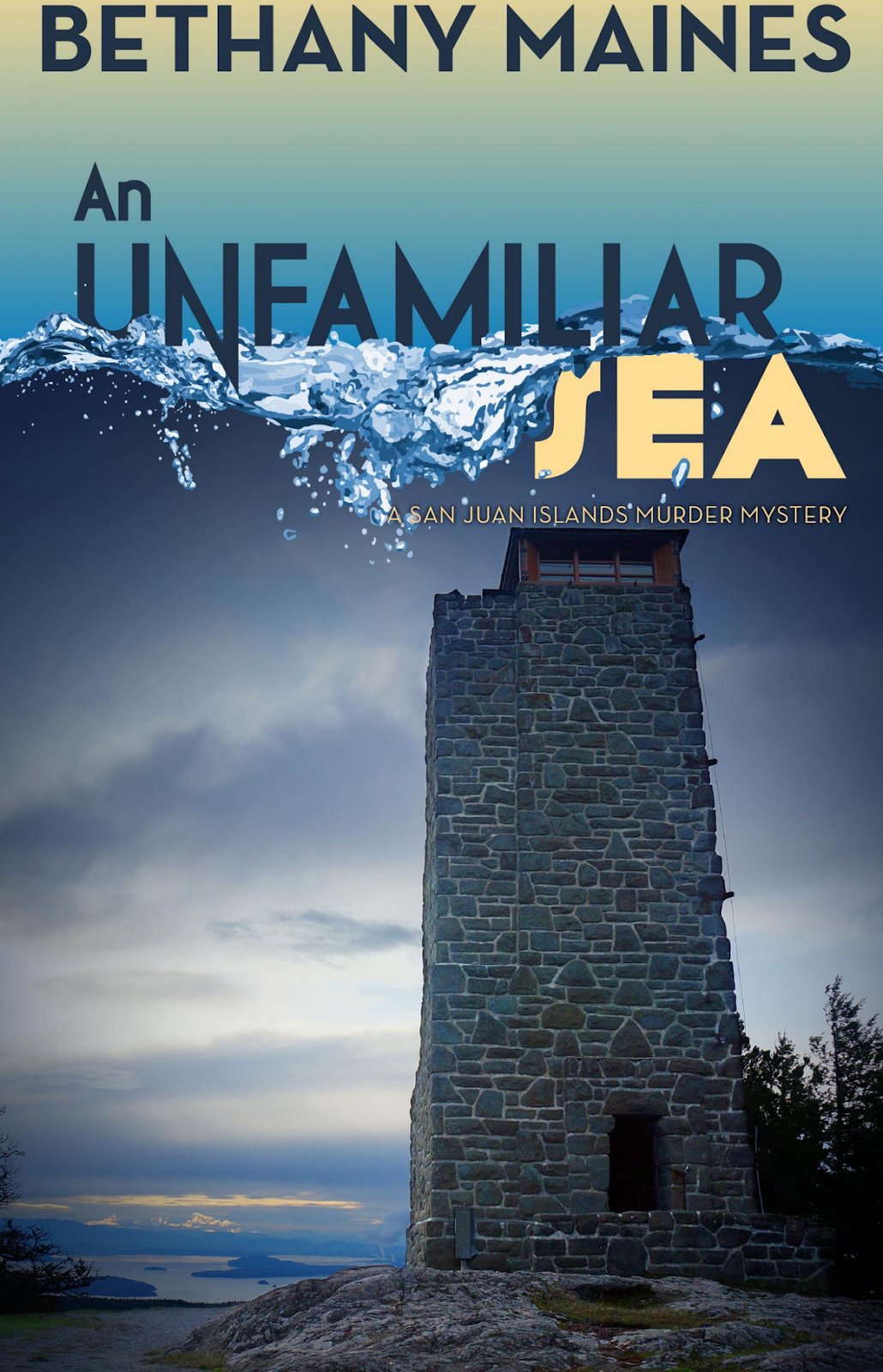
San Juan Islands Mystery #3, AN UNFAMILIAR SEA, Fast-Moving Traditional Mystery from Bethany Maines

There are two kinds of crime fiction: the ones that begin with action, suspense, and risk, and the ones that build up to it with a few chapters that connect you first to the characters and the setting.

No, come to think of it, there's a third kind, and Bethany Maines writes this kind -- the ones that begin with a moment of conversation that makes you snort your coffee in the wrong direction, or grin so widely that strangers ask what you're reading.

Maines brought out a series a decade ago based on a global cosmetic company being a front for high-tech, high-action women agents in international espionage. Those "Carrie Mae" books tended to get me into trouble with my quietly reading spouse, because I'd be choking, laughing, and insisting on telling him the wild and wildly funny plot twists.

With her San Juan Islands series (islands off the coast of Washington state), Maines takes a few steps into more traditional layouts for detection and espionage: Tish Yearly, a lapsed actress, wound up living with her aging grandfather Tobias on Orcas Island because she ran out of other options -- and learned in the process that he's a retired CIA agent. To keep him busy, she's helped him get a private investigations agency rolling, and at the start of book 3, AN UNFAMILIAR SEA, Trish is digging into island life by opening her own business: a wedding destination.

But nothing's as simple as it sounds at first. For example, there's the process of being a boss -- when Tish least expects it, an employee for the wedding business anounces, "I'm pregnant."
Tish's thoughts and her feet came to a stumbling halt. "What?" Tish stared at twenty-two-year-old Penelope Drue, who was clasping and unclasping her hands in front of her chest. Penelope looked like she needed more than a one-word question, but Tish needed more than a two-word announcement. "Congratulations?" Tish tried.
When Penelope is found dead the next day, and only Tish and presumably the father know about the pregnancy, Tish tackles convincing the law enforcement team on hand that there could be more to the death than an accident. That shouldn't be too hard to do, considering Tish is "involved" with one of the investigators -- but actually that complicates things most of the time. ("Dating Nash had never been in her plans, but kissing Nash was always on her top ten list. He made her toes curl.")

Add in discovering her grandfather's been jailed on the mainland, and trying to sort out a possible involvement of the local drug dealer on several fronts. But what Tish never dreamed would happen is a personal attack from that very same grandfather, who's apparently been sure she won't stay on the island and therefore won't keep the business going and ... should we mention what that could do to Nash, in grandfather Tobias's unkind opinion?

Don't confuse this with a "romance mystery." Tish often has a sardonic edge to her, which keeps the dialogue snappy, whether it's with suspects, or just in her head -- or with Detective Spring, a law enforcement pro who definitely doesn't have a soft spot for her:
"Here to bail [your grandfather] out?" he asked.

It was exactly this kind of question that annoyed Tish. He knew the answer. Why even ask?

"No," said Tish. "I brought him a cake with a file in it, but other than that, I figure he's on his own. I'm going to spend my evening recording over his Matlock collection." Detective Spring raised an eyebrow and gave her a look. She gave him a look back.
Maines balances a delicious amount of risk and re-thinking with the perils of island life, and her red herrings (fresh from the Pacific?) provide both puzzle solving and lively distraction along the way. As with most traditional mysteries, you've got a chance to figure out the villain before Tish was -- but you may be chuckling (or biting your nails) too much to follow the right thread. One way or another, shelve this one as really good entertainment — a well-blended caper mystery with memorable scenics and characters, just enough edge to the humor, and satisfying strands in the solving.

PS:  Looking for more mystery reviews, from cozy to very dark? Browse the Kingdom Books mysteries review blog here. 

Monday, February 03, 2020

Is This Our Future? AGENCY from William Gibson

[originally published in the New York Journal of Books]


“As for all really important worldmaking, the key to the power of Agency is not the imaginative twists of computers, software, or politics, but what people do for the sake of those they care about, and those who care about them. Even if the one caring is clearly a piece of software. ”

For suspense readers, “agency” is shorthand for the CIA. But Agency in William Gibson’s speculative creation goes far beyond an intense, suspenseful thriller—it’s the intro to a new world, one in which crime and criminals, whether government-hired or corporate or “mob,” test the boundaries of how to shape the future. And maybe even the past.

The book begins simply enough: A software tester, better known these days as a beta tester, takes on an assignment for a San Francisco-area company, after a couple of years of unemployment. Verity Jane (Jane’s her last name) believes the parent company is “in gaming.”

But when Verity powers up the augmented reality (AR) set she’s taken home to test, it—or she, Eunice—clearly has capacities well beyond the expected. In fact, Verity’s first notable action is to ditch the AR gear and retreat to the bathroom, to make a private call to the CEO who’d hired her. “‘Is this for real? … Just tell me there’s not someone somewhere doing Eunice, for my benefit?’”

The moment that Verity starts digging in to test Eunice’s capabilities for herself, readers leap from the West Coast to somewhere in Britain. The second chapter of the book actually springs farther than that in terms of worldmaking, though: Detective Inspector Ainsley Lowbeer, striding along beside a freelance investigator she’s pulling back onto a case, is reflecting on the terminology for chunks of the past, called “stubs,” that people in her system are able to initiate. Except they’re more like branches, pieces of continuity forking away from the recorded past, to expose potential futures where government and society may vary radically.

Inevitably, these two strands of narrative meet, and swiftly. Government in the future insists on seeking out Eunice’s origins and intent, although it will be a long time in the lives of all the protagonists before the British manipulations begin to make sense and have effects, positive or negative. At least at first, it seems Verity Jane is in a kinder, better world than DI Lowbeer and her hired hand, Nethercott. Eunice, who identifies as African American, claims to be eight hours old. In turn, Verity’s thirty-three.

“‘Jesus year,’ said Eunice, ‘thirty-three.’

‘You religious?’

‘It just means time to get your shit together.’

There was a looseness to this beyond [Verity’s] experience of chatbots, but a wariness as well.”

Soon Verity and Eunice move beyond talking about movies and apps, and Verity’s reputation as an “app whisperer” turns out to hide a deep and intelligent loneliness that Eunice mitigates. Can we say that Verity matters to Eunice, just because Eunice makes sure Verity gets the breakfast she needs, or finds important items already packed when it’s time to run? Without Verity—and there’s clearly no frivolousness in Gibson’s choice of this name—can Eunice achieve what she/it intends to? How much will the British interfere, and if there’s really a risk of nuclear war behind all of this, will Eunice’s existence affect that risk? Can the British team affect it?

As for all really important worldmaking, the key to the power of Agency is not the imaginative twists of computers, software, or politics, but what people do for the sake of those they care about, and those who care about them. Even if the one caring is clearly a piece of software.

And that title, Agency? Here’s the first definition from one dictionary: “the capacity, condition, or state of acting or of exerting power.” Much like Gibson’s world-shaping debut novel Neuromancer (1984), Agency points with creative and incisive interest toward the choices that portend. We’ll be fortunate if the human journey of non-artificial reality gives us artificial intelligence as significant and generous as Eunice—with worldmaking agency to follow. 

PS:  Looking for more mystery reviews, from cozy to very dark? Browse the Kingdom Books mysteries review blog here.

Sunday, December 01, 2019

Brief Mention: HOUSE ARREST by Mike Lawson, Political Thriller

A new Mike Lawson title is always welcome, and early 2019 release of HOUSE ARREST carried me along as a fast page-turner with Washington, DC, conflict. (Apologies for the delay in posting. Life got in the way.) But this political thriller has nothing to do with the controversial presidential administration of the moment -- and everything to do with classic crime fiction motives like money, power, and love. Plus it's a great brain teaser!

Series protagonist Joe DeMarco is a troubleshooter for US Congressman John Mahoney—he does the slightly unpleasant work that a congressman can't afford to be connected with. So although he has a DC office, small and shabby, he has little clout on his side. Almost casually, he's framed for a high-profile murder of another congressman, and almost immediately gets arrested, locked into a jail that's also hosted high-profile federal prisoners in the past. And he doesn't have an attorney:
Consequently, he didn't call a lawyer; he called the only person who could help him, praying she'd answer her phone. She often ignored phone calls; he just hoped she didn't ignore this call tonight.

She answered the phone saying, 'Yes?"—which was the way she usually answered the phone.

"Emma, it's Joe. I've been arrested for murdering Lyle Canton. I'm at the Alexandria city jail. I need a lawyer."

His statement was greeted by several seconds of silence, before Emma said, "Okay." Then she hung up.

DeMarco thought: She could have at least acted surprised that I've been accused of murder.
Count on this frame to involve big money, lots of power, and chases and investigation that will put DeMarco at risk. It's a classic thriller investigation, and a great way to put your feet up and forget your to-do list. Not heavily promoted, so you may not have heard of the series, but fans of Joseph Finder will recognize the action and brisk narrative. Classic escape suspense, very enjoyable!

PS:  Looking for more mystery reviews, from cozy to very dark? Browse the Kingdom Books mysteries review blog here.


Friday, October 18, 2019

Terrifying New Crime Fiction, THE CHAIN, from Adrian McKinty

[ originally published by the New York Journal of Books ]


“The Chain will unforgettably haunt you even if you just read the first chapter—so you might as well lock the doors, bite your nails, and read it all.”

Irish author Adrian McKinty has built a pair of crime investigation series, as well as a handful of stand-alones. Always dark with an undertone of grit and desperation, he’s also seasoned his compelling fiction with a generous twist of wry humor.

But leave the frivolous behind: The Chain is any parent’s horror story, spelled out in twisted and lurid detail. The only way to read it is to be very sure it’s not going to happen to you and yours—but McKinty doesn’t leave much room for that certainty. It’s tempting to wonder whether this increasing noir tension results in part from the author’s relocation to New York City: away from the direct effects of “The Troubles,” and into the binding net of American urban life and menace.

At the outset of The Chain, divorced mom Rachel O’Neill learns her young daughter Kylie has been kidnapped—learns it from a disembodied voice on her phone, followed by a call from the mother who committed the crime. How can she get her daughter back? Money, yes, but the ransom is the smallest part of the task: She must kidnap another child, set up the same threat scenario, keep the “chain” of kidnaps going. Or else her daughter will die. The mom who’s taken her child prisoner has done so under the same threat, for her own child. And on it goes.

Most Americans and many Europeans will have received a “chain letter” at some point. They used to come in the mail, with the names of a few friends who waited for you to send them a recipe, or something similar. Their more threatening form arrived with the Internet: “Send this to five people and get rich; fail to send it, and you’ll have bad luck, bad karma, horrible results.”

McKinty, in his note at the end of the book, admits to a fascination from fifth grade with such poisonous threats. And by melding it to a dreaded Mexican concept of “exchange kidnapping” and his own twist on terror, he designed this long-term threat—then set it on Plum Island, a resort section of coastal Massachusetts that can morph to an ominously barren region in the non-tourist season.

The exhilaration of a crime ride with McKinty is that he never stay just on the surface. His jabs to the underworld aren’t just in terms of menacing criminal figures; they reach the darkness in all of us. Detached now from his Irish setting (he moved to New York City with family), he pries open how humans react to evil. One moment Rachel’s the shower, trying fruitlessly to “get clean.” The next, she’s calling BS on a quote from Camus, “in the depth of winter I finally learned that within me there lay an invincible summer.” And she confronts her soul:

“All she feels is pain and misery. Fear above all. And yes, this is the depth of winter all right. This is the middle of the Ice Age at the sunless North Pole. My daughter has been kidnapped and to get her back I’m going to have to grab a sweet little boy from off the street and threaten him and his family and mean it. Mean it when I say I’m going to kill him because if I don’t I’ll never see Kylie again.”

And of course, if and when Rachel obeys, she doesn’t know whether she can live with herself afterward. Or whether her daughter will accept her if she does this.

McKinty’s fierce twists of narrative and pressure create one highly believable surprise after another, for a compelling up-to-date twist on crime and threat. The Chain will unforgettably haunt you even if you just read the first chapter—so you might as well lock the doors, bite your nails, and read it all.

But don’t recommend it to parents of small children!

PS:  Looking for more mystery reviews, from cozy to very dark? Browse the Kingdom Books mysteries review blog here.
-->

Wednesday, February 28, 2018

Investigator in Pain, Revealing the Cost of Murder, in R. J. Ellory's THE DEVIL AND THE RIVER

The moment I opened the American publication of R. J. Ellory's THE DEVIL AND THE RIVER, I knew I was hooked. Although I spread my reading time for the nearly 400 pages over several days, I would have loved to skip work and just stay on the couch with this book. Not only does it probe life in a sleepy Mississippi town, with a pointed finger trailing through voodoo as well as murder -- but it probes the residue of the Vietnam War through the flashbacks and soul-deep damage to investigator John Gaines. Here's the first paragraph, under the chapter heading "Wednesday, July 24, 1974":
When the rains came, they found the girl's face. Just her face. At least that was how it appeared. And then came her hand -- small and white and fine like porcelain. It surfaced from the black mud and showed itself. Just her face and her hand, the rest of her still submerged. To look down the riverbank and see just her hand and her face was surreal and disturbing. And John Gaines -- who had lately, and by providence or default, come to the position of sheriff of Whytesburg, Breed County, Mississippi, and before that had come alive from the nine circles of hell that was the war in Vietnam, who was himself born in Lafayette, a Louisianan from the start -- crouched on his haunches and surveyed the scene with a quiet mind and a steady eye.
This is what we demand of our best crime-solving people: a quiet mind and a steady eye, and an inner recognition of the horrors and pain embedded in violence. If only it could all be balanced neatly! But as Gaines will soon discover, to probe the roots of this death will also mean reactivating his own most terrible memories of the war, and facing what it has done to him.

The body surfacing from the muddy river bank turns out to be that of Nancy Denton. When she was just 16, two decades earlier, she'd gone for a walk in the Whytesburg woods -- and never returned. Very quickly, John Gaines realizes hers is not a recent death, but perhaps one that dates to the day of her disappearance. How has the body been preserved? What actions were taken before it found a resting place? And who felt the need to kill this lovely young woman?

Gaines is an inexperienced sheriff, driven by poignant and forceful memories of killing and survival in the Vietnam jungles, as well as by a longing to have his returned-to-America life carry some goodness, some meaning, and deep justice. He soon finds that Nancy's teen years took place in a small group of close friends, where romances were both budding and frustrated. And a powerful Southern family, the Wades, is somehow involved in covering up what happened 20 years earlier.

Gaines's most direct route back to the "cold case" is through another veteran, this one of an earlier war: Michael Webster, one of the lucky ones who returned from live action in World War II, minus all the others in his fighting group. Could it be Michael, with his own raw PTSD, who killed Nancy Denton? One of the Wade family members, defending Michael, challenges Gaines to go easy on this veteran so similar in some ways to himself:
"You are perhaps made of stronger stuff than Lieutenant Webster. Some men are just a little more fragile than others, you know?"

"You're telling me that he is the victim here? Are you f**ing crazy?"

"Oh, I am saying nothing of the sort, Sheriff. I am well aware that a heinous crime has been perpetrated here, that some poor girl was abused and murdered, but this was all twenty years ago ... I just think Michael Webster is incapable of establishing any kind of stable ground for his own defense, and I would like to think I am assisting him with his constitutional right to fair representation when it comes to his day in court."

"This is just bullsh**, if you don't mind me saying, Mr. Wade."
What Gaines suspects, beyond the possible violent act in the past by Webster, is that Wade himself is somehow involved in the coverup, for reasons of his own. Or could Wade have been the killer?

It's complicated. And Sheriff John Gaines can't get to the truth without sorting his own war memories and what they have done to his capacity to be human, to be caring, to take part in community.

Don't be confused by earlier releases of the book in the United Kingdom; this is the American release, orchestrated by Overlook. If, like me, you carry conflicting emotions and memories of the Vietnam War years, here is a potent narrative in which to reconsider your own past, as well as the country's. And if you value a crime novel that probes the vulnerability and courage of the mind -- as Charles Todd has done with his World War I-era detectives, for instance -- you'll want the book on your shelf for repeated reading. Add it also to novels of the South and the grief and beauty entwined there.

PS:  Looking for more mystery reviews, from cozy to very dark? Browse the Kingdom Books mysteries review blog here.

Monday, October 09, 2017

New Texas Ranger Mystery Series from J M Gulvin, THE LONG COUNT

US cover
The name J M Gulvin won't be familiar even to readers of this British/American author's long series of previous books, because it's a new pen name -- earlier titles came out from "Jeff Gulvin" and the pseudonym "Adam Armstrong."

Hard to say whether this newest nom de plume is intended to sound like Texas. In fact, the toughest part about THE LONG COUNT, a debut in a Texas Ranger series, is that almost nothing in the book "sounds like" the Lone Star State. And for a region with such distinctive language, that's quite a drawback in a novel set there.

On the other hand, there's plenty of Southern in the book, where Ranger John Quarrie (careful, don't confuse this with Quarry, a creation of Max Allan Collins) is struggling to keep up with the work load during student protests during the Vietnam War. Quarrie's tangled connection with a recently returned Nam veteran, Isaac Bowen, takes him dashing along back roads and sometimes all the way past the Texas border to Louisiana. What's the story behind Isaac's father's death -- and is it suicide (which John Quarrie doubts) or murder? Where is Isaac's missing brother Ishmael? Why do the members of this devastated family have ties to a high-security asylum for the criminally insane?

It took me a while to get into THE LONG COUNT because of the lack of Texas feel to it. But I finally found Quarrie -- or John Q, as he is also known -- such an interesting detective that I fell into the story after all. Quarrie's friendships and unusual extended family, including his young son, are especially intriguing. So is the rich language with which Gulvin piles details into the scenes:
Quarrie approached the house along the overgrown footpath with a flashlight the chief had retrieved from the truck. The stoop was cut from rough-looking wood and two of the steps were rotten, the edges turned to mush. He picked up a scraping of mud that seemed to have been deposited at an odd angle. Coasting the beam from the flashlight across the grass he saw where it was flattened in places and that was not due to the rain. Moving away from the stoop he looked more deeply and shone the torch on the turned earth under the window.
You can see from that sample that Gulvin's Britishisms haven't been fully pruned out. It makes for some odd descriptions, with a bit of a strange rhythm to the prose. But the plot twists are smart and dark, and the book is still a good read.

Besides, I love getting in on the first book of a series -- it's exciting to wonder how the author will grow with the characters in the titles yet to come!

THE LONG COUNT -- the title refers in one sense to going underwater and holding your breath -- is brought to American readers by Faber and Faber, and comes recommended by the magnificent Ann Cleeves. Keep your expectations modest, and enjoy the ride.

PS:  Looking for more mystery reviews, from cozy to very dark? Browse the Kingdom Books mysteries review blog here.

Sunday, February 26, 2017

Heads Up: Emelie Schepp, MARKED FOR REVENGE, and Bill Pronzini, THE VIOLATED

I won't be posting full reviews of these two books coming out in the next week or so, but want to mention them -- and the reasons for my choices.

Emelie Schepp lives in Sweden, and her "Marked" trilogy is being adeptly translated -- the second book, MARKED FOR REVENGE, was moved into English seamlessly by Suzanne Martin Cheadle (it's hard to even tell it was translated). It's suspense, with high stakes; the protagonist, prosecutor Jana Berzelius, is investigating the international drug trade and child trafficking in Sweden.

My problem with it is really my own ... I find graphic child abuse really hard to read. I read all of the first book in this series, Marked for Life, and couldn't bear to reframe it as a review. As soon as I started reading the second book, MARKED FOR REVENGE (release date February 28), all the emotions from the first book rolled back at me. I've skimmed book 2, and it's brilliantly plotted and tightly written. But again, the level of abuse and violence is so far outside my comfort zone (which is pretty wide really ... I have read and enjoyed most of Andrew Vachss and Carol O'Connell, for example, as well as The Girl with the Dragon Tattoo series) that I'm not going to spell it all out. If you're into it, you can see reviews elsewhere. Sorry.

For a very different reason, I'm not going to present THE VIOLATED, the March 7 release from Grand Master of Mystery Bill Pronzini. This one's an audacious attempt at narrating the investigation of a serial rapist's career and murder from multiple points of view. I thought the technique took the book into being very flat, and the tension never rose the way a good work of suspense should. Not did the character acquire enough depth. Even the California setting didn't quite come to life. I can't recommend it -- but that said, Pronzini is generally marvelous, and if you haven't yet read any of his books, do try some of the others. I'll be watching for his next book, figuring that he too knows this one didn't work out as well as he'd hoped ... so he'll create a major winner on the next round.

Obviously, if you're a Pronzini collector, you'll pick up a copy of THE VIOLATED anyway. Go for it.

PS:  Looking for more mystery reviews, from cozy to very dark? Browse the Kingdom Books mysteries review blog here.

Friday, April 08, 2016

DELIVERING THE TRUTH, Edith Maxwell, A Clever Mystery With Insight

Quaker life, and the tender mysteries of childbirth: In DELIVERING THE TRUTH, Massachusetts author Edith Maxwell selects two areas that are intensely private, and in that choice she promises us secrets ... secrets to witness, to explore, and to reveal the human failings that lead to crime.

There have been other Quaker mysteries, of course, but Maxwell sets her new series (she has three others already spinning!) in the 1880s in the close-knit and prosperous town of Amesbury, Massachusetts, where several businesses manufacture carriages. Those complicated creations -- wheels, springs, issues of comfort for traveler and horse, and above all, stylish decor -- fuel the town's growth and keep its families well fed. So when sudden flames destroys a large carriage factory, also killing a dozen men trapped there, it's hard to find anyone untouched by the disaster.

Midwife Rose Carroll, slowly growing her one-woman business with integrity, medical care for mother and baby, and wisdom gained day by day, collides with this wave of grief and loss at a painful level. Although her own small family -- the brother-in-law and nieces and nephews, whose home includes an office that she uses for her midwifery, as she also assists with her dead sister's children -- takes no direct hit from the fire, their closest friends lose work and even loved ones. And Rose herself is still hurting from her own sister's recent death.

Almost immediately, Rose realizes she has observations that may assist the investigation into what's soon declared arson. She's seen a possible suspect right before the fire; she knows, because of her woman-centered work, at least one of the illicit ties in town that involve married men; and soon the police are even asking her to quietly seek answers and report to them on the inner workings of family in the town.

And it's not just her midwifery that makes her a candidate for a careful and observant sleuth: It's also her religious identity as a Quaker -- one of the Society of Friends -- where integrity matters as much as a willingness to wait for divine direction and guidance, and where silence is more common than gossip.

Maxwell's mystery has the hallmarks of a classic in historical fiction, and the softer side of crime investigation that is braided along with such a setting. As in many a "cozy," when death arrives, it does so discreetly, without graphic gore or agony, other than the emotional forces of grief, envy, despair -- the aspects that are seen via the insight and "Light" for which Rose Carroll wishes to be known. But to her shock, one of the deaths in this small-town catastrophe is linked to an item from her own bag that she carries to births: an item shown to her with dried blood on it.
"Is that your knitting needle, Rose Carroll?"

"Yes. It's one of a pair my mother painted for me as a birthday present." I closed my mouth and sat with my hands clenched in my lap. This was the murder weapon ... This was too awful to contemplate. But I had to. I forced myself to unclench my hands.

Kevin regarding me say in silence, as well. I'd read of this tactic in a serial novel, this silent treatment that was usually effective to prod guilty parties to talk. But I was a Quaker. I'd had a lifetime of sitting in silence. And I was guilty of nothing.
Rose's ability to sustain silence, along with her stiff backbone and refusal to bend away from the teachings of her religion, make her a prickly character. She's being courted by a doctor, and open to the courting, although the religious difference involved is rapidly becoming an issue. She's tough, and resolute, and clever.

All of this makes her sleuthing effective and often, for her, very painful emotionally. The cost of looking with clear eyes at the failings of others is high. And her self-judgment is at least as painful.

So DELIVERING THE TRUTH doesn't have the sweet side that many a cozy provides. Moving steadily from one clue to the next, one hypothesis to another, and seeking advice from Quaker leader and noted poet John Greenleaf Whittier, as well as from an older midwife who'd trained her, Rose epitomizes the calm and unyielding focus of, say, Agatha Christie's Hercule Poirot, but with more personal cost and risk.

Maxwell has already shown her skill in building series characters and confrontations, so that her Local Foods series is deepening nicely and her Country Store mysteries provide another lively and warm community; DELIVERING THE TRUTH is subtitled "A Quaker Midwife Mystery" but also is signaled on her website as a "Carriagetown Mystery." So that makes three strong reasons to pick up a copy of this new mystery, released today in bookstores and online: (1) for the intrigue of learning about life within the 1880s Quaker community (Maxwell herself is also a member of the Society of Friends, in a nearby town); (2) for the persistent sense of awe and discovery and human risk that midwife stories by their nature enfold; and (3) to be able to follow this series in its debut and growth.

From the profound magic of childbirth to the personal horror of discovering a death and a killer, midwife Rose Carroll offers a clear-eyed gaze at the complicated lives we sustain. I think this is going to be a series that's both clever and insightful -- and DELIVERING THE TRUTH is a strong and enjoyable start.

[From mystery specialty publisher Midnight Ink.]

Friday, April 01, 2016

Mystery in Maine and Chicago, Clever and "Snarky," HUSBANDS AND LAP DOGS BREATHE THEIR LAST, David Steven Rappoport

Philanthropist Cumming Flynn Wanamaker and his husband live in contemporary Chicago, but their network of friends and locales extends to the coast of Maine. That turns out to be very helpful for this amateur sleuth, when he's the guest of a friend at a Chicago meeting of an occult gathering with delicious steampunk accents. When the speaker self-combusts, Cummings quickly receives an urgent requent to discover more of what had been going on under the table (so to speak) in the group, as well as to recover an item of jewelry that the speaker had flourished.

But Cummings has barely begun to investigate the odd couplings within the group when he gets a second request for his amateur sleuthing skills: His only friend in the rural town of Horeb, Maine, the "elderly, upper class New Englander" Ernestine Cutter, needs him at once to investigate a suspicious death in her own circle. In quick succession, Cummings realizes that not only do both deaths connect with authors (including a gay romance author compared with Barbara Cartland for his many works), but they also both relate somehow to William Reich's psychological explorations of "orgone," a sexual force long since ignored. How can the two deaths share so much, at such a distance from each other?

Between artful descriptions of Chicago classic architectures, "snarky" (the author and publisher's term) interactions among several sets of husbands, and explorations of the occult, this romp through motives and means is in turns a bit naughty and very entertaining. The book is David Steven Rappoport's debut, but he's no raw beginner himself -- author of two Off-Broadway plays, holder of a pair of master's degrees (one is in writing), and a full-time consultant for high-dollar nonprofit plans for health care and other missions, he deftly crafts a lively and often humorous tale, with a lively balance of red herrings and a memorable cast of bizarre characters. I liked Cumming in particular for his habit of solving his choice dilemmas with a combination of stopwatch and random selection. But he's also a dogged investigator who won't leave a stone unturned in the hunt to solve his cases.

HUSBANDS AND LAP DOGS BREATHE THEIR LAST is titled from Alexander Pope's poem "The Rape of the Lock." The pace is lively, the twists abundant, and the characters unstoppable (including in their romantic commitments). I considered it a good page-turner, keeping me well engaged and chuckling, in spite of a few leftover-from-revisions errors that the casual publisher, Mainly Murder Press, allowed to slide by. The book came out in e-version first, and today is the paperback release date; I'll be watching for the sequels, which are Dead Words, and Heidi on the Half Shell. 

Monday, February 15, 2016

Released Today, THE SAMARITAN, 2nd Thriller from Mason Cross

My family laughs at the gaps in my "cultural awareness," usually in terms of TV or films. I'm too busy reading to catch all the screen shows, I confess.

But I've started paying attention to little things that mark how skilled an actor can be, like Alan Cumming, a "Scottish character actor" whose native accent never shows in the abrasive character he plays on television's The Good Wife. It's as if he stepped through a looking glass into a different life entirely.

I get the same feeling when I read a thriller by Mason Cross. Another Scot, born in Glasgow and living and writing in England, his thrillers are flawlessly American -- not even an occasional European spelling or expression to distract from the relentless pace and compelling characters.

With THE SAMARITAN, Cross earns high praise in a blurb from one of America's top writing -- and well followed -- thriller authors, Lee Child, whose terse comment is, "My kind of book."

"Carter Blake" (a false name, but one he's comfortable with) reappears here, speaking a similar language to Child's skilled and heroic Jack Reacher. Blake isn't former military in the way Reacher is; instead, he's cut loose from a skilled "black ops" locate-and-assasinate team recruited by the US government, and he's making an independent living locating the lost for those who need to find them, in a "white hat" sort of way. In fact, as THE SAMARITAN opens, he's putting a runaway daughter back in touch with her dad, and solving their complications casually in the process. A chance glance at a TV news item sends him jetting out of Florida toward Los Angeles, where he's dead certain he knows the perpetrator of a newly discovered series of grisly murders.

But the spotlight dances quickly away from Blake, and it isn't until nearly halfway through this fast-paced crime novel that Blake speaks the name of the strong and fierce FBI Special Agent he worked with in The Killing Season ... and even then, it's only to establish his bona fides for the Los Angeles cops.

Instead, Cross gives us primary interest in a woman homicide detective, Jessica Allen, as determined and with as much integrity as Elaine Banner showed when she teamed up with Blake in the earlier title. Allen's new in LA, and wears a taint of possible betrayal of the force in her last police position, so that she's an outsider on the LA team. An unexpected collaboration from another local detective and the information that Blake can provide will tip the scales at last toward giving her a chance to prove her worth against the serial killer. But Blake can't reveal too much. Take this moment, for instance, when he's trying to get the ex-cop dad of one of the murder victims to open up:
I took my time responding, because I couldn't share everything here. I couldn't talk about the fact that I knew the killer's name.

"I think this guy has killed before -- before any of these three, I mean -- so we might be able to do something by backtracking, tagging open and unsolved case to him. I think he's done it in the past and he'll do it in the future, so that means he needs to be stopped by any means possible."

Boden's eyes flicked up to me at that last remark, but he didn't comment. The personal fighting back against the professional, maybe.
Cross uses some writing devices to keep the strong characters' voices separate: Carter Blake's experience comes in first person, as just demonstrated, but both detectives Jessica Allen and her partner are in third person, as are the scattered glimpses into the killer's viewpoint. It works, but it does mean you've got to stay alert while chasing the clues here.

Cross's narrative is top notch -- well, not yet as powerful as Lee Child's, but never distracting, and his pacing is well chosen, keeping the pages flipping. His female characters, like Jessica Allen, are a bit less engaged in reacting to Blake than Child's women are with Jack Reacher; the difference may cost him some of the devotion that Reacher's drawn, but with the plus of a more "real" feel to the choices made. THE SAMARITAN includes some great twists, too.

Today's the release date, and I think I'll buy another couple of copies to share. It's always exciting to catch a new author in the early work, and feel the buildup toward the top of the field. Mason Cross seems likely to succeed in that climb. Many thanks to Pegasus Crime for making sure the series is available on this side of the Atlantic.

And yes, I think if you have time, the resonance from reading the debut The Killing Season first will be worthwhile, but it's not necessary; THE SAMARITAN stands fiercely and triumphantly on its own.

Monday, November 30, 2015

Trust Your Neighbor? Not in Mette Ivie Harrison's Second Mormon Mystery, HIS RIGHT HAND

Mette Ivie Harrison's second crime novel, with its December 1 release, is a terrific addition to the winter reading list. It's an excellent gift for most mystery readers (the only exceptions would be devoted cozy fans who don't read other forms) -- and an even better gift to oneself, for a powerful journey into a little-understood but all-American culture: that of a middle-class community of Mormons, in today's Utah.

Like Linda Castillo's framing of Amish culture, or Donna Leon's of Venetian, Harrison portrays the gentle force of isolation that can arrive with a community where belief or geography draws a line of defense -- "people who live here" know each other, and know the rules of interaction, in a way that outsiders can't.

In the opening of HIS RIGHT HAND, the second Linda Wallheim mystery, Linda's quickly aware of unusual frictions around her. The scene is a three-couple evening out, the "annual bishopric dinner" where her husband Kurt, the bishop, is host to his closest assistants Tom and Carl, and all three wives. A Mormon bishop is not at all similar to a Catholic one -- the task is a lay leadership one, heavy with prayer and study, yes, but very much "one of the people" agreeing to manage the local community, known as the ward. It's all a volunteer effort, laid on top of working full-time jobs. So for Kurt, Tom and Carl are essential: "Without them, the job of bishop would have overwhelmed Kurt. They were his right hand in more than one way," Linda reflects.

But Carl and his wife Emma don't show up as planned, Carl's not answering Kurt's phone calls, and when Linda places her own call to Emma instead, the background conversation reveals fractures in Carl and Emma's marriage that make Linda suspect the relationship is in deep trouble, and possibly abusive.

A bishop's wife, in Harrison's world, gets as heavy an assignment as her husband but with no formal standing: Her husband relies on her to let him know when pastoral care is needed by women and children in the community, and to do her best to smooth over the normal life frictions around her. (And that's on top of being a somewhat "dated" version of a wife, plus mom.) Linda's ready to pry a bit into the lives of this couple who live near her. And when Carl and Emma finally arrive at the restaurant, she's on Emma's side in what might be an uneven situation where the men aren't respecting the women -- at least, as Linda sees things:
I wasn't going to let Carl off so easily. "We're all God's children, here to do His work to serve each other," I said to him. "The form that service takes surely matters less than the fact that we have a joint purpose." I watched Emma nod once and set her hands on the table, folded.

But Carl didn't let it go. "We may have a joint purpose, but our roles are entirely different. Women have one path to follow and men have another. We can only find true perfection in fulfilling our roles completely, and accepting that God is the one who chooses who is to have one role and who is to have the other."
When Emma opts to head home, away from this pontificating, Carl hurries out to join her. And that's the last Emma sees of him -- his death soon after leaves her drenched in guilt for her suspicions about him, her own harsher-than-usual words, and the possibility that she's overlooked what's going on in her neighbors' lives, when she's supposed to be paying attention and helping her husband know where to add extra caring and support.

Harrison's explanations of Mormon (Church of Latter-Day Saints) life can sometimes come across as a bit stiff and lesson-like. But her characters, especially Linda and Kurt, are rich and well rounded, and Linda's mix of guilt and curiosity, and soon her determination to fix things, are easy to believe and to empathize with. So are Linda's regular lapses from the submissive role she knows she "ought" to take with Kurt as she probes the situation and the people around her who may have had motives to
murder Carl.

A second powerful plot line is the fracturing taking place in Linda's own family, where one of her grown sons announces his identity and life choices in ways that make her unsure whether she'll be able to hold her family together. Soon the issues in her home prove to be a rippled echo of the ones stressing the community at large -- including, oddly enough, Carl and Emma's family, too.

Harrison's pacing is strong, and her portrayals of stress and mental illness ring valid, no matter what community or religion is involved. For many readers, this will be a first look inside Mormon family life, and Harrison is clear and proud as she opens the doors and windows for newcomers.

If there's a flaw here, it's in Linda's impulsiveness, which at times goes well beyond curiosity and the urge to make amends, into meddling and deliberately ignoring her husband's more tempered pace. I found the same uneasiness with her choices in Harrison's first book, The Bishop's Wife -- but let's face it, the poor choices of amateur sleuths are building blocks of this genre! Here, it wasn't enough to spoil the pleasure of this well-spun mystery and Linda's struggles with her beliefs about God and the faith she upholds. A really good read, and I strongly recommend this book! Yes, you'll get more out of HIS RIGHT HAND if you read The Bishop's Wife first -- but Harrison's explanations fill in the details quickly, and reading the pair in inverse order will be just about as good.

From Soho Crime, again -- a great choice for bookshelves that feature strong mysteries with unforgettable settings and all-too-human motives.

Saturday, November 07, 2015

Brief Mention, THE RECKONING, Vol. 3 of Niceville Trilogy, Carsten Stroud

The finale of Carsten Stroud's Deep-South gothic Niceville Trilogy came out at the end of the summer, and I devoured it -- I really needed to see how Stroud would wrap up the series, and there was a lot of waiting involved, as publication of THE RECKONING was delayed more than a year.

The blurb that fronts the book is from Stephen King and says, "An authentic work of American genius." I'd be happier with something more pointed -- say, a 21st-century follow-up to Faulkner blended with the malice and darkness of T. Jefferson Parker at his most wicked. Carsten's task in the final book is to decide how much victory Nick Kavanaugh and his wife Kate Walker will be able to salvage from a part-paranormal burden of horror and evil that sucks its energy Niceville. I completely bought the interweaving of Native American and plantation and greed -- enough to ride with the paranormal parts pretty contentedly. (Who hasn't entered a place that said "creepy" and known it was rooted in the history of what took place there?) Carsten's blunt caper humor that interrupts the tension is a bit heavy-handed, but deliberately so (think Westlake or Zeltserman). The book's startling in its shifts from one mode to the other, though.

Don't read this one unless you plan to read all three. (Check out this review of book 2.) And keep your expectations for the finale modest -- I found the endings a bit too neat, and a bit too sweet, considering all the tension and darkness that had gone before. But it's definitely worth the read, and I wouldn't be surprised to see the trilogy take its place as an American classic.

Oh. Maybe that's what Stephen King meant? Yeah. That works for me.

Monday, October 12, 2015

Vivid History, and Reasons to Honor "Indigenous Peoples Day"

Nonfiction mystery this time!

Sometimes the mysteries of the U.S. mail baffle me. A page-proof copy of GLOOMY TERRORS AND HIDDEN FIRES by Ronald M. Anglin and Larry E. Morris arrived here a month or so ago, and when I saw "October 10" as the release date, I assumed it meant 2015. Actually the book was published a year ago. But I'm very glad it arrived here anyway, with its compelling U.S. history and narrative of the life of an early explorer.

John Colter, who traveled with Merriweather Lewis and William (Bill) Clark in their famous early-1800s expedition sponsored by Thomas Jefferson, could almost have had his own book on the strength of his work with the noted explorers "West of the Mississippi." But he became far more recognized for the generously mythologized episode in his life that happened in 1808, when he supposedly accepted a challenge from a group of Blackfeet (Native Americans). He ran -- naked and shoeless -- for his life, outracing the indigenous people he had already deeply offended by trespass, theft, and the deadly shooting done by his partner. Not only did he make his way through the "wilderness" alone for eleven days, half starving en route -- but he became known as the man who'd bring Yellowstone itself to national notice, and he survived a few more years, to become legendary.  "Colter's Run" is still observed as a race today.

What Anglin and Morris do with their book is trace and retrace Colter's sparsely documented life. Working from records kept by others -- Colter left none -- they build a forceful tower of speculation that eventually stands on its own, to describe the frontiersman himself.

But far beyond hanging flesh onto the bones of legend, these authors outline bluntly the repeated, deliberate, and deceitful treatment by the explorers, of the tribal peoples who welcomed, guided, supported, and often rescued them. By the time I'd finished the first three chapters, I was mightily sickened by the actions of the "white men" who'd probed the Western lands, and even more horrifid by the actions that followed, whether by settlers or by politicians. In the words of the authors:
Four short years into the nineteenth century, Lewis and Clark had failed to understand the Lakota for want of an interpreter -- and also for want of a desire to treat the Indians as equals. Sadly, this misunderstanding prefigured an entire century of false impressions, misreadings, distrust, and tragedy. On that pleasant day of September in 1804, when Colter looked up to see his horse gone, he could not have imagined what that missing horse would someday symbolize.
So I'm recommending GLOOMY TERRORS AND HIDDEN FIRES as a book to open on "Columbus Day" (today) or any time this coming winter. Ignore the flawed introductory material -- the chapters themselves are full of detail and well written. The passion of the two historians rings clearly, and they document their narrative and assertions -- and in particular their view of the interactions of the early invading entrepreneurs and the Lakota Sioux nation -- in abundant detail. It's a page-turner, and may also be a mind changer. It was for me -- I think it's long past time to make the change from Columbus Day to Indigenous Peoples Day. It's the least we can do to acknowledge the presence of the nations of tribal peoples who were so terribly dealt with for so long, and who still struggle for the treaty rights that once seemed legally binding.

Wednesday, September 09, 2015

Ray Celestin, THE AXEMAN: New Orleans Serial Murder, Lively Crime Fiction

The surge of "imports" in today's mystery and crime fiction is bringing wonderful work to American readers, without the necessity of crossing any oceans. It's almost taken for granted now that the most captivating of Scandinavian, French, and Italian crime fiction will be quickly translated to English and in our hands within a year or sooner -- sometimes even simultaneously with European publication. An odd twist to this situation is the growing number of English, Scottish, and Irish (here I just mean Irish setting, English language) mysteries that ought to be released at the same time in both the United Kingdom and the United States, since the language is close enough to being the same ... but somehow the publishers are not always doing this. I've reviewed several authors' works recently that face a delay of one to three years before jumping the Atlantic to America.

Of all of them, THE AXEMAN by Ray Celestin may be one of the most frustrating in terms of delay, title, and "frills." As the Dutch blogger at A Fantastical Librarian notes, there's very little available online about the author ... and the information on the book, a debut mystery, is mightily confused by its two titles: originally The Axeman's Jazz  and now THE AXEMAN. The longer version is also the title of a Julie Smith book, so that may explain the switch -- but even so, if you go looking for reviews and articles on the book, you'll find most of them appended to the longer title anyway.

That said, for a pleasant interview with author Ray Celestin, check out the already-mentioned librarian blog, linked here. And now for the book itself:

THE AXEMAN opens with a Prologue from the point of view of an alcohol-soaked journalist in May 1919 in New Orleans, John Riley, who stumbles on a letter from a self-proclaimed serial killer, in his newspaper's heap of letters to the editor. The narrative then leaps back a month, to a funeral procession where young Lewis Armstrong adds his trumpet work to the music. Yes, that Lewis ... the one who'd later be Louis. Then it jumps to Detective Lieutenant Michael Talbot, inspecting the crime scene of yet another killing by the Axeman, whose gruesome violence is increasing and now includes five occasions. And the third point of view, the one that will become compelling, intimate, and risk-taking, is that of Luca D'Andrea, a newly released convict -- caught between a corrupt police force and the local gangsters. It's Luca's gaze that will become ours, as he walks from where he spent his five-year sentence, toward the city that is his. Or maybe that owns him.
Luca hadn't been expecting his return to New Orleans to be an easy experience. He knew the city was no paradise; it was violent and unforgiving, awash with criminals and immigrant communities that treated one another with hostility and suspicion. But it was also a city with a beguiling energy to it, a bright and opulent charm. For all its segregation and spite, its shabby streets and faded glory, it was easy to become bewitched by the city of New Orleans. And so the whole time Luca was in Angola he couldn't help feeling that when he returned, he would be entering a better world. That the slime of the prison life would wash off him like some kind of amniotic fluid. But now, as he looked at [inquiring reporter] Riley, he wondered if he wasn't just exchanging one kind of slime for another.
Luca and Lewis will connect; mysterious woman and their effects play a role in hunting the killer; and the distance from the 1919 city of New Orleans to Luca's birthplace in Sicily is shorter in some ways than the walk from Angola prison to the downtown.

Celestin's a long-time scriptwriter for film and TV, which explains why his debut novel has the feel of a pro. Not only are the strands of crime and investigation and the pace of suspense and intrigue expertly woven -- but the insight into and connections for Luca, Michael, and young Lewis Armstrong kept me entirely involved. The book's clearly headed into a sequel, set in Chicago, and I hope it will arrive in "the States" soon; I'd drop almost everything else on my desk, to curl up with the next book from the mysterious Ray Celestin.


Sunday, December 28, 2014

Diversion: STATION ELEVEN, Emily St. John Mandel -- Not a Mystery, but Mysterious

Mysterious and wonderful. Deeply satisfying. A book to remember and share.

Emily St. John Mandel's much-promoted novel STATION ELEVEN begins in the middle -- not just in the middle of stage, in the middle of a performance of King Lear, where actor Arthur Leander is about to die. But in the middle of the timeline of this dystopian novel. And whether the dystopia is defined by the Hollywood of our century, or the survivalist mode that follows a dramatic plague outburst upon the earth, is open to question.

But there's never a moment in the entire adventure when there's any doubt about the integrity and passion of Kirsten Raymonde, once a child actor, later a performer on the edge of the known world. And for all the desperation and violence of her new world, Kirsten's one of several people well worth liking in this tapestry of rediscovery.

Renewed. Refreshed. Bathed in an unearthly light that sings. That's where my "take a holiday" plunge into this non-mystery landed me. I am so glad.

[PS -- like graphic novels? you may be amazed at how Mandel's fictionalized one takes life in the center of this book.]

Saturday, October 11, 2014

Intriguing Traditional Mysteries: CAT ON A COLD TIN ROOF (Mike Resnick) and THE BUTTON MAN (Mark Pryor)

I've been taking time off from those complex, thought-provoking global mysteries and thrillers flooding the market, to sink into two really good traditional mysteries that turn entirely different settings and sleuths into well-plotted, well-paced, satisfying books. And when I'd finished both CAT ON A COLD TIN ROOF from Mike Resnick (yes, the same Mike Resnick famous for his science fiction) and THE BUTTON MAN from Mark Pryor (a prequel!), I suddenly realized they were from the same publisher, Seventh Street Books. I think that's a great sign for this mystery-focused imprint of Prometheus Books.

Eli Paxton in CAT ON A COLD TIN ROOF is the kind of detective I hope I might be if I'd gone that route: able to use his network of friends and acquaintances (including the best fences in Cincinnati, Ohio) to probe into the case that he's just landed through a police officer buddy. The police are at a murder scene, and officer Jim Simmons wants Eli right away to look into a side aspect of the scene, a missing cat. Sounds pretty trivial, until Eli soaks up several facts: the cat's owner, now dead, was a hugely wealthy reformed criminal ("organized" crime); the widow, who's hiring him, is throwing cash on the table right away; and, as he soon realizes, this cat was worth a fortune, for a very unusual reason.

Author Mike Resnick keeps the progress on the case both risky and entertaining, with a steady series of humorous moments (Eli's obnoxious dog and his overly curious landlady have leading roles). By the end of the second chapter, I was chuckling and saying "Replaces Westlake for goofy caper type crime fiction" -- and soon after, I was ignoring phone calls and work assignments to discover how Eli would juggle partnering with a "fixer" from the Chicago mob, and being chased by Bolivian killers. Plus there's a steady patter of "foodie" chat, as Eli and his contacts migrate around Cincinnati restaurants and comment on the specials.

Here are two more pieces of good news: This is the third in an established series (Dog in the Manger, originally published 2001 but reprinted by Seventh Street in 2012; and The Trojan Colt, also from Seventh Street, 2013), so there's some fun to catch up on. And Resnick is an even more established author of sci fi, much of it linked to Africa and the Kikuyu people -- so I'll be watching for his other titles over the winter.

THE BUTTON MAN also adds to an established series, but in this case Mark Pryor provides a prequel to his three Hugo Marston crime novels, all set in France: The Bookseller, The Crypt Thief, The Blood Promise. Neatly labeled "2008," the opening chapter takes place in a cemetery in London, where Marston -- a newly minted head of security for the U.S. embassy in London, after retiring from FBI profiling -- literally walks into a body. Almost immediately, he discovers it's one of the two visiting American performers he's been asked to protect as they film a movie in rural England.

And that's just the start of a quick series of startling connections among the visitors, the local politicos, and a kinky up-scale sex club out in the countryside. Soon Marston is depending on a secretive young hotel employee named Merlyn, whose surprising ties to both the actors and the club keep him racing to cope with one "situation" after another, trying to meet the demands of his job and his own sense of moral fairness.

When the rising body count betrays a possible serial killer entangled with the same individuals and institutions, Marston's job requires that he race to avert further violence. But without the final missing pieces, he's not catching up with the criminal, and time's running out.

Although the pace is much quicker and the circumstances obviously up-to-date, Pryor's mysteries remind me of the neatly twisted British work of Dame Agatha Christie: puzzles that we readers have a hair of a chance of solving before the sleuth, with memorable characters and scenes that make the most of London fog, back roads without road signs, old money and new. Traditional, professional, refreshingly suspenseful without horror -- I'd pick up (and keep) a Mark Pryor/Hugo Marston mystery any day!

Monday, October 07, 2013

Debut Mystery: THE SÉANCE SOCIETY, Michael Nethercott

Looking for a traditional mystery with memorable characters and clever twists of investigation and plot? Vermonter Michael Nethercott provides a cozy read in his debut detective novel, THE SÉANCE SOCIETY, set in 1956 Connecticut and introducing willing but inexperienced detective Lee Plunkett and his unusual sidekick, the Irish and bearded Mr. O'Nelligan.

Lee Plunkett is an accidental detective -- not quite a true amateur sleuth, he's fallen into the business role by inheriting it from his father but hasn't ever quote committed to it. The same applies personally, as he's more or less in love with his long-time fiancée, Audrey, and it's her connection with Mr. O'Nelligan, her neighbor, that brings the older gent into Lee's casework.

Hired by a police detective who's about to retire and doesn't want a poor result to his last case, Plunkett is soon investigating an untimely death, perhaps accidental electrocution, within a cadre of spiritualists -- whose performance he's already witnessed, in company with Mr. O'Nelligan and Audrey. Plunkett isn't convinced that the death is particularly significant or interesting, either. He comments to Audrey as he reads of the death, "Well, the man's bought his own ticket to spiritland." When she challenges his "rather callous" remark, he adds that it's "ironic that someone who's put so much effort into seeking out the company of ghosts --" and Audry caps him, "Should turn himself into one with some stupid mistake?"

Séances are performance art, Plunkett knows (and he's not the sort to contemplate big issues like Life Beyond Death anyway, so being a skeptic comes naturally to him). But he's no Sherlock Holmes, and lacks craft and flair. Instead, he's gifted with a stubborn refusal to accept what doesn't make sense -- and with the company of Mr. O'Nelligan, who is not going to let Audrey's boyfriend fail on this assignment. Between quotes from Irish bard Yeats and snippets of Irish parables and mottos, the older man shoves Plunkett into decisive action after all.

Nethercott provides a clever twist to "motive, means, opportunity" and insight into the machinations of spiritual fakery along the way. He also paints an enjoyably innocent time and place in America by choosing the 1950s. And he clearly has his mystery positioned for a series: goaded by career, fiancée, and Mr. O'Nelligan, Lee Plunkett shows promise as a detective after all. And maybe he'll even get around to marrying Audrey!