Showing posts with label Pegasus Crime. Show all posts

Tuesday, April 21, 2020

American Espionage Deepens, with THE COLDEST WARRIOR from Paul Vidich

[Originally published at the New York Journal of Books]

There are two special pleasures for a book reviewer: to spot a stirring talent with the first published book from an author, and to see an author's skills and passion ripen during further work. If you savor a well-turned novel of espionage and moral challenges, THE COLDEST WARRIOR, the third book of espionage fiction from New Yorker Paul Vidich, belongs on your shelf.

Here's the premise: Readers know from the first chapter that Dr. Charles Wilson, a scientist in a high-security government program, became a major security risk in 1953 and was, ahem, enabled to take a plunge from a hotel window high enough above the Washington, DC, streets to kill him at once. But when CIA agent Jack Gabriel approaches retirement from the Office of Inspector General in 1975, twenty-two years later, he's tagged by his superiors to exhume the case and determine what role the Agency played in the death.

Vidich rarely gives much description of a scene or personal appearance, but sketches the interior of a character -- and all his significant ones are men -- deftly and sharply. Jack Gabriel's been drawn to his work by the "cerebral challenge" and the complex problems coupled to high adventure and an urge to fight "the great Cold War against Communism." But his choices are also based in deeper rhythms of moral character:
The call to worldly action had been planted in him by a mother who pushed him to excel in school, who did everything in her power to have him see opportunity beyond the small Midwestern town she hated. ... When young Gabriel arrived in New Haven [for college], he carried a bundle of hundred-dollar bills she had pressed into his hand, a fondness for Shakespeare, an affinity for his mother's Socialism, and a deep skepticism of the rituals of the Catholic Church. The world, he'd been taught to believe, was a dangerous place.
That's a very typical sample of Vidich's writing style, where disclosure comes more from the author's revelatory passages, and less from the situations playing out. In that sense, this author's style differs greatly from the classic work of John Le Carré, who reveals George Smiley's driving forces through his unexpected efforts on behalf of small people: a Russian emigré living in poor housing, a petty criminal who'd lost his beloved to a political betrayal, a retired police officer raising bees. Vidich also walks a very different journey from Olen Steinhauer, whose protagonists bleed from long-ago inner wounds and must rise above their understandable frailty when confronted by political evil-doing.

And the first few chapters of THE COLDEST WARRIOR aren't the greatest quality -- whether from overworking, or hasty rearrangement, or careless editing, it's impossible to know. Yet Vidich soon blooms with powerful moments and short snippets of insight that cut deep: Of one of the antiheroes in this thriller, Phillip Treacher, Vidich exposes Treacher's despair over his relationship with his wife by writing, "He was aware of the first lie he'd told her that Thanksgiving long ago. That deception had metastasized in his soul. He felt more alone than ever."

The halls of power in Washington, DC, shook in the 1970s from Presidential disasters like John F. Kennedy's Bay of Pigs fiasco, Richard Nixon's Watergate lies and brutality, and the casual use of the CIA to topple international figures. All of this comes through in THE COLDEST WARRIOR, as the threats around Jack Gabriel mount and writhe. The book spins quickly into risk and danger, and the final chapters, fast-paced and dark with threat, provide one of the best manhunt and intended escape sequences of current espionage fiction. One could quibble with the very last scene, a bit soft for a book of such terse "noirish" narrative -- but the heart of the book is so good that it's an important one to grab, read, shelve, and think about. What other moments in our nation's political past may metastasize in its soul? How about in its present season?

Pegasus, part of Norton, published THE COLDEST WARRIOR and released it in February. And of course, this is the year when fine books will falter, due to social distancing and the hum of anxiety across the globe. So order a copy, through a local bookstore's "curbside delivery" or online. You'll want the satisfaction of having read Paul Vidich's work now, when he rises toward the top of this field later.

PS:  Looking for more mystery reviews, from cozy to very dark? Browse the Kingdom Books mysteries review blog here.

Saturday, March 26, 2016

Gower St Detective Series #3, DEATH DESCENDS ON SATURN VILLA, M.R.C. Kasasian

M.R.C. (Martin) Kasasian's Gower St Detective Series is quirky, often confusing, frequently dark, threaded through with vicious humor -- and irresistible in terms of posing puzzles to solve and placing it all in the most graphic sort of Victorian world.

In short, I like these books. A lot. My only problem has been deciding which friends to share them with. It's entirely possible that anyone I give a Gower St book to will think I am as strange as the characters within. Alas!

And they are fiercely memorable characters. For instance, there's the narrator, a young woman named March Middleton -- except she only narrates part of DEATH DESCENDS ON SATURN VILLA. There's her godfather Sidney Grice, most famous and most unpleasant detective in the mean streets of London. (Not to mention his insistence on disgusting vegetarian meals, his abuse of his untutored maid-of-all-work, and his scorn for March Middleton herself.)

The puzzles set before March and Grice in the previous two books, The Mangle Street Murders and The Curse of the House of Foskett, have dragged March into gutters and gruesome crime scenes. Her assistance to Grice is a painful necessity: Stranded in his home, unable to live separately due to the mores of Victorian London (and lack of funds), she's caught up in his investigations for lack of anything else to do. And even though his lessons to her are mean-spirited and stingy, she's learning how to assess a crime scene.

But as DEATH DESCENDS ON SATURN VILLA opens, March is on her own, unexpectedly, when a summons arrives from a relative she never knew existed. Risky though it is to accept such an invitation, she feels compelled: Perhaps this new "uncle" can shed light on the terrible suspicion she's harboring about her godfather's role in the death of her own mother.

What March can't have expected, though, is that Uncle Tolly's home will exert such odd effects on her that she'll soon be convinced she herself has committed murder. Will Sidney Grice exert himself far enough to solve her case? Or will his evidence condemn her in court?

Even as March struggles to gain Grice's assistance, the pair continue to play out a "who's on first" sort of dialogue with the uneducated, blunt-tongued maid, Molly:
"Dear March," Mr G spoke tenderly, "I think you may be telling the truth that you do not know if you did it -- whatever it may be."

Molly came in and put a tea tray on the table. "Cook said I was very rude to say that about your dress the other day, miss."

"It does not matter," I told her.

"I just wanted to make it clear," she continued. "There wasn't not nothing wrong with the dress. Anybody else might have looked pretty in it."

"Thank you, Molly."

"And -- "

"Get out," her employer commanded, "before Miss Middleton attacks you as she allegedly did the last maid who crossed her path."

"Oh miss." Molly put her hand to her mouth. "I never even knew you had a path. I hope I never allegingly cross it."
As you can see, the further you're drawn into DEATH DESCENDS ON SATURN VILLA, the more you are trapped halfway between Alice in Wonderland, and Douglas Adams's Hitchhiker's Guide to the Galaxy, with a dash of Jasper Fforde on the top. Is this your kind of book?

I confess it's mine on alternate Tuesdays and Thursdays, and crazy though the series is, I can't put the books down, once I start them. Kasasian's plot twists are always unexpected and bizarre, although perfectly reasonable in hindsight (considering the characters involved). The pace is brisk, and the frank depiction of the dirt and dismay of Victorian everyday life is oddly endearing. Most of all, March Middleton is someone worth saving, somehow, so her disappearance in the middle of DEATH DESCENDS presses the book into desperate straits.

I know -- you're going to tell me you are NOT one of the people I should give this book to. Wait -- you've read this far? Maybe ... maybe you like this crazy British humor in detective guise, after all? Go ahead -- get a copy and enjoy snickering and snorting.

Yes, you can read this without reading the other two books first. But I think it's a lot more fun for this series to take one after another. Mute the phone, and keep the tea and crumpets (no cold cabbage stews!) coming.

PS - There's no author website at the moment, as far as I can tell, although Pegasus Crime hosts a launching spot for Kasasian. Look for him on social media instead.

Monday, February 15, 2016

Released Today, THE SAMARITAN, 2nd Thriller from Mason Cross

My family laughs at the gaps in my "cultural awareness," usually in terms of TV or films. I'm too busy reading to catch all the screen shows, I confess.

But I've started paying attention to little things that mark how skilled an actor can be, like Alan Cumming, a "Scottish character actor" whose native accent never shows in the abrasive character he plays on television's The Good Wife. It's as if he stepped through a looking glass into a different life entirely.

I get the same feeling when I read a thriller by Mason Cross. Another Scot, born in Glasgow and living and writing in England, his thrillers are flawlessly American -- not even an occasional European spelling or expression to distract from the relentless pace and compelling characters.

With THE SAMARITAN, Cross earns high praise in a blurb from one of America's top writing -- and well followed -- thriller authors, Lee Child, whose terse comment is, "My kind of book."

"Carter Blake" (a false name, but one he's comfortable with) reappears here, speaking a similar language to Child's skilled and heroic Jack Reacher. Blake isn't former military in the way Reacher is; instead, he's cut loose from a skilled "black ops" locate-and-assasinate team recruited by the US government, and he's making an independent living locating the lost for those who need to find them, in a "white hat" sort of way. In fact, as THE SAMARITAN opens, he's putting a runaway daughter back in touch with her dad, and solving their complications casually in the process. A chance glance at a TV news item sends him jetting out of Florida toward Los Angeles, where he's dead certain he knows the perpetrator of a newly discovered series of grisly murders.

But the spotlight dances quickly away from Blake, and it isn't until nearly halfway through this fast-paced crime novel that Blake speaks the name of the strong and fierce FBI Special Agent he worked with in The Killing Season ... and even then, it's only to establish his bona fides for the Los Angeles cops.

Instead, Cross gives us primary interest in a woman homicide detective, Jessica Allen, as determined and with as much integrity as Elaine Banner showed when she teamed up with Blake in the earlier title. Allen's new in LA, and wears a taint of possible betrayal of the force in her last police position, so that she's an outsider on the LA team. An unexpected collaboration from another local detective and the information that Blake can provide will tip the scales at last toward giving her a chance to prove her worth against the serial killer. But Blake can't reveal too much. Take this moment, for instance, when he's trying to get the ex-cop dad of one of the murder victims to open up:
I took my time responding, because I couldn't share everything here. I couldn't talk about the fact that I knew the killer's name.

"I think this guy has killed before -- before any of these three, I mean -- so we might be able to do something by backtracking, tagging open and unsolved case to him. I think he's done it in the past and he'll do it in the future, so that means he needs to be stopped by any means possible."

Boden's eyes flicked up to me at that last remark, but he didn't comment. The personal fighting back against the professional, maybe.
Cross uses some writing devices to keep the strong characters' voices separate: Carter Blake's experience comes in first person, as just demonstrated, but both detectives Jessica Allen and her partner are in third person, as are the scattered glimpses into the killer's viewpoint. It works, but it does mean you've got to stay alert while chasing the clues here.

Cross's narrative is top notch -- well, not yet as powerful as Lee Child's, but never distracting, and his pacing is well chosen, keeping the pages flipping. His female characters, like Jessica Allen, are a bit less engaged in reacting to Blake than Child's women are with Jack Reacher; the difference may cost him some of the devotion that Reacher's drawn, but with the plus of a more "real" feel to the choices made. THE SAMARITAN includes some great twists, too.

Today's the release date, and I think I'll buy another couple of copies to share. It's always exciting to catch a new author in the early work, and feel the buildup toward the top of the field. Mason Cross seems likely to succeed in that climb. Many thanks to Pegasus Crime for making sure the series is available on this side of the Atlantic.

And yes, I think if you have time, the resonance from reading the debut The Killing Season first will be worthwhile, but it's not necessary; THE SAMARITAN stands fiercely and triumphantly on its own.

Sunday, July 19, 2015

Crime Is Serious - But Not So Much, in Gesternstadt, Bavaria: P. J. Brackston

Humorous mysteries come in wildly diverse shapes. There are the capers that Donald Westlake gave us, burglars and other petty criminals dashing around cities, slipping on figurative banana peels as they struggle to complete their crimes. There are the very dangerous Stephanie Plum investigations from Janet Evanovich, with the threat of pulling a muscle from laughing too hard at this Jersey Girl's detective work and allies. Not yet well known, but wonderful, are the "Junior Bender" books written by Timothy Hallinan, a cross between a Westlake caper and a heartbreak (no, I won't explain now -- but click here to know more).

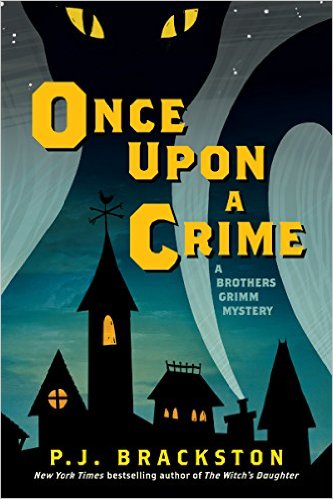
But there is nothing, absolutely nothing, that compares to P. J. Brackston's marvelous "Brothers Grimm Mysteries" featuring, in 18th-century Bavaria, the amazing Gretel (yes, that Gretel) and her eating-disordered but charming brother Hans, still sorting out their PTSD from that disastrous episode with the witch and the gingerbread house. Gretel is a very successful private investigator herself, weaving deftly among the political realities of kings, princesses, and "Kingsmen" (the police) -- but even with her local background in Jack (the one who planted the beans and climbed the beanstalk) and his family, she's had no preparation for coping with what this particular investigation demands, in ONCE UPON A CRIME.

It sounds simple enough at first -- Frau Hapsburg swears three of her cats (among more than two dozen) have been kidnapped and she has plenty of money to pay Gretel to take the case of tracking them down, even rescuing them. But after accepting a hefty deposit, Gretel checks in with a fortune-telling friend who's pretty accurate with a Tarot deck. The mention of a tall handsome stranger in the reading is something she figures is a put-on; it's the mention of a troll that has her worried. Good thinking.

I delayed several serious chores, in order to stick with Gretel in her perils. Is the king's executioner really going to take off her head? What was that about torture on the rack? Is that tall, dark stranger really interested in her? And how on earth did Hans come up with some real skills to assist Gretel in her work?

Come on, let go of any prejudice against a fairy-tale environment -- if you've read Jasper Fforde, you already know it's great grounds for crime and crimesolving, and Brackston's writing won't demand the literary background of Fforde's; those half-remembered stories will do you just fine for case background. I promise the plot makes sense, the characters (when not covered with mud) are endearing, and the insights into Gretel's thinking are good detective work, no matter how the costumes appear. Consider this moment as Gretel gets a good massage to make up for a trying visit to said troll:
She now knew someone was snatching the cats, or, more accurately, having the cats snatched. She knew also that this person lived over the mountains one day hence. Furthermore, she knew that the troll knew who this person was. In addition, she had a rare insight into the life, habits, and singular desires of trolls, but she decided against counting this as a plus of any sort. She had also deduced that the troll was more involved than he was letting on, given the missing finger on the corpse ... the only way to discover the identity of the cat collector was to obtain a human finger and take it to said troll.

"Argh!" she cried, as the masseur found a particularly sensitive spot.

"Fraulein, you have been overworking these muscles. It is important to build up stamina before attempting any serious activity."

Gretel groaned. "Needs must. Besides, I'm not sure what the recommended training would be before encountering trolls."
 Oh, I know, you're still skeptical. I can't blame you -- if Pegasus Books hadn't started me on Brackston's series with Gretel and the Missing Frog Prints (not a typo) last winter,  I might have missed out. This series sounds more than a little crazy, right?

But Brackston's books are fun, lively, well-written, inventive -- and they honor all the expectations for a well-knitted mystery, with a great balance of red herrings (or capes, or shoes) and useful clues and entertaining distractions. Didn't you promise yourself that you wouldn't take life so seriously? Here's a great way to start!


Saturday, March 07, 2015

THE KILLING SEASON, Mason Cross: Deadly Sniper Escapes and Starts Killing Again

I'm a devoted fan of Lee Child's Jack Reacher series -- there's something about the honor code that Reacher carries into his work that gives these fast-paced thrillers an odd satisfaction, despite their high body counts and strongly gendered character roles.

So it's interesting to see how Mason Cross changes the pattern. Born in Glasgow, Scotland, and living and writing in England, Cross's debut, THE KILLING SEASON, is set squarely in the American heartland. The premise is all too believable: A mentally very nasty sniper, sentenced to die and being transported toward his final cell, somehow ends up released as a side effect of a mob move. Or at least, that's what it first looks like to specialist Carter Blake, hired by the FBI for quick action, and the single-mom FBI special agent working with him, Elaine Banner.

Carter Blake is good -- everyone on the short list of people who know him and his work agree. But it's quickly clear that he and Banner are being used, not just by the agency but also by the Chicago sniper, as they race across the country, trying to prevent more spree killings.

Banner's colleague Steve Castle running the operation doesn't think much of her, or of the specialist tagging along. That's a problem that Carter Blake needs to manage, too, as well as chasing the killer:
"This is a warm-up," I said. "He'll move on to specific hits soon. His enemies. People who he thinks have wronged him."

Banner was still crouched next to the body. Her eyes flicked up to me, and for the first time I heard irritation in her voice. "Were you paying attention to the file? That's completely inconsistent with the established MO."

"It's not inconsistent at all," I said. "And the conditions on the ground have changed. He's a soldier. Soldiers adapt."

"Wardell's an indiscriminate killer," Castle said. ... "Maybe you need a little more time to catch up, Blake. I'm sure we can find you someplace quiet to study."

I glanced at the body again. "The last thing Wardell is," I said, "is indiscriminate. You believe that, you're making a big mistake."
See? Jack Reacher probably wouldn't have explained that much. Carter Blake has reasons to do so, including keeping his reputation and trying to get the agency to work with him, not against him. But the escaped sniper Wardell has a plan that even Carter Blake can't see for quite a while, and the clock is ticking toward the next killing spree, not far ahead.

There's a lot to enjoy in this thriller (and little sexual perversion, something of a relief lately, I have to admit) -- plus Cross provides plot twists that raise the ante, as well as the suspense. Hard to believe this one's a debut; I'll be watching for more of his books. This one was brought across from the UK by Pegasus Crime, which is releasing a nice line of mystery and crime fiction in 2015. Another from Mason Cross, The Samaritan, is scheduled for UK release this May.

Gothic Thriller: THE SEEKER, R. B. Chesterton (Carolyn Haines)

R. B. Chesterton is one of many pen names for Carolyn Haines -- and the author says she uses this one to probe the dark side of crime. THE SEEKER came out in 2014, and the softcover became available from Pegasus Crime a couple of weeks ago. So if you haven't tried this author under her noir-ish nom de plume yet, here's a good opportunity.

THE SEEKER is not just dark -- it's creepy. Aine Cahill's graduate studies at Boston's Brandeis University have taken her in two deliberately opposite directions: away from her Irish immigrant family and its "curse" that's migrated with the family to the South, erupting in Kentucky whiskey-running followed by a modern specialty in OxyContin ("hillbilly heroin"); and toward her great-great-great-great aunt Bonnie Cahill, who may have been Henry David Thoreau's lover during his retreat at Walden Pond.

But the further Aine reaches in on-site research in Massachusetts, the more strongly she finds her stay by Thoreau's pond haunted, by terrifying shreds of a past that she never dreamed of when she figured she'd track an unknown literary love affair. Two suitors also pursue her -- and even as she yields to the promised attention, a particularly nasty haunting occupies the same space and time:
No matter that Mischa was not in the cabin. She was in my head, and I had no clue how to exorcise her. Tomorrow, though, I would explore that option. There were plenty of Catholic churches in Concord, and through I'd left the pomp and ritual of the church far behind me, I knew where to find a priest.

I drifted into sleep, and found myself floating ... Struggle as I might, I couldn't break the thrall of the whale.

When no land was visible on the horizon, the whale surfaced. One blurry eye pinned me, and a rush of red blood shot from its blowhole. "You've met your destiny, Aine Cahill."
Think Nathaniel Hawthorne crossed with Steven King, and you're close to what R. B. Chesterton provides here. Keep the lights on, and the doors locked, while you read.