Showing posts with label Boston. Show all posts

Thursday, September 15, 2022

New Novel from Paul Theroux, THE BAD ANGEL BROTHERS


[Originally published at New York Journal of Books]

“The book’s suspense rests on whether and when Cal will finally turn to face his lifelong attacker. What will he lose, in what sequence? How humiliated and abased will he become? Is there any moment when he can say enough? As it turns out, there may indeed be such a point. And, as the saying goes, what will happen when the worm turns?”

It’s impossible to read a novel by Paul Theroux without thinking of, and even longing for, his unforgettable books of travel, from The Great Railway Bazaar onward. But although The Bad Angel Brothers opens in a small city somewhere in the cluster between southern New Hampshire and Boston, and Cal Belanger’s parents were middle-class Québecois (French Canadian) immigrants, Cal is outward bound as soon as possible. His reason: to make as much space as he can between his daily life and that of his horrible brother Frank, whom he initially labels (only to himself) “a high-functioning ass****.” Not only does Frank invert and manipulate all the stories of the lives of the two brothers—he does it with malice and intent to degrade Cal in as many ways as possible.

Somewhere along the way, mostly through his gentle father, Cal absorbed the message that he should treat his older brother as, well, a brother. But Frank either missed the message or decided bluntly that it only applied in one direction. He’s out to humiliate. And as he reaches maturity, he spreads his malevolent impact over the impoverished clients of his law practice, too.

Through one episode after another, Cal is battered and belittled. He admits the high school nickname for the two of them, the Bad Angel brothers, pins them together in an odd way. In addition, as long as he’s within Frank’s easy reach, he seems helpless to protect himself. So it’s a huge relief to protagonist and reader alike when Cal takes his geological expertise on the road, makes some quiet gold discoveries and a few very good friends, and develops a pattern of travel that includes half the globe, thus putting Theroux’s other side to work in swiftly and evocatively sketching the people and lifeways with which Cal can readily connect. He is actually a nice person. He just seems captive, like the protypical victim of a cobra, unwilling to run.

When Cal’s lovely and adoring Columbian wife insists on living in the New England neighborhood where Cal grew up, in close proximity to Frank, anyone but Cal can tell what will happen next. At first, his brother’s manipulations only make him more grateful for Vita,  the “beautiful woman, to town, alone, innocent, not knowing that Frank was saying with assurance, ‘Vita,’ summoning her for evaluation. The vision made me love her more and vow to protect her; it made me despise Frank.”

After this, the book’s suspense rests on whether and when Cal will finally turn to face his lifelong attacker. What will he lose, in what sequence? How humiliated and abased will he become? Is there any moment when he can say enough? As it turns out, there may indeed be such a point. And, as the saying goes, what will happen when the worm turns?

That’s when The  Bad Angel Brothers becomes crime fiction. And the reader, having maintained connection with Cal this long, may well be hoping some effective violence finally takes place.

Watch the magician’s hands: Theroux has some powerful twists in his hat, and the language and compelling prose with which to offer them into the spotlight. He may yet pull a coin from your ear. Or from Cal’s.

PS: Looking for more mystery reviews, from cozy to very dark? Browse the Kingdom Books mysteries review blog here.

Monday, October 04, 2021

Rock Music, Suspense, Dark Thriller: HOLD ME DOWN by Clea Simon


Clea Simon's deep dives into the crime, pain, and heroics of Boston's club music world gave a fierce and dark passion to her crime novel World Enough (2017). With HOLD ME  DOWN, Simon goes multiple layers deeper and darker—thanks to the persona of Gal, a scarred and angry woman who has held crowds in the palm of her hand as she belted out the lyrics of her own top songs, mic stand and the strings of the bass as much a part of her as her own vocal cords and rough screams of rage and sexuality.

For Gal, a Boston return, 20 years later, is fraught with potential failure. Taking a cameo role in a club performance, she falters at first, realizing the guitarist is "all metal and speed, still" -- can Gal keep up? But she finds out right away: "The move centers her ... belting out the chorus as well as she knows the tattoo on her wrist—an F clef, faded blue—as the song pours out of her, the words coming easily now. Winding up to the hook. The line with the hiccup. One extra beat that makes the rhyme different." And she's back in charge of the image she's been ready to project, of a woman and a band grown tougher with age, "blooded, in ways they can only imagine." It's about power, sexuality, control.

And then, with one tricky glimpse for a moment of a face in the crowd, she's rubbed raw again, and in danger.

Scenes of touring, of the drug-supported physical challenge of performing for one crowd after another, clawing up the charts, the band becoming a life form of its own: Simon peels these like layers of a sharp onion, tears and rage starting to flow with Gal's slow recognition of the deep punishment she's sustained in her life. Her best songs—including the iconic "Hold Me Down"—root in that festering pain and anger that only her closest friends have even a hint of. 

"That song, 'Hold Me Down,' had been their breakout. Their hit, even in the rough four-track version they'd recorded down at Randy's, burning up the college stations with a waiting list for the single. Fans asking at the record store whenever she dropped back in to pick up a shift. It was why the suits had come calling, taking the shuttle up from New York to hear them at the Rat, the Channel, Taji's."

With the "suits" had come the controllers, the people who shoved the band at a pace beyond human capacity, drugging them as needed, pressing them into alcohol and drug abuse and a demand for performance that's deadly in its effects.

As the 20-years-later brutal murder of one of the team confronts her, so long after the band's success, Gal slowly admits to herself why the killing happened and who has deliberately done damage to her and the others. Then the police get involved, demanding that she reveal information she's barely coming to terms with. "You could come in and speak with us, if you'd like. Or should I send someone to get you?" That's the investigator. And Gal replies that she'll come in, without being dragged—admitting, in that moment, that her choices are "all about control."

But you can't control what brutal crime does to you. You can only cling to your friends and what's left of who you thought you were, and keep going. Or not. 

Simon's pacing in this crime thriller offers more than plot and character: She reincarnates the demanding sexuality of the rock underground with the costs of fame and addiction. Page by page, scene by traumatic scene, there's no guarantee that Gal can even perceive a safe harbor. 

Anyone who's dreamed of the power of being a rock performer will get double the emotional kick from this raw and compelling suspense novel. Simon's particular genius in HOLD ME DOWN is shining her light into the world of tough, struggling, and brilliant women—a side of the rock world rarely acknowledged or envisioned. HOLD ME DOWN is a heartache packed into 248 pages, with the possibility of breaking always just within reach.

After multiple genres of mysteries and crime novels, this Boston-area author has come into her own, so that Gal yells the words so many have had in the back of their throats, an accusation: "You wanna, you wanna hold me down." It's all about how we fight back. Can Gal do it—and survive?


PS:  Looking for more mystery reviews, from cozy to very dark? Browse the Kingdom Books mysteries review blog here.


Sunday, January 24, 2021

Magic and Mystery from Clea Simon, in A CAT ON THE CASE


Boston-area author Clea Simon has always excelled at world building.

Some of this in her previous books has evoked the passionate underworld of Boston's music scene, with its drugs, sex, rock and roll, but above all, deeply needed relationships. At other times she's woven complex relationships between humans and their pets, often understood better by the four-footed companions. Her hauntings and witchery have delved into human longing, as well as desperation.

Now, in A CAT ON THE CASE, Simon evokes a layered set of mysteries: a crime that involves a mostly helpless immigrant music student (make that two crimes, as one uses her as a front and the other threatens to sink her into hopeless debt and danger). And the longing of pet owner Becca Colwin to exert magical abilities,which enfolds a mystical confusion of its own, as Becca is sure she's already been able to make something magical take place—which her three cats, savvy and powerful, know darn well was something they achieved, not Becca.

Readers of Simon's "Witch Cats of Cambridge" series (Polis Books) will already know that the cats Clara (the youngest and assigned to protection detail), Laurel, and Harriet have a long and powerful past and are rather arrogantly aware of their own power. Simon's world building includes lives of felines dating back to the awesome Egyptian deity Bast, and the first couple of chapters of A CAT ON THE CASE require close attention to what's going on.

But after that, the book becomes a classic mystery involving a possibly valuable antique violin, thieves at the crystals-and-magic shop Charm and Cherish where Becca works, and a murder next door. Becca's determination, and her sense that the vulnerable Ruby is worth caring about, quickly propel her into chasing down danger and sniffing out the double entrapment that Ruby is too naive to notice.

Becca's old friend (and magic circle member) Maddy isn't convinced.  

"So tell me everything you know. I mean for real, Becca. Not just that you have a feeling about this girl."

"I do, though." Becca paused before continuing. "There's something going on with her, but I don't get any sense of danger from her. More than that, my cats are very calm — they were fine with her and they're fine with the violin."

That's the violin that seems to be the target of international thieves willing to murder in order to possess it. But why?

Good thing Becca has three savvy cats to watch over her and work out the means, motive, and perpetrators, whether in person or in spirit!

Yes, this is a feline-filled cozy, but it's also an intricate work of speculative fiction. Shelve with Boston mysteries, cat tales, female protagonists, and intricate fantasy, all wrapped into an unusual crime-solving exploration of friendship and the paranormal.

PS: Looking for more mystery reviews, from cozy to very dark? Browse the Kingdom Books mysteries review blog here.

Saturday, January 23, 2021

Top-Notch New "Wounded Sleuth" from Lisa Gardner, BEFORE SHE DISAPPEARED


[Originally published at New York Journal of Books]

Before She Disappeared introduces what may be the most powerful sleuth of the decade, an “ordinary” woman driven to uncover the truth at any personal cost. There’s only one thing to ask for by the time the book ends: please, please, a sequel and a series.

The new thriller from Lisa Gardner, Before She Disappeared, cuts remarkable new ground. An intense and fast-paced investigative novel—practically a police procedural—it features the compelling presence of Frankie Elkin. Sober more than nine years, Frankie’s on a hunt for the only thing that eases her personal cravings: finding the lost.

Her arrival in the Mattapan section of Boston comes hard. White and female, she might as well wear a target or a sign that says “hurt me” in the rough district. But she’s there to find Angelique, a vanished high school student. Whatever search there’d been for “Angel” ended months ago, as far as Frankie can tell. Drugs, prostitution, or just leaving town, those are the common assumptions made about a kid on the wrong side of life.

But not by Frankie. Looking straight at the situation, she sees no reason that a high-achieving Haitian immigrant determined to save her family from deportation would just vanish and not even reassure her mom or brother. And Frankie’s got a plan for investigating and trying to find Angelique, as she’s done with fourteen earlier missing persons. Only this time she hopes, as she hopes every time, to find the person alive.

Taking up a job as a bartender may sound risky for her sobriety, but although booze hasn’t lost its appeal, she’s committed to something more powerful, the surge of adrenaline from finding the lost. Her first task: persuade the local bar owner to give her the job, as well as the empty upstairs living quarters. In spite of her white skin.

“He shakes his head. With more glasses to dry, he crosses his arms over his chest and looks at me straight on. He still doesn’t say a word.

‘I work hard.’ I tick off a finger. ‘I’m on time, especially because I’m going to be living upstairs, and I won’t siphon your booze. I pour fast, I know how to change out a keg, and I’m an excellent listener. Everyone likes a good listener.’

‘They won’t like you.’

‘Neither did you, but you’re coming around. Give me a month. By then no one will notice my white skin or superior gender. I’ll just be another fixture behind the bar.’”

Why here? Because this is where Angelique and her relatives belong. And in a very short time, Frankie figures out why the hunt for this teen started late, ended early, and isn’t going anywhere. Partnering with a police detective who’s frustrated at the lack of progress, Frankie earns her way past his reluctance to trust her, and proves that her ability to listen—especially to teens and women—can reopen the case.

When Frankie discovers proof that the teen is still alive, and seeking help, that partnership with the local detective becomes essential. But it stays charged with anger and territory, and the hunger Frankie carries with her: consuming, propulsive, and perhaps entirely destructive. That’s similar to what drives the “kids” around her, including another missing teen, revealed as “the missing girl no one even knew was missing,” yet who sets a criminal enterprise into focus and ramps up the danger to all involved.

Gardner’s fierce and skillful blending of rage and despair and unhealable wounds makes Frankie an unforgettable protagonist. She can’t be called an amateur sleuth, because her impassioned searches have shown solid results. She has families that speak for her, because she cared enough to work for discovery of what happened to their loved ones. Yet she’s not paid by any of those. And she walks a knife edge of internal haunting.

Before She Disappeared introduces what may be the most powerful sleuth of the decade, an “ordinary” woman driven to uncover the truth at any personal cost. There’s only one thing to ask for by the time the book ends: please, please, a sequel and a series.

PS: Looking for more mystery reviews, from cozy to very dark? Browse the Kingdom Books mysteries review blog here.

Thursday, December 20, 2018

Multilayered Thriller TRUST ME from Hank Phillippi Ryan

Hank Phillippi Ryan's TRUST ME, her first stand-alone thriller, came out at the end of August. I missed the chance to review it then -- but thanks to a copy she sent here recently, I dove in, and was stunned by the intricacy and layers of revelation in this complex thriller.

Mercer Hennessey, a noted crime writer with a publisher who'd like to see her get back in the saddle, has spent more than a year crippled with grief: Her husband and two-year-old daughter Sophie died in a car accident, a one-car crash nearby. With the joy of her life gone, and little reason to take interest in life again, Mercer's been having a one-woman pity party at home all this time.

But her publisher, Katherine Craft, is Boston Back Bay stubborn, and sees Mercer as the perfect writer to tackle a courtroom story unfolding that week: the trial of Ashlyn Bryant, accused of murdering her own tiny daughter for the sake of more freedom in her skanky life. The little girl's corpse was called Baby Boston when first discovered, in its decomposing anonymity. There's no real doubt about Ashlyn's guilt. The trial will be direct and brutal, though -- and Katherine's offering a chance for Mercer to view the trial by a private line, the type set up for TV stations and other big journalistic enterprises, so she can stay home, see it all, and pound out a full-length book during the trial period, ready to rip into sales within just a few weeks from the "Guilty" verdict being finalized.

Katherine's both a friend and a clever editor, and she sets Mercer up brilliantly, so that the highly depressed writer takes a spark of anger and blows on it:
Kath understands, as much as anyone can. It's unfair for me to take my grief out on her. Is she right? Is there something I can do? ... Yes. I'll do it. To avenge Baby Boston. And I'll secretly dedicate this book to Sophie. To every little girl unfairly wrenched away from the world. The more I think about it, the more I know I can do it. I yearn to do it. ... Plus writing a book beat the options I'd already contemplated.
At first it looks like Kath's scheme will succeed: Mercer is up and at it, researching, pounding out a "true crime" book (with creative dialogue) that will rack up sales like crazy. If, of course, the trial goes as planned.

But when it doesn't, and Kath's idea of book rescue involves Mercer and Ashlyn getting to know each other, very creepy and scary psychological twists pile up rapidly.

Not only is this one of the scariest and most believable thrillers I've handled recently -- cutting very close to the lives of many an author! -- but the suspense is brilliantly paced. And, perhaps even more striking, it appears Ryan has dipped deeply here into her own life, which includes investigative reporting and being married to a criminal defense attorney.

When the book races to its highly satisfying conclusion, astute readers will also believe they know a lot about Hank Phillippi Ryan and her husband, about Boston crime and crime solving, and about the possible redemptive strength from pairing courage with love, and not giving up.

PS:  Looking for more mystery reviews, from cozy to very dark? Browse the Kingdom Books mysteries review blog here.

Sunday, October 22, 2017

Boston Noir With a Dangerous "Backbeat" in Clea Simon's WORLD ENOUGH

She's quietly brought us four different semi-mystical cat and amateur sleuth mystery series over the past decade -- and some edgy nonfiction before that. Now Boston author Clea Simon lets her inner rock 'n roller out of the back room and rips into a dark and compelling murder mystery of Boston's music nightlife in WORLD ENOUGH, due to release on November 1.

The book roots in Simon's own passion for rock 'n roll and the feisty bands that brought original rock to "the scene." She's been a denizen of that world herself -- check out her moody and detailed article from this past summer, reviving memories of the Kenmore Square nightclub called the Rathskeller, better known as "the Rat":
When R.E.M. wanted to play a club, the night after headlining a show at Harvard, they dropped in on the Rat. When David Bowie and Iggy Pop were in town for a gig at the Harvard Square Theater in 1977 and wanted to hear some music, they hung out there. Although the club’s reputation had declined before its 1997 closing, by then the grungy music room had hosted the likes of The Police, The Ramones, Talking Heads, Sonic Youth, Joan Jett, Husker Du, Metallica, and a thousand local bands — including some, like The Cars, that would go on to worldwide fame. [Read the whole article here.]
Tara Winton's on a nostalgia trip of sorts, when she hangs out in a local club to hear a music group from the old days, the Whirled Shakers. Their music "still gets her going," even though she knows she's part of an aging group of fans who miss the old locales that have long since become condos, parking garages, the new city where youth and love flourish. The groupies may still own leather jackets, but their hair's gone gray and they look, hmm, kind of out of shape if they get up to dance. There's a long route back to the good old days, but the passage is one way only and Tara is grieving.

Soon there's more than just the "scene" to mourn -- one of the musicians, Frank, is dead, supposedly some strange form of suicide, and Tara needs to attend the funeral. Reflecting on the crowd that still shares these moments of her life, Tara has to admit: "We're sickly. We have fewer successful marriages and happy families. Too many of us have died."

But it's just a matter of bad luck, isn't it? Like Frank's death?

Maybe not. And when Tara accepts a journalistic assignment to retrace the old bands and track down the players -- both the musicians and the most vital of their groupies -- she begins to realize she's missed a lot of signals over the years. Things were never as safe or loving as she wanted to believe. Even her own ex-husband is pulling away from her friendship now, leaving her newly vulnerable as she pries apart the old frictions and competitions, to find out what's now going on around her.

Simon's murderous imagination, honed over years of having her mysteries creep further and further to the dark side, gives us Tara's believable naiveté and frustrated persistence. She also paints in vivid color the sense of the really hot music as a group grows into its own legend, as well as the abrupt emergence of a star:
Chris Crack -- the name stuck, despite its affectation -- didn't enter so much as pounce. A glad rock throwback in a woman's eyelet blouse two sizes too small, he leapt onstage, grabbed the mic stand and swung it -- narrowly missing Jerry -- before opening his mouth for a caterwaul that had Nieve at the bar looking up, open-mouthed. Dropping from the falsetto scream into a rough baritone, he delivered the lyrics of the Aught Nine oldie -- "Beer for Fools" -- as if it were the gospel. And when he tore into a new song -- Tara, at least, had never heard it -- he pushed back into that falsetto, letting it fade away into something as soft as a lover's sigh,

By the end of the set, he had lost the shirt, and under its sheen of sweat, his pale torso glistened. He looked like what he was fated to become: a rock star. And all five people who heard him that night knew it.
Tara's search for the truth of both the rock 'n roll past and her present conflicts takes her down dark paths in rough company. And the answers turn out to have everything to do with how human we all are ... and how the backbeat can seize us and turn us into wild ones, even now.

The publisher is Severn House; the book's available for pre-order now, and since Severn House doesn't have huge first printings, a pre-order might be wise for collectors. Simon's mid-air twist into this sharp-clawed noir is well worth reading, and I hope is the first of more to come.

Oh, and if you don't know the source of the title ... try looking up "world enough and time" in your search bar (smile).

PS:  Looking for more mystery reviews, from cozy to very dark? Browse the Kingdom Books mysteries review blog here.

Tuesday, June 07, 2016

Excellent Boston Investigation, DARK HORSE, Rory Flynn

Rory Flynn's second Boston crime novel was released today, DARK HORSE -- and it is at least as good as his amazing debut book Third Rail, which came out two years ago. What a delight! And the great impressario of Boston-based crime lit, Dennis Lehane, has even added his "hurrah" to the promotions.

If you missed Third Rail, don't feel too bad; not many people realized at first what a gem it was. The buzz built very slowly. And you have time to still pick up a hardcover copy, which I definitely recommend. It's a twisty, semi-noir, Boston-drenched tale of Detective Eddy Harkness, who at the book's opening has lost his premier position among the big-city drug police, banished to emptying parking meters in his fractured but still very "historic" hometown of Nagog. Eddy's issues with substance abuse and bad choices in "dating" have really messed up his life, and for most of the book, it's anybody's guess how he'll end up.

So in a sense, if you go directly into DARK HORSE, you've already spoiled some of the suspense of the first book, because you know Eddy's lived to tell the tale, and is working back in Boston. But it's OK -- go ahead and read DARK HORSE now, and then catch up with the earlier book. The flavors of the pair are so different that you'll still be surprised at almost every situation Eddy falls (or climbs) into.

At any rate, as DARK HORSE opens, Eddy -- more often called Harkness, by himself as the point-of-view character and by many of the cops and criminals in his life -- is making a real difference in Boston, working in the Narco-Intel team of the Boston Police Department with a pair of, hmm, let's say eccentric partners. He lives with Candace and her little daughter May, and he stays out of trouble. Mostly. In fact, an unpredicted hurricane's just swamped the Lower South End of Boston and the extra push that Harkness gives to doing his job turns him into an instant hero for one of the rescues he manages. The trouble is, he's a good enough cop (with trained nose for drug traffic) that he realizes he's stumbled across the influence of a rash of drug marketing in a single region of the city -- with a really strange form of heroin called Dark Horse, where the packets even include nifty labeling that includes the horse image.

Tracking the unusual pattern of the drug's spread, as well as its puzzling composition, takes Harkness into a confrontation with a secretive cabal that's manipulating real estate in the wake of the storm. At the same time, a bunch of displaced residents from the Lower South End are invading Eddy Harkness's home town of Nagog and the situation smells of advance planning and coordination. Plus an old colleague from the town phones him with bad news:
"Eddy, it's me." It's the voice of Captain Watt out at Nagog police headquarters. "Got a big problem out here."

"What's going on?"

"Got a pissed-off guy cuffed and screaming in the back of my squad car."

"What'd he do?"

"Attempted B and E."

"Sound like you got your man. What's the problem?"

"It's your brother, Eddy. It's George."
If you're a Boston fan, you'll get extra enjoyment from DARK HORSE, because you'll know the streets, the significant buildings, the feel of that downtown rush of energy contrasted with the leafy suburbs that think they're better off somehow. And if you don't know Boston at all, the version of it that Eddy Harkness knows -- from his "bad-boy" past, to his passion for unraveling criminality, to his dream of living peacefully (even as a cop) with Candace and May -- is so convincing, you'll probably feel at home when you finally visit "Beantown."

Buckle up for a fast ride through complications, fistfights, a few (not too gory) murders, and an inside look at urban power brokers versus Occupy-type activists. It's the world of Eddy Harkness. And it's a great, great read.

Monday, December 08, 2014

New Boston Crime Fiction Voice: THIRD RAIL, Rory Flynn

Some books are just too good to keep to yourself -- even while reading. THIRD RAIL is one of those. By the end of the first chapter, I was regularly interrupting my reading to comment to my husband, who is a long-time noir fan: "This one's for you." And by the third chapter, I was double checking the author's credits, because THIRD RAIL, featuring disgraced Boston cop Eddy Harkness, is way too good to be a debut crime novel.

And here's the fruit of my investigation: Rory Flynn is a pen name for Stona Fitch, erstwhile journalist and author of four dark and thought-provoking novels, spiked with dark humor and richly detailed characters and plots. In fact, Fitch was on his way into crime fiction before this change of name and announcement of the Eddy Harkness series. But I have to agree with the change: Rory Flynn actually "sounds" like the Boston he's summoning.

Boston might as well be one of the main characters in THIRD RAIL. Even though Eddy Harkness has been exiled from the downtown narcotics unit where he'd become a legend for his sense of where the goods are hidden (maybe even a "sixth sense"), and is supposed to be tending parking meters in a suburb, he can't resist following up on a fatal accident that swiftly pulls him into investigating distribution of a new "designer" drug ... and into the political dangers of the Boston crime world at the same time.

The fact that he's lost his service weapon (gun) and is crawling through Beantown's underworld armed with only a plastic toy gun isn't helping. Neither is his latest girlfriend, the notorious Thalia Havoc, barmaid extraordinaire in a shady watering hole.

Thalia's lack of sympathy for Eddy's loss of his gun is classic:
Thalia pulls the sheet up to cover her breasts. "Don't get all freaked out."

"This is serious, Thalia."

"Then go find it. Didn't you tell me you were really good at finding things?"
But it's the paragraphs right after this exchange that show how Flynn nails Boston over and over, in this place-bound narrative that "couldn't happen anywhere else":
Harkness retraces the straight route to the gas station with a kicking donkey on its sign, scanning the sidewalk and finding only cigarette butts, burger wrappers, beer bottles, receipts, losing scratch cards, crushed vodka nips, and a couple of mismatched gloves. He walks past tow lots with prowling Dobermans, a food bank with a line stretching around the block, and the low, hulking South Bay House of Correction, where Narco-Intel sent dozens of dealers. Harkness wonders if any of them are watching out the tiny square windows as he dives down and over, hands on cold cobblestones, to look beneath cars.

The Southeast Expressway roars with morning traffic and his head throbs like a slowcore band warming up. He's had rough nights out before, but nothing like this -- a lost night giving way to a cold reckoning.
Eddy Harkness is definitely the victim of this scam, and if his missing gun becomes known, he won't even be holding onto the parking meter route. Haunted by a death that he failed to prevent -- one that seems to have re-instituted the Curse of the Bambino on the Boston Red Sox, who haven't won a game since it happened -- Harkness is everyone's pick for kicking.

But he's stubborn. And his life hurts too much for him to give in to more abuse. And a career as a narcotics cop means he's got both experience and intelligence, if he can line them up in time and in the right way to beat this case and pull leverage against the criminals trying to frame him. Hey, it's much harder to do it solo than when you're part of a team. Eddy's got to try, anyway.

Occasional flickers of an Irish sort of sixth sense (haunting? really??) flit through but they don't distract from this dark, intense, and well-written investigation. I'm really, really glad to see all the traditional signs that this is the start of a series.

Best recommendation: If you like dark, and Boston, and torment balanced with smarts, pick up a copy of THIRD RAIL very soon, before it slips into later printings. The first printing's always best for collecting. Then line up for the next book. I listened to Rory Flynn at a recent crime fiction conference; he knows what he's doing, and this is likely to be a memorable series.

Saturday, September 20, 2014

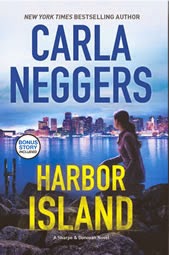
Classic Mystery Puzzle With Dash of Romance: HARBOR ISLAND, Carla Neggers

The new Sharpe and Donovan mystery from Carla Neggers, HARBOR ISLAND, came out just as the garden demanded harvesting and pickling, but I managed to stay up extra late and keep reading -- because Neggers is a storyteller who constantly nudges the next "and then ..." into place.

FBI Agent Emma Sharpe's new status as fiancée of another FBI agent, Colin Donovan, hasn't yet been announced to her family, and there's always a fresh conflict of interest for her on the job: Which is more her core, her agent status or her family's profession in solving art crimes? Added to that, Colin's still wondering how she'll handle the engagement, considering that her past includes a season in Maine as a postulant -- not quite a nun, but to Colin and his brothers, there's not much difference.

True to classic Neggers style, the author juggles Emma and Colin's uncertainties with the way each of them is called to step into danger to chase the art thief they've hunted for in Ireland in a preceding book. And now the thief seems to have followed them home to New England and may be turning violent -- a sudden death by gunshot of an informant can't be a coincidence, can it?

HARBOR ISLAND is also a traditional puzzle mystery, as it sets up a small cast of characters and moves the question around the group: Motive? Means? Opportunity? Will it be Emma or Colin who finally cracks the case?

A big part of the charm of this series is its settings, from Boston to Maine to Ireland and back again. Count on each clue holding some meaning, neat twist of plot, and tidbits about Irish whiskey tucked in often. This isn't quite a "cozy" mystery, as the sleuths are professionals, not amateurs, but between the romance and the landscapes, it's a gentle read, ideal for unwinding by an autumn woodstove with a cup of tea and a cat. Or something even sweeeter.

Saturday, October 12, 2013

Catching Up on William G. Tapply's Mysteries

Emma at Open Road Media sent this along a few weeks back, and I just made time (finally!) to visit the website for William Tapply at Open Road Media. What a great idea -- Tapply's books were challenging to find at times even when he was still "among us." Since his death, I've thought of his series from time to time, and wished I'd collected all of his books when I still had the chance to meet him. Now, with this "Tapply library" so accessible, I can at least indulge in reading the Brady Coyne titles I never did add to my shelves. Here's Emma's message:
We are thrilled to announce the ebook publication of seventeen Brady Coyne legal mysteries by William G. Tapply. Written between 1984 and 2009, Tapply’s beloved mysteries begin with the Scriber Crime Novel Award–winning Death at Charity’s Point, and feature the avid fisherman and Boston lawyer, Brady Coyne. The Washington Post claims Brady Coyne is “one of the most likeable sleuths to appear on the crime scene in quite a long time.”

William G. Tapply (1940-2009) was the author of over 40 books, including over two dozen Brady Coyne mysteries. He was a frequent contributor to outdoor magazines, such as Field and Stream and American Angler, as well as an English professor at Emerson College and Clark University.

We hope that by making these novels available as ebooks, they will reach the wide audience that they deserve. I’d be delighted if you shared the news on your site or through your social networks, and I encourage you to check out the new cover art, available on the author’s page here.