Showing posts with label humor. Show all posts

Monday, March 09, 2026

New Taipei Night Market Crime Novel from Ed Lin, THE DEAD CAN'T MAKE A LIVING


If you are an American or a European, you may feel like "immigrants" is a fighting word where you live -- the kind of issue that lures people into strong positions and sometimes regrettable statements. Your region's not the only one struggling with issues of migration, migrant workers, and immigration, though.

Ed Lin's newest Taipei Night Market novel (I reviewed Incensed, 99 Ways to Die, and Death Doesn't Forget - click on those) releases from Soho Crime on April 7, but of course you can pre-order it if you like. And THE DEAD CAN'T MAKE A LIVING is so packed with humor, peril, and plot twists that you might as well line up a copy to get you through whatever crises you feel like you are just barely handling.

 It helps if you know what the night market is in Taiwan, but Lin is expert at pulling you into the action with deft strokes of explanation. During his first class session at the night college that Jing-nan recently signed up for, to improve his life options, he's ready with a self-intro: "I want to tell you about my daily life, what it's like at the Shilin Night Market, where I have a stand called Unknown Pleasures. Visitors from every continent around the world love our skewers."

 But his very nasty teacher would rather tell the class about all the crimes Jing-nan's been involved with, calling them "stunts" and saying Jing-nan is associated with figures from Taiwan's underworld.

 Well, that last part is true, but it's not something Jing-nan would talk about --  he does have family members who carry clout in the criminal world. With such a nasty teacher, he's glad to know others will back him up, even though there's always a price to pay for that kind of support, isn't there?

The crux of this crime novel begins to unfold just a few pages in, as a group of Filipino customers are taking up a lot of the seats when Jing-nan gets back to his food stand. His quick math indicates they've spent a lot of money on his food, and he's glad to encourage them.

"We're happy to have generous customers like you. Thank you all so much." I meant it sincerely. These weren't tourists from the Philippines. They were migrant workers, and some had been taking the government Mandarin classes. Maybe they were from the nearby food-processing plant. ... they streamed into the night market, which offered a lot of food and entertainment for relatively cheap. I put my hands together and bowed my head slightly to my customers, a universal sign of humility and appreciation for their business. 

For Jing-nan, that amounts to a commitment to see even these migrant workers treated well. So when one of them is clearly murdered, and another asks him for help finding out what happened, this chef and "adult student" agrees to look into the death.

Soon he's in too deep to back out, and even his uncle Big Eye can't stop bad things from happening to him. Ever the entrepreneur, he speculates on the value of adding a crime blog to his food blog:

My crime posts wouldn't be journalistic and dry. They would start on a visceral note: "Two hours in, blood from my loosened molar continued to drip down my throat. I asked for a drink of water to wash away the metallic taste, but my kidnapper refused. It was going to be a long night."

Will Jing-nan ever make it back to class? Actually, with his relatives interfering on his behalf, will his nasty teacher make it back?? And how will all of this affect his bottom line, his de facto marriage to Nancy, and his ability to staff his food stand?

Admit it. You have to know what happens next. I did ... I couldn't put this one down. 

Wednesday, May 31, 2023

Adventure, Murder, and Twists of Bookstore Merriment from Tamara Berry, in MURDER OFF THE BOOKS


Tamara Berry's wicked sense of humor is a great match for her neatly twisted plots in her "By the Book Mysteries," set in the Big Woods country of the Northwest. Crime novelist Tess Harrow's family legacy in this timber-centric town isn't as wild as her best-selling status, but it does include a former hardware stores (see the earlier books of the series) that she's turning into a bookshop of her own, with of course a stack of her newest release on the counter.

But Grand Opening plans run awry when (of course!) murder sweeps into town once again. This time, a top-selling podcaster arrives at the same time, and starts to paint Tess's recurring corpse discoveries as possible indications that she herself is a criminal!

Perish the thought, or even better, perish the podcaster. Except that's not going to happen. Tess's daughter is thrilled by the visitor. Her definitely difficult mother sweeps into town at the same time -- and the corpse turns out to be Tess's mother's boyfriend of the moment, the notorious Levi Parker, who might have tried something deadly if he hadn't been killed first. And oh yes, Tess and the sheriff may or may not be an item. Complications.

Is your head spinning yet? Jump into this lively bibliomystery laden with smart sassy women and to-die-for dialogue, as well as a plot that gets more crazy and more likely at the same time, page by page. MURDER OFF THE BOOKS is the fun mystery your summer reading stack has been waiting for. 

[The earlier books in the series are Buried in a Good Book and On Spine of Death -- treat yourself!]

PS: Looking for more mystery reviews, from cozy to very dark? Browse the Kingdom Books mysteries review blog here.

Sunday, January 01, 2023

Outrageous Alaska Adventure from John Straley, BLOWN BY THE SAME WIND


The town of Cold Storage, Alaska, is John Straley's best invention: a place where almost any sort of humane criminal activity can and does happen, with a steady twang of Alaskan country music in the background and a slew of strong women enjoying cash-poor life as much as the men around them. The minute you aim for this locale, you give up control of what makes sense -- and ride with a mix of wild characters for the duration. Earlier Cold Storage novels began with The Big Both Ways, then Cold Storage, Alaska, and What Is Time to a Pig? 

It's crime fiction ... sorta. Remember the scene in The Godfather with the horse's head? That could happen in Cold Storage, on the chilly and salty coast. Except it could be a grizzly head. Still attached. And the person who held the door for the bear to come in would still be standing nearby, tipping back a beer (not the "craft" kind).

There was still no road into or out of Cold Storage, but somehow, in 1968, the world had arrived. In March, Lyndon Johnson announced that he had decided not to rub for president. Some said it was because of the Tet Offensive in the first part of the year. Boys from Cold Storage had gone to the war and three of them had died ... All of the boys had fished with their families and were memorialized on a hill off the road to the dump.

But the tale gets into gear with one of the boys who made it home, Glen Andre, with long hair, a tendency to not speak much, and an army jacket "with a bronze star pinned on the front." Because this is, after all, Cold Storage, you should simply nod hello with the rest of the crowd when the Kentucky anti-war monk Thomas Merton also arrives in town ... followed by a couple of obviously nasty criminals, and a probable FBI agent.

Still, even in Cold Storage, if a person wants privacy he can sort of get it, and if Thomas Merton wants to call himself Brother Louis, and teach something about God, that's up to him. The trouble is, he's explaining it to a striking young woman named Venus, who never met a boundary she didn't want to cross. Or a man who wasn't fascinated by her.

[The brother] began to see Venus not as an American teenager, but as a sprite from A Midsummer Night's Dream. On that night he followed Venus and the lights on her helmet up the hill, where at the summit he would try to reveal the mystery of both God's omniscience and His absence as Louis's heart beat like a steam engine in his chest.

By this point, either you devoutly want to read this novel, or you wouldn't touch it with a ten-foot bookmark. If you've embraced Donald Westlake, Janet Evanovich's Stephanie Plum series, or the Junior Bender books from Timothy Hallinan, I hope you're already ordering a copy of BLOWN BY THE SAME WIND. You're going to have a lot of fun and an occasional moment of thinking maybe you just figured out something you care about, a lot. 

Published, of course, by the boundary-challenging Soho Crime, an imprint of Soho Press.

PS: Looking for more mystery reviews, from cozy to very dark? Browse the Kingdom Books mysteries review blog here.

Sunday, July 24, 2022

From Larry Beinhart ("Wag the Dog"), THE DEAL GOES DOWN


Tony Casella's dream life may be a lot more satisfying than the awake part. He's just been pitched a job as a hit man, while riding a train to a funeral. It's got him confused, but also tempted, because his finances have never been worse. But his thinking is pretty messed up, even in a dream about someone he's sure is dead:

I meanwhile had an ordinary, pleasant, live person's conversation with Owen. He said business was good, but not as good as it had been, big companies largely created through national security money were moving in and everything was going digital. By then, some of my own ghosts were sneaking in, some to taunt, some to make me mourn ... my wife and my son ... to tear my heart out if I'd still had one.

Part New York noir, part unexpected hero, and a big part dark caper novel, this satirical thriller is a lively return to publication for both Larry Beinhart (his previous book was in 2013) and his long-time private eye, Tony Casella. Despite a solid series of detective fiction, Beinhart's probably best known for the film adaptation of his book Wag the Dog (with an all-star cast). So it's good to see THE DEAL GOES DOWN as a solid book-on-paper, with an August 9 release date (time to pre-order it).

This will especially suit Donald Westlake and Walter Moseley fans, as well as readers who've discovered Rory Flynn. Restoring Manhattan Noir is well worth the effort! Brace for a quirky ending ... but then again, why not?

PS: Looking for more mystery reviews, from cozy to very dark? Browse the Kingdom Books mysteries review blog here.

Sunday, November 14, 2021

Martin Limón Brings Back Sueño and Bascom in WAR WOMEN, 1970s US South Korean Occupation

As for so many of the crime fiction series from Soho Crime (Soho Press's dedicated imprint), there's a lot of eager anticipation for each year's new novel from Martin Limón. WAR WOMEN, a November 2021 release, features US Army CID (Criminal Investigation) agents George Sueño and Ernie Bascom, chasing down criminal activity -- not necessarily to shut down crime during the US occupation of South Korea in the 1970s, but to make military life easier and more profitable for their bosses.

Two major twists take this adventure into new terrain for the pair of investigators. The first is that one of their particularly eccentric fellow soldiers, Sergeant First Class Cecil B. Harvey—known to George and Ernie as "Strange," for his unending hunger for tales of romantic and especially sexual strangeness—has gone missing, along with a top-secret document. Both of these aspects are so unexpected for "Strange" that the investigators would be chasing him down no matter what, just to satisfy their own curiosity. But in fact the sergeant, who's in charge of the 8th Army's classified documents, is such an essential ally that they've got to find him and try to get him back. Digging into the disappearance will pit them against both their own army and the North Korean espionage system.

Every new moment puts them at risk, though: As George notes, "I'd just reached out to hang my coat on the rack. I held it a moment, frozen in fear. Had they already discovered the theft of the document? Had Strange told them of our involvement? As calmly as I could, I turned and asked, 'What's this about?'"

As usual, Sueño and Bascom need to manage their personal pursuits while also obeying orders. In this case, their assigned task is to manage a tabloid journalist threatening to expose their superior officers. That would be tough on its own, but the journalist is Overseas Observer reporter Katie Byrd Washington, whose brilliant ability to sneak around and use colleagues against each other has already burned the two in the past. And somehow, they're supposed to lock her up:

Katie Byrd Washington was a civilian. Her legal fate fell well outside of 8th Army's jurisdiction. The US military could pull her press pass and deny her access to our bases—if we had justification—but arresting her would be strictly illegal. Illegal not only under American law, but also under Korean law.

It turns out that their bosses expect George and Ernie to manipulate their Korean police colleague, nicknamed (with reason) Mr. Kill, into doing the job for them. Anyone who's read any of this series knows that's failure just waiting to happen. Mr. Kill isn't just non-manipulable ... he's downright dangerous when annoyed.

WAR WOMEN offers a great romp across terrain and situations, including some little-known roles of Army women and their Korean allies. There are no particularly high-tension moments, and not a lot of change in Ernie and George—but as winter entertainment, the book is a delight.

PS:  Looking for more mystery reviews, from cozy to very dark? Browse the Kingdom Books mysteries review blog here.

Tuesday, October 19, 2021

Peter Diamond Gets a Private Eye, in Peter Lovesey's 20th in Series, DIAMOND AND THE EYE


 [Originally published in New York Journal of Books]

“Every private eye from Sherlock Holmes to Matt Scudder needs a line into the factory. Sam Spade had his tame sergeant, Tom Polhaus. Philip Marlowe had Officer Randall from Central Homicide. It comes with the territory.”

Peter Lovesey’s Peter Diamond investigation series is in its 20th full-length title, and with age comes the privilege of taking things very lightly – so Diamond and the Eye is an almost nonstop giggle, as well as a classic police detection episode with this British Detective Superintendent. It’s the perfect prescription for those who’ve been taking their lives (or their crime fiction reading) too seriously.

From the very start, Diamond is fed up with a private investigator—the private “Eye” of the title—crashing into his Friday evening, and then a missing person case as well. Diamond’s perception of PI Johnny Getz (a nom-de-dick for the job) tells it all: “The stranger’s voice was throaty, the accent faux American from a grainy black-and-white film a lifetime ago. This Bogart impersonator was plainly as English as a cricket bat. His face wasn’t Bogart’s and he wasn’t talking through tobacco smoke, but he held a cocktail stick between two fingers as if it was a cigarette … he was dressed in a pale grey suit and floral shirt open at the neck to display a miniature magnifying glass on a leather cord.”

From calling Diamond “bud,” to speaking of him as “Pete” to colleagues, Johnny Getz is a man without boundaries—but with a determination to get his first and only PI job done for his relatively trashy client, Ruby, daughter of an antiquities dealer named Seppy Hubbard. Seppy’s vanished, Getz is supposed to find him or find out what happened to him, and Diamond, fighting back as hard as he can be bothered to do, soon discovers there’s been at least one murder involved, with every reason to bring in his team.

But there’s nothing straightforward about tracking down a missing (perhaps dead) dealer, when Johnny Getz keeps butting in. Peter Diamond’s Detective Sergeant Ingeborg Smith attempts to keep the peace, assuring Diamond that Getz won’t stay involved: “He’s out of his depth now. Private eyes don’t investigate homicides except in books. A missing person case, maybe, but not a killing.” But once Ingeborg does meet “Johnny,” she’s got to admit he’s going to stick around as they work this case.

Johnny Getz litters his conversation and his performance with references to PIs of the past, all in books. Readers of classic detective fiction can giggle and guffaw as they ride shotgun with this new wacky character, recognizing his American PI heroes well before the British police team grapples with what Johnny’s attempting to copy. Finally, Ingeborg feels the need to take a stand: “Don’t knock my guv’nor,” she warns Getz. His response is to tell her how much he values Diamond. Why, after mentally calling the DS a fat slob? It’s simple: “Every private eye from Sherlock Holmes to Matt Scudder needs a line into the factory. Sam Spade had his tame sergeant, Tom Polhaus. Philip Marlowe had Officer Randall from Central Homicide. It comes with the territory.”

Though Ingeborg protests that PIs belong in a different country and a different century, far from 21st-century Bath in Britain, she doesn’t have a chance of talking Johnny Getz out of getting his man, so to speak. And getting paid.

Through the nonstop campy humor runs a solid and clever little mystery, with some great red herrings and a fine twist before solution. The one part unresolved by the end of Diamond and the Eye is whether Johnny Getz will now leave “Pete” alone.

It’s the nature of a series to leave the reader suspecting there is more to come of this frustrating and funny pairing, in Peter Lovesey’s books ahead. 

PS:  Looking for more mystery reviews, from cozy to very dark? Browse the Kingdom Books mysteries review blog here.

Wednesday, April 21, 2021

Legal Thriller from William Deverell Offers Rich Read, Moral Choices, Laugh-Out-Loud Moments

[Originally published at New York Journal of Books]


“Along with its humor, every chapter of Stung offers both the cost of taking moral action, and the deep suspense of being human. “

Stung is the eighth of Canadian author William Deverell’s award-winning Arthur Beauchamp legal thrillers. Dogged by the challenges of his own aging mind—unsure whether he can absorb the details of a case, let alone defend a group of radicals who’ve clearly committed a crime—lawyer Arthur Beauchamp finds himself caught in a tripled disaster. First, there’s the defense of the seven urban radicals who invaded an insecticide factory, to bring attention to the mass deaths of honeybees resulting from its products. Second, his home retreat on an island off Canada’s west coast is under threat from a mining company. And third, he keeps disappointing his politician wife, who’s spending a lot of her time in Toronto and other urban and urbane locales. Oh, and then there’s the dog problem.

Deverell doubles the size of this enjoyable crime-and-defense enterprise to nearly 600 pages by narrating from both Arthur’s point of view and that of one of the defendants, the very clever (if in many ways naive) activist Rivie Levitsky, whose task to prepare for the factory attack was the almost-seduction of one of its managers. (This is one of very few crime novels in which She give He a “roofie,” for extraordinary reasons.) And Rivie is a delight, full of surprises and passion. But it’s Arthur that Deverell presents as the character under most threat, and under demand for personal courage and change.

When he first appears, in the second chapter, he’s not in great shape after stepping on a wasp nest in his pasture: “Arthur Beauchamp is in his underpants, seated, his right foot elevated, an inflated pink balloon, and it hurts like the wrath of God. Thirteen stab would fir which a cold pack, calamine, and baking soda offer not a tittle of relief. … Arthur used to don his gown for occasional courtroom forays, always scuttling back to his sanctum sanctorum with great heaves of relief. That’s history. Let his record of thirty-six straight wins be his legacy.”

His intent has been to retire, continue his island paradise, love his dog. But the dog dies and gets replaced by an enormous and spirited Irish wolfhound that can’t stay out of trouble; paradise gets invaded by commerce; and the only ally he has who’s capable of rescuing his home is a lawyer who’s involved with the arrested activists and maneuvers Arthur into a swap: One will save the island, and the other will do his best to save the activists (who, in the name of “all publicity is good publicity,” are already proclaiming their “criminal actions” as utterly necessary to save the globe).

Despite its length, it’s almost impossible to put down Stung—Arthur and Rivie are warmly likeable, doing their best to stand up for their moral imperatives, despite the way they stumble: Arthur from aging (can he re-engage his courtroom dynamism if he can’t recall names anymore?), and Rivie from impulsiveness and at times terror. The threats are well portrayed, the action quickly paced, and the stakes enormous. Plus, Deverell provides word-play and humor in moments like this one, when Arthur narrowly avoids yielding to a neighbor’s seductive offer:

“Now, in the bathroom, standing under a hot, cleansing torrent, aghast that he’d skirted so close to a disaster of orgasmic magnitude, hardly able to fathom how, God knows how, he’d found enough strength to deny the primitive urgings of his id, desperate to believe he had not encouraged what nearly happened, feeling shame but still flushed and quivering with carnal heat, Arthur takes matters into his own hands.”

But of course, there’s also courtroom drama, and continued backsplash of crime and threat for the defendants, from both the corporation they assaulted and their public. Along with its humor, every chapter of Stung offers both the cost of taking moral action, and the deep suspense of being human. Shelve this one in the “read it twice” section, for good fun and thoughtful provocation around what it will take to save the planet and its best people.

PS: Looking for more mystery reviews, from cozy to very dark? Browse the Kingdom Books mysteries review blog here.   

Saturday, February 08, 2020

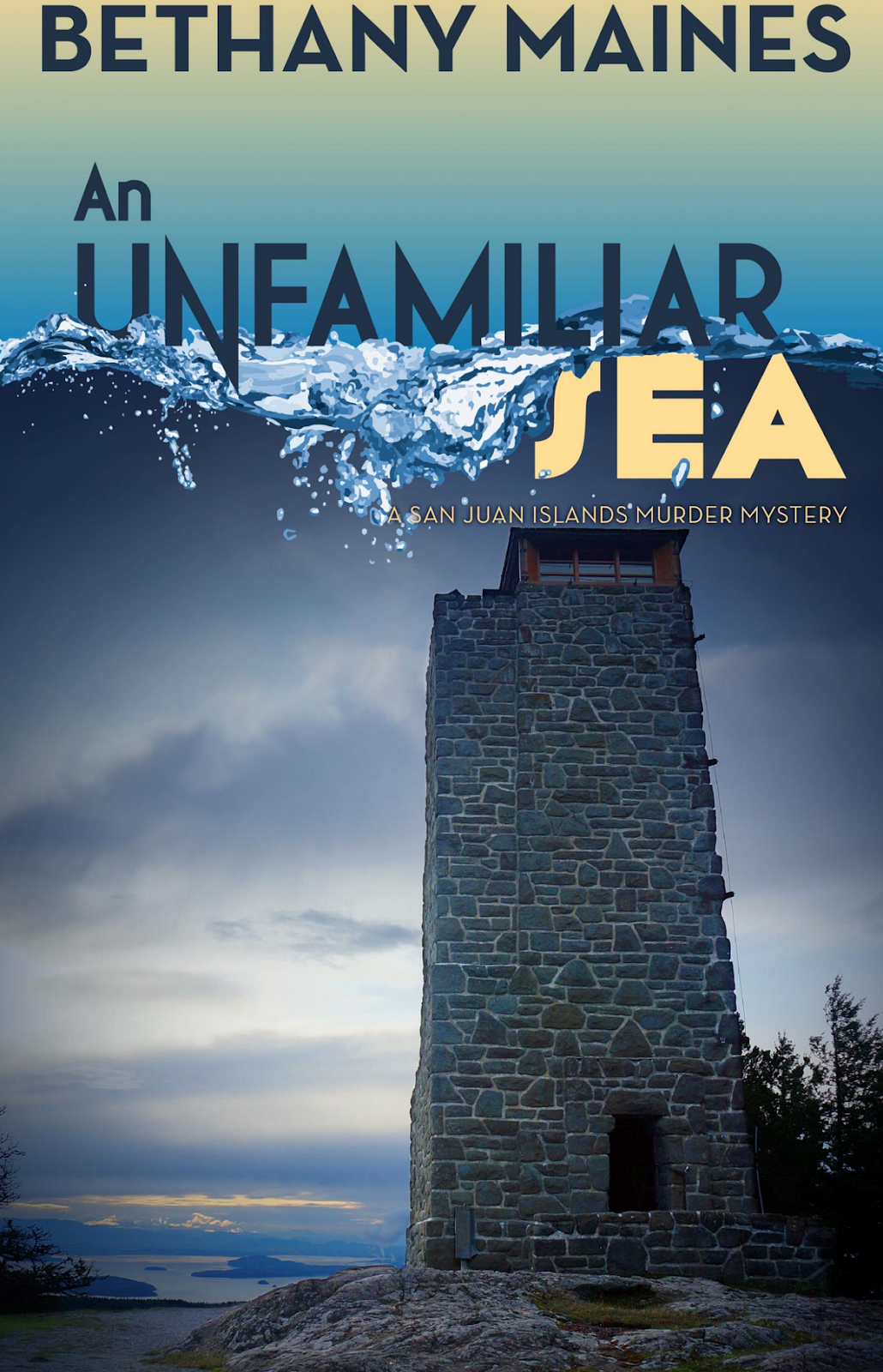
San Juan Islands Mystery #3, AN UNFAMILIAR SEA, Fast-Moving Traditional Mystery from Bethany Maines

There are two kinds of crime fiction: the ones that begin with action, suspense, and risk, and the ones that build up to it with a few chapters that connect you first to the characters and the setting.

No, come to think of it, there's a third kind, and Bethany Maines writes this kind -- the ones that begin with a moment of conversation that makes you snort your coffee in the wrong direction, or grin so widely that strangers ask what you're reading.

Maines brought out a series a decade ago based on a global cosmetic company being a front for high-tech, high-action women agents in international espionage. Those "Carrie Mae" books tended to get me into trouble with my quietly reading spouse, because I'd be choking, laughing, and insisting on telling him the wild and wildly funny plot twists.

With her San Juan Islands series (islands off the coast of Washington state), Maines takes a few steps into more traditional layouts for detection and espionage: Tish Yearly, a lapsed actress, wound up living with her aging grandfather Tobias on Orcas Island because she ran out of other options -- and learned in the process that he's a retired CIA agent. To keep him busy, she's helped him get a private investigations agency rolling, and at the start of book 3, AN UNFAMILIAR SEA, Trish is digging into island life by opening her own business: a wedding destination.

But nothing's as simple as it sounds at first. For example, there's the process of being a boss -- when Tish least expects it, an employee for the wedding business anounces, "I'm pregnant."
Tish's thoughts and her feet came to a stumbling halt. "What?" Tish stared at twenty-two-year-old Penelope Drue, who was clasping and unclasping her hands in front of her chest. Penelope looked like she needed more than a one-word question, but Tish needed more than a two-word announcement. "Congratulations?" Tish tried.
When Penelope is found dead the next day, and only Tish and presumably the father know about the pregnancy, Tish tackles convincing the law enforcement team on hand that there could be more to the death than an accident. That shouldn't be too hard to do, considering Tish is "involved" with one of the investigators -- but actually that complicates things most of the time. ("Dating Nash had never been in her plans, but kissing Nash was always on her top ten list. He made her toes curl.")

Add in discovering her grandfather's been jailed on the mainland, and trying to sort out a possible involvement of the local drug dealer on several fronts. But what Tish never dreamed would happen is a personal attack from that very same grandfather, who's apparently been sure she won't stay on the island and therefore won't keep the business going and ... should we mention what that could do to Nash, in grandfather Tobias's unkind opinion?

Don't confuse this with a "romance mystery." Tish often has a sardonic edge to her, which keeps the dialogue snappy, whether it's with suspects, or just in her head -- or with Detective Spring, a law enforcement pro who definitely doesn't have a soft spot for her:
"Here to bail [your grandfather] out?" he asked.

It was exactly this kind of question that annoyed Tish. He knew the answer. Why even ask?

"No," said Tish. "I brought him a cake with a file in it, but other than that, I figure he's on his own. I'm going to spend my evening recording over his Matlock collection." Detective Spring raised an eyebrow and gave her a look. She gave him a look back.
Maines balances a delicious amount of risk and re-thinking with the perils of island life, and her red herrings (fresh from the Pacific?) provide both puzzle solving and lively distraction along the way. As with most traditional mysteries, you've got a chance to figure out the villain before Tish was -- but you may be chuckling (or biting your nails) too much to follow the right thread. One way or another, shelve this one as really good entertainment — a well-blended caper mystery with memorable scenics and characters, just enough edge to the humor, and satisfying strands in the solving.

PS:  Looking for more mystery reviews, from cozy to very dark? Browse the Kingdom Books mysteries review blog here

Wednesday, December 04, 2019

Do You Like Your Espionage Icy or Warm? Check out JOE COUNTRY by Mick Herron

Mick Herron's Slough House espionage novels come along mostly as an annual series now, with occasional diversions into standalone works and novellas and such. JOE COUNTRY is the sixth full-length novel in the set that opened with Slough Horses, where the ever-farting and outwardly vulgar Jackson Lamb corrals the failures of Britain's government-run system: the men and women who've committed mistakes so glaring or costly (or stupid) that they can't be allowed back in the saddle, yet can't be simply fired either, since they know too darned much. Hence Lamb verbally abuses and embarrasses them while giving them small tasks to keep them out of trouble.

But readers of the series know that some of what's put the "slough horses" into this corral has been bad luck or someone else's successful venial plot. Or love. Or grief. So from time to time, Jackson Lamb sends his crew out to actually accomplish something in "joe country": the landscape of where the working spy, aka the "joe," struggles to undermine the forces of evil and somehow stay alive.

In John Le Carré's classic espionage series, George Smiley's drive is not really love or protectiveness, but an ardent belief in honor that can only be justified if he can make the scales around him come into balance. To do that, he has to pay attention to and care about the small people being run over by the government and espionage ("church and spy") maneuvers and sacrifice plays.

Herron gives a very different set of characters, only one of whom might fit into Smiley's honorable world: River Cartwright, grandson and espionage heir of the O.B. (Old Bast***). But as JOE COUNTRY gets underway, River's grandfather is dying, not going to outlast the day.
He had thought about calling his mother, but for no longer than it took to shake his head. Then he'd willed himself up and into yesterday's clothes, arriving at Skylarks, the nursing home, before the sun. His grandfather had been moved into a room that was purpose-built to die in, though nobody actually said so. The lighting was gentle, and the view through the window of winter hills, their treeline a skeleton chorus. The bed the O.B. would never leave was a clinical, robust device, with upright panels to prevent him from rolling off, and various machines monitoring his progress. On one, his pulse echoed, a signal tapping out from a wavering source. A last border crossing, thought River. His grandfather was entering joe country.
River's deep solitude of the soul, and his bitter state of mourning, were in place long before his grandfather began to fail. But they're not a symbol for the state of England (or Britain); they're an honest assessment of his world and his provoked failures in it, as well as the violence of joe country itself. Each of the others who accompany River in Lamb's entourage is broken in some way, some of the ways more entertaining than others—it can be a hoot to see Roderick Ho lasciviously spy on random women and think he's a hot ticket, while it's desperately sad to walk with Catherine Standish as she flirts with destroying herself alcoholically ... only holding back in order to either punish or rescue Lamb (pick any two).

Meanwhile, the Park—that is, the formally surviving manor of espionage where the pay and the politics both serve as honed blades—aims to destroy Lamb and his entourage. Fortunately, Lamb's not just tricky and malicious (and much smarter than his opponents): He's discovered a dangerous foreign agent manipulating the top brass and knows how to use that to ensure protection for his game.

It's Catherine Standish, despite her vulnerability, who takes in the whole scope of the mess at last. "She had to remind herself, maybe for the millionth time, that this was the world she lived in; that Spook Street wasn't all boring reports in manila folders. That joe country lay around the corner."

The twists and wicked humor in JOE COUNTRY, combined with the odd forms of loyalty embedded in the operations underway, make it a classic. Shelve it. Mark for re-reading. (I have.)

Do you need to read the others in the series first? I always want to say no, but ... tell you what, pick any of the preceding titles (Slow Horses, Dead Lions, Real Tigers, Spook Street, London Rules) and read that one first. Then JOE COUNTRY will feel twice as satisfying.

But no matter which route you take, when you finish this book, make room for the other Mick Herron titles on the same shelf. They deserve the space, including in the heart.

PS:  Looking for more mystery reviews, from cozy to very dark? Browse the Kingdom Books mysteries review blog here.

Sunday, October 07, 2018

Taipei Night Market (Crime) Novel 3, 99 WAYS TO DIE, Ed Lin

The next "Taipei Night Market" novel, 99 WAYS TO DIE, comes out from Ed Lin and Soho Crime on October 9 -- and it's worth pre-ordering it now, to line up a reading session of enjoyment, lively suspense, and a taste of another world's other world.

Jing-nan, an amiable young man with a strong business drive, runs his dynamic and carefully balanced food stand in a sort of late-hours-only food court in Taipei, Taiwan. He's dead serious about the quality of food he serves, and ponders ways to add interest and excitement to the menu without losing the solid "Yelp" type following he already has among American tourists. His thinking on creating a vegetarian item from a new kind of fruit he finds on sale is downright intriguing (it almost sent me to the kitchen).

But what really counts with Jing-nan is loyalty to his friends. Even when his life is in danger.

So when his former classmate Peggy Lee phones him in tears, even though he has customers queuing at the stand, he's there for her -- although it's hard to understand what's up, between her sobs and the fact that her powerful father (who happens to be Jing-nan's landlord) could not possibly be the victim of a crime. Could he? Fortunately, the two other worked in the stand -- whose ethnicity will soon be significant! -- pick up on the crisis and give Jing-nan room to listen.
I fully turned my attention back to my old classmate. Her sobs had decreased in volume and frequency. Maybe she could talk now.

"Peggy," I said as I looked to the wall. "I want to make sure I heard you right. You said your father was kidnapped?"

"Yes," she managed to say. Peggy Lee, who would be nonchalant while standing on a cliff that was crumbling beneath her feet, was having difficulty verbalizing a single syllable. She must love her father more than anything.
And that, actually, could be a problem for Jing-nan if he gives in and tackles trying to rescue Peggy Lee's dad ... because no matter the risks involved, Peggy will feel they are justified, and won't care if Jing-nan's injured or killed in the process!

Fortunately, Jing-nan's girlfriend Nancy offers some counterweight to this tendency of Peggy's. But the kidnapping turns out to involve gangs, money, business ... and the politics of Taiwan, which holds a very uncomfortable position in terms of mainland China. And oh yes, since it's Peggy Lee's family at stake, this will be a media circus as well.

Lin's plotting has tightened over his career, and he's now adept in twisting his crime fiction in marvelous ways that incorporate almost as much humor (in mystery, we call it "capers") as the master Donald E. Westlake -- while winding into the plot the tensions of native, aboriginal, mainland, island, in lively and quickly grasped strands of added tension. Best of all are his characters: I wished Jing-nan and Nancy lived a lot closer (although I don't think I'd want to have a lot to do with Jing-nan's employees, whose skills extend beyond the kitchen in somewhat scary ways).

I enjoyed book 2 in this series, Incensed, almost as much. Although there's no need to read the earlier books before 99 WAYS TO DIE, it's a lot of fun to catch up with Lin's narratives, and I think I'll add number 1, Ghost Month, to my shelf, for the pleasure of such good reading.

Published by Soho Crime, an imprint of Soho Press, which continues to gather great additions to international crime fiction.

 PS:  Looking for more mystery reviews, from cozy to very dark? Browse the Kingdom Books mysteries review blog here. 


Sunday, August 12, 2018

Chasing Crime in Laos with Dr. Siri Paiboun, #13, DON'T EAT ME, Colin Cotterill

Dr. Siri Paiboun has retired from his Party-required position as national coroner of Laos (1980s style). That gives him plenty of time to spend with his wife, Madame Daeng, assisting at her noodle shop -- except somehow he's pretty often away on adventures instead. As DON'T EAT ME (number 13 in this highly entertaining international caper series) opens, Dr. Siri and his good friend Civilai -- Comrade Civilai, that is -- have smuggled a large, bulky item home on a raft. And the next morning brings them a regrettable visit from their friend Inspector Phosy, who has not retired and therefore needs to confront them with presumably smuggling a weapon into the People's Democratic Republic of Laos.

The good part is, it's not a weapon -- it's an enormous electrical movie camera, for the friends' ambitious notion to create a Laotian version of War and Peace on screen. Starring, of course, handsome young men like themselves (okay, like they Once Were).
A year earlier there had been an incident that resulted in the old boys coming into possession of some drug money. Quite a sum in fact. Siri had invested much of his in charitable acts while Civilai had smuggled in some delicious but rather expensive wines, a new lounge suite and a car -- not new but classic. Yet still they had not completely used up their ill-gotten gains. In fact they had enough not only to buy the camera, but also, with a little budget tweaking, to produce a modest film of tehir own. ... They removed the camera and wrapped it in an old parachute canopy. Getting it to the Lao side would be Siri's problem. ...

"How do we develop the film?" Civilai asked.

Siri laughed.

"Old Brother," he said, "on the eve of the race does the marathon runner worry about what drinks will be available at the winner's reception party? No. He takes one step at a time."
Once Phosy realizes he doesn't have to arrest his buddies, everyone relaxes. Which in turn leaves time to comtemplate the challenges for their plan: No power to run the machine. No operating manual. An interfering sort of local bureaucracy that's likely to rewrite the script for its own members, if it gives a shooting permit at all. And, oh yes, complications in the family circle, related to Mr. Geung.

Readers of the series will leap at the notion of hearing more about Mr. Geung's life, especially his planned marriage (!). If you haven't read any of the earlier books, be warned: You need to abandon disbelief, go with the flow, and let Dr. Siri and Mr. Geung demonstrate the fine points of the Laotian spirit world, where each of them keeps connecting.

But there's more to DON'T EAT ME than the madcap adventures of these rebels! There is, of course, a crime ... perhaps two or three? ... a skeleton (not yet bare) ... a criminal enterprise involving animal smuggling ... and conflict with the "real" bureaucracy.

Cotterill's passion for clever and unexpected twists that show the Party at its manipulative worst (and of course Dr. Siri fumbling his way toward a solution that his friends will help implement) takes the plot to drastic extremes this time. It felt like a lot of chapters spent wondering whether the team would ever be able to restore its usual lives -- and feeling highly anxious about missing family members!

Colin Cotterill's Dr. Siri books are always a delight. DON'T EAT ME may be one of the most memorable in the series. And it's almost sure to send you back to the earlier titles, whether for the first time or the third (or more). Good fun, and a great summer read, from Soho Crime (an imprint of Soho Press).

PS:  Looking for more mystery reviews, from cozy to very dark? Browse the Kingdom Books mysteries review blog here.

Sunday, June 03, 2018

Bittersweet Humor, Taut Crime Pacing, in LONDON RULES from Mick Herron

Mick Herron's Slough House series has already drawn a pair of CWA (Crime Writers' Association, UK) silver daggers -- and with this fifth of the full-length "MI5/6" style crime novels in the series, he's hitting some of his best notes yet.

Any reader of John Le Carré already knows the term "Moscow Rules": the keep-safe guidelines for espionage on foreign turf, where every stranger can be ready to sabotage your effort or your life. In a brilliant an enteraining twist, Mick Herron provides "London Rules" -- the conventions of the dog-eat-dog tangle of British espionage agencies competing for government favor, funding, and job security along the Thames and in the adjacent terrain.

LONDON RULES opens (after a dramatic mass murder preface) with an artful discussion of the daylight's revelations in Slough House, home to failed domestic espionage agents who can't be fired -- but can be made supremely miserable and humiliated by repeated assignments to tasks involving phone bills, website listings, and such. In fact, the tiny pocket of underemployment would be an utter failure and disgrace, were it not for its leader, the bright but rather disgusting (verbally, in appearance, and through massive farting) Jackson Lamb. Because Lamb may have the Service's supreme screwballs. But when they get to Slough House, they become HIS screwballs, to torment and mock in conversation and duties ... and to align and operate under the radar when he so chooses, protected by his massive influence, connections, and, sigh, persistent blackmail.
[Lamb's office] is cramped and furtive, like a kennel, and its overpowering theme is neglect. Psychopaths are said to decorate their walls with crazy writing, the loops and whorls of their infinite equations an attempt at cracking the code their life is hostage to. Lamb prefers his walls to do their own talking, and they have cooperated to the extent that the cracks in their plasterwork, their mildew stains, have here and there conspired to produce something that might amount to an actual script ... a moving finger had write before deciding, contrary to the wisdom of the ages to rub out again.
Such pretentious teasing prose is quickly balanced by a sequence of disasters and threats that forces Jackson Lamb to place his "agents" back into play, even as he mocks the chances that they might succeed.

But it's necessary, because as Lamb's rather unpleasant agent Shirley Dander -- on her 62nd drug-free day -- discovers, someone is trying to murder her fellow agent Roderick ("Roddy") Ho. And the grotesque linkages in Slough House mean if one agent's at risk of sudden death, so are they all.

Soon Lamb and his able (if a lot crazy) assistant Catherine Standish take Shirley's side. They even confront one of the superiors trying to shut them down, Emma Flyte, as Flyte argues about that opening mass murder and its sequelae:
"So let's say he's right. Even if the Park [the active security force] don't listen, tell them about it and you've covered your back."

[Lamb responds] "Yeah, not really. Because if these guys are laying waste to the country using a script the Service wrote, there are few lengths the Park won't go to to cover it up. And anyone who knows about it will be in the firing line. Which includes you, if you'd lost count. Don't make the mistake of thinking you'll be safe when they start playing London Rules. Because you're not a suit, Flyte. You're a joe [agent]. And joes are expendable." ... Lamb shrugged. "I'm in no hurry to be elsewhere. But what I'm appealing to are your survival instincts."
Lamb's right. The question is, with London Rules pushing the powerful to protect their own backsides and shove everyone else into the line of fire, how can the Slough House team -- the Slow Horses -- possibly get out of this, both alive and employed?

Series readers already know how quickly Herron can tie these burned-out and substance-abusing agents into knots that are somehow also hilarious, just the way one of Lamb's farts would be if it took place in certain higher offices. LONDON RULES pushes the stakes and the twisted hilarity higher than ever,

Oh sure, you can plunge into LONDON RULES without reading the earlier books first -- think of yourself as stepping through Alice's mirror or down the rabbit hole, and roll with it. Then grab all four preceding titles (reviews here) and have yourself a explosive week of head-shaking, food-spitting laughter.

And somehow or other, Herron always pulls the plot lines back into place in time for a highly satisfying denoument. This time -- well, it's explosive in terms of what's ahead for the series. But if this is your first Slough House book, you'll have to watch really closely to see what the hidden hand is up to as the book reaches its finale.

Herron's books usually reach publication in the United Kingdom first, and Soho Crime (an imprint of Soho Press) brings them across the "pond." Thank goodness.

PS:  Looking for more mystery reviews, from cozy to very dark? Browse the Kingdom Books mysteries review blog here


Sunday, February 26, 2017

British Spies Who Break Your Heart, from Mick Herron, SPOOK STREET

Mick Herron has done it again -- written an espionage novel where the characters might as well be members of your own family. (Maybe they are, and Herron just changed the names.) It's the fourth in his Slough House series of British "spooks" who've made major mistakes in their careers and have ended up in a painfully humiliating backwater of spydom, headed by the unpleasant, unclean, and constantly flatulant Jackson Lamb.

And if SPOOK STREET were just a riff on this situation, the misery of being labeled a career failure with no way to regain a decent spying slot, or the black humor of a physically disgusting boss in a falling-down building, well, who'd want to read it?

But instead, it's a vivid and achingly sad (and also terrifyingly funny!) mingling of the once cream of the crop, still smart and savvy but isolated, with their humanity way out in front of them. There's Louisa Guy, expecting (with mixed feelings) a sexual come-on from one of the younger men in the group, River Cartwright; the midlife stylish Roderick Ho, a genius on a computer but a disaster at reading his colleagues; the new and apparently both crazy and dangerous colleague JK Coe, whose PTSD seems to live in his fingers, which keep fingering an invisible piano in an effort to drown out what he remembers. And more.

The thing is, they all care about each other. Well, maybe not Coe -- he's too new to matter much -- but all the others hiss and spit and in the long run would lay down their lives to save each other, as dry-drunk Catherine Standish did in an earlier book of the series, and River Cartwright has, too. Even Jackson Lamb himself somehow cares, if only to spite the other Secret Service teams: If you're one of his "joes," he won't let you drown. Much.

So in spite of their frequent mistakes and bad language, the washed-up spies of Slough House grabbed a bit of my heart long ago. In this fourth title, the office sniping and insults fall way short of the disaster that's taking place: River Cartwright's once-famous grandfather, who still know enough to sink the Secret Service (which is one reason River is at Slough House, not out on the street), has dementia. At what point will the mainstream spy network discover this fatal failing? Will someone try to take advantage of the elder Cartwright (known mostly as the O.B., which does not stand for Old Boy, but Old B--, well, you know)? Or will he be mercifully executed before he can spill his dangerous old secrets? That's River's problem in terms of his aging grandfather. A very big problem.
Louisa had said: Yeah, I wasn't actually suggesting they'd have him murdered, though I can see you've put some thought into that.

But how could he, his grandfather's grandson, not have done?

And what really worries me, River had wanted to tell her, is that he's always loved telling stories. Even now, visits meant sitting in the O.B.'s study, sharing a drink and hearing secrets. That these had grown confused, frequently petering out down lanes that led nowhere, didn't mean they were no longer secret, and the thought of the O.B. on his daily pilgrimage round the village -- butcher, baker, post office lady -- weaving for all the same webs he'd spun for River, had kept him awake two nights on the trot.
It turns out River's right to be concerned, and nearly too late, as Jackson Lamb soon finds himself identifying a former spy's body for the police ... but who has shot whom? And what does all of this have to do with River's missing mother, and his unknown father? Not to mention the terrorism that starts the plot spinning?

By the time everything is "sorted," we know a lot more about each of the Slough Horses, especially River, but also the inimitable Catherine Standish, and even the mysterious JK Coe.

I don't know how I'm going to wait an entire year for the next in this series, from Soho Crime.

Can you jump directly into SPOOK STREET without having read Slow Horses, Dead Lions, and Real Tigers first? Of course you can. Mick Herron is an amazing storyteller, and you'll be just fine.

Besides, your heart won't clench up nearly as hard that way -- because the more you get to know Mick Herron's desperate group of failed spies, the more you'll care about them. I do.

PS:  Looking for more mystery reviews, from cozy to very dark? Browse the Kingdom Books mysteries review blog here.

Friday, August 05, 2016

Colin Cotterill's 14th Dr. Siri Paiboun Mystery, I SHOT THE BUDDHA

This time of year is perfect for curling up with an entertaining sort of mystery -- not too dark, not too serious, and yet full of adventure and fun. In other words, it's time to welcome I SHOT THE BUDDHA, as Colin Cotterill spins his 14th mystery of Dr. Siri Paiboun and friends, muddling through retirement, political chaos, and crime in Laos.

Cotterill provides a caution at the front of the book:
A mental health warning. Through necessity this edition is heavily spiced with supernatural elements. For those of you who prefer your mysteries dull and earthly, this is not the tome for you. Don't say I didn't warn you.
Cotterill might as well have also warned: Get ready to laugh, a lot. At least, I did ... Chapter 2 opens in the 1970s, as usual, with the aging (retired coroner) Dr. Siri and his noodle-cooking wife Madam Daeng attending a Communist Party seminar that condemns the pagan rituals of spirit worship. That could be seen as a poor match for the couple: Dr. Siri's struggle with the spirits that live in and around him now has him vanishing from time to time, without warning. And Madam Daeng's recent cure for arthritis left her with a small but presumable waggable tail. Add to this, later the same day, police inspector Phosy and his wife Nurse Dtui, and Dr. Siri's good friend Civilai Songsawat, a former politboro member. The good friends' enjoyment of another superb noodle dinner gets interrupted as Sirit shares the latest news of a Thai forest monk who's been living in Siri's official government residence with other homeless people (Siri's idea).

All of that's fine -- the problem is, the monk, Noo, appears to have been kidnapped. And he's left Siri a mission to complete for him that will involve crossing the border illicitly into Thailand.

Within a few more pages, all three friends -- Siri, Phosy, and Civilai -- have taken off, with their usual traveling companions, to try to solve various parts of Noo's disappearance and cope with the mission. And each one confronts questions about politics, religion, and mortality in his own inimitable way. Which is to say: with all the eccentricity of old friends who do things their own way. Spirit guides included.

Cotterill must have chuckled all the way through writing this one. Siri pulls off some great distractions of other police officers as needed ("Well, comrade," said Siri, "you know you can't hurry an eighty-year-old bladder) and wrestles with his spirit quandary, which turns out to be oddly linked to the crime he investigates. Civilai and Phosy keep in touch with him in odd ways. Even the dog Ugly turns out to have a useful role, and there are at least two forms of exorcism along the way, booting out evil and rescuing the good.

Ride along with the fun, and all the crimes and their solutions will make sense by the end of the book. But I'm still shaking my head over the wry insights on spirit and religion that Cotterill's characters dispense through the pages.

No, you don't "have to" read any earlier Dr. Siri investigations before you read this one -- but consider the author's warning and be aware that the charm and quirkiness of the early books in this wonderful series have now escalated to marvelously ridiculous (and hence quite deep!) adventures, discoveries, and friendship. (It will also help if you know the saying about what to do if you meet the Buddha along the road. It has nothing to do with the story, but it will keep you guessing in enjoyable ways.)

To browse some other reviews of Cotterill's tales, click here.

From Soho Crime, host to a range of international crime fiction that boggles the imagination in all the best ways.

Thursday, January 21, 2016

Best Caper Espionage, in HIGH-CALIBER CONCEALER, Bethany Maines #3

Women have been hiding their skills from their boyfriends for generations. It's called flirting. But when high-ranking Carrie Mae covert agent Nikki Lanier finds herself getting serious -- as in, living together, maybe long term -- with CIA agent Z'ev Coralles, she's got more to hide than her firearm skills. Just as she comes close to seizing a major drug dealer, she's got to back off for Z'ev's own take on the sting operation underway. And after all, even the CIA doesn't realize what the Carrie Mae makeup company really is: dead serious about helping women in the most competent and permanent ways. And dangerous. (Did I mention firearm skills?)

So it's a good thing in HIGH-CALIBER CONCEALER that Nikki's entire team is the corporate equivalent of grounded: laid off for two weeks, as a penalty for killing a bad guy without the right approval, while Nikki was out of the country.

Bumped into her own reluctant vacation, Nikki heads for her grandmother's farm near the Canada border, the place where Nikki grew up, loved and smart but almost dumbed down ... until Carrie Mae recruited her, years back, and set her onto a growth path where she thrives.

One easy revelation turns out to be firearm skills, after all: Nikki's grandmother, adapting to the times, has her own handgun and wants Nikki to catch up. Much more challenging is the rapid shift of who's in which rooms at the old farm, as not only Z'ev but also Nikki's team of Jane, Jenny, and Ellen land in the midst of what looks like a classic DEA operation gone wrong, surrounding the old home place and pitting Nikki's loyalties in several directions at once. And, oh yes, her mother pulls in, too.
"Well, this seems to be going well," said Jane carrying a stack of plates.

Nikki stared at her in disbelief. Sometimes she thought Jane existed in a parallel universe. "My mother is offering to show my boyfriend my junior high photos. Jenny is draped over my ex-boyfriend, which would be a lot less annoying if he didn't look so happy about it. And Ellen and my grandmother are attempting to discuss ammunition using mime, since they don't want my mother to notice."

"I know! It was adorable."
Good thing somebody's having fun, because Nikki's choices are rapidly narrowing. Oh, she'll stop the drug operation -- that's the easy part. But managing her family issues, especially once the family secrets start coming out (including a big one she didn't know about), is much tougher. And what happens to her romance if she's got to take charge, as she's been trained to do so well?

The first Carrie Mae spy-plus-spoof action novel that Bethany Maines brought out was Bulletproof Mascara, with Nikki's rocky road through being recruited and trained; then Compact With the Devil caused some dangerous side-effects of laughing too hard while reading in bed (as in, irritable husband syndrome -- but those elephant issues, how could I help it?); this third Nikki Lanier adventure, with a tamer crime situation but a much tougher management conundrum, may be the funniest yet. And it's clear from the finale that there's a fourth title coming soon (Glossed Cause -- one chapter included as a teaser).

If you've ever wondered what would have happened if James Bond and, more importantly, Q himself had been born savvy women ... here's the answer. But much, much funnier.

Enjoying Tim Hallinan's Junior Bender series? Have a hidden stash of Donald Westlake's caper mysteries? Love to tackle a good spoof on Sherlock Holmes?

This one's better. Write to me when you've read all three. Yes, they'll be best if you start with the first book. But if you're impatient, dig right into HIGH-CALIBER CONCEALER and then get the others underway. Available at online retailers, or order them through the local bookstore, or have the fun of getting yours signed, directly from the Tacoma, Washington-native author: http://bethanymaines.com

Turning Noir Inside Out with HAMMETT UNWRITTEN, "Owen Fitzstephen"

There's nothing like a journey into the roots of modern noir to put things into perspective. A little Dashiell Hammett, a little Maltese Falcon -- whether in the book or film or (chuckle) in modern pastiche as "Guy Noir" on A Prairie Home Companion, it's all a great refresher. That solitary, whiskey-soaked detective has Hollywood flair: That's where the genre rose to its early glory.

So it felt a bit risky to open up HAMMETT UNWRITTEN by "Owen Fitzstephen" (with "Notes and Afterword" by Gordon McAlpine, the author of record). Would it make fun of the famous detective, or respect him? Would it be dark, or a spoof?

It turned out to be a little of both -- and even more, a mystery-writer's mystery, probing the tragic illness known as "writer's block." The cover blurb from Ken Bruen signals there will be some depth of character, too! And, as Bruen cautions, "Writer's block will never be quite the same again."

Item: one statue of a black bird, worthless. Item: one former girlfriend, scorned, emerging from prison. Item: a deal with the lady, a trade of a useless item, a sacrifice of the past in order to hold onto the Hollywood life, shared with a successful and beautiful playwright. Hmm.

So that jailbird gal, Moira, confronts "Sam" Dashiell Hammett in 1933 in the second chapter and tells him:
"A joke is exactly what it is. Your problem is that you don't know the punch line yet."

Hammett knew this: in his bed one night in '22 -- before the fullness of Moira's dark, conspiratorial nature became clear to him -- she'd rested her head in the crook of his arm and confessed that she'd pilfered his case notes on the Black Falcon affair (then still embroiled in mystery) from his desk at the Pinkerton office. As her confession occurred ... Hamilton's reaction was relaxed. She proceeded to tell him that the most important thing she gleaned from his notes was not any single piece of information, but the realization that he possessed a strong, straightforward prose style that not only served as something of an aphrodisiac for her but also suggested he might one day be wise to trade in his Pinkerton-issued .38 for a typewriter.
Oh, this is a fun read! If you're facing a snowy week ahead, or a rainy one, it will make good company. If your shelf includes The Maltese Falcon, you can tease this onto the same shelf. Why hot?

From Seventh Street Books, where the line of good mysteries keeps growing.

Friday, January 23, 2015

A Brothers Grimm Mystery: Sardonic and Playful Investigation from P. J. Brackston

Welsh author Paula Brackston is known for her historical mysteries that feature witches; now, under the alternate name P. J. Brackston, she brings us a new series, GRETEL AND THE CASE OF THE MISSING FROG PRINTS. If you like Jasper Fforde's books, or (to jump genres) those of Douglas Adams, this one's for you!

Remember when you first learned that "fairy tales" weren't just for kids? And in fact, the originals were far more gruesome -- Cinderella's sister chopping off pieces of her foot in order to wedge herself into the glass slipper, and so on? Brackston takes this into a darkly funny and twisted form of growing up, by letting Gretel (yes, that Gretel) be the one who's become an adult: focused on food and clothes and social events, and supporting herself and her witless brother Hans by working as a private investigator ... in Bavaria, during a time when royalty and dukes mattered (say, the mid 1700s). Imagine a Germanic sort of fairy-tale land, much as the Brothers Grimm did. Now add the highly practical: Gretel's famous for her investigations already (although this is only the first book in the series), and when a case involving two missing prints by the artist Albrecht Dürer comes her way, finances demand that she accept. Besides, she'll get to travel to much more urban Nuremberg, where wigs are done properly.

I wasn't sure I could focus on this one -- but on the second page found this:
Gretel returned to deciphering the loopy lettering [in the client's letter]. The green ink appeared to have been applied by a man of shaky hand and feeble mind. Perfect client material, in Gretel's experience. In her many years as a private detective she had learned that it was preferable by far to be in the employ of simpletons and nincompoops, for they were easily pleased, easily strung along, and, crucially, easily parted from their money.
Okay, that was my moment -- I knew I'd read the whole thing.

Of course, there's competition for the investigation, as well as trouble getting paid, clues that confuse, and, since this is after all the land of Gretel (yes, that Gretel) and Hansel, some side issues like talking rodents (very helpful!) and an unpleasant hobgoblin or two.

But rest assured, Gretel's efforts are true to the spirit of detectives in every era, as well as those of a fashionable woman with a reputation to uphold. There's a lot of fun here, and I'm sure since the next in the series involves a cruise (!!), there's plenty more entertainment ahead.

The author's website isn't great, but you can click here to see it. Also check here for some encouragement from Brackston on the writing process. The book is showing up on some "young adult" (YA) lists; if you know a teen who is already into sardonic European humor, it will be a good fit.