Showing posts with label horror. Show all posts

Sunday, August 29, 2021

Indelible Darkness: THE HOUSE OF ASHES by Stuart Neville


In a fierce and powerful twist away from his crime fiction that roots in Ireland's "Troubles," Stuart Neville's September 7 release THE HOUSE OF ASHES (Soho Crime) is a stand-alone stirring the tides of domestic violence. Narrated in two time periods -- a dread-saturated present-day one of Sara Keane, newly arrived in Northern Ireland with an abusive and criminal husband (and his much more frightening father), and a set of multiple murder recollections from 60 years back, in the mind of the elderly Mary Jackson, more or less incarcerated in a "care" home -- this hardboiled thriller paints a shattering image of how absolute power becomes absolute control. Of life, itself.

More than the actual plot, the power of THE HOUSE OF ASHES comes from its blunt revelation of men's potential brutality. It's hard to connect this to the politically scented preceding Neville novels: There's nothing in either Sara's abusers (vintage mob-style dominators) or Mary's (three men who treat women as rape-able animals and kill of their babies) that can be tied directly to the emotional trauma of Irish life. Except one morsel, delivered early in the book through Sara's eyes:

[Sara] had met Damien at the University of Bath, he a postgrad architecture student, she in her second year of studying for a social work degree. She would never have imagined, even after they married, that she would come to live in the place he never ever called Northern Ireland. Always the North, the North of Ireland, sometimes the Six Counties, but never Northern Ireland. As if to speak its name would shame him.

Their move to a house that Damien's father has purchased and rebuilt for them—from a fire-struck wreck—is supposed to be a fresh start, removing Sara from the place where she'd had a breakdown and installing Damien as an architect in his father's property development firm.

But the arrival of a confused elderly woman at the house shatters Sara's preoccupation with staying obedient and blind, and as Mary Jackson's background becomes clear, Sara can't close her eyes to her own situation.

This is a work of psychological horror, drenched in blood, death, and sexual abuse. Perhaps only Stuart Neville could bend the arc of narrative in such a way as to make the story compelling. The terrors revealed and persisting match the book against such classics as Silence of the Lambs, but Neville leaves open the possibility that either Sara or Mary may escape the surrounding real-life nightmare.

It would be comforting to think that this fictional version is a wild exaggeration of abuse that doesn't actually take place in real life. Unfortunately, despite the persisting paranormal threads that are so classically Neville's, this crime novel makes real situations violently present and unforgettable. Read at your own risk ... but trust that the author also knows what impels survival and escape.

PS: Looking for more mystery reviews, from cozy to very dark? Browse the Kingdom Books mysteries review blog here.


Saturday, December 07, 2019

More 2019 Crime Fiction to Sample, from J. D. Allen, Luca Veste, David Putnam


Sort these terms between the categories of "mystery" and "crime fiction": investigation, puzzle, elucidate, race the clock, sleep on it, round up resources, prevention, seek justice.

There, you see? Even on the days when you can't spell out the difference, it's there.

So here are three powerful works of crime fiction from 2019, with diverse locations and investigations, and a drive to cope with an often dark and violent world:

J. D. Allen's second in her Sin City Investigations series is SKIN GAME, again featuring Las Vegas private investigator Jim Bean, as in the first book, 19 Souls. The plot is intense — Jim's ex-fiancée turns up looking for her missing sister, and Jim's own disastrous past surges up to overflow and consume him. The human trafficking ring he faces turns this book into high-risk suspense. The writing also thrives by including great moments of what's important in life, like this cat, for instance:
[Ely] pulled the fussing feline out. "Didn't want the pigs to let her out or hurt her when they pulled their Stormtrooper act." He cooed at her. Patted her head. She calmed down some. ...

Again, Jim fought the urge to let the past and his anger overwhelm him. Annie [the cat] leapt from Ely's arms to his. She clung to his shoulder, digging in with her claws. He inhaled her kitty scent. Petted down her soft back fur. "I really like that damn door. Just painted it blue."
Reed Farrel Coleman blurbed this book, and Jeffrey Deaver blurbed the first one; it's close in feel to their urban suspense, but also a good match for those who enjoy Karen Slaughter and today's California Noir authors. [Midnight Ink is the publisher.]

*

The sixth book from English author Luca Veste, who describes himself as of Italian and Scouse heritage, is a terrifying crossover of very dark (noir) crime fiction, and horror. THE BONE KEEPER begins with three teens daring each other to pass through a dark tunnel -- and one never makes it back out. DC Louise Henderson probes the case through the uncertain and frightening memories of victims who may have experienced related attacks:
"How did you get away, Caroline?" Louise asked, not taking her eyes off the woman in the bed. "How did you end up on that road?"

Caroline shook her head, blinking away more tears. "I don't know. I don't remember. I was just suddenly ... out. I must have broken whatever was holding me. ... I just know. It was going to kill me. There's no way it would have let me go. No one every gets away from it."
Veste has a perfect pace of terror, suspense, and discovery, so that even though the book had me checking the locked door and turning on extra lights, I never put it down until the end.

[This author's website is not up to date, but here is his agent's. Sourcebooks is the publisher.]

*

David Putnam, a former law enforcement pro, writes the Bruno Johnson series. THE RECKLESS, his 2019 title, is the sixth. He won a lot of praise for the earlier books, of which I liked The Squandered, but not so much The Vanquished. I was relieved to find THE RECKLESS taut and well-paced with wonderful twists. Bruno Johnson, a young Los Angeles County Deputy Sheriff, gets loaned out to the FBI and finds himself caught up in a criminal case that links back to a triple homicide from Johnson's own past, and an episode in the Watts riot of 1965, when he was a kid -- and his father witnessed an accident, extricated a child, and had Bruno, only a child himself, drive them to the hospital, the only way Dad sitting in the passenger seat could keep the child alive.
"Faster, son. You're going to have to go faster. You're doing fine. We only have ten blocks to go, that's all." He brought his foot over and put it on top of mine, and pushed down. The car lurched forward.

One block passed, then another.

"There. There's a police officer," Dad said. "Honk the horn. Honk."

Dad had always taught be to stay away from the police whenever possible, that sometimes the police did not treat blacks appropriately. That's all he'd say about it. My entire life, I'd dodged them, took the long way around, whenever I came upon them. Now, he wanted me to get their attention while I was committing a crime.
Putnam's writing isn't always as smooth as the writers at the top of the field, but it's always edgy, well paced, and comes squarely to grip with the grit and harshness of real life. He continues to earn praise from authors like Michael Connelly and Timothy Hallinan, and he's earned it for sure with THE RECKLESS. [Oceanview Publishing deserves big credit for these.]

PS:  Looking for more mystery reviews, from cozy to very dark? Browse the Kingdom Books mysteries review blog here.

Friday, October 18, 2019

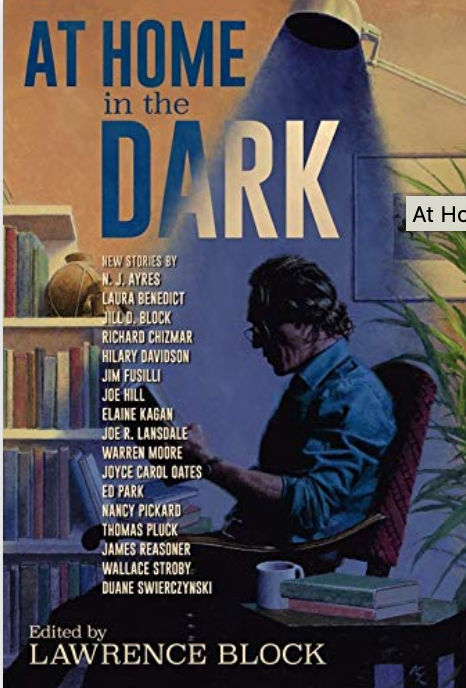
Spooky, Dark, Great for the Season: Short "Noir" Collected by Lawrence Block


[originally published in the New York Journal of Books]


“Serious stories, taking in the main a hard line on reality, and any gray scale would show them on the dark end of the spectrum.”

When mystery author extraordinaire Lawrence Block gathers stories for an anthology, top names mingle with newcomers among the authors he taps on the shoulder. His own mysteries have dipped deeply into the classic New York City and Los Angeles dark police procedurals, but also skated and danced with merriment at times. Obviously, its the darkness that Block wants for At Home in the Dark—starting with a chatty Foreword that reviews the history of “noir” and explains why he’s avoided that term in his title.

But you can’t avoid the genre, since each story here features some aspect of the unsettling, creepy, menacing, and lock-the-door disturbing. There are 17, and it’s worth grabbing this collection just for the sake of reading another mystery by Joyce Carol Oates. But Joe R. Lansdale, Nancy Pickard, Jim Fusilli, and Duane Swierczynski will also draw fans. And part of the fun (if being alternately scared and despairing is fun!) is the contrast among their styles, as well as the surprises in the directions each one chooses.

Loosely speaking, James Reasoner’s story is a Western (but dark!), Joe Hill’s is horror, and Joe R. Lansdale jumps to an unexpected dystopian future.

But then there’s Elaine Kagan’s story “Hot Pants,” which launches this collection. It opens in a nursing home where everyone’s losing whatever marbles they entered with, yet it’s where Lucinda Conte needs to keep her failing father housed and cared for. Grim motivation for working in an Italian restaurant with good tips … and a kitchen culture straight out of the #metoo nightmares. See whether you would have predicted the final sentence, and the way the last action ties back to the title.

What would you guess a story called “The Eve of Infamy” would be about? Hint: Think FDR and his famous speech. Here’s a taste of the story, by Jim Fusilli:

“No, he decided, knee-deep in debris. He’d wait out the war and go back to the Bronx. The streets were in his blood. He knew the rooftops and alleyways. Theft came naturally, violence did too. If the next few years broke his way, he could bankroll a future, playing steady amid the turmoil. Then he’d go back home a champion. He’d aim high. The cops wouldn’t dare touch him.”

In other words, don’t look for happy endings in this collection. A few “just desserts” maybe, but even those are grim. Block’s roundup proves that The Girl With the Dragon Tattoo wasn’t unusual, just longer than usual for this genre. Brace for violence, sexual and otherwise. Don’t read this if you’re on the brink of depression, as it might tip you in. But if you’re a survivor of many a dark crime novel, there’s great pleasure in these concise, tight, and twisted tales.

One of the most enjoyable aspects of At Home in the Dark is seeing the collection as insight into Lawrence Block’s preferences, amply described in his “rant” at the opening. His description of the noir collections in vogue is spot on: “They are serious stories, taking in the main a hard line on reality, and any gray scale would show them on the dark end of the spectrum.”

Here’s one more classic snippet to treasure from the collection, from the story “The Cucuzza Curse” by Thomas Pluck: “Joey was here because he knew people, and he knew people. … He had a reputation as a reasonable if foppish good earner with an even temper, respected by men of violence.”

Don’t say you didn’t know what you were getting into: the dark!!

PS:  Looking for more mystery reviews, from cozy to very dark? Browse the Kingdom Books mysteries review blog here.
-->

Sunday, April 15, 2018

To the Woods, the Woods -- for Horror and Crime, from J. P. Choquette and Jenny Milchman

I never used to carry "bear spray," aka heavy-duty pepper spray, into the woods with me. Bears in New England aren't interested in connecting with humans; sing loudly, or wear "bear bells," and they will move away before you're close enough to know you have company. Most other wildlife behavior is similar here (although nothing likes being stepped on). But the first time I realized a human was following me on those long lonely paths, I bolted to the camping supply store to buy a large personal spray canister.

So two books from my stack have struck a shivery chord of recognition for me recently. The first, which I was re-reading (it came out last fall), is J. P. Choquette's Vermont horror novel, SHADOW IN THE WOODS. It starts with a few hints about a Sasquatch and a disappearance, then fades to normal with Addie Preston's prep for a group hike with clients. Addie is a relatively new mental health counselor with an understandable crush on her older male colleague, Dr. O'Dell ("call me Dell"). And she's thrilled to be the second professional on an eco-therapy effort, taking four patients up into the mountains for overnight camping and new experiences of coping with their internal anger and fears.

But some of that anger is not so internal after all, and neither are the terrors, some of them perfectly rational as Addie realizes nobody has the skills to save her from even the ordinary perils of rain-washed trails, limited map skills, failed phone service ... and a quick run of injuries and losses turning the trip into a nightmare. Choquette (who has written sleuth fiction in the past but is on an exuberant roll with gothic-inspired suspense situations now) sets up the likely losses, and spins Addie into panic-stricken coping efforts. Some readers will wish the book were longer, with more room for Addie to face her own changes -- instead, it's a tight 248 pages of action and response, a good weekend read (as long as you're not planning an overnight trip up your mountain, right?).

Escalate that sense of dread and peril with the newest book from Jenny Milchman, WICKED RIVER, coming out May 1. This is her fourth, and she's ramped up the intensity and threat in every twist. Start with newlyweds Natalie and Doug Larson, headed for a back-country honeymoon in the Adirondacks. So what that there are six million often-roadless acres in front of them ... they have GPS, Doug has friends who may cross paths with them, and between their rugged vehicle and a new canoe, and Doug's massive expertise, everything should be fine.

Except there are people hiding in those forested acres who have no desire for company -- or if they do want Natalie and Doug to come see them, there are no valid exit plans that will succeed, once a wilderness psycho and a few criminal moves get woven into the journey.

I was so creeped out that I had to read this one in short bursts. And I bought a new canister of bear spray. Sinister? Yeah. And besides, Doug's injured, way too early in the intense adventure, and the two of them in many ways barely know each other. Of course, Natalie can push that thought aside:
You didn't question a bond like theirs just because things had gone horribly wrong. Look at what Doug had been willing to do for her when it came down to it. She didn't want to be out here without him. She didn't want to be anywhere without him.

Doug lowered himself onto the forest floor, gingerly positioning his arm. "I was trying to save you," he said mildly.

"Oh Doug," Natalie said. Tears stung her eyes, though there didn't seem to be enough of them to fall. "If you had died, I don't think I could have gone on without you." She said the words with more certainty than she'd spoken her vows just six days ago.
But Natalie's underlying unease isn't groundless; Doug has in fact compromised their safety, and she's nowhere near understanding what's ahead.

You'll want your own pepper spray after this one. You might want to schedule a practice session in the back yard, to be sure you're prepared.

PS:  Looking for more mystery reviews, from cozy to very dark? Browse the Kingdom Books mysteries review blog here


Saturday, March 03, 2018

A Scientific Look Behind a Thriller, in MAKING THE MONSTER, from Kathryn Harkup

Kathryn Harkup calls herself a "science communicator," and her book A is for Arsenic: The Pisons of Agatha Christie made quite a hit a few years ago. Now she's tackled the work of another woman author -- or should we say teenager in this case, since Mary Shelley began writing Frankenstein when she was just 18, and saw it published at age 20!

Somewhat to my disappointment, MAKING THE MONSTER: THE SCIENCE BEHIND MARY SHELLEY'S FRANKENSTEIN rarely looks at the author of this classic thriller and sci-fi progenitor. But that's my own curiosity going in the wrong direction -- Harkup is clear from the start that what she's gathered are the scientific backgrounds to the many fresh creative efforts that Shelley drew together into the novel of Dr. Vincent Frankenstein and his animated cadaver, the monster himself. After a brief opening laying out Mary's personal troubles (ouch!), Harkup swiftly moves to the medical, chemical, and electrical amazements that were rocking the European world 200 years ago. I particularly enjoyed her assessments of alchemists and their theories as they played into the eventual novel Mary would craft:
The three alchemists that Mary chose as influences for Victor Frankenstein's early life -- Albertus Magnus, Cornelius Agrippa and Paracelsus -- were three of the more dominant names in the history of alchemy as it was viewed in the early nineteenth century. However, the interests of these three historical figures demonstrate the huge range of philosophies held by so-called alchemists. Interestingly, none of the three would have called themselves alchemists and all of them wrote dismissively about those who tried to turn base metals into gold.
That's a fair sample of the writing that Harkup packs into this densely typeset, 300-page book. She moves quickly from one thorough assessment of scientific revelations to the next, including aspects of lack of refrigeration at the time, issues of anatomy, and even embalming:
Egyptian practices of mummification were for empowering the soul after death. The ancient Egyptians therefor saw no need to preserve everything in the body. Most of the internal organs were thus removed with only the heart being returned to the body. The bain was probably allowed to liquefy so it could be drained out of the skull. ... Bodies were dessicated using salts, left exposed to the elements, or dried out in ovens. Such techniques would not have been appropriate for Victor's requirements.
If you're able to overlook the slight queasiness of that liquefied brain part, and find you'd like to know more, MAKING THE MONSTER is meant for you! But it's also a great background text for those appreciating (or writing for!) TV shows like Criminal Minds, as well as grasping more of the background to Thomas Harris's grotesqueries. In other words, even if you can only digest a chapter or two now and then, there can be good reason to have this comprehensive reference on your shelf.

The book is published by Bloomsbury, and retains its British-isms. Great timing, for the 200th anniversary of Shelley's book. And if you're hungry for more about the author of Frankenstein herself, check out Fiona Sampson's book In Search of Mary Shelley -- Sampson is even appearing at times with Harkup in the United Kingdom, in this brave new era of appreciating the women who crafted potent thrillers and gothic horror at a time when they were better known as victims of Jack the Ripper and others.

PS:  Looking for more mystery reviews, from cozy to very dark? Browse the Kingdom Books mysteries review blog here.
Sunday, October 08, 2017

Brief Mention: THE FURY, John Farris, Classic Crime and Horror Fiction Re-Released by Chicago Review Press

Film buffs may be far more familiar than I was with THE FURY, released in the horror genre in 1978 (a Brian De Palma film). The recent release of this book in softcover by the independent Chicago Review Press gives an exciting way to see the original book and how John Farris, known for his contemporary horror, handled the plot some 40 years ago.

Today's fiction has surged past the premise of THE FURY in many ways -- it's not at all surprising to find that a CIA agent (Peter Sandza) needs to seek out his government-kidnapped exceptional son Robin. And the paired plot line with a mega-wealthy family's daughter, Gillian Bellaver, sharing some of Robin's unusual psychic gifts (and perhaps a psychic bond?) is not unusual, either.

But without the frills and imagery of the silver screen, it's fascinating to watch the author lay out these two young lives as the ordinary and familiar unravels. I didn't find it as chilling as the film surely was in 1978. But I couldn't put it down, either. And seeing the book as prelude to today's masters of the paranormal crime mystery (like John Connolly) is irresistible.

For insight into how the horror genre developed and for a fascinating look at the written precursor to the noted film, THE FURY is well worth picking up and ... dare I say, enjoying? (Oh, don't let the rather basic cover deter you. It's irrelevant to the work.)


PS:  Looking for more mystery reviews, from cozy to very dark? Browse the Kingdom Books mysteries review blog here.

Saturday, November 07, 2015

Brief Mention, THE RECKONING, Vol. 3 of Niceville Trilogy, Carsten Stroud

The finale of Carsten Stroud's Deep-South gothic Niceville Trilogy came out at the end of the summer, and I devoured it -- I really needed to see how Stroud would wrap up the series, and there was a lot of waiting involved, as publication of THE RECKONING was delayed more than a year.

The blurb that fronts the book is from Stephen King and says, "An authentic work of American genius." I'd be happier with something more pointed -- say, a 21st-century follow-up to Faulkner blended with the malice and darkness of T. Jefferson Parker at his most wicked. Carsten's task in the final book is to decide how much victory Nick Kavanaugh and his wife Kate Walker will be able to salvage from a part-paranormal burden of horror and evil that sucks its energy Niceville. I completely bought the interweaving of Native American and plantation and greed -- enough to ride with the paranormal parts pretty contentedly. (Who hasn't entered a place that said "creepy" and known it was rooted in the history of what took place there?) Carsten's blunt caper humor that interrupts the tension is a bit heavy-handed, but deliberately so (think Westlake or Zeltserman). The book's startling in its shifts from one mode to the other, though.

Don't read this one unless you plan to read all three. (Check out this review of book 2.) And keep your expectations for the finale modest -- I found the endings a bit too neat, and a bit too sweet, considering all the tension and darkness that had gone before. But it's definitely worth the read, and I wouldn't be surprised to see the trilogy take its place as an American classic.

Oh. Maybe that's what Stephen King meant? Yeah. That works for me.

Tuesday, February 17, 2015

Vermont Gothic Thriller: THE SILENT GIRLS, Eric Rickstad

It's been a few years since Eric Rickstad's first book, Reap, garnered so much attention and introduced the Northeast Kingdom region of Vermont to a fresh set of readers. In THE SILENT GIRLS, Rickstad goes well beyond the ticking clock of suspense and the dangers of a thriller, to the very creepy aspects of a true Gothic. You know what I mean, if you've read Jennifer McMahon lately -- but subtract any chance of humor along the way.

A short first chapter, datelined Halloween, sixteen years earlier than the rest of the book, lays out a bloody and painful horror component at the start. But then THE SILENT GIRLS shifts apparent subgenres, becoming a classic police procedural, Frank Rath -- once a noted police detective in northern Vermont but working as a private investigator instead -- agrees to back up a local investigation into a missing teen. When Rath and his official colleagues find four more missing teens in the area over the past two years, the pattern hints at a serial killer. But the girls who are missing seem to have nothing in common: not body shape, grades, background. What could be the motive for their abductions? And is there a chance to save any of their lives? When one teen's body is found, the case takes on even more urgency.

Rath is a classic noir investigator, haunted by inner turmoil and guilt and a bad alcohol habit; his fellow investigators also show aspects that could make an employer uneasy, from anger to addiction of sorts. And what Rath has kept secret, especially from his adopted daughter, is erupting in unpredictable ways, thanks to an unexpected parole hearing for the killer who'd ended Rath's earlier career path.

Brace for dark, grim, and even horrific in this one -- an excellent interview with Rickstad (click here) tips a hat to the recent trends in Scandinavian crime writing, as well as to Stephen King. The book is smoothly written, tightly paced, with a taut plot that insists on quick reading. Clear the schedule (and keep the lights on).

A quick note to fellow Vermonters: Don't try to map the towns, roads, and counties that Rickstad lays out -- they're not where you'd expect. Pretend it's all new to you. Except, of course, for that grim stretch of late October and early November weather that's been called "locking time." That, and the cruelties of some Rickstad characters and plot twists, may feel familiar, after all.

Sunday, December 28, 2014

THE CURSE OF THE HOUSE OF FOSKETT, M. R. C. Kasasian: Victorian Dark Humor and Crime

THE CURSE OF THE HOUSE OF FOSKETT is the second in the Victorian England crime-solving series of detective Sidney Grice and his ward -- and although reading the first book, Murder in Mangle Street, isn't actually necessary, it would save you from the errors that dogged my reading of the first few chapters. Grasping right away that the novel resembled a grim Sherlock Holmes reality show (dirt, spoiled food, discomfort), I assumed Grice's ward was male, like Watson. It wasn't until the third chapter that I realized this "March Middleton" narrator was female. As you can tell, it shook the universe my "reader's eye" had been constructing.

But I kept thinking I was in the midst of a Sherlock Holmes pastiche -- recognizing phrases like the "engineer's thumb" for example -- for a few more chapters. In fact, I felt as though I were on the far side of a train window, trying to make sense out of lip-reading half of a conversation. The stunningly nasty comments that detective Sidney Grice makes, his often-described infected eye socket with glass eye, the grotesque conditions and bluntly described dirt and stench of this "world," and March Middleton's unfortunate slowness to catch on to the plot twists (Grice isn't a lot faster) kept me dog-paddling in a lake of misunderstanding for a long time.

And yet ... I couldn't stop reading. A reviewer of the first book said it hadn't appealed much to the heart, and that's probably just as true for this one -- trust me, you don't want to identify with anyone in these pages! -- yet March Middleton has a stubborn persistent courage, even though she has little other choice, and I liked her gradual assertion of her own worth and her outreach for some kindness in her gray, grim life. She rarely pauses to feel sorry for herself -- there is too much going on. Grice is being paid to step into a "death club" where he cannot stop the deaths from taking place, and he quickly decides the whole disaster is actually all an attack on him -- which March can clearly see fits his vanity.

Kasasian's writing is fluid and his images and plot twists are vivid and surprising. Once I'd managed to let go of all Holmesian expectations, I found the rather shocking scenes to be freshly surprising:
The moment we appeared our visitor jumped up and grasped my guardian's hand.

"Mr Grice. It is such a thrill to meet you. I have read so much about you in the newspapers."

"You will have been hard pressed to find an accurate fact then," Sidney Grice told him.

"And you must be Miss Middleton." Mr. Green compressed my hand in his. "I believe you helped Mr. Grice solve the Ashby stabbing case."

My guardian adjusted his eye. "She may have accompanied me on that case," he said, "but I can assure you she was nothing but a hindrance. Ring for tea, Miss Middleton."

"I shall try my idiotic best." I pulled the bell rope twice as the two of them sat facing each other, then got myself an upright chair. ... "I can smell something," I said, but both men ignored me.
The further I read, the more parallels I found to having fallen down a rabbit hole, or having met a very dark version of Jasper Fforde -- literary allusions, outrageous metaphors, symbols and clues that mean something far different from first impression. If you've read the original Alice's Adventures in Wonderland, you know it's far more vicious than the cartoon visions. So is the gruesome Victorian England in which Grice and March Middleton investigate.

And that, finally, makes this one of the more original and surprising mysteries I've read recently! Recommended for those who want to move beyond the Holmes we've known, to the brute necessities of his time and place -- but not for the faint of heart, and definitely not (despite the attractive cover) for any young impressionable readers who might carry the book's nightmare qualities into their sleep.

[No author website at present, but an insightful interview with the author here.]

Sunday, December 21, 2014

Horror Suspense: THE VOICES, F. R. Tallis

Psychologist and long-time author Frank Tallis crafts suspense crime fiction in which the twists and power of the mind compel both the characters and the plots -- and he does it well. His list of award nominations overflows the space allocated. Because he is British, it's almost irresistible to compare his work with that other British expert in psychological suspense, Ruth Rendell, who writes this genre under her other name, Barbara Vine.

In the same way, Tallis sets his horror fiction, with its strong thread of the paranormal, under the nom de plume F. R. Tallis. Dark, frightening, and with maximum risk of life and sanity, his new book THE VOICES proposes a classic haunted house frame, this time for a young composer of film soundtracks, Christopher Norton, and his wife and toddler daughter. And the first sign of something "extra" in their newly rehabilitated Victorian home is the added sounds persisting on the baby monitor, as if something were in the bedroom with young Faye. And Christopher, being a sound engineer, records them on his studio equipment and, sensibly, shares his newly made tape with a friend:
 "What are you suggesting?" Christopher asked.

The engineer studied the smoke rising from his cigarette. "I don't think these voices are radio transmissions."

"Then what are they?"

"I don't know, but ..."

"But what?"

"You'll just say I smoke too much Mary Jane."

"If you think you know what's going on, say."

"I don't know what's going on. Not really. It's just a thought."

"Tell me."

"I don't think they're transmissions. I think they're communications."

The two men looked at each other and the quiet seemed to congeal around them.
Cleverly, Tallis sets this tale of increasing terror in 1975-1976, well before widespread digital technology can take on a role in the exploration of what's taking place. The changes that push the book's horror side are internal: Christopher's growing obsession with recording what he believes are spirit voices -- his wife Laura's crumbling personality -- and the reader's painful awareness that little Faye is increasingly unsafe in the house and with these parents.

I'm a mom and have a couple of wee grandsons who now occupy the "worry zone" of my mind and heart; this book terrified me. That said, Tallis is a master of his craft, and every twist, every drawn-out moment of risk and threat, every terrible unavoidable step toward disaster is immaculately scripted.

If you can't get enough Stephen King or Dave Zeltserman to feed your taste for psychological suspense, THE VOICES (and the two earlier F. R. Tallis titles) should zip onto your shelf this season. And if you're collecting Barbara Vine among your British crime fiction, THE VOICES should set right next to her books. We all have a sense of what's creepy; Tallis grabs it, pins it to the pages, and provides the dread and clenched stomach that mark a gifted work of crime horror.

Saturday, December 06, 2014

Brief Mention: Dave Zelterserman, THE BOY WHO KILLED DEMONS; Graham Masterton, BROKEN ANGELS

Dave Zeltserman is a master of dark fiction -- the "noir" -- and his mysteries have powerful ties to Boston's underworld of mobsters and contract killers. His horror fantasy novels, though, come in distinctly different forms. I still haven't shaken the mingled chill and pity that I felt as I finished reading his The Caretaker of Lorne Field in 2010; every time I tangle with an overgrown section of my garden, I feel the nightmare of that story all over again.

This season, Zeltserman's new offering, THE BOY WHO KILLED DEMONS, looks like it might become the first in a series, judging by few threads at the finale. Narrated by 13-year-old Henry Dudlow, it's an investigation of how demons have invaded the world, with ominous intent. And this struggling teen, half smothered by his thoroughly unlikeable parents but lifted out of the mess via friends and his first girlfriend, has a terrible gift and responsibility that have arrived with puberty: He alone, among the people he talks with, can see the demons in their real and menacing form. They're after him, of course. And when he realizes what their goals are, not to mention how they pursue them, he knows he has to stop them.

If you know a teen who's already read a lot of Stephen King, and laps up horror and funky sex as if these were breakfast cereal, you might want to share this book with that teen. Otherwise, keep it for yourself (provided you, too, are a horror fan!) and enjoy the journey back to your own teens, as you keep Henry company.

Because I'm intrigued by the stream of Irish noir flowing across the Atlantic, I tackled the newly released US paperback version of Graham Masterton's BROKEN ANGELS. [This is the second in the series that began with A Terrible Beauty, later retitled White Bones.] Here too, terror and the grotesque are lined up, as Detective Superintendent Katie Maguire in County Cork heads up an investigation into the murder of a priest. The mutilation of the corpse -- well, actually it happened before death -- convinces almost all the detectives that the killing is revenge for child abuse inflicted by the priest, who'd been a target of unpleasant accusations. But as the death count and mutilations mount, Katie becomes convinced there's a larger and even more unpleasant reason for the string of murders.

I won't go into more detail -- partly to avoid spoilers, and partly because there's a lot of mixing of sex and sadistic violence here, some of which is truly horrifying (but no surprise to readers who may already have tracked Masterton's powerful but frightening narratives; he's a well-established author in Europe). This one's not for traditional mystery fans, but only for those who don't suffer nightmares or PTSD or loss of appetite among such horrors. Count on a fast pace, believable twists, and an investigator worth admiring. But also, consider yourself warned.

Wednesday, October 29, 2014

The book, the movie, the book: THE GERMAN DOCTOR, Lucía Puenzo

Sometimes the whole book process gets very complicated. Established Argentinian scriptwriter Lucía Puenzo wrote The German Doctor,  which has been published in 10 languages -- then she directed and produced it as a dramatic thriller film. Now IPG (Independent Publishers Group, in its Trafalgar Square Publishing imprint) is releasing the translation in America in November.

The thriller fits into that narrow subgenre of material rooted in history, but taking place in what may be "the present." At first, all we know is that the doctor is hiding in Argentina, and is obsessed with racial purity and his experiments; he has brought his notebooks and even some samples with him, and he has a particular fondness for examples of how racial interbreeding causes genetic disasters (to his mind). And, oh yes, he's also obsessed with twins.

If you've delved into the dark horrors of the Holocaust, you already know who "José" resembles: the notorious Josef Mengele, a physician whose experiments in the concentration camps ignored scientific method and truth, and instead caused maximum distortion and pain. He's known to have fled Germany in 1945, arrived in Argentina in 1949, and when hunted by those seeking justice, he relocated first to Paraguay and then to Brazil.

In Puenzo's dark and very creepy narrative (Mengele is seducing Lilith, a 12-year-old girl who suffers from dwarfism, and he and she both are thrilled by the process), we meet José at his departure from Buenos Aires, about to cross the desert to a more welcoming and protective community of Nazi German refugees in Paraguay. The rigors of the journey provide entry for him into the not-so-innocent Lilith's family, just in time to assist with the survival of prematurely born twins.

At stake: whether Lilith will resist or encourage the final seduction, which turns out not to be sex but science; what's being perpetrated on the twin babies; how the community will react to recognizing the wicked doctor in its midst; and even a hint of suspense around whether the German doctor has any humanity in him (a Native resident sees his hollowness).

David William Foster's translation is smooth and quirky at the same time, conveying the formality and awkwardness of German into Spanish, upper class to lower, and more. Here's a sample, from the doctor's point of view as he starts to cross the desert:
When he was advised to leave Buenos Aires immediately, they had promised him at the same time that the south of Argentina was as close as he could get to German Switzerland. They spoke to him of trees, lakes, snow-covered mountains. You people were not the only ones who did a good job of cleansing, they said. They told him stories of Indian attacks that had dominated the same arid lands he was now crossing at a snail's pace, with his eyes glued to the three small blonde heads examining him out of the corner of their eyes ... He felt anguish crawling up his legs like spiders.
Whether José's sadism will be recognized, along with his unmodified facial features, continues to raise the ante; so does the arrival in the area of a Nazi hunter who knows this doctor all too well.

It's a grim book, admirably paced, and steps into one of the nastiest aspects of Argentine and world history adeptly -- we know how the doctor's story will end (he died in 1979 and was buried under a false name; his remains were verified in 1985), but this crime novel lingers within the potent years of his life in the New World. Puenzo creates Ultimate Creepy effectively, complete with dolls (see the book cover?), and tells a powerful story that, unfortunately, I will probably never forget.

And oh yes -- coming to a theatre near you. Watch for its Spanish name, too: Wakolda.

Friday, September 05, 2014

MARY: THE SUMMONING, YA Horror from Hillary Monahan

Campfire season lingers here in Vermont, through the crisp fall evenings. But the summer is over, and most of the sleepovers are, too.

But aren't those great memories? I still relish the story of the girl with the green ribbon around her neck, learned at an overnight with neighborhood kids. And there's the one with the voice that calls out, "Mary, I'm on the second step ..." Ooooh!

I wish I'd had a copy of MARY: THE SUMMONING at the start of the summer (or back in the days of those teen get-togethers). It took me a couple of days to shake off the shivers from this deftly written and quick-paced horror story featuring four teenage girls and a mirror -- and a malevolent spirit who won't leave them alone. And then, of course, I wanted to tell the story to anyone else who wanted to feel really scared.

This is Hillary Monahan's debut, but you wouldn't know from the writing, which is tight and exciting. It's based in part on the folklore of "Bloody Mary" -- which I looked up and found is every bit as shivery as this book (click here for the folklore). If you have a teen you'd like to impress or delight with a blood-curdling tale where determination and inner strength matter, pick up a copy.

Just make sure to leave time to read it yourself, first!

***

A glimpse of what Shauna discovers:
I wished Jess had known what could happen so she could have prepared us, so we would have known to run long and run far to get away from Bloody Mary.

Then it hit me. Maybe Jess had known. The pictures on the wall. She'd taken the pictures down. Why would she suspect Mary could be anywhere other than a proper mirror? She'd said safety, but that was a bizarre leap to make.

"Oh no. Come on," I whispered. "No."
And later:
Scree. Scree.

THUD!

I shot up in bed, the cuts on my back screaming. My vanity trembled. My plastic bucket of makeup tumbled over ... There was no way I could sleep in this house if she was in the mirror. I counted down from three and jerked the robe aside. There was no face there, but written backward in sludgy black tar was a single word that sent me falling to the floor and sobbing.

MINE.

Friday, August 08, 2014

"Slasher Film" Plus Courage = WELCOME TO THE DARK HOUSE

Okay, 'fess up: Don't you sometimes feel just a little nervous when you get home alone to a dark house and something feels "funny" about the door, or the streetlight being out, or the light you thought you'd left on for yourself that isn't ... Or maybe for you it's when thieves hit the neighbor's house and you see it in the paper the next day and realize it was the same night you thought something was scratching outside your downstairs window but you couldn't wake up enough to check. Or -- you in the suburbs, maybe that 2 a.m. walk back home on a street you know well, but that suddenly has an eerie side to it?

Now go back 15 years (or 30, or 45), to when you were a teen and had your own particular nightmare, one that lingered maybe from when you'd been little. Something involving the closet, or your parents disappearing? I hope you don't have the real-life horror that Ivy Jensen has lived through as WELCOME TO THE DARK HOUSE (by Laurie Faria Stolarz) opens: the murder of her parents, in which she actually met the murderer, who called her "Princess" and who could be searching for her or even watching her now.

Ivy's stepping into a reality-show-in-the-making, hosted by horror film director Justin Blake and his creepy Nightmare Elf. Her motive for taking part: She thinks the e-mails she received about the adventure out in the country have promised she'll finally be free of her nightmares. But it turns out all seven of the teens called to the very creepy film set have earned themselves a place through their graphic descriptions of their own nightmares, and ... they are each about to face what they fear most. Alone.

WELCOME TO THE DARK HOUSE is the first book in a horror series for teens, one that repeatedly refers to slasher films (yep, gratuitous violence, from knife to ax to flesh-eating creatures) and that tilts from one character's point of view to the next, including screenplay segments from would-be filmmaker Parker Bradley, and lustful cheer from Shayla Belmont, not to mention the goofy but dangerous exploits of Garth Vader (care to guess what his dad liked?). And more.

I'm no fan of slasher films, but ... hey, I like this book! Every voice is distinct, every teen suffers from both a "nightmare" and a deep misunderstanding of what the world is going to do for her or him, and there are as many kinds of courage and folly as there are characters. The only down side is, this is the start of a series, and the ending is absolutely a hanging one ... How long do I have to wait for the next book from the amazing Laurie Faria Stolarz? (If you're a teen or purchasing books for teens, check out her website here: http://www.lauriestolarz.com.)

The adventures in this book are NOT what you want in your "how I spent my summer vacation" essay. On the other hand, reading this lively and fast-paced horror mystery is sure to give you fresh perspective on what really happened (or might have)!


Wednesday, July 17, 2013

Carsten Stroud, THE HOMECOMING: Niceville II, Crime + Horror


One of the epigraphs to Carsten Stroud's crime horror novel Niceville is from "Tartuffe": "Malicious men may die, but malice ... never." After that moment of high culture, the book sweeps into nonstop small-town action and suspense, told from multiple viewpoints -- most of them, through the eyes of clever and emotionally frozen criminals who seize opportunities and don't care who gets hurt along the way. Some of these sociopaths are trim and elegant, like Coker, the police sniper, a "Clint Eastwood" figure with silvery hair and compelling gaze; others, like Byron Deitz, look nearly as ugly and creepy on the outside as on the inside.

And then there are Nick Kavanaugh and his wife Kate Walker, a family-practice attorney. Maybe their exteriors aren't as clearly painted. But they are the smart, kind people here -- along with Native American (Maiami tribe) Lemon Featherlight, whom all the women warm up to. Of course, Nick has a crimp in his military past that's preventing him from going back to active duty, and Lemon has a rap sheet that's turned him into being a CI, a confidential informant. And Kate? You could say she gives her love and loyalty so passionately that she complicates life.

Or, like Nick, you could admit she's simply standing for honor, something he holds just as dear as she does.

So, where does that leave Rainey Teague, whose probably distant relatives keep turning up in the threatening situations that surround Kate and her allies -- but who is (at least on paper) just a half-grown kid fresh from a year of a coma, welcomed by Kate into her home and heart -- what side is Rainey on, anyway? Kate's? Or, umm, the dark shadowy threat that keeps interfering in his life but seems to be attached to him?

This week is the release of book II in the Niceville trilogy: THE HOMECOMING. Reading it was the bravest thing I've done this year. It's so darned good ... the action is so swift, the twists so unexpected yet fitting, and the determination that Kate and Nick show is so irresistible. But -- and this is a big but -- I knew as I devoured it (407 pages!) that nothing big would resolve or clarify by the end, because (groan) there's still another 400+ pages to go, in 2014, in The Reckoning. OMG!!!!

Maybe you've already had the good fortune of staggering through Tanya French's or Stuart Neville's Irish crime fiction, where the weight of a violent past -- of a person, a family, a country -- cripples and haunts the living women and men who grapple with crime (on both sides). Stroud crafts the U.S. version, and evil's presence in THE HOMECOMING is vicious, hungry, and dark. A Florida resident, he's set the scene in a Southern town called Niceville, which dates from 1764 but takes its undercurrents from events during the Civil War (a.k.a. the War of Northern Aggression) and the decades afterward, including World War I. Something about the interactions of Niceville's four founding families is so saturated with shame and rage that there's a dark force stalking the town's prominent citizens even now.

Stroud's writing is rich and colorful, and took me instantly to the Deep South (Niceville is within a night's driving distance of Metairie, Louisiana). That restless growth and fertility, the bitter enduring heritage of slavery's brutality, abuses of power by class, gender, and race -- they all surround Kate and Nick. Even with the tribal knowledge that Lemon Featherlight adds to their grasp of the forces around them, chances look pretty slim that they'll escape unharmed. Each one even wonders whether their marriage will hold up as they struggle with Rainey Teague's terrible heritage.

So here's the deal: You can pick up a copy of Niceville (the first book) in hardcover now, or wait until mid August when it comes out in softcover. But I suggest getting THE HOMECOMING right away. Stroud is a deft and powerful writer -- he gives enough detail in this second book to cover for the first one, without spoiling anything major in it, so it will work fine (in this rare case) to read the books in reverse order if that's how you access them.

And then you can join me in the agonizing wait for June 2014 and the third book in the Niceville series. (Here is Stroud's website to reassure you.) Misery loves company, they say. I wonder whether malice would say the same?

Shiver. I'm shaken by Stroud's very personal version of evil and malice. But I trust Kate and Nick, and most of all, Lemon. I want to read the third book.

If only I were enough of a Stroudian sociopath to go steal the manuscript from whatever publishing safe it's waiting in. Oh wait -- is the dark presence in Niceville affecting me now?

PS -- I see I've left out the details of how amazingly funny the situations can be that Stroud's villains create around themselves. I only want to add, though, that the black humor never spoils the tension. Not even when the Chinese get involved. The Chinese in the American South? Think fancy Lear jet. Really.

Friday, August 03, 2012

Threat Level Very Scary: Jennifer McMahon, Doug Wilhelm


Summer reading includes catching up on some scary tales and topics. I found two slim novels in the stack to be un-put-down-able in July, and I recommend both, for VERY different reasons.

Jennifer McMahon enjoys her daughter's new love of horror films. McMahon herself, who resides in Vermont, has spun her own share of terror on the page. Somehow I missed her 2008 book when it came out: ISLAND OF LOST GIRLS. Who would have guessed that Peter Rabbit could become a scary character? Well, not exactly the cuddly bunny type -- this one is clearly an adult in a rabbit suit, who walks off with a small girl from a car outside a convenience store. The abduction is one of the sharp saw teeth of increasing despair and confusion, as McMahon whips back and forth between 2006, and 1993, when terrible events were taking place in the lives of today's adults, then children. This is emphatically not  a book for kids, and I'd even hesitate about giving it to an older teen; the topics are hard to handle. But boy, is it good. Check the website: http://www.jennifer-mcmahon.com/island_of_lost_girls_61500.htm

TRUE SHOES by Doug Wilhelm is the new hit of the middle school/junior high crowd, and deserves every bit of acclaim (the first printing actually ran out! fear not, the publisher has printed more). Although it's technically a sequel to Wilhelm's popular The Revealers, it works fine as a solo book. And why do adults (like me) want to read it? (1) Every scrap of detail about cliques and bullying rings true in both today's world and our own younger days. Russell's life is totally American junior high/early high school. (2) Despair -- especially leading to teen suicide or murder -- and courage are both part of our days. We need to name them and claim the courage part. Russell is my kind of reluctant hero. I feel as though I've known him and hope he'll text here soon. (3) Wilhelm's storytelling is smooth, exhilarating, a great ride in a work of fiction that insists on being "real." Oh, you want some plot details? A crowd of powerful stylish girls is brutally ruining people's lives through rumor and malicious teasing. Russell and his mostly "outcast" friends -- the ones that share the cafeteria table where nobody else would want to be seen -- are easy targets. Romantic triangle, parental problems, reluctant rescuers ... it's all here. Surprise the teens in your life by knowing this book before they do. It'll steal an evening or two out of your summer, and live in your heart. Website: http://www.the-revealers.com

Wednesday, July 18, 2012

Dracula, Frankenstein, and Other Reasons to Engage the Edge of the Mysteries Field: Books by Stephen Seitz and Dave Zeltserman

There are at least two dozen authors who are on my "automatic" list: I know that I enjoy their mysteries and/or crime fiction reliably, and I mark my calendar for when the next book by one of these is coming out. When I look over the list, I realize I've become a fan of, umm, character-driven dark mysteries in which someone has to dig deep into inner resources in order to solve the crime -- or even just to survive.

But I do read outside this core quite a bit, and that includes urban spoof/caper mysteries, cooking mysteries (I check the recipes first), plenty of espionage, lots of thrillers that start on university campuses, almost anything with a strong female lead, and probably way too many books that involve threats and death. (By the way, I've discovered that when life serves up the "real thing," I stay away from the book version. Shudder.)

Thanks to some bold authors who say "Hey! Read this!," I also find some gems that don't fit into any of my usual areas. For instance, Dave Zeltserman writes some of my favorite -- although very dark! -- crime fiction, mostly set in the Boston area. But sometimes he zigzags off into horror, a genre I normally don't endure. Still, if it's by Dave Z, I get curious. So, a while back, I read and really, really enjoyed his horror parable (yep, really) The Caretaker of Lorne Field. And that led me to his newest title: MONSTER: A NOVEL OF FRANKENSTEIN.

Set firmly in 19th-century Germany, complete with religious twists, extremes of poverty and wealth, and curious rituals of friendship and courtship. MONSTER spins out from the mind and heart of Herr Friedrich Hoffmann, broken on the "wheel" as an accused murderer of his own fiancée and soon patched together in Dr. Victor Frankenstein's obscene experiment. Yes, in case you've forgotten, "Frankenstein" wasn't the inventor's monster -- it was the name of the inventor, in the old tale. In Zeltserman's adept narrative, the Monster becomes a distraught and terrified individual coming to grips with how his soul has been installed in a terrible body, and the evil perversions of his "creator" threaten to turn him into a true monstrosity. Grief at such horrors spurs him to action:
I bellowed again in rage, and stopped only when I realized that the leather strap that had been tied around my chest had broken. The slow trickle of strength that had been ever so slowly ebbing back into my body must have turned into a raging torrent over the last few days, for in my rage I broke that strap, which was something not even a wild beast could have done. I sat up with ease and tore apart the strap that bound my legs to the table as easily as a child might have torn a paper ribbon.


I was free.
But what is the true nature of this reborn Friedrich Hoffman? May he assert the compassion of his former self? Or must the evil of his re-creator stain him and turn him into perversions that mock his best efforts?

Zeltserman kept me turning pages, aching for resolution.

MONSTER came out this spring through the audacity and continued courage of The Overlook Press, which continues to prove there are still publishers who value diversity and outrageous creativity. The press even presents P.G. Wodehouse books. Diverse!

Another such press, which I only discovered through agreeing to read its newest book, is MX Publishing. This firm is based in the United Kingdom and specializes in "NLP, Sherlock Holmes, Property, and Children's books." Turns out that NLP is neuro linguistic programming. I don't think it's connected in any way with the line of Sherlock Holmes books -- but I can't be sure.

At any rate, MX Publishing boasts "a large stable of the best modern Holmes writers with traditional stories and short fiction through to fantasy and other unusual adaptations." And its newest is SHERLOCK HOLMES AND THE PLAGUE OF DRACULA by Vermont author Stephen Seitz. If that title makes you shake with uncertainty or despair, you're not alone. I wasn't sure I wanted to open this one ... Dracula has never been a passion of mine. Vampires are great in Charlaine Harris's "True Blood" series, but the original Vlad the Impaler? Hmm.

Well, the first chapter hooked me. Who can resist prying into how Dr. Watson's relationship with Sherlock Holmes stressed his marriage -- when the take is spun at least 90 percent convincingly in that voice so familiar from A. Conan Doyle's classic detective fiction? And for the sake of more Watson-and-Holmes intrigue, I was willing to admit that Mina Murray -- the protagonist of the Dracula novel -- could actually have brought to Holmes the case of her vanished fiancé, Jonathan Harker.

Seitz stays closer to Conan Doyle's "no spiritualist solutions" than the Holmes creator ultimately did, for Dr. John Watson tracks Holmes's insistence that the "vampire" effects must be explained scientifically. It's a great twist, and the team's journey to the hazards of Dracula's castle is well told, a great tale in classic form. Did it match 100 percent with an original Holmes story? Well, not quite. But it's so close that I could brush aside the occasional dissonance and revel instead in the adventure and solving the puzzles provided.
October 2, 1890

It is a bitter, dark day for justice.

We took photographs of the poor girl's desecration. Holmes measured every square inch of the tomb and collected several samples. We had Van Helsing in our very palms, and Lestrade despatched constables to bring him in.

Yet we have been frustrated again.
Oh yes, for those who are Holmes afficionados: Seitz has a brand new take on what actually happened at the Reichenbach Falls.

So, that's a pair of quirky new novels to try out, if you're in the mood for something very different. Let us know which parts you enjoy most -- or whether one book or the other is creepy enough to keep you checking the door and pulling out the garlic and such. It's all in good fun, I think.