Showing posts with label Gideon Stoltz. Show all posts

Tuesday, February 14, 2023

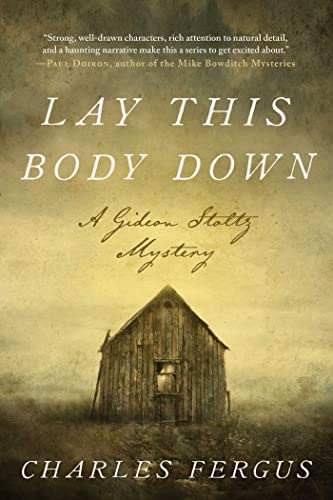
Third Crime Novel for Sheriff Gideon Stoltz, LAY THIS BODY DOWN, by Charles Fergus


 [Originally published at New York Journal of Books]

“Fergus’s writing lays out both the struggles of a new nation, and the pains of growing into determined manhood with its allegiances, regrets, and consolations. If murder and kidnapping can be halted, why not enslavement, also?”


The lines of good and evil are firm in this third antebellum mystery from Charles Fergus: Enslavement is brutal, and deprives the 1837 American nation of honor. Immediate emancipation could restore that honor—but in Sheriff Gideon Stoltz’s industrial Pennsylvanian town of Adamant, a rough crowd jeers at a visiting speaker advancing such an argument, and Gideon’s role as lawman is keeping the peace. Not advancing abolition.


However, Fergus positions Gideon as an outsider himself, with a strong “Pennyslvania Dutch” German accent that marks his difference in the hardscrabble Scotch-Irish town. Young and inexperienced for his job and without training, supported by his wife and a few friends, Gideon identifies with runaways and victims. It’s a dangerous position when there’s a national law requiring that he enforce “property ownership” toward Black fugitives. Although his state backs away from that position, the town is just 80 miles from Maryland, and his neighbors, a mostly rough crew, could inform on a runaway and expect Gideon to jail that person.


“What if the right thing—whatever it is—and what the law requires turn out to be two different things?” Gideon asks his wife True. Her answer: “I hope you would do the right thing.”


Chapters of Lay This Body Down open with excerpts from historically real reward notices seeking fugitives. When slave hunters turn up in Adamant, seeking a Black youth who’s helped Gideon in the past, what he’ll choose is never in doubt: He owes a debt, and servicing it fits with his growing belief that enslavement is cruel and wrong. Instead, the rapidly ramped-up tension in the book comes from the prevalence of malice among those hunting fugitives and those who already despise Gideon as not one of them, neither by heritage nor by attitude. As he struggles to find and protect this and other runaways, he plunges into personal danger.


In that sense, this is an intimate novel of connection among working men with opposing worldviews. Gideon will only succeed and survive if he can find enough allies to defend his choices and actions. It’s soon clear he’s even being betrayed within his own office. His own superior in law enforcement doesn’t even have his back. But his wife does.


Readers of the earlier two titles in this series (A Stranger Here Below; Nighthawk’s Wing) will not find much of the mystical and supernatural that appeared in those books, although True Burn Stoltz, finding her way out of her long depression over the loss of the couple’s child to illness, clearly relies on a related set of beliefs. Instead, the conflict in this novel foreshadows what was already erupting across the nation’s frontier at the time: ardent beliefs in independence and the sanctity of property, playing against philosophical and humanist efforts to impose a better form of civilization.


Gideon’s weaknesses, part psychological from his own mother’s murder, part physical as a residue of concussion (alas for the results of horse accidents and human beatings!), hold potential to transform into powerful incentives to action. As he prunes away the rot around him, he finds himself able to say to a stranger, “Maybe you can help me.”


Fergus’s writing lays out both the struggles of a new nation, and the pains of growing into determined manhood with its allegiances, regrets, and consolations. If murder and kidnapping can be halted, why not enslavement, also? The author’s meticulous historical portrayal offers a potent integrity, to ground the growth of Gideon Stoltz into a man who’s certain of the right thing to do, after all.


 PS:  Looking for more mystery reviews, from cozy to very dark? Browse the Kingdom Books mysteries review blog here. 

Monday, March 01, 2021

Guilt Stalks the Sheriff, in NIGHTHAWK'S WING from Charles Fergus


In the second Gideon Stolz mystery, set in Pennsylvania Dutch terrain in 1836, the young sheriff is acutely aware of how different he is from many of the people he's supposed to protect and serve. There's his accent, of course, and his personal legacy of loss and violence, yet equally important are his beliefs about justice and worship, strands that are vital in a community still very much built as a set of frontier settlements.

But as NIGHTHAWK'S WING takes off, Gideon has far more to worry about than just feeling awkward among others. He hasn't recovered from striking his head in a fall from a horse, and the ongoing physical effects and memory loss threaten his job, his reputation, even his marriage and his liberty. As he realizes he's not even keeping up with routine tasks, his questions turn frightening:

Gideon asked himself why he hadn't remembered the horse as soon as he smelled the stench. Or before he went out for his walk. Or maybe he had remembered it and had gone out from the jail to check on whether the horse had been removed, and then forgotten why he'd ventured out in the first place.

Why couldn't he remember such things? ... Why couldn't he remember anything about his own accident, getting thrown off Maude or otherwise falling off her, striking his head on the ground, and (so he'd been told) lying insensible on the road?

He worried about the gap in his memory. He didn't know how far back it went.

Charles Fergus delicately draws out the differences in pioneer culture—the absence of medical knowledge, the fragmented communities from different European roots who knew just enough to be suspicious of each other, the fierce expectations of gender and age—as Gideon investigates a violent death on a farm some distance from the town where he lives. Has there been accidental poisoning? Are there implications of witchcraft, and of punishment for such deviation? Worst of all, he discovers incontrovertible evidence of having played a role in the tensions on the farm, before the death: With no reliable memories of what had taken him there at the time and of what had taken place, must he now suspect himself of abuse or violence?

Even Pastor Nolf in the farming community represents strangeness to Gideon. As sheriff, he needs to grasp how this German offshoot of religion functions here:

Nolf continued, "You asked earlier if I thought that Rebecca Kreidler had a disturbed mind. I told you yes, I did sense that. I also sensed in her a deep anger and a black despair. As Neigeboren, we work to purge from our lives that which would not be pleasing to the One we serve, including anger and despair. One thing I have been considering since her body was found: I think it's very possible that Frau Kreidler took her own life. That she purposely ate a plant she knew would kill her, and in a way that would inflict severe pain."

Meanwhile, Gideon's double distraction—over the dead woman's cause of death, and over his own possible enmeshment in the case—results in his effectively abandoning his gravely depressed young wife. Each of them, Gideon and True, is still in deep pain over the death, from illness, of their small child. And neither seems able to give the other what's needed. There's a chance that the marriage may be damaged beyond repair, despite Gideon's love for True. She reminds him: "You only believe in what's standing in front of you and nothing else. There's other ways of seeing, other ways of knowing. Maybe someday you'll figure that out."

Fergus's measured pace, rich with the feel of the raw, unsettled landscape and its fragile human bonds, provides a depth to the double mystery: the crime, and how to reinvent a marriage after a child's death. Not until the very end of the book will the answers become clear—and the pain and loss along the way are vivid and visceral. In the tradition of Jeffrey Lent's In the Fall, Erik Larson's The Devil in the White City, and even Nathaniel Hawthorne's early American novels, NIGHTHAWK'S WING melds human frailty and strength into the very texture of the place and time, creating a mystery that will call for multiple readings that savor its layers and revelations.

PS: Looking for more mystery reviews, from cozy to very dark? Browse the Kingdom Books mysteries review blog here.