Showing posts with label short stories. Show all posts

Friday, February 24, 2023

Short Story Collection from James R. Benn, THE REFUSAL CAMP


Crime and war. Unfortunately, they go well together. Especially in the hands of James R. Benn, whose 17 Billy Boyle mysteries place an Irish-American cop at various sites and trenches of World War II, investigating the dark side of moneyed warfare on behalf of his distant cousin General Dwight Eisenhower.

THE REFUSAL CAMP gives Benn the space to air tales of other wars, other time periods, and of course other motivated protagonists (although there is a gem of a Billy Boyle story tucked among these). The collection opens during the years when Connecticut settlers still enslaved Africans, and unfolds from the point of view of an enslaved teen. It swiftly becomes a crime story, one where the most disadvantaged person on the scene must summon both courage and insight, as well as a clever riposte, if he's to escape hanging.

There are eight more stories—one published in an earlier Soho Crime Collection, The Usual Santas. Billy Boyle fans will especially enjoy the Boston investigation "Irish Tommy," featuring police lieutenant Daniel Boyle, as well as "Billy Boyle: The Lost Prologue," a tale removed from the first Billy Boyle mystery before publication. The cleverest may well be "The Secret of Hemlock Hill," a haunted Civil War tale brought into the present. "The Refusal Camp" offers a concentration-camp possibility that reminds us that "victims" often found effective ways to hold their own.

Seasoned Benn/Boyle fans need this collection for their shelves featuring the youthful, loyal, and often rash wartime detective; those new to Benn's work may find the character-focused and neatly plotted and twisted stories so satisfying that they'll wish to dip into the full Boyle series.

Best of all, this nicely balanced collection can temper the rest of the Northern Hemisphere winter season, providing good reading for the last of the fireside evenings and lazy weekends before the yard, gardens, and outdoor sports reassert their siren calls.

Soho Crime/Soho Press will release the collection on March 14; this is a good time to place a pre-order to be sure to get a copy "hot off the press," as Billy Boyle would have said.

PS:  Looking for more mystery reviews, from cozy to very dark? Browse the Kingdom Books mysteries review blog here. 

Friday, May 20, 2022

Phryne Fisher #22, THE LADY WITH THE GUN ASKS THE QUESTIONS


Whether you met her in one of the series on Public Television, or in one of the 21 earlier books by Kerry Greenwood, it's not surprising if you wish you ran into her more often. Australian sleuth Phryne Fisher is elegant, stylish, and a liberated woman of the 1920s. With her friends among the police and her ever-loyal assistant Dot, Miss Fisher exerts her lively curiosity and sharp wits to solve all sorts of murders and related crimes.

Book 22 in Kerry Greenwood's Miss Phryne Fisher series, THE LADY WITH THE GUN ASKS THE QUESTIONS, is a story collection crammed with delight. Only half of that pleasure involves the crimesolving -- the other half is the way Greenwood allows the stories to reveal her writing process and how she chooses her adventures. Her "Apologia" at the start of the collection offers:

As you will see, sometimes I try out some of the cast of a novel in a short story to see if they like me enough to stay for a whole book, there being a great difference between 3,000 and 85,000 words, and an author needs to pick her company if she has to give them house room for so long.

Greenwood follows this short introduction with a second, called "On Phryne Fisher," that reveals how she began the series. If you're already a fan of the books, some of this won't be new -- but it's still fascinating. For instance, "Because I wanted her to be a female wish-fulfillment figure, I wanted her to be like James Bond, with better clothes and fewer gadgets." Bingo! Greenwood adds, "She's a bold creature for the 1920s but not an impossible one. None of the things she does are out of the question for that brittle, revolutionary period." And then there's the author's insight on the balance that good historical fiction must convey: "Too much detail and the reader is bored. Too little and it fails to convince."

But of course, the whole point of this collection is to present the stories themselves. It's actually a republication of a 2007 group, with four brand new stories added, all set in 1929. The author admits she's done a light re-edit on the earlier stories to tidy up some loose ends -- and then explains more. "Hotel Splendide" is based on an urban myth first written down in the 1920s; "The Vanishing of Jock McHale's Hat" was written for a Christmas collection ("I wanted something light and frivolous, yet with dark undertones"). "Marrying the Bookie's Daughter" explores Phryne's personal independence (can you really expect her to accept a marriage proposal?). And in the midst of all this, of course, these are proper mystery stories, embedded with neat clues, clever puzzle twists, and Phryne's marvelous personal style: "You horrible little insect," she tells one criminal, adding, "I suppose it is educational to find out that you can't have everything that you want," as she offers to lock up the perpetrator with a snake, instead of turning him over to the police.

Summer's just about here — and this is a great addition to the reading pile for real relaxation and plenty of smiles. If you read a copy ASAP, you might even be ready to re-read it at the opposite end of the season. Think of how frugal you'll prove yourself to be! And by that point, you may even have decided which of Phryne Fisher's tea gowns would suit your own style. (Right?)

PS: Looking for more mystery reviews, from cozy to very dark? Browse the Kingdom Books mysteries review blog here.


Monday, April 25, 2022

Terrific Short Crime Fiction in July Anthology, JACKED, from Run Amok Books


If your crime fiction reading is dominated by the books that get advertising dollars, that's completely understandable -- because those are the ones you hear about often.

But where's the adventure in biting the hook when it's baited with those ad dollars?

Great news: Run Amok Books, a small "indie" press near Princeton, NJ, has a new crime fiction imprint. JACKED is part of that launch. Pulled together by author/editor Vern Smith, who's already had a finalist novella for Canada's Arthur Ellis Award, this new release includes 21 stories of murder, mayhem, and wry mystery that rise way above expectations. 

That's because the authors providing the stories are already seasoned in this field. Take the story "Killing in Periot," a short pithy tale of family disfunction. It's by Allison Whittenberg, who's racked up three Pushcart Prize nominations. A cross between a hard-boiled approach and a YA revenge tale, the story builds to the perfect finale in a single word: "Good." Unforgettable.

"Len Bias" turns crime fighting and the war against drugs inside out in completely unexpected ways. Setting it in Portland, Zephaniah Sole offers a cop with a bad back  (don't they all have that?) who proudly reports that "I'm the FBI guy embedded in the team." The team turns out to have a brilliant way of infiltrating the worst drug business, and I shook my head for quite a while after I figured it out. Sole gives a clean, clear, well-paced approach to the twist, and an astute reader may get it, just before the author pulls back the curtain.

And what about that creepy approach that made Edgar Allan Poe a trailblazer? Meagan Lucas, highly experienced as both author and editor, shapes "Picking the Carcass" into a women's updated version of "The Gold Bug." Shivers. More shivers. What a mom will do to get by, right?

My favorite might be Ricky Sprague's "The Gryfters," but then again, that might be because it takes root in some of the best of both hard-boiled and caper fiction. The first line is, "I handled by first carjacking with real sang-froid." Could that be you?

I could go on, crooning over this nest of snarky, crazy, neatly twisted stories until I've had a chance to find a reason to name each one of them "the best" in some aspect. But it makes a lot more sense to stop here, and let you look ito JACKED for yourself.  It's coming out July 1 (can be pre-ordered now!) and in the meantime you can check out the press website (https://runamokbooks.website) and some cool readings by the authors on the Run Amok Facebook page (https://www.facebook.com/runamokbooks). Make sure to check out the very lively and intriguing blog attached to the website, too.

PS: Looking for more mystery reviews, from cozy to very dark? Browse the Kingdom Books mysteries review blog here.

Sunday, January 23, 2022

New and Needed! Peter Lovesey's Story Collection, READER, I BURIED THEM


Peter Lovesey's British police procedurals have stacked up enjoyably over the past 50 years, without growing stale. If you're already a fan, the new collection of his stories, READER, I BURIED THEM, AND OTHER STORIES is a must for the shelf.

But there are a lot of great mystery authors in the world, so if you aren't yet familiar with Lovesey's tales, don't blush -- just go pick up this volume. Because in addition to marking his continuing career, the collection offers a fine introduction to his wry sense of humor and adept story twists.

The flavors of the stories make up more than a wide menu. "Formidophobia" (defined as a fear of scarecrows) has the enjoyable feel of a G. K. Chesterton mystery; "Remaindered" manages to combine a gangland spoof with a used bookstore; and "Agony Column" (British term for a Dear Abby sort of pursuit) is funny enough to make anyone in the room with you get exasperated as you giggle or snort.

There are also some clever homages, like "The Deadliest Tale of All," which pictures Edgar Allan Poe suffering through a visit from a journalist, and "A Three Pie Problem" (come on, you know the title this spoofs on), bringing in Peter Diamond's Bath, England.

For the serious collector, this volume is also a must because it offers 17 pages of a "Peter Lovesey Checklist." The author foreword also offers revelations and delight.

The release date from Soho Press is February 1 -- do pre-order, to be sure of snagging a first edition for your shelf, and for much pleasure in both reading and re-reading. Also, if you were about to take a course in how to write short mysteries, just think of all the money you'll save by getting this 384-page volume.

PS: Looking for more mystery reviews, from cozy to very dark? Browse the Kingdom Books mysteries review blog here.

Tuesday, October 19, 2021

Tis the Season for Classic Detection Stories, in A SURPRISE FOR CHRISTMAS AND OTHER CHRISTMAS MYSTERIES


Martin  Edwards has a marvelous mystery series of his own, featuring Rachel Savernake, set in the Golden Age. A perfect transformation has turned him into the editor of several collections of detective stories brought out by British Library Crime Classics (Poisoned Pen Press, a Sourcebooks imprint). 

A SURPRISE FOR CHRISTMAS, released last week, is the fourth anthology in this series of "classic crime stories with a wintry theme" -- or, as Edwards also calls them, "detective stories in the classic vein." Scanning the author names for the dozen tales gave me shivers: among them Ngaio Marsh, G.K. Chesterton, Carter Dickson, Ernest Dudley, and Margery Allingham. Some of their stories may be almost unknown, even to those who have read the full-length crime novels from this pantheon of writers. As a Chesterton fanatic, I know I'd read "The Hole in the Wall," but so long ago that I'd forgotten the critical twist until I was several pages in. Cyril Hare's "A Surprise for Christmas" is morbidly funny; "Give Me a Ring" from Anthony Gilbert, one of the longer stories in the collection, has a sweet air of old-fashioned threat, from the days before risk and danger had to be garbed in gore or psychosis.

Adding to the delight of this collection are short forwards to the stories, recapping each author's presence in the Golden Age and noted sleuths. But often the stories presented come from outside the commonly known work of these authors. For example, the one from Ngaio Marsh does not feature Roderick Alleyn — but for "Death on the Air," which was published just three years later than Alleyn's first exposure in print, Marsh presents a classic "closed-circle detective story of the period," says the story's introduction. 

The tales also vary enormously in length, adding to the feel of opening a range of holiday gifts. With, of course, the advantage of no torn paper or ribbons to clear away afterward.

There is perhaps one drawback to A SURPRISE FOR CHRISTMAS: Any passionate reader of the authors collected here will need to purchase two copies ... one to savor as the days grow shorter, and one to give to the very best of friends.

PS:  Looking for more mystery reviews, from cozy to very dark? Browse the Kingdom Books mysteries review blog here.

Monday, October 04, 2021

Elderly and Wicked! Darkly Funny Murder from Helene Tursten in AN ELDERLY LADY MUST NOT BE CROSSED


[Originally published in New York Journal of Books]

“If you’re looking for distinctive international bouquet in your “Scandi noir,” this isn’t going to fit your shelf. Instead, it will be a dandy holiday gift, pocket size, darkly light-hearted, and a quick and easy introduction to the tongue-in-cheek side of one of today’s leading Swedish crime novelists.”

HeleneTursten summons her two established Swedish sleuths from two different series, Irene Huss and Embla Nyström, to tackle the wicked machinations of 88-year-old Maud in An Elderly Lady Must Not Be Crossed, a holiday treat that will make a great stocking stuffer. Maud’s debut appearance in 2018’s An Elderly Lady Is Up to No Good demonstrated that a stack of cleverly twisted short stories can comprise a delightful book. Tursten’s choice to pit her two detectives against this frankly wicked old lady adds to the dark humor of her newest tales.

For Maud, the pressure applied by the two police investigators as a team is the last straw: She’s successfully gotten away with murder in her own home, but it’s taken quite a lot of scheming and arranging, and she’d like a break. Why not treat herself to a luxury trip to South Africa, be wined and dined, see amazing wildlife, all while disguising her cleverness under the deceptive appearance of aging into confusion? People do so much work for you if you appear to be frail and needy, don’t they?

After the first tale, “An Elderly Lady Begins to Remember Her Past,” these dryly funny and dark stories form a mostly chronological sequence—starting with Maud as a child, caretaker of an 11-years-older sister with increasingly odd habits. Not that Maud herself is particularly normal! As she reflects during her flight to Africa, “Memories rise to the surface. That’s what happens when you get older.” We find the grim smiles of “little Maud” executing a trap for bullies; we also find her smiling as she rehearses her father’s fishing methods while making sure a competitive colleague will have a terrible accident.

“No point in brooding over the past,” Maud reassures herself. “Sometimes a person had to do certain things in order to survive the hard life of a single woman with a heavy responsibility to bear.”

In delightfully creepy steps, Maud develops her murderous personality through this set of six revelatory narratives. And if the ending is perhaps a little more sweet than an aging Maud has led us to anticipate, don’t neglect the pair of cookie recipes at the end of An Elderly Lady Must Not Be Crossed. Innocent and sweet as they appear, one of them has been a murder weapon in Maud’s hands. But only, of course, because she was forced to use it!

Marlaine Delargy’s translation never gets in the way of the action in Tursten’s stories. On the other hand, it has little Swedish flavor to it, so if you’re looking for distinctive international bouquet in your “Scandi noir,” this isn’t going to fit your shelf. Instead, it will be a dandy holiday gift, pocket size, darkly light-hearted, and a quick and easy introduction to the tongue-in-cheek side of one of today’s leading Swedish crime novelists.

PS:  Looking for more mystery reviews, from cozy to very dark? Browse the Kingdom Books mysteries review blog here.

Wednesday, April 21, 2021

WHEN A STRANGER COMES TO TOWN, from Mystery Writers of America


 [Originally published at New York Journal of Books]

“When a Stranger Comes to Town will give you the very best of what crime fiction should deliver. Means, opportunity, and obsession—right?”

Just seeing Michael Koryta’s name as editor for When a Stranger Comes to Town makes a mystery reader’s fingers itch to open the cover—which also bears the names of noted crime fiction authors like Alafair Burke, Michael Connelly, Joe R. Lansdale, Joe Hill, and Lisa Unger. There are nineteen wildly varied stories in this collection from the Mystery Writers of America, and each one packs a punch of plot and character, bound so tightly in the short story format that their power can be explosive. Or, on the other hand, haunting.

Part of the fascination of these compressed-action stories is wondering where they fit into each author’s outpourings. For example, the Michael Connelly story has nothing to do with his iconic protagonists Harry Bosch and (Lincoln lawyer) and Mickey Haller. Instead, it gives us a nearly solo detective on a busy resort island, with a plot twist that provides both whiplash and high excitement. So you have to wonder after reading it: Was this a character that Connelly intended (or will intend) to introduce into one of his two big series? A situation he imagined Bosch falling into? Or something he dreamed up especially for Koryta’s Mystery Writers of America collection, with delight in building a new “world” and characters?

On the other hand, S.A. Cosby, in spite of being an Anthony Award winner, isn’t anywhere near as well known. His “Solomon Wept,” just nine pages long, opens the volume with a startling glimpse into a desperate female criminal’s world. The experience of stepping into this story will take many readers off in search of more by this Southern author.

Compare that to the hefty 44-page story from Lisa Unger, so complex that it’s divided into twelve mini chapters, with a major plot twist that emerges in the final section. Or explore for diverse experiences, like the horror that Joe R. Lansdale serves up (if you’ve read his crime novels, you’ll be ready), a toe into Mumbai crime with “Kohinoor” by Smita Harish Jain, Ukrainian online crime and love (!) from Bryon Quertermous, or the emergency-room story from Steve Hamilton, set at the front edge of the COVID-19 pandemic: “It’s a cold night in February and Charlotte is about to see her first snowfall. And her first gunshot wound.”

Positioned as the collection’s finale is “Last Fare” from Joe Hill. A quirky and tender tale that veers into speculative fiction, it holds the potential for crime to erupt out of all the interpersonal tensions revealed. That may be one of the big “life lessons” from reading crime fiction: that crime doesn’t come out of a vacuum, but often from the pain and not knowing what to do next. Hill’s precision comes through in this shred of experience for Gene, who’s losing everything via her alcohol problem, and desperate enough to risk her very soul, it seems, in a taxi ride: “The time bomb tick-tick-tick of the meter gave her a queer feeling in the head. She reached for the crank and lowered her window halfway, feeling a sudden urgency for fresh air. The night smelled of baked clay, the still-hot kiln of the painted desert. The stone-oven heat rushed in and dried the bad sweat on her forehead.”

That’s the marvel of really fine short stories: Despite the intensity, the demand that everything important take place in a handful of pages, these authors provide vivid details of character and location and terrible situation so that in almost change of protagonist, there’s a fresh demand for attention, excitement, and even compassion.

When a Stranger Comes to Town will give you the very best of what crime fiction should deliver. Means, opportunity, and obsession—right?

PS: Looking for more mystery reviews, from cozy to very dark? Browse the Kingdom Books mysteries review blog here.   

Saturday, February 06, 2021

Treasures from Alexander McCall Smith, in PIANOS AND FLOWERS, a Book of Stories


Perhaps your high school teacher gave you the assignment: Here's a photo—write a short story based on it. Poets do it often, and even have a name for when the image is actually artwork. The resulting poem is described as ekphrastic.

But when Alexander McCall Smith tackled a similar assignment a year or so ago, he accepted a selection of photos from the archives of The Sunday Times and created a world of affection and often loss around each of them. The result, including some that were published in the newspaper, became his newest stand-alone book: PIANOS AND FLOWERS, BRIEF ENCOUNTERS OF THE ROMANTIC KIND.

Some meander from one person in the photo to the next, tracing the odd connections of our lives; some tell love stories; and my favorite of the 14 of them is "I'd Cry Buckets," which opens with a photo of two young men waking with a pack horse that in turn is carrying a dead deer (or, as it's called in England, a stag). The opening is evocative:

The sweep of the hills. The burn tumbling joyously across the rock. The pony sure-footed but scared of moving water, picking his way gingerly under the burden of the dead stag. And the two boys, who were sixteen, and who were tired from being up on the hill since six that morning when it was still chill and misty and not quite yet light. They had two uncomfortable house to go before they would be back at the lodge.

Bruce, the boy in front, checks that David is all right, in a conversation that stays determinedly on the mundane at first -- until David asks, "Do animals ever think they're going to die?"

The teens continue this pattern of surface discussion with abrupt deep moments, and it gradually becomes clear that they share some secret knowledge of each other, in a protective fashion. Of course they grow up and take divergent paths, only to meet during wartime, aware again of each other's interiors in ways they choose to silence. In tiny details, Smith allows a slow recognition that the bond between the two is deeper than friendship. And trembles under the weight of knowing that death comes to everyone, not just the stag on the ridge.

The wide variety of images, and hence of characters that Smith breathes life into, takes him far deeper than his usual mystery series have time to probe, with a lush descriptive narrative that depends on and interacts with the small photos provided. PIANOS AND FLOWERS evokes a tenderness founded in shared human pain and delight, and demonstrates that the big things in life are grown from the small one, treasured and gathered and finally, in meticulous description, known and loved.

Order two copies: one for your own shelf of Pandemic Relief, and one for a person you care about.

PS: Looking for more mystery reviews, from cozy to very dark? Browse the Kingdom Books mysteries review blog here.

Thursday, October 08, 2020

Hauntingly Delicious Irish Crime Fiction: THE TRAVELLER AND OTHER STORIES, Stuart Neville


Devouring and pondering the character-rich crime novels from Stuart Neville has been a delight since his debut in 2009 with The Ghosts of Belfast. Not only does he give us criminals and investigators torn by their loyalties and losses, but he evokes the abiding presence of The Troubles — Ireland's violent internal war — as a force that nurtures long-term resentment, revenge, and personal damage. When his characters brush up against an opposite force such as redemption, it's often with a raised shoulder or calloused fingers.

After interrupting this string of powerful novels with a couple of thrillers in a different direction (under the nom-de-plume Haylen Beck), Neville returns this season to his earlier characters and scenes in THE TRAVELLER AND OTHER STORIES. Of course, of course, this author must have written short fiction along the way, but it's been less visible. Now the stories are gathered for easy access, along with a hitherto-unpublished novella, The Traveller. In his introduction, Neville notes that it is 

a response to the messages I've received over the years asking what happened to Jack Lennon and his daughter, Ellen, after the events of The Final Silence. Although I've always known exactly where Jack wound up—the coastal village of Cushenden, working as a security guard—I'd put off writing about it for several years This collection  offered the opportunity to finally put that right, as well as tie up several loose ends, including the eponymous villain coming back to take his revenge.

Each of the dozen shorter tales offers insight into other characters, suspense and delight in the reading, and a sideways squint into the author's diverse interests. "The Last Dance," following up on the life of Gerry Fegan from The Ghosts of Belfast, is a great gift to Neville's regular readers.

If you want to give friends an unexpected and highly memorable trick-or-treat, get a couple of extra copies of this collection. Make sure to ink your name into your own copy, so it won't walk away lightly. It will be, indeed, haunted.

[Released this week from Soho Crime, an imprint of Soho Press, with a fascinating foreword by the remarkable John Connolly.]

PS: Looking for more mystery reviews, from cozy to very dark? Browse the Kingdom Books mysteries review blog here.

Friday, October 18, 2019

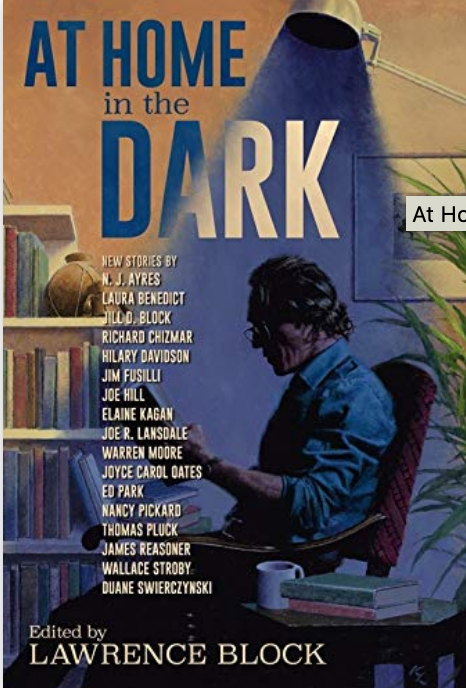
Spooky, Dark, Great for the Season: Short "Noir" Collected by Lawrence Block


[originally published in the New York Journal of Books]


“Serious stories, taking in the main a hard line on reality, and any gray scale would show them on the dark end of the spectrum.”

When mystery author extraordinaire Lawrence Block gathers stories for an anthology, top names mingle with newcomers among the authors he taps on the shoulder. His own mysteries have dipped deeply into the classic New York City and Los Angeles dark police procedurals, but also skated and danced with merriment at times. Obviously, its the darkness that Block wants for At Home in the Dark—starting with a chatty Foreword that reviews the history of “noir” and explains why he’s avoided that term in his title.

But you can’t avoid the genre, since each story here features some aspect of the unsettling, creepy, menacing, and lock-the-door disturbing. There are 17, and it’s worth grabbing this collection just for the sake of reading another mystery by Joyce Carol Oates. But Joe R. Lansdale, Nancy Pickard, Jim Fusilli, and Duane Swierczynski will also draw fans. And part of the fun (if being alternately scared and despairing is fun!) is the contrast among their styles, as well as the surprises in the directions each one chooses.

Loosely speaking, James Reasoner’s story is a Western (but dark!), Joe Hill’s is horror, and Joe R. Lansdale jumps to an unexpected dystopian future.

But then there’s Elaine Kagan’s story “Hot Pants,” which launches this collection. It opens in a nursing home where everyone’s losing whatever marbles they entered with, yet it’s where Lucinda Conte needs to keep her failing father housed and cared for. Grim motivation for working in an Italian restaurant with good tips … and a kitchen culture straight out of the #metoo nightmares. See whether you would have predicted the final sentence, and the way the last action ties back to the title.

What would you guess a story called “The Eve of Infamy” would be about? Hint: Think FDR and his famous speech. Here’s a taste of the story, by Jim Fusilli:

“No, he decided, knee-deep in debris. He’d wait out the war and go back to the Bronx. The streets were in his blood. He knew the rooftops and alleyways. Theft came naturally, violence did too. If the next few years broke his way, he could bankroll a future, playing steady amid the turmoil. Then he’d go back home a champion. He’d aim high. The cops wouldn’t dare touch him.”

In other words, don’t look for happy endings in this collection. A few “just desserts” maybe, but even those are grim. Block’s roundup proves that The Girl With the Dragon Tattoo wasn’t unusual, just longer than usual for this genre. Brace for violence, sexual and otherwise. Don’t read this if you’re on the brink of depression, as it might tip you in. But if you’re a survivor of many a dark crime novel, there’s great pleasure in these concise, tight, and twisted tales.

One of the most enjoyable aspects of At Home in the Dark is seeing the collection as insight into Lawrence Block’s preferences, amply described in his “rant” at the opening. His description of the noir collections in vogue is spot on: “They are serious stories, taking in the main a hard line on reality, and any gray scale would show them on the dark end of the spectrum.”

Here’s one more classic snippet to treasure from the collection, from the story “The Cucuzza Curse” by Thomas Pluck: “Joey was here because he knew people, and he knew people. … He had a reputation as a reasonable if foppish good earner with an even temper, respected by men of violence.”

Don’t say you didn’t know what you were getting into: the dark!!

PS:  Looking for more mystery reviews, from cozy to very dark? Browse the Kingdom Books mysteries review blog here.
-->

Sunday, January 20, 2019

Six Sherlock Holmes Stories from Tim Symonds, A MOST DIABOLICAL PLOT

There may be nothing quite as challenging in the crime fiction world as crafting a good Sherlock Holmes pastiche. You need the tone exactly right, the historic details, the color of the time -- and most importantly, a twist of a crime puzzle that Holmes will find of interest and Watson will feel compelled to record.

Tim Symonds, an Englishman who's also traveled widely, is no amateur at this task. A MOST DIABOLICAL PLOT is his sixth effort in the field, if I've counted correctly (see his website here). His route into the challenge is to enhance the character of Dr John Watson, opening some of the doors that Sir Arthur Conan Doyle left closed. Thus, he creates a new vantage point, one that's effective in distracting the viewer from any small slips of tone or language.

This latest six-story collection is a highly enjoyable gem; my favorite of the six is "The Captain in the Duke of Wellington's Regiment," which leans on Watson's history in the British imperial forces. Consider this useful maneuver, which the good doctor can execute on his own:
I left the Park and hailed a brougham. "Cabbie," I shouted, "Apsley House, if you please, at the double!" A moment later I called out, "First, take me to 221, Baker Street." I would change into my old Medical officer's uniform brought back from Afghanistan, replete with indelible stains of blood from the fatal battle of Maiwand. On previous occasions my army uniform proved a useful entrée when brother officers were around.

There was no sign of Holmes. I dropped the Police Gazette on his chair, changed clothes, and returned to the waiting cabbie.
Although of course it is Holmes who adds the perceptions that unravel the final knot, it's a pleasure to see Watson so diligent in his efforts. A must-have collection for anyone who enjoys the strenuous effort of latter-day Holmes fiction -- and a delightfully relaxing read, as well.

Cordial thanks to the author for sending a copy of the book from "abroad," and a tip of the hat to Manchester, New Hampshire (USA), resident Brian Belanger for the cover design. The publisher is Holmes expert MX Publishing of London.

PS:  Looking for more mystery reviews, from cozy to very dark? Browse the Kingdom Books mysteries review blog here.

Wednesday, November 07, 2018

Best Holiday Stocking Stuffer: Helene Tursten's AN ELDERLY LADY IS UP TO NO GOOD

If you live with or love or are great friends with another mystery fan, you may have already experienced this holiday quandary: You'd like to slip a relevant and enjoyable gift into one of the stockings hanging at the mantel but a book is too large to fit -- or create a package in an eight-nights-of-small-gifts stack that doesn't instantly scream "book." Pilgrim, your search is ended. (Oops, if you recognize that line, you're as old as I am.)

In a generous and marvelous move, Soho Press just published (available as of yesterday) a marvelously wicked set of stories by Swedish author Helene Tursten. No, it's NOT related to her powerful Detective Inspector Irene Huss series ... instead, it's a set of situations that the elderly and solitary Maud finds frustrating. Living alone quite nicely, and in her eighties, Maud shouldn't have to put up with extreme frustrations, should she, at her age??

Fortunately for the clever protagonist of AN ELDERLY LADY IS UP TO NO GOOD, Maud's scruples regard principally her own comfort. If it's necessary to undertake criminal action in order to protect her way of life, her main concern is not to be a suspect -- and of course, not to make a huge mess of her charming apartment.

The five stories are neatly tucked into a darling hardcover book, about 4 by 6 inches -- yes, it will fit into most stockings, and definitely won't be guessed right away at a Yankee Swap party (you don't know about those? click for details of this odd New England custom).

Here's a taste from one of the tales as Maud prepares to take action:
Maud's luggage consisted of a suitcase and a sturdy stick with a rubber spike on the end. The stick had been leaning against the wall by the door of the clinic when she went to see the doctor about the problem with her eye. She had picked it up on the way out. You never know when something like this might come in handy, she had thought.
Oh, there is a short cameo appearance by Detective Inspector Huss near the end -- but is she good enough to tag Maud for any crime? Have fun discovering the answer.

I'm getting a modest stack of copies myself. This book is solving a lot of problems for this not-yet-elderly lady, and may prevent my having to take some of Maud's steps!

PS:  Looking for more mystery reviews, from cozy to very dark? Browse the Kingdom Books mysteries review blog here.

Sunday, May 27, 2018

Zingers and Twists, in TINY CRIMES: VERY SHORT TALES OF MYSTERY & MURDER

It's almost release day (which will be June 1), so I'm jumping in with another enthusiastic recommendation (if you read mystery reviews, you've seen some already!) for TINY CRIMES, a compact, neatly designed, and very, very enjoyable set of extra-short stories, aka flash fiction, that set out mysteries, suspense, crime, or astonishing darkness. It's as if editors Lincoln Michel and Nadxieli Neito skimmed the best and strangest tales from all the strongest mystery magazines going, and packed them into this intense block of well-designed illustrated pages. Thirty-nine of them.

Many are written by specialists in the short story form -- which isn't my usual area of reading, so the names of the authors were new to me, although their credits at the back of the book are fierce and impressive. Two particularly thrilled me: a New England tale well spun by Elizabeth Hand, and an unforgettable surreal one from Japanese noir novelist Fuminori Nakamura. I also like the one from Paul La Farge, which begins "The next to last time I saw Polanski" (talk about classic!), and couldn't stop marveling (with dark chuckles) at "Hygge" by Dorthe Nors.

Treat yourself. As far as I can tell, there's only one drawback to buying this book: You won't want to pass it along to a friend ... because there's always going to be a moment when you think "That story I liked so much, I should read it again" -- and this one's going to have to stay on your shelf. Or even on the bedside table.

From Black Balloon, published by Catapult. Good stuff.

PS:  Looking for more mystery reviews, from cozy to very dark? Browse the Kingdom Books mysteries review blog here. 

Saturday, October 21, 2017

Story Collections to Savor, John Sandford, Soho Crime, D. P. Lyle


There's something about the on-rushing holiday season that makes a good collection of short stories especially welcome -- a way to grab some entertainment in a small pocket of time, a chance to savor the compact and intense writing of an already favorite author or sample an unfamiliar one, and at its best, a way to place the heavy demands of the American end-of-year culture back into perspective.

So I'm delighted to have three interesting collections to describe. I hope you'll take advantage of the season and dip in.

First -- because the editor is among the top crime fiction authors of our time, and because his introduction is so significant -- consider THE BEST AMERICAN MYSTERY STORIES 2017, edited by the inimitable John Sandford. Author of some 40 novels, best known for his "Prey" series (it started with Rules of Prey about 1989), Sandford also has a gift few authors can boast: He can write compellingly ABOUT writing. Here, from his introduction, are some guidelines for the ideal short story:
The story must be tight and well written; a novel can take a few fumbles without much damage, but a short story really suffers from them.

The opening must be catchy and quick and set a mood -- the story should be rolling with the first line. No space here for the dark and stormy night. ... [He quotes from a story by C. J. Box.]

Scene-setting should be integral to the story, part of the fabric rather than long blocks of exposition. The scene-setting ideally should contribute to the mood and texture of the story. [This, he illustrates with a PI -- that is, private investigator -- story from Charles John Harper.]

Now, we get to character. The physical description of the characters is critical, and what the reader sees in this physical description should tell us much about the character's personality. There's a reason for that: it creates an immediate image in the reader's mind, so that laborious explication isn't necessary [Fedora, double-breasted suit, smoking Lucky Stroke Green? Or an excerpt from Dan Bevacqua's story of a thin man with an orange beard and a tattoo over each eyebrow.]

And finally: there has to be some resolution. You can't just end a short story; you have to wind it up. 
Sandford's picks for the collection -- drawn from a larger pool provided by Otto Penzler -- also include stories by Jeffrey Deaver, Brendan DuBois, Loren Estleman, Craig Johnson, William Kent Krueger, and Joyce Carol Oates, among others. They are all over the map (and timeline), and they demonstrate the many delicious flavors of suspense, risk, complexity, and satisfaction that a mystery story can best serve up. Yumm.

Should you happen to be frustrated by today's phrases that carefully edge around the religious roots of year-end festivals, here's balm for your wounds: THE USUAL SANTAS, a bluntly Christmas-focused collection from the always inspiring Soho Crime unit of Soho Press, with an introduction by British crime fiction leader Peter Lovesey. Lovesey's intro chants gleefully the wide range of mystery types included here: from cyber criminals to Sherlock Holmes, and from dark noir to tender kindness to deep mysteries of life and death (including a ghost story).

If you're already savoring some of the Soho Crime authors, this collection is like a dessert buffet. Recognize any of these names? Helene Tursten, Mick Herron, Martin Limón, Timothy Hallinan, Teresa Dovalpage, Mette Ivie Harrison, Colin Cotterill, Ed Lin, Stuart Neville, Ted Goldberg, Henry Chang, James R. Benn, Lene Kaaberbøl & Agnete Friis, Sujita Massey, Gary Corby, Cara Black, Stephanie Barron, and of course Lovesey himself ... I was drooling just from the Contents page, mentally rehearsing the locations from Thailand to Chinatown, England and Ireland, Utah, Scandinavia ... and timelines that include Ancient Greece as well as World War II.

I haven't yet reviewed Sujita Massey -- her first Soho Crime book comes out soon though, so I will -- and I was briefly stumped by Teresa Dovalpage, a Cuban writer whose first Soho book wasn't crime fiction. But in 2018 the press brings out her first mystery, featuring the characters introduced here, a great chance to taste the work ahead of time.

Don't expect me to say my favorites; there is still time to re-read the collection in the holiday mode, and I will probably change my mind at least twice more. Every one of these stories is worth multiple readings. I might have to give several copies as gifts!

Last in this group is a collection that's not intended to be mystery/crime fiction, but happens to be edited by -- with a story by -- an expert teacher in the field, D. P. Lyle. The books is called IT'S ALL IN THE STORY -- CALIFORNIA and is an "anthology of short fiction" from the Southern California Writers Association. The level of work is uneven, but it's interesting to see the wide range of approaches among this gathering of Golden State scribblers. It's not a pick for crime fiction readers (unless you are a "completist" in terms of Lyle). But if you have a Golden State itch, this will provide a good scratch, with appearances by William Randolph Hearst and by San Francisco's Russian immigrants, as well as mention of San Jan Capistrano. And of course the gold rush!

Wishing you many moments to read in the upcoming months. It will surely add some spice -- and suspense! -- to the season's special treats.

PS:  Looking for more mystery reviews, from cozy to very dark? Browse the Kingdom Books mysteries review blog here.

Wednesday, October 12, 2016

Mystery Novella and Short Stories, from James Grippando and Jim Fusilli

There are seasons when shorter crime fiction is a perfect fit for the days and evenings. I was glad to discover James Grippando's new work, THE PENNY JUMPER. About 140 pages of the book is a novella, "The Penny Jumper," a provocative and highly suspenseful tale of how a brilliant software developer finds her life highjacked -- and her freedom threatened.

Ainsley Grace tuned her coding skills in astronomy, following her father's passion for exploring the night sky through giant telescopes and their programming. But when her programming tackled the fine units of time difference that show up in the light from distant galaxies, it also had applications to a form of stock-market trading called penny jumping. What happens once Ainsley solves the market application is downright terrifying, and totally convincing. This one's a real nail-biter.

Two stories and a reflection by the author on his long-time pet follow the novella -- all enjoyable, and giving good evidence for how a notion or puzzle becomes transformed into a good piece of writing. The book just released in hardcover from Nightstand Press, and Grippando is a former trial lawyer turned best-selling author (The Pardon was his debut novel in 1994).

CRIME PLUS MUSIC, edited and contributed to by crime fiction author Jim Fusilli, ties together 20 stories where music takes a starring role in vicious attacks or criminals. Jazz, rock, blues ... the stories not only twist suspense and puzzle solving, but they also showcase their authors' musical passions, some of which are already familiar to their readers -- like that of Craig Johnson of Longmire note. I especially liked Peter Blauner's clever contribution as the first story of the group, "The Last Temptation of Frankie Lymon." It was also enticing to search for the pieces by Reed Farrel Coleman, Val McDermid, Peter Robinson, David Corbett, David Liss, even Zoë Sharp, as well as authors whose writing isn't as familiar to me.

This collection comes from Three Rooms Press, and could make a dandy Halloween hostess gift (to yourself or your host). As Fusilli writes in his introduction, "You are warned: Songs familiar and not so will be brought to mind, yes, but there will be blood."

Both of these are good candidates for the shelf of short crime fiction, as well as for completing a collection of works of any of the outstanding authors involved.

PS: Looking for more mystery reviews, from cozy to very dark? Browse the Kingdom Books mysteries review blog here.


Sunday, August 28, 2016

New from Mickey Spillane and Max Allan Collins: A LONG TIME DEAD

Actually, Max Allan Collins is very much alive -- and even Golden Age crime fiction author Mickey Spillane has only been dead for a decade (he lived from 1918 to 2006). Instead, the title for this delightful eight-story collection comes from one of the tales included. And they all have that great Spillane flavor: like "The Big Switch," "Fallout," and "So Long, Chief." A LONG TIME DEAD comes out on September 6 from Mysterious Press, and it's well worth pre-ordering.

Spillane was the creator of Mike Hammer, a detective whose style is closer to gangland than to cop, even though his buddy Captain Pat Chambers will most likely help him cover up the seamy side of his crimesolving. Hammer has a little issue that today would disqualify him totally for that PI license (or "tag" as he calls it): He tends to shoot the bad guys dead, once he's established that they're at fault. He hardly ever means to do it, but most often he confronts someone who pulls a gun on him, and the only way to stop his opponent's trigger finger from aggression is if Hammer's own immediate shot blows out the brain network of the criminal. See?

If you don't see that, don't worry -- you have plenty of time to catch on, as story after story goes in that direction. Even so, the diversity among these is wide and enjoyable. It's also fun to realize that Collins, a master of crime fiction himself and a superb collaborator, has taken the left-behind beginnings of Spillane's abandoned shorter works and built them into full-fledged tales. I found it fascinating in each one to guess at what part had been Spillane's and what part Collins erected on the foundations. What's never in doubt, though, is Mike Hammer's adoration of his smart and sassy secretary/partner Velda, and his blunt assessment of a situation:
You don't need doctors or coroners or medical examiners to tell you when somebody is dead. Not this kind of dead. You say, "Shit," because you knew this dead somebody and he was a great old guy who was your friend. And because he was your friend, you are the reason he is stuffed inside a wooden crate with bullet holes in him.
In a long introduction, Collins explains how all this came to pass, and the long close friendship he'd had with Spillane. One tale, "Grave Matter," he says he wrote mostly himself; another, "Skin," brings us the aging detective and his attempt to straighten out his crimefighting style, along with some updates in technology (not really the 'Net, but at least cell phones).

Fond of the Golden Age classics? Treat yourself to this collection. It's almost like being there, all over again.

Wednesday, June 08, 2016

When Mary Higgins Clark Edits the Stories ... and Lee Child and Thomas Cook (and More!) Join Her in Writing Them

In 2015, Mystery Writers of America celebrated its 70th birthday. For the occasion, a leader of 20th-century mystery writing, Mary Higgins Clark, brought together and edited a collection of new stories set in MWA's own city: MANHATTAN MAYHEM. Not only are the stories lively, quirky, and wonderfully clever, but they are accompanied by classic photos of the city neighborhoods where they take place, from Chinatown to Hell's Kitchen to the Empire State Building's own district, as well as Harlem, Wall Street, Little Italy, and more. The Flatiron Building has its own photo -- it has a starring and romantic role in a Jack Reacher story that showcases the tough generosity of one of my favorite mythic characters, the man Clark calls "Lee Child's drifting modern warrior."

The great news for this week is, Quirk Books just released a paperback edition of MANHATTAN MAYHEM. Bookended by a story from Mary Higgins Clark, "The Five-Dollar Dress," and another from Jeffrey Deaver (World War II espionage, who would have guessed?) called "The Baker of Bleecker Street," the authors also include Nancy Pickard, Julie Hyzy, Lee Child, Thomas H. Cook, Brendan DuBois, Jon L. Breen, Ben H. Winters, Angela Zeman, N. J. Ayres, Margaret Maron, Judith Kelman, Persia Walker, T. Jefferson Parker, Justin Scott, and S. J. Rozan.

At least four of the stories in here suit my taste so well that I would have bought the collection for those alone -- and it's not just the fun of sampling these fine writers in short form that makes the book sing, but also the way each one creates a different way to pace the challenging form that encapsulates a crime, a character worth caring about, and an unexpected but satisfying resolution.

If you're looking for a summer reading choice that can be savored in short bits of time before you nod into a nap on the hammock or beach chair (or late in the evening after the work's done), here's a prime candidate. MANHATTAN MAYHEM is both a reader's and a viewer's delight, and MWA was brilliant in choosing Mary Higgins Clark to pull it together.

Thursday, March 31, 2016

Haunting Photos, Frightening Tales, in THE STARLINGS, editor Ann Cleeves

There's a certain inevitability to it: When your best friends are crime writers, and everyone gets together around a stack of scary photographs, each picture can easily become the seed of suspense, twisted desire, and murder.

At least, that's what happened when British crime fiction author Ann Cleeves and the group calling itself Murder Squad -- a team of half a dozen writers co-promoting each other's bloody endeavors -- received a stack of photos of Pembrokeshire, Wales, with a proposal to write short stories to accompany the black-and-white-and-spooky images.

Hence: THE STARLINGS. Published in 2015 in Britain and just arriving in the US now (publication date April 1), this elegant and professional photo exhibit calls forth shudders of anticipation before the text starts to unfold. Packed for more than 200 pages with bizarre and calculated crime from a dozen writers (six in Murder Squad and six added partners), the book brings the hard-boiled home for these Britishers, who oddly enough all had connections somehow to the landscape of the photos that David Wilson had taken. And for us in "the States," the images recapitulate our own ghosts: deserted houses, unexpected and inhuman visitations, unfinished desperate circumstances of the past.

I particularly enjoyed Cleeves's own brief twist of plot and characters in the title story, "The Starlings" (and yes, the adjoining photo does call forth Hitchcock's "The Birds"):
She closed her eyes and thought that even an odd snatch of conversation might help.

When she opened them there was a face staring in through the Land Rover window. She was startled. At first she thought it might be the local officers, though the siren had been a long way off and even deep in thought surely she would have heard their car on the track. And the face belonged to an elderly woman. ... The woman was pale and dishevelled with white hair straggling over her face. Vera felt ridiculous. She might be haunted by the past but Forbes' death could be something more commonplace -- a domestic situation that had developed into a tragedy; she could see that this woman might have mental health problems. ... Vera introduced herself.

"You'll have seen that Edward's shot himself. The bloody fool."

"I can see that he's dead. No idea yet how it happened."

The woman blinked as though she'd been slapped.
Though the stories are all impressively compact crime narratives, they have an unexpected result, at least for me: What I wanted to do after reading the book was keep returning to those photos, the way they captured desolation and betrayal and death.

What a collection! From Graffed, brought to the US by Trafalgar Square Publishing.

[To explore more of this blog, click here, or on the title bar at the top of the post.]