Showing posts with label dark. Show all posts

Monday, October 04, 2021

Rock Music, Suspense, Dark Thriller: HOLD ME DOWN by Clea Simon


Clea Simon's deep dives into the crime, pain, and heroics of Boston's club music world gave a fierce and dark passion to her crime novel World Enough (2017). With HOLD ME  DOWN, Simon goes multiple layers deeper and darker—thanks to the persona of Gal, a scarred and angry woman who has held crowds in the palm of her hand as she belted out the lyrics of her own top songs, mic stand and the strings of the bass as much a part of her as her own vocal cords and rough screams of rage and sexuality.

For Gal, a Boston return, 20 years later, is fraught with potential failure. Taking a cameo role in a club performance, she falters at first, realizing the guitarist is "all metal and speed, still" -- can Gal keep up? But she finds out right away: "The move centers her ... belting out the chorus as well as she knows the tattoo on her wrist—an F clef, faded blue—as the song pours out of her, the words coming easily now. Winding up to the hook. The line with the hiccup. One extra beat that makes the rhyme different." And she's back in charge of the image she's been ready to project, of a woman and a band grown tougher with age, "blooded, in ways they can only imagine." It's about power, sexuality, control.

And then, with one tricky glimpse for a moment of a face in the crowd, she's rubbed raw again, and in danger.

Scenes of touring, of the drug-supported physical challenge of performing for one crowd after another, clawing up the charts, the band becoming a life form of its own: Simon peels these like layers of a sharp onion, tears and rage starting to flow with Gal's slow recognition of the deep punishment she's sustained in her life. Her best songs—including the iconic "Hold Me Down"—root in that festering pain and anger that only her closest friends have even a hint of. 

"That song, 'Hold Me Down,' had been their breakout. Their hit, even in the rough four-track version they'd recorded down at Randy's, burning up the college stations with a waiting list for the single. Fans asking at the record store whenever she dropped back in to pick up a shift. It was why the suits had come calling, taking the shuttle up from New York to hear them at the Rat, the Channel, Taji's."

With the "suits" had come the controllers, the people who shoved the band at a pace beyond human capacity, drugging them as needed, pressing them into alcohol and drug abuse and a demand for performance that's deadly in its effects.

As the 20-years-later brutal murder of one of the team confronts her, so long after the band's success, Gal slowly admits to herself why the killing happened and who has deliberately done damage to her and the others. Then the police get involved, demanding that she reveal information she's barely coming to terms with. "You could come in and speak with us, if you'd like. Or should I send someone to get you?" That's the investigator. And Gal replies that she'll come in, without being dragged—admitting, in that moment, that her choices are "all about control."

But you can't control what brutal crime does to you. You can only cling to your friends and what's left of who you thought you were, and keep going. Or not. 

Simon's pacing in this crime thriller offers more than plot and character: She reincarnates the demanding sexuality of the rock underground with the costs of fame and addiction. Page by page, scene by traumatic scene, there's no guarantee that Gal can even perceive a safe harbor. 

Anyone who's dreamed of the power of being a rock performer will get double the emotional kick from this raw and compelling suspense novel. Simon's particular genius in HOLD ME DOWN is shining her light into the world of tough, struggling, and brilliant women—a side of the rock world rarely acknowledged or envisioned. HOLD ME DOWN is a heartache packed into 248 pages, with the possibility of breaking always just within reach.

After multiple genres of mysteries and crime novels, this Boston-area author has come into her own, so that Gal yells the words so many have had in the back of their throats, an accusation: "You wanna, you wanna hold me down." It's all about how we fight back. Can Gal do it—and survive?


PS:  Looking for more mystery reviews, from cozy to very dark? Browse the Kingdom Books mysteries review blog here.


Friday, October 18, 2019

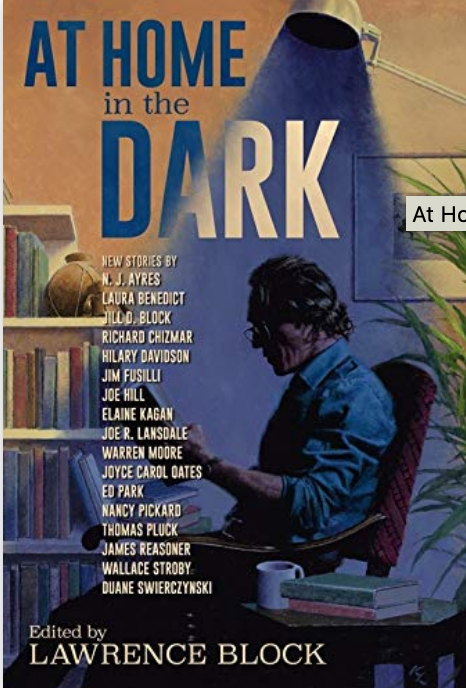
Spooky, Dark, Great for the Season: Short "Noir" Collected by Lawrence Block


[originally published in the New York Journal of Books]


“Serious stories, taking in the main a hard line on reality, and any gray scale would show them on the dark end of the spectrum.”

When mystery author extraordinaire Lawrence Block gathers stories for an anthology, top names mingle with newcomers among the authors he taps on the shoulder. His own mysteries have dipped deeply into the classic New York City and Los Angeles dark police procedurals, but also skated and danced with merriment at times. Obviously, its the darkness that Block wants for At Home in the Dark—starting with a chatty Foreword that reviews the history of “noir” and explains why he’s avoided that term in his title.

But you can’t avoid the genre, since each story here features some aspect of the unsettling, creepy, menacing, and lock-the-door disturbing. There are 17, and it’s worth grabbing this collection just for the sake of reading another mystery by Joyce Carol Oates. But Joe R. Lansdale, Nancy Pickard, Jim Fusilli, and Duane Swierczynski will also draw fans. And part of the fun (if being alternately scared and despairing is fun!) is the contrast among their styles, as well as the surprises in the directions each one chooses.

Loosely speaking, James Reasoner’s story is a Western (but dark!), Joe Hill’s is horror, and Joe R. Lansdale jumps to an unexpected dystopian future.

But then there’s Elaine Kagan’s story “Hot Pants,” which launches this collection. It opens in a nursing home where everyone’s losing whatever marbles they entered with, yet it’s where Lucinda Conte needs to keep her failing father housed and cared for. Grim motivation for working in an Italian restaurant with good tips … and a kitchen culture straight out of the #metoo nightmares. See whether you would have predicted the final sentence, and the way the last action ties back to the title.

What would you guess a story called “The Eve of Infamy” would be about? Hint: Think FDR and his famous speech. Here’s a taste of the story, by Jim Fusilli:

“No, he decided, knee-deep in debris. He’d wait out the war and go back to the Bronx. The streets were in his blood. He knew the rooftops and alleyways. Theft came naturally, violence did too. If the next few years broke his way, he could bankroll a future, playing steady amid the turmoil. Then he’d go back home a champion. He’d aim high. The cops wouldn’t dare touch him.”

In other words, don’t look for happy endings in this collection. A few “just desserts” maybe, but even those are grim. Block’s roundup proves that The Girl With the Dragon Tattoo wasn’t unusual, just longer than usual for this genre. Brace for violence, sexual and otherwise. Don’t read this if you’re on the brink of depression, as it might tip you in. But if you’re a survivor of many a dark crime novel, there’s great pleasure in these concise, tight, and twisted tales.

One of the most enjoyable aspects of At Home in the Dark is seeing the collection as insight into Lawrence Block’s preferences, amply described in his “rant” at the opening. His description of the noir collections in vogue is spot on: “They are serious stories, taking in the main a hard line on reality, and any gray scale would show them on the dark end of the spectrum.”

Here’s one more classic snippet to treasure from the collection, from the story “The Cucuzza Curse” by Thomas Pluck: “Joey was here because he knew people, and he knew people. … He had a reputation as a reasonable if foppish good earner with an even temper, respected by men of violence.”

Don’t say you didn’t know what you were getting into: the dark!!

PS:  Looking for more mystery reviews, from cozy to very dark? Browse the Kingdom Books mysteries review blog here.
-->

Wednesday, August 23, 2017

Noir That Lingers, in A DARK AND BROKEN HEART, R. J. Ellory

British author R. J. Ellory wins long-term fans for his dark crime fiction through his characters -- mostly men, whose shadowed lives are twisted, bitter, yet somehow vulnerable. A DARK AND BROKEN HEART is already a classic of his work -- and it just arrived for American readers through Overlook Press.

What's with Detective Vincent Madigan, anyway? Doesn't he know crime won't pay, after being a cop for so long? Actually that seems to be the opposite of what he's learned with the NYPD and the corruption surrounding him. His own struggles have put him deep into debt to both a bookie and drug lord and to his lawyer (it all makes bitter sense). Not to mention alimony. And underneath all of Madigan's horror at the tangled mess of his life is a small, persistent hope: that somehow, some day, he can do something that will delight his teenage daughter and hear her speak his name with happiness and excitement.

That's the dreamy and tender kernel to the man that can make this worth reading, through violent scenes of desperate efforts gone wrong. Even Madigan knows his plan of using three career criminals to help him steal that drug lord's cash delivery is way too risky. He can picture what Sandia, the crime boss, would say after catching Madigan in the act:
You killed my people and you stole my money to pay your debt to me. You paid me back with my own money. And don't insult me by telling me you didn't. Tell me the truth and I'll kill you quickly. Lie to me and I will have someone torture you for a month.
As Madigan assessed the situation, "This was what he had. It didn't get much worse than this."

But it can indeed get worse, and does. Buckle up for more than 300 pages of bad decisions and bloody consequences. If you stick with it -- and readers who already like Dave Zeltserman's crime fiction and the deep gritty noir that Overlook is so skilled at finding will indeed be hooked -- don't count on a happy ending. Madigan may expect it (that's why readers hang with him), but he's been wrong so often that the finale is bittersweet, but not exactly unexpected -- unless, of course, you are the often high, always scheming, ever hoping Madigan himself.

PS:  Looking for more mystery reviews, from cozy to very dark? Browse the Kingdom Books mysteries review blog here.

Friday, December 09, 2016

Noir: The Darker Side of Life, and Mysteries


When I was a child, one of my grandmothers regularly sent me milk chocolate squares from Switzerland, and I understood that it was the finest chocolate in the world.

Now we live in an era of chocolate gourmands, and most of the best chocolate seems to be dark -- with various additions that still surprise me.

Mysteries, of course, range widely in "color" (whether that's an emotional term, or a plot description). Many of the cozy mysteries that I've reviewed recently are sweet, to the point of describing a lot of desserts, as well as affection between characters, human or not. Then I appreciate in fresh ways the contrast and bite of the darker mysteries, of which today's Scandinavian police procedurals are among the very darkest. Today's dark Irish and Scottish ("tartan noir") crime novels often come in as close seconds.


Hollywood explored the possibilities of these dark, moody, stormy mysteries very effectively, even decades ago. From the gritty urban mysteries of Raymond Chandler, to the eerie perspectives of Alfred Hitchcock, to the special effects of smoke, fog, and gruesome visual death effects, film noir  -- via the mystery and crime dramas that took root in the 1940s and 1950s -- continues to capture the desolation and danger that translate brilliantly across many kinds of boundaries.

Exploring the website and writings of Eddie Muller, "noirchaeologist," adds valuable background and insight to this darker side of mysteries, and to how authors and filmmakers portray life and death. There are moments when despair and loss serve to highlight how to value the light and hope that other places and plots include -- even if that light is simply the glow of the windows in a diner, seen down a hard road.

The poster shown here is from one of the Noir City festivals that Muller curates and nurtures. Kingdom Books is thrilled (really!) to present this -- as Muller himself signed it. It's available for purchase, and could be exactly the right gift for someone who treasures this side of the mystery world. Drop us an e-mail at KingdomBks at gmail dot com and we'll provide details on price and shipping (and conversation, of course!).

PS:  Looking for mystery reviews, from cozy to very dark? Browse the Kingdom Books mysteries review blog here.

Saturday, March 26, 2016

Gower St Detective Series #3, DEATH DESCENDS ON SATURN VILLA, M.R.C. Kasasian

M.R.C. (Martin) Kasasian's Gower St Detective Series is quirky, often confusing, frequently dark, threaded through with vicious humor -- and irresistible in terms of posing puzzles to solve and placing it all in the most graphic sort of Victorian world.

In short, I like these books. A lot. My only problem has been deciding which friends to share them with. It's entirely possible that anyone I give a Gower St book to will think I am as strange as the characters within. Alas!

And they are fiercely memorable characters. For instance, there's the narrator, a young woman named March Middleton -- except she only narrates part of DEATH DESCENDS ON SATURN VILLA. There's her godfather Sidney Grice, most famous and most unpleasant detective in the mean streets of London. (Not to mention his insistence on disgusting vegetarian meals, his abuse of his untutored maid-of-all-work, and his scorn for March Middleton herself.)

The puzzles set before March and Grice in the previous two books, The Mangle Street Murders and The Curse of the House of Foskett, have dragged March into gutters and gruesome crime scenes. Her assistance to Grice is a painful necessity: Stranded in his home, unable to live separately due to the mores of Victorian London (and lack of funds), she's caught up in his investigations for lack of anything else to do. And even though his lessons to her are mean-spirited and stingy, she's learning how to assess a crime scene.

But as DEATH DESCENDS ON SATURN VILLA opens, March is on her own, unexpectedly, when a summons arrives from a relative she never knew existed. Risky though it is to accept such an invitation, she feels compelled: Perhaps this new "uncle" can shed light on the terrible suspicion she's harboring about her godfather's role in the death of her own mother.

What March can't have expected, though, is that Uncle Tolly's home will exert such odd effects on her that she'll soon be convinced she herself has committed murder. Will Sidney Grice exert himself far enough to solve her case? Or will his evidence condemn her in court?

Even as March struggles to gain Grice's assistance, the pair continue to play out a "who's on first" sort of dialogue with the uneducated, blunt-tongued maid, Molly:
"Dear March," Mr G spoke tenderly, "I think you may be telling the truth that you do not know if you did it -- whatever it may be."

Molly came in and put a tea tray on the table. "Cook said I was very rude to say that about your dress the other day, miss."

"It does not matter," I told her.

"I just wanted to make it clear," she continued. "There wasn't not nothing wrong with the dress. Anybody else might have looked pretty in it."

"Thank you, Molly."

"And -- "

"Get out," her employer commanded, "before Miss Middleton attacks you as she allegedly did the last maid who crossed her path."

"Oh miss." Molly put her hand to her mouth. "I never even knew you had a path. I hope I never allegingly cross it."
As you can see, the further you're drawn into DEATH DESCENDS ON SATURN VILLA, the more you are trapped halfway between Alice in Wonderland, and Douglas Adams's Hitchhiker's Guide to the Galaxy, with a dash of Jasper Fforde on the top. Is this your kind of book?

I confess it's mine on alternate Tuesdays and Thursdays, and crazy though the series is, I can't put the books down, once I start them. Kasasian's plot twists are always unexpected and bizarre, although perfectly reasonable in hindsight (considering the characters involved). The pace is brisk, and the frank depiction of the dirt and dismay of Victorian everyday life is oddly endearing. Most of all, March Middleton is someone worth saving, somehow, so her disappearance in the middle of DEATH DESCENDS presses the book into desperate straits.

I know -- you're going to tell me you are NOT one of the people I should give this book to. Wait -- you've read this far? Maybe ... maybe you like this crazy British humor in detective guise, after all? Go ahead -- get a copy and enjoy snickering and snorting.

Yes, you can read this without reading the other two books first. But I think it's a lot more fun for this series to take one after another. Mute the phone, and keep the tea and crumpets (no cold cabbage stews!) coming.

PS - There's no author website at the moment, as far as I can tell, although Pegasus Crime hosts a launching spot for Kasasian. Look for him on social media instead.

Saturday, September 19, 2015

From Europe to Texas, Mark Pryor Moves for HOLLOW MAN

I'm a huge fan of Mark Pryor's Hugo Marston series, set in Europe (mostly circling around Paris) where Marston, a retired FBI profiler, provides security for the U.S. Embassy. (Reviews here!)  The Reluctant Matador was the 2015 title in this series, so it's intriguing to have an extra Mark Pryor book in the same year, and this one's billed as a standalone: HOLLOW MAN.

You don't need to know the T. S. Eliot poem that provides the title -- it's clear right away that Domenic, the narrator, is a psychopath, making his way as a Texas prosecutor with a performed set of emotions that he doesn't really feel. Or at least, his versions of them are very different. He's interested, intrigued, annoyed, even angry, but kindness, for him, is a matter of calculating what's in his best interest. A job transfer to a less compelling and less profitable division distresses him. But in the process, the possibility of creating a "perfect crime" arises, and of course, he can't walk away from the challenge.
But I did resist. I had to. It's one thing being unable to get off the slide once you begin; it's quite another to step onto that slippery slope with your eyes wide open. I'd trained myself that being a functional human being meant, for me, recognizing dangerous situations and steering around them. Not resisting the temptations, but avoiding them in the first place. I was the serial adulterer hiring an ugly secretary, or the booze-hound driving the long way home to avoid his local liquor store.

"Prosecutors don't steal cars," I said. "Not this one, anyway."

"It's not stealing," she said, "if you give it back. It's not even borrowing. It's teaching him a lesson."
I've got very mixed reactions to this one. Pryor's writing is compelling and convincing, and the plot he provides is neatly twisted and well paced. But I found I was uneasy "identifying" with this narrator. Maybe I should be used to it -- the Wyatt books from Garry Disher are equally disturbing in terms of being inside a psychopath's mind. But Disher's Wyatt has weak spots in his personal defenses, and takes some risks for others at odd but significant moments, and I find myself on his side. For Domenic, a cautious emotional distance fits much better. I wanted to like him, but all in all, I didn't -- and I wouldn't necessarily prioritize reading another book from his point of view. (Good thing for me it's a standalone, then.)

What did intrigue me mightily was seeing author Mark Pryor make the shift to the Texas setting, where he is himself a transplanted Englishman and an assistant district attorney. I appreciated his know-how on both the legal career and the effect of changing countries. (He has a family and does not appear to be a psychopath himself, I'm glad to note.)

After the already-mentioned Australian Wyatt series and of course the Dexter books, plus Dave Zeltersman's series, I found Pryor's psychopath approach less than satisfying, the the plot was more predictable than I like. But other readers have found the ending surprising. If you like really dark noir and the tension of crossing a legal career into crime, check out HOLLOW MAN. From Seventh Street Books, a publisher that keeps on impressing me with its reach and range.