Friday, April 14, 2023

New Tight, Dark Canadian Hard-Boiled from Vern Smith, SCRATCHING THE FLINT


Run Amok Crime Fiction releases today/tomorrow a new hard-boiled detective novel from Vern Smith. SCRATCHING THE FLINT continues to wind his dark twists tighter, until explosion is inevitable. Set in pre 9/11 Toronto, the book opens with a grim killing of a squealing witness that implicates a sleazy lawyer in the messy patterns of mob execution.

Hard-boiled as a genre is saturated with rage and impulse; Smith takes it a layer deeper by leaking the real precursor to rage, the inner morass of doubt and shame invading lives spent avoiding human connection. Here's Gordon, for instance:

First came Gordon's return to drink, falling down after last call in front of the Bovine Sex Club, breaking his wrist, claiming he did it rollerblading. The emergency doctor prescribed enough painkillers to kill all kinds of hurt. Then Gordon was hooked on those, too. Luckily, the cops didn't bother with a blood test three weeks ago, relying only on his breathalyzer reading, 0.81, which was bad enough. That made him not just a bona fide boozer, but a bona fide boozer inside the small world of Toronto journalism. ... Did that make Gordon lowlife? ... And did he even want to know?

Meanwhile, anti-fraud team Alex Johnson and Cecil Bolan (from Smith's earlier short story collection The Gimmick) try to break into the mobbed-up crime ring that Gordon wishes he were good enough to expose — and Gordon sneaks up on their investigation. Not surprisingly, he digs himself into deeper messes, while the detectives circle around the same swamp. At times it's hard to tell the good guys and their guilt from Gordon and his shame ... except Gordon's making worse mistakes because he's so darn scared. 

If you cut your reading teeth on Los Angeles noir, or Donald Westlake's series under his Richard Stark pen name, here's a great chance to step deeper (or, considering Gordon, higher) and grab the bitter disillusionment of modern police challenges and the messy choices that power provides. Oh, and that title? Think a Zippo lighter ... and all the steamy and screwed up moments likely to follow that scratched flint.

PS:  Looking for more mystery reviews, from cozy to very dark? Browse the Kingdom Books mysteries review blog here. 

The Living, Lasting Legacy of Author Anne Perry (1938-2023)

(Author Anne Perry in 2012. Credit: Wikimedia Commons.)

Dave and I met one of the great mystery authors of our lifetime at a reader/writer conference, Bouchercon, when it was held in Albany, New York. We'd prepared for months —even years—for this, collecting the books written by Anne Perry. Others in line around us clutched to their chests one or two books to be signed; some, like us, had more. We toted ours in big canvas book bags.

I recall how awestruck I felt when I reached the front of the line and stood in front of this British author. There wasn't time for conversation: Maybe another hundred people waited behind us. Briskly, in our practiced rhythm, Dave and I opened each lovely hardcover book to the title page for this author's bold signature, then the next, and the next, as one of us put away signed copies and the other lifted more books to the table.

In minutes, it was over; I felt breathless, truly amazed that life could include such a moment.

Historical mystery author author Charles Fergus, however, made much different use of his time with Anne Perry. I love his story of that moment and its lasting legacy in his writing. Here you are (the original is published on his blog, https://charlesfergus.com/blog-posts):

Anne Perry's Advice to Me: Make True a Major Character

Anne Perry, who died recently at age 84, wrote dozens of popular mysteries set in Victorian-era England. According to her website, more than 26 million copies of her novels have been sold since the first one was published in 1979.


Perry wrote 32 William and Charlotte Pitt mysteries; they feature a police officer in late 19th-century London and his wife, an unconventional aristocrat. Perry also wrote a 24-book series about a detective named William Monk, who loses his memory after a carriage crash, and Hester Latterly, a former Crimean War nurse who ultimately becomes William’s wife and helps him adjust to his brain injury and solve crimes. 


I met Anne Perry in 2013 at a conference of the Historical Novel Society, which was held in an old hotel in St. Petersburg, Florida. I had completed a manuscript for the first Gideon Stoltz mystery, A Stranger Here Below, and was looking for a literary agent. I’d also signed up for a course on how to craft effective pitches – both a longish description of a novel, and a shorter one, sometimes called an “elevator pitch” from the notion that you can deliver this near-breathless summary during a brief elevator ride. 


Perry gave the keynote speech on the conference’s first evening. The next morning when I came down to breakfast, I saw her sitting there by herself. I asked if she wanted company, expecting her to say no, but she was delighted to share the meal and some conversation. 


She asked where I was from and what I was writing about. I said with a laugh that I’d just give her my brand-new elevator pitch: “In 1835 in the Pennsylvania backcountry, a young sheriff unearths disturbing links among a judge’s suicide, a trial and hanging 30 years ago, and a recent murder. To conduct his investigation, he must relive his own mother’s murder, a crime that remains unsolved.” 


I also mentioned that one reason I’d written a murder mystery was because I had lost my own mother to a murder, and I wanted to write a story that did not trivialize the horrific, life-swerving effects that a murder leaves in its wake. 


Years later, I would find out that Anne Perry had committed murder herself. In 1954, in Christchurch, New Zealand, at the age of 15, she and a pathologically close 16-year-old female friend killed the friend’s mother by bludgeoning her using a sock with half a brick in it. They somehow thought that killing the woman would prevent the friend’s parents from leaving New Zealand, which would have forced the two adolescent girls to separate.


Ms. Perry’s criminal past had been revealed in 1994 when Peter Jackson told her story in his film Heavenly Creatures, starring Kate Winslet as the confident, conniving teenager Juliet Hulme – who, after serving five years in prison, would be given a new name and ultimately would become the bestselling mystery author Anne Perry.


That morning in St. Petersburg, after hearing about my planned mystery series, Perry urged me to develop Gideon’s wife, True Burns Stoltz, into a major character. Perry said that in writing her novels, she felt that having both male and female main characters helped her examine situations, relationships, and crimes from two very different perspectives. She felt that readers liked that approach. And she said that writing from those differing viewpoints was fun. 


By then I’d begun working on my second mystery, Nighthawk’s Wing. In it, True hauls herself out of a deep and nearly suicidal depression brought on by the death of her and Gideon’s infant son. And in the third mystery, Lay This Body Down, True blossoms into a quirky, tough, determined heroine whose way of looking at the world differs from – and complements in an important way – that of her rational, thoughtful, sometimes almost plodding sheriff husband. 


Perry’s obituary in the New York Times noted that she never married; friends felt she ended romantic relationships because she didn’t know what to say about her past. It also quoted some things she’d said in a 2017 documentary film about her life: “In a sense it’s not a matter – at the end – of judging,” she said. “I did this much good and that much bad. Which is the greater?” 


She continued: “In the end, Who am I? Am I somebody that can be trusted? Am I someone that is compassionate, gentle, patient, strong?” She mentioned other traits, including bravery, honesty, and caring. “If you’re that kind of person,” she said, “if you’ve done something bad in the past, you’ve obviously changed.”


Anne Perry offered me encouragement and spot-on writing advice. I’m glad to think of my character True as one of the things she gave to the world.


 PS:  Looking for more mystery reviews, from cozy to very dark? Browse the Kingdom Books mysteries review blog here. 

Tuesday, April 11, 2023

Cuban-American Romantic Suspense from Chanel Cleeton, THE CUBAN HEIRESS


[Originally published at New York Journal of Books]

“A tenderness for Cuban life and the way the island draws people back to their roots colors the determined women of this novel and the men who assist them. Cleeton’s characters offer a beautiful pairing of tenderness and passion, anger and revenge, courage and resolution.”


This lively and twisty suspense novel from Chanel Cleeton pairs the glamour and desperation of women’s survival in the Great Depression, highlighted with a delicious Cuban American flair. Occupying different parts of the magnificent luxury liner S.S. Morro Castle are two women whose secrets intertwine, and two determined thieves, one charming, and the other a clear menace. Cruise-ship entertainment may hide the dangers during daylight, but on the night decks, murder knows few bounds.


Elena Reyes, say one woman’s false documents. Her first mission on the boat is to retrieve a pistol that’s been smuggled aboard for her, thanks to other Cuban American allies. Her justofied rage is more than sufficient for the pistol’s use—but are her other skills enough to protect her?


New York heiress Catherine Dohan can flash emerald earrings and a massive diamond engagement ring while traveling with her wealthy fiancé and his small child from an earlier marriage, with whom she’s not supposed to interact. But when the earrings turn out to be as false as her persona, that’s another revelation about the supposedly wealthy man she’s engaged to.


When the charming and insightful Harry pays too much attention to Catherine, her hunger for romance and real affection flares into an uncontrollable response. And even though she can see the hard-scrabble career of seduction and theft that Harry juggles, the complications of the deception she is working mean she needs an alliance with this mysterious rogue.


She’s done her best to size him up: “Perhaps he’s hunting for a wealthy spouse as well … While I shouldn’t fault him, given my own ambitions, I won’t countenance anyone jeopardizing mine.” Prodded, though, she spits out her reality: “I like seeing people get what’s coming to them.” With Harry’s widened eyes, she instantly knows she’s made a mistake and revealed that she’s not the spoiled and pampered heiress she’s working so hard to portray.


Cleeton deftly alternates points of view between these two crafty, scheming women, and only gradually is the connection between them revealed: a fire, an abusive man, an escape. A false death certificate. And something about Raymond, the man Catherine’s engaged to.


As Harry becomes a more trusted ally, he shares his criminal insight with her: “There’s something about Raymond—a disregard for others, disdain for anyone he views as beneath him. … Whatever your game is, don’t think he doesn’t have one of his own.”


Cleeton, a Florida native with Cuban roots of her own, shows the skills she’s honed in four earlier romantic historical novels as she whips between the two women’s deceptions and risks. A tenderness for Cuban life and the way the island draws people back to their roots colors the determined women of this novel and the men who assist them. Cleeton’s characters offer a beautiful pairing of tenderness and passion, anger and revenge, courage and resolution. Not until the poignant final chapters will all the twists be satisfyingly revealed, with Catherine’s wish fulfilled: that people “get what’s coming to them.” And that includes the possibility of love, after all.


PS:  Looking for more mystery reviews, from cozy to very dark? Browse the Kingdom Books mysteries review blog here. 


Monday, April 10, 2023

Extraordinary Graphic-Novel Version of Sherlock Holmes, "The Final Problem"

[Originally published at New York Journal of Books]


“
Sherlock Holmes: The Final Problem in the hands of Hannes Binder is a must for any collection of Baker Street investigations, opening new awareness of the impact of this classic in its time.”


Ignore the any “young readers” alert where this book is promoted or displayed for sale: Hannes Binder’s graphic novel version of Arthur Conan Doyle’s Sherlock Holmes tale, The Final Problem, is a masterpiece of dark significance and foreboding. To a Holmes fan or collector, each page offers an art-embedded insight into a story that once shook thousands of readers, as Doyle attempted to escape the burden of writing more about the noted detective.


The 1893 story called “The Adventure of the Final Problem” began with an abrupt appearance by Holmes at the private consulting room of his ally, Dr. Watson. Binder’s graphic version begins at the same point. Then, however, an adventure opens in compressing the retelling of this tale into a slender “picturebook” format. This will be most appreciated by readers already familiar with Doyle’s original and with the impact of the story in 1893 (and through the next century). The intense and detailed illustrations—which vary from full-page, to two-page spreads, to boxed sequences like an old comic—convey at times even more than the original text.


For example, a haunting triptych offers the smoke curling from (probably) Holmes’s cigarette, rounded contours of a brain’s “white matter,” and an ominous arachnid gripping a globe that echoes the mind of the arch criminal—or does it belong to Holmes himself? A glaring embedded eye later views Watson’s tortuous maneuvers to escape Moriarty. Mountainous landscapes, fierce skies, and storm-torn waters deepen the degree of threat and terror.


Binder, a seasoned creator in this form, is noted for his scratchboard illustrations. Here, in haunting detail, they are printed in a deep blue that exerts more impact than a black-and-white might have. Glaring faces and ominous oncoming weather nestle among views of rocks and rivers. The smallness of Holmes and Watson, compared to the enormity of Moriarty’s evil and related network, emerge in ways beyond the wording of the original text, yet without distorting it in any way. So when the pair of sleuths approaches the Reichenbach Falls, you can see both their attempt to be casual, and their vulnerability. The inevitable closing of the story, conveyed with a bold series of waterfalls and desperation, is suddenly tremendously moving—as the story must have affected its first-time readers more than a century ago.


Sherlock Holmes: The Final Problem in the hands of Hannes Binder is a must for any collection of Baker Street investigations, opening new awareness of the impact of this classic in its time, and even today, as new forces of evil confront humanity. If we could illustrate the chaos and threat of our times as Binder has done here, and present it to each available reader, perhaps it could act as a deterrent to the end of the world as we know it.


At last, it is Watson’s words that echo with the well-paced return of the drawings to urbane England: “Two years have passed, but I still feel the gap that Holmes’s death has left in my soul.” Most readers will know that, under pressure from readers, Arthur Conan Doyle found himself forced to pick up the narrative of Sherlock Holmes once again. But this graphic version conveys the agony of the years “in between,” and offers a new impact to what could never be reduced to a mere series of detective fiction.


 PS:  Looking for more mystery reviews, from cozy to very dark? Browse the Kingdom Books mysteries review blog here. 

Tuesday, March 07, 2023

Terrific Sniper Thriller from Cara Black, NIGHT FLIGHT TO PARIS


[Originally posted at New York Journal of Books] 

“Black's work is leaping ahead in power and energy, and Night Flight to Paris is one of the notable thrillers of the season.”


Cara Black
, well known for her long Parisian series featuring PI Aimée Leduc, has come into her own. Her new series features a woman sniper who, in last year’s first book of the series, Three Hours in Paris, faced nightmares of capture and death as she works undercover for the British, on multiple assassination targets.

In the second book in this dramatic and fast-paced new approach, Night Flight to Paris, American Kate Rees thinks her failed mission (as she sees it) from 1940 will keep her in Britain as a sharpshooting instructor for the rest of the war. But in 1942 her former handler, Colonel Stepney, has pressing reasons to send her back to the occupied City of Light on a triple mission: a delivery, an assassination, and the exfiltration of one of her close friends, Margo, who's specifically demanded Kate's assistance.

But nothing's very clear in the rushed briefing to the mission, as Colonel Stepney seems to be more than a bit obscure, telling Kate: "‘A good undercover legend is like a diamond. Crafted to meet the four Cs—the carat, cut, clarity, and color. They sparkle so brightly you can't look past them.’ Diamonds were hard. Was Stepney saying something else here? ‘Much of your mission depends on what happens on the ground after you land, and how Margo plays it. We can't know anything for sure.’ Plan. Pivot. And re-plan. Hadn't Wilkes drilled that into the trainees? Or as her pa would say, ya gotta be ready to turn on a dime, Katie.”

When Stepney issues Kate a cyanide suicide pill, that confirms how risky this mission will be. And it's complicated by the mess Kate left behind two years earlier since there is a warrant out for her arrest in Paris, and she'll have to be in heavy disguise as a result.

Black ramps up the tension in every plot twist, and offers an unforgettable experience of both wartime Paris and the sheer guts and creativity needed for undercover work. 

“She'd walked into a setup. Her own damn fault. ... Under her Red Cross Cape, she slid her 9mm Welrod's 12-inch cylinder, containing its bolt, barrel and baffle, down her sleeve. It took seconds, during which she never broke eye contact with the Nazi.”

In contrast to Black’s Leduc books, this new series avoids swaddling the action in romantic questions, which in turn leaves Kate Rees clearer about her own capacity, able to plan swiftly, and incisive in questioning what’s coming at her and responding from strength, despite some obvious flaws in her preparation:

“In the garage, Kate opened her bag in the creaking cabinet, ready to change into the Wehrmachthelferinnen uniform. Sickening Nazi symbols decorated the sleeves. Would it fit her big-boned frame? With this uniform and the stolen ID, she’d have credentials and blend in unnoticed. But the few phrases of German she’d picked up left a lot to be desired. Face it: the moment she opened her mouth she’d be dead.”

Overall, Black shows that her transition from the Leduc detective series to this thriller format is an excellent choice. Although there are a few inconsistencies at chapter jumps—maybe from all the adrenaline in crafting this high-suspense, high-threat adventure—Black's work is leaping ahead in power and energy, and Night Flight to Paris is one of the notable thrillers of the season.

 PS:  Looking for more mystery reviews, from cozy to very dark? Browse the Kingdom Books mysteries review blog here. 

Friday, February 24, 2023

Short Story Collection from James R. Benn, THE REFUSAL CAMP


Crime and war. Unfortunately, they go well together. Especially in the hands of James R. Benn, whose 17 Billy Boyle mysteries place an Irish-American cop at various sites and trenches of World War II, investigating the dark side of moneyed warfare on behalf of his distant cousin General Dwight Eisenhower.

THE REFUSAL CAMP gives Benn the space to air tales of other wars, other time periods, and of course other motivated protagonists (although there is a gem of a Billy Boyle story tucked among these). The collection opens during the years when Connecticut settlers still enslaved Africans, and unfolds from the point of view of an enslaved teen. It swiftly becomes a crime story, one where the most disadvantaged person on the scene must summon both courage and insight, as well as a clever riposte, if he's to escape hanging.

There are eight more stories—one published in an earlier Soho Crime Collection, The Usual Santas. Billy Boyle fans will especially enjoy the Boston investigation "Irish Tommy," featuring police lieutenant Daniel Boyle, as well as "Billy Boyle: The Lost Prologue," a tale removed from the first Billy Boyle mystery before publication. The cleverest may well be "The Secret of Hemlock Hill," a haunted Civil War tale brought into the present. "The Refusal Camp" offers a concentration-camp possibility that reminds us that "victims" often found effective ways to hold their own.

Seasoned Benn/Boyle fans need this collection for their shelves featuring the youthful, loyal, and often rash wartime detective; those new to Benn's work may find the character-focused and neatly plotted and twisted stories so satisfying that they'll wish to dip into the full Boyle series.

Best of all, this nicely balanced collection can temper the rest of the Northern Hemisphere winter season, providing good reading for the last of the fireside evenings and lazy weekends before the yard, gardens, and outdoor sports reassert their siren calls.

Soho Crime/Soho Press will release the collection on March 14; this is a good time to place a pre-order to be sure to get a copy "hot off the press," as Billy Boyle would have said.

PS:  Looking for more mystery reviews, from cozy to very dark? Browse the Kingdom Books mysteries review blog here. 

TINA, MAFIA SOLDIER, Striking New Sicilian Crime Fiction from Maria Rosa Cutrufelli

The opening chapters of TINA, MAFIA SOLDIER go very slowly, as the narrator—would-be author of a biography of Cettina, now Tina, a Mafia youth—renews her acquaintance with Gela, a city in Sicily. This harsh frontier-like city, once a coveted location in ancient history, is now a battered orphan of the petrochemical industry. Its historic face has vanished; instead, the narrator sees it as "Young and cruel. It's a cruel landscape that I find hard to recognize and doesn't correspond to the map of my memory anymore."

The city itself reeks of masculine violence and brutality. But embedded in it today is Tina, a' masculidda, Tina the little tomboy, documented in a folder the narrator carries with her. Recently imprisoned, Tina isn't yet 20 years old, but her leadership of her small teen gang within the Mafia culture has brought her strength and notoriety.

The quest for Tina herself begins with interview upon interview of relatives and friends of this "Mafia soldier" in hopes of gaining a visit with the prisoner, who can choose whether or not to admit someone, almost a bizarre form of royalty. And in fact, Tina is a figure worth admiring, even worshiping, with her motorbike, her weapons, the loyalty she's demanded and inspired.

Bear with this narrator and the translation (by Robin Pickering-Jazzi), because the discomfort of the chapters builds toward an awkward yet compelling understanding of Tina herself and the "cruel" city that has brought her into being. A sexual intermediate, neither muscled male nor seductive female, Tina is a quintessential "other," trans in every aspect of her being.

Here is a taste of Tina, struggling to outwait the customers at the beauty salon operated by her cousin Giovanna:

The roots of her bad mood sank down into embedded realities that were different and deeper than dissatisfaction or unfulfilled needs. She would have liked to make a spectacular entrance that day. She dreamed of the splendor of an entrance worthy of her. The Alfa 164 and black leather jacket. ... "Did you all see her? Rambo." Constraining her to give tough answers, always poised on a razor's edge.

Then there's Tina's friend Graziella, who works for a production company and represents another side of the muddled sexuality and violence of the place:

Graziella is a nervous brunette who's going back and forth between a printer and a video, extricating herself from snarls of wires that are hanging down and getting entangled between stools and tables, obviously hindering her movements. But more than her exuberant nature, I think it's her still very young age that makes her easily confront a job whose dangers she doesn't see, even though she knows perfectly well what they are, and complain about the job just being temporary.

Though men are interviewed too, it's the women who love Tina for herself and would do anything for her. Giovanna, for instance, "raises the cigarette to her mouth, a darting little snake with a pointed tip, and says as she exhales the smoke, 'She's a warrior.' A reverential fear that gradually dissolves in veiled disapproval."

By the time our narrator finally forms a connection with Tina herself, the grim, assaultive, and sexually confusing journey into the teenager's life, into the Cosa Nostra, into Sicily and its asphyxiative presence, has changed her irretrievably. What she will facilitate at last for Tina will tear apart the fabric she has spent so much time and effort crafting, as she calls Tina out of the cell and into compelling pages.

TINA, MAFIA SOLDIER is complex, with seductive metaphors and a grimly poisonous atmosphere that daunts the emergence of any necessary self-love. Once it picks up speed, it's compelling and potent. There can be no return to any mythic Sicily after this fictive immersion in reality provided by Sicilian-born Maria Rosa Cutrufelli.

PS:  Looking for more mystery reviews, from cozy to very dark? Browse the Kingdom Books mysteries review blog here. 

Brief Mention: LAST SEEN IN LAPAZ, by Kwei Quartey


Collecting international crime fiction? Ghana-born physician and author Kwei Quartey's Darko Dawson series, set mostly in Ghana, has been a pleasure; Quartey's current series is a spinoff that features Emma Djan, a private detective always alert to gender discrimination as she works her way up in a local agency (the police force dumped her, early in the series).

LAST SEE IN LAPAZ opens with the disappearance of a young Nigerian woman, daughter of a friend of the agency owner. (Lapaz is a town in the Accra Metropolitan District -- not related at all to La Paz, New Mexico.)  The attractive and hard-working Ngozi seems to have run away from home, across the national border, and might be in Accra. If, that is, she's alive.

Emma Djan isn't yet authorized to do a lot of investigation on her own, but she has an advantage here, because she can perform a flirtatious role with the greedy (in every sense) hotel owners who seem linked to the disappearance. When one hotel turns out to be supplying female companions, perhaps forced into this upscale prostitution, Emma's both horrified and fascinated. Anything to avoid the boredom of routine PI work!

Her insight into women's lives also gives her an advantage as she investigates with Boateng, the local DI (inspector on the police force):

Boateng grunted. "You seem to be studying this room closely, Djan. What do you see?"

"No disorder, no chaos. It has a controlled feeling. Someone who has been in this room was trying to gain control over the other, but couldn't quite do it. ... This entire house is a clue."

Despite his California location, Quartey's writing continues to have the choppy feel of translated material, possibly an intentional effect to suggest the movement among local languages and dialects. The book suffers somewhat from quick changes in point of view, among investigators and criminals. But it's still a revelatory experience of urban life in Ghana, and neatly plotted, with caste and related attitudes deftly portrayed. 

Collect it for your African mystery shelf, as well as for the diverse spread of Soho Crime's continued global outreach.

PS:  Looking for more mystery reviews, from cozy to very dark? Browse the Kingdom Books mysteries review blog here. 


Tuesday, February 14, 2023

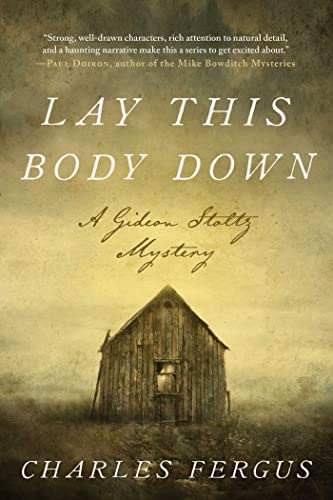
Third Crime Novel for Sheriff Gideon Stoltz, LAY THIS BODY DOWN, by Charles Fergus


 [Originally published at New York Journal of Books]

“Fergus’s writing lays out both the struggles of a new nation, and the pains of growing into determined manhood with its allegiances, regrets, and consolations. If murder and kidnapping can be halted, why not enslavement, also?”


The lines of good and evil are firm in this third antebellum mystery from Charles Fergus: Enslavement is brutal, and deprives the 1837 American nation of honor. Immediate emancipation could restore that honor—but in Sheriff Gideon Stoltz’s industrial Pennsylvanian town of Adamant, a rough crowd jeers at a visiting speaker advancing such an argument, and Gideon’s role as lawman is keeping the peace. Not advancing abolition.


However, Fergus positions Gideon as an outsider himself, with a strong “Pennyslvania Dutch” German accent that marks his difference in the hardscrabble Scotch-Irish town. Young and inexperienced for his job and without training, supported by his wife and a few friends, Gideon identifies with runaways and victims. It’s a dangerous position when there’s a national law requiring that he enforce “property ownership” toward Black fugitives. Although his state backs away from that position, the town is just 80 miles from Maryland, and his neighbors, a mostly rough crew, could inform on a runaway and expect Gideon to jail that person.


“What if the right thing—whatever it is—and what the law requires turn out to be two different things?” Gideon asks his wife True. Her answer: “I hope you would do the right thing.”


Chapters of Lay This Body Down open with excerpts from historically real reward notices seeking fugitives. When slave hunters turn up in Adamant, seeking a Black youth who’s helped Gideon in the past, what he’ll choose is never in doubt: He owes a debt, and servicing it fits with his growing belief that enslavement is cruel and wrong. Instead, the rapidly ramped-up tension in the book comes from the prevalence of malice among those hunting fugitives and those who already despise Gideon as not one of them, neither by heritage nor by attitude. As he struggles to find and protect this and other runaways, he plunges into personal danger.


In that sense, this is an intimate novel of connection among working men with opposing worldviews. Gideon will only succeed and survive if he can find enough allies to defend his choices and actions. It’s soon clear he’s even being betrayed within his own office. His own superior in law enforcement doesn’t even have his back. But his wife does.


Readers of the earlier two titles in this series (A Stranger Here Below; Nighthawk’s Wing) will not find much of the mystical and supernatural that appeared in those books, although True Burn Stoltz, finding her way out of her long depression over the loss of the couple’s child to illness, clearly relies on a related set of beliefs. Instead, the conflict in this novel foreshadows what was already erupting across the nation’s frontier at the time: ardent beliefs in independence and the sanctity of property, playing against philosophical and humanist efforts to impose a better form of civilization.


Gideon’s weaknesses, part psychological from his own mother’s murder, part physical as a residue of concussion (alas for the results of horse accidents and human beatings!), hold potential to transform into powerful incentives to action. As he prunes away the rot around him, he finds himself able to say to a stranger, “Maybe you can help me.”


Fergus’s writing lays out both the struggles of a new nation, and the pains of growing into determined manhood with its allegiances, regrets, and consolations. If murder and kidnapping can be halted, why not enslavement, also? The author’s meticulous historical portrayal offers a potent integrity, to ground the growth of Gideon Stoltz into a man who’s certain of the right thing to do, after all.


 PS:  Looking for more mystery reviews, from cozy to very dark? Browse the Kingdom Books mysteries review blog here. 

Tuesday, February 07, 2023

Engaging Mystery from J. D. Robb, ENCORE IN DEATH


[Originally published at New York Journal of Books]

“It’s unusual to find a crime page-turner that’s this compelling while also probing affection and loyalty, without gore or grotesque maneuvers. Motive, means, opportunity—Encore in Death is classic crime fiction at its best.”


Setting the Eve Dallas crime thrillers ahead in time, with a few more technological advances, doesn’t really give this homicide detective any more of an edge than today’s savvy sleuths. After all, even if test results come more quickly and communication is fine-tuned, solving a crime still comes down to getting inside the minds and emotions of potential suspects.


So when theatrical stars Eliza Lane and her husband Brant Fitzhugh throw an A-lister gala for patrons of their work, just as Eliza’s new Broadway show is about to open in the year 2036, it turns out that Brant’s sudden death is from cyanide, that well-known almond-scented poison. And the roster of suspects is no different than today’s would be: friends true or false, family, lovers, and competitors for the spotlight and awards.


But really, who could want to hurt Brant? His wife, a much edgier and sharp-tongued person, can’t imagine any reason. “Brant didn’t like conflict, and found ways to avoid it,” Eliza sums him up. Generous as an actor, a friend, a spouse, and even philanthropist, his death comes from toasting his wife with a sip from her specially prepared champagne cocktail. So who was the intended victim—husband or wife?


J. D. Robb’s polished and well-paced writing, honed in more than 200 novels so far, keeps the narrative on the move. Its second line of action takes place between Eve and her own husband, the wealthy Irish entrepreneur Roarke—who, whether by contagion or interest, is starting to “think like a cop” and lending a hand to Eve and her investigation. Eve spots this even before Roarke’s willing to admit he’s caught up in puzzle and how to solve it, as she outlines the need to follow the money here, and says she’ll take a look. Roarke steps right into her trap:


“I could do that for you while you dig down on the cast and crew. You may find it’s not the person who didn’t get the part, but a friend—as you were looking at Sylvie—a relative, a lover. Someone who’d do the deed for someone else.”


Roarke’s ability to quickly deep-dive into financials adds power to the investigation; his deft and determined efforts to support Eve’s work and the couple’s gentle jockeying in support of each other add charm and passion (and some lovely teasing) to the story, too.


As Robb lays out the plot with her quick professional skills, she paints solid marriages just as effectively. It’s unusual to find a crime page-turner that’s this compelling while also probing affection and loyalty, without gore or grotesque maneuvers. Motive, means, opportunity—Encore in Death is classic crime fiction at its best.


PS:  Looking for more mystery reviews, from cozy to very dark? Browse the Kingdom Books mysteries review blog here. 

Tuesday, January 31, 2023

Carrie Doyle Spins Another Quirky, Fun Mystery: THE GIRL WITH THE DRAGONFRUIT TATTOO


The third Plum Lockhart mystery in the Trouble in Paradise series is at least as much fun as its predecessors, It Takes Two to Mango and Something's Guava Give. At first glance, Plum's plunge into entrepreneurship with her own villa rental company on the tropical island of Paraiso looks rash and foolish -- and could anyone really be such a murder magnet as this scrappy yet star-struck amateur sleuth?

But Plum can grow on a person! A refugee from corporate marketing and the now outdated world of New York City magazines, Plum is determined to salvage her self-esteem by out-competing the very nasty Damian Rodriguez in representing the best villa rentals on the island. If that means making nice with the glitterati on a luxury yacht in the neighborhood, Plum has the guts to do it.

When one of the staffers from the yacht wants to consult her about a deadly threat, Plum has trouble clearing time for this distraction. So when the girl with the dragonfruit tattoo gets attacked, is it Plum's fault? She'll clear some emotional space by dressing down one of the sleazy men on board:

"I don't like your behavior, Joel," said Plum, who crossed her arms angrily for effect. "You are humiliating your wife. Everyone on the boat watches you flirt outrageously with an actress young enough to be your daughter. It's pathetic. I hate what you are doing to my friend, and you should remember you're a married man in a position of power and not exploit it."

The left vein on Joel's temple started to throb, and Plum thought it might explode.

Doyle's plotting, as usual, is tight, and the action sparkling; if Plum's combination of courage and naivety stilts some of her trilled or whispered conversation and moves the plot twists to the quirky side, it's a fair trade for the fun of discovering how she'll handle the next intensely awkward situation. Not to mention whether she'll ever have a functioning romance with Juan Kevin, the security guard who's been trying to date her!

Don't take anything seriously in THE GIRL WITH THE DRAGONFRUIT TATTOO. All the fun and frivolity may not give you the feel of a tropical vacation ... but a few hours away from real life might be almost as good as one of the many fruity cocktails that Plum keeps swigging.

PS:  Looking for more mystery reviews, from cozy to very dark? Browse the Kingdom Books mysteries review blog here.


Monday, January 02, 2023

Dark Longings and Dork Disasters, in THE MOTION PICTURE TELLER from Colin Cotterill


 Is it crime fiction or is it magical realism? Colin Cotterill's Dr. Siri Paiboun forensic tales, set in the collapsed corruption and congenial community of working Laos, have already shown this author must blend the two. 

In THE MOTION PICTURE TELLER, Cotterill leaps to 1996 Bangkok and the run-down but almost cute -- in a very dorky way -- lives of two unambitious men running a video rental store. Pay attention to Supot, who delivers mail for the Royal Thai Postal Service. (Cut to a view of his uniform, shabby perhaps but worn with some muddled pride as he dodges unpleasant dogs with his pack of letters and parcels.) Supot's "real life" begins after work each day, assisting in a video shop and watching films with Ali, the official owner. (Ali can be quite mischievous to his customers, but he makes ends meet.)

When these two nerdy, film-obsessed guys discover a film called "Bangkok 2010" that could be the greatest ever -- the kind that makes Supot's almost girlfriend consider, for a moment, actually fooling around with him, before opting to watch the film again -- they tumble into a bottomless mystery: The actors are unknown. The production company has vanished. How could they be holding a copy of the greatest film ever, and be unable to find out anything about who made it and when it's going to be released? Wait -- is this the only copy ever made?

When Supot finally reaches someone connected with the mysterious film, mystery readers will know the tale has just taken on danger (beyond that posed by dogs to mail carriers), as the letter offers a strong of urgent questions:

Where did you find 2010? Is it a copy, or is it the original film? Has anyone else seen it apart from you? If your answer is yes, how many people have seen it? ... I want you to promise me that nobody else will watch it, and that no copies are made of it.

From here, the story threads get wilder and Supot is soon way out of his comfort zone. The charm of Cotterill's writing is that this video fanatic, in love with a vision of an actress, is so believable, so close to the dork in each of us, that the pages must keep turning. 

THE MOTION PICTURE TELLER could be the strangest mystery you read this year, or even this decade. And you absolutely won't forget it.

Releasing January 17 from Soho Crime, an imprint of Soho Press.


PS:  Looking for more mystery reviews, from cozy to very dark? Browse the Kingdom Books mysteries review blog here.

Sunday, January 01, 2023

Outrageous Alaska Adventure from John Straley, BLOWN BY THE SAME WIND


The town of Cold Storage, Alaska, is John Straley's best invention: a place where almost any sort of humane criminal activity can and does happen, with a steady twang of Alaskan country music in the background and a slew of strong women enjoying cash-poor life as much as the men around them. The minute you aim for this locale, you give up control of what makes sense -- and ride with a mix of wild characters for the duration. Earlier Cold Storage novels began with The Big Both Ways, then Cold Storage, Alaska, and What Is Time to a Pig? 

It's crime fiction ... sorta. Remember the scene in The Godfather with the horse's head? That could happen in Cold Storage, on the chilly and salty coast. Except it could be a grizzly head. Still attached. And the person who held the door for the bear to come in would still be standing nearby, tipping back a beer (not the "craft" kind).

There was still no road into or out of Cold Storage, but somehow, in 1968, the world had arrived. In March, Lyndon Johnson announced that he had decided not to rub for president. Some said it was because of the Tet Offensive in the first part of the year. Boys from Cold Storage had gone to the war and three of them had died ... All of the boys had fished with their families and were memorialized on a hill off the road to the dump.

But the tale gets into gear with one of the boys who made it home, Glen Andre, with long hair, a tendency to not speak much, and an army jacket "with a bronze star pinned on the front." Because this is, after all, Cold Storage, you should simply nod hello with the rest of the crowd when the Kentucky anti-war monk Thomas Merton also arrives in town ... followed by a couple of obviously nasty criminals, and a probable FBI agent.

Still, even in Cold Storage, if a person wants privacy he can sort of get it, and if Thomas Merton wants to call himself Brother Louis, and teach something about God, that's up to him. The trouble is, he's explaining it to a striking young woman named Venus, who never met a boundary she didn't want to cross. Or a man who wasn't fascinated by her.

[The brother] began to see Venus not as an American teenager, but as a sprite from A Midsummer Night's Dream. On that night he followed Venus and the lights on her helmet up the hill, where at the summit he would try to reveal the mystery of both God's omniscience and His absence as Louis's heart beat like a steam engine in his chest.

By this point, either you devoutly want to read this novel, or you wouldn't touch it with a ten-foot bookmark. If you've embraced Donald Westlake, Janet Evanovich's Stephanie Plum series, or the Junior Bender books from Timothy Hallinan, I hope you're already ordering a copy of BLOWN BY THE SAME WIND. You're going to have a lot of fun and an occasional moment of thinking maybe you just figured out something you care about, a lot. 

Published, of course, by the boundary-challenging Soho Crime, an imprint of Soho Press.

PS: Looking for more mystery reviews, from cozy to very dark? Browse the Kingdom Books mysteries review blog here.

Thursday, December 29, 2022

North-Woods Crime, Cold Case Frame-Ups, and Easy Humor from Tamara Berry, ON SPINE OF DEATH


Considering how tough life on a desert island can be, adding Tamara Berry's engaging mysteries to the packing list seems very wise—from the nicely complex characters to the neat plotting to the clues and chuckles, these are books that lift the gray out of the day (or winter, or desert isle).

ON SPINE OF DEATH (a play on the phrase "on pain of death" but otherwise an irrelevant title for this recipe-free cozy) is the second adventure tucked into "Winthrop, Washington" (the timberlands in the east of the state) featuring bestselling author Tess Harrow. The series title is By the Book Mysteries -- especially apt this time, since the skeletons found in Tess's inherited hardware shop seem to match those in a mysteriously authored book that's turned up in the town: Let Sleeping Dogs Lie, by Simone Peaky, a nom de plume that even Tess's resources fail to match with a real person. 

There's less urgency to locate the author of this tell-all at first, since the skeletons are obviously from cold cases ("disappearances") in the little town. But when Tess figures out that the book is also giving burial details for the local sheriff's vanished sister, the pressure is on. Not only does Tess want to solve all three cases ... she's got to do it quickly, because the devastated sheriff is also a man she cares deeply about. (How deeply? One-way or two-way? That too is a mystery.)

"It makes sense," she said quietly. She didn't let go of his hand even though it sat like a cold, dead weight in hers. "You know it does. ... Your sister's case matches every aspect of it."

The deeper she gets into the investigation, the more the local ne'er-do-wells (woods crime family, anyone?) embed themselves into her life. At last, she has only one focus, helping the sheriff: "She knew this man well enough to realize that there was only one thing that could help him heal, and that was finding the killer."

Between her risk-taking but brilliant teen daughter Gertie, her librarian buddy who's an undercover investigator, and a perilously young new FBI agent desperate for her attention, Tess has a lot to handle. Not to mention solving the case, saving her (uncertain) relationship, and responding to queries from her agent.

A third book in this series is already titled, so it's time to snag both ON SPINE OF DEATH and its predecessor, BURIED IN A GOOD BOOK, and enjoy some lively and occasionally absurd distraction.

PS: Looking for more mystery reviews, from cozy to very dark? Browse the Kingdom Books mysteries review blog here.

Delightful Peter Diamond (British) Mystery from Peter Lovesey, SHOWSTOPPER


A good traditional British mystery is a great gift to a reader in this genre, and Peter Lovesey provides yet another in his December 2022 offering, SHOWSTOPPER. The premise is clear and clever: A popular TV show called Swift began six years earlier, after the awkwardness of its star actress dropping out before filming -- and a quick and workable replacement. But when multiple injuries make it into the media, the notion of a curse on this show heightens attention.

This coincides with the production moving to Bath, where Peter Diamond is Chief of the Avon and Somerset Murder Squad. At least, he hopes he still has the job -- his peculiarly unpleasant boss Georgina is once again working on ejecting him, this time as a forced retirement on the excuse that he's lost his ability to solve cases. So there's only one obvious solution: Discover the all-too-human source of the "curse" and stop the cascade of crimes. Even though, of course, he's been told not to bother.

By evening, the seriousness of what he had done caught up to Diamond. Georgina was sure to hear about the van called out to Claverton Down, the scene of crime unit at work on the airfield and the tramp and his dog in the custody cell. She'd be livid. He'd ignored her instruction to drop all interest in the jinx story, go into virtual lockdown and get the team applying for refresher courses. If his future as a police officer had looked doubtful then, it was in free fall now.

Beset by self-doubt but determined to get his crew cracking the case, Diamond retains the skills that have brought him so far -- including when to listen to his instinct and do a solo grilling of one of the "riggers" for the TV set. "Fergus clenched his fists and the serpent tattoos wriggled. Baiting him was a dangerous game, but Diamond wasn't stopping now."

This is a must-read for any dedicated reader of this genre, because it's tightly plotted, neatly twisted from clue to clue, salted with humor, and, as the publisher crows, a "meticulous mystery." And all this from an 86-year-old author who's been named a Grandmaster in both America and Britain. The conclusion is clear: There's no excuse for shabby writing, when Peter Lovesey demonstrates time and again that a well-applied mind and creative spirit are well up to the task. 

You might as well order or purchase two copies; you'll want to share it, but you won't want to chance losing your own copy, right? Hat tip to this author who teaches us all that aging might only make you better at your work. (And for more of our Lovesey reviews, click here.)

PS: Looking for more mystery reviews, from cozy to very dark? Browse the Kingdom Books mysteries review blog here. 

Tuesday, December 06, 2022

New Espionage Fiction in the Top Tier, JUDAS 62 from Charles Cumming


[Originally published at New York Journal of Books]

“Cumming effectively ramps up suspense, in this hefty page-turner revelatory of modern espionage’s methods. “


If the arc of history is long and bends toward justice, what about the arc of espionage? Is there an inevitable personal price to pay for the lies and wounds of a past career deceiving others politically across the globe? For lifelong spy Lachlan Kite, now director of a secret counterintelligence unit in the United Kingdom, the dead enemies of the past seem to rise up and walk again, when he finds his name on a Russian kill list. But do the enemies who have put his long-ago alias onto the JUDAS 62 list know who he really is?


British author Charles Cumming is reliably accurate in assigning capacities for data gathering, manipulation, and plotting to his teams, whether Western or Russian; writing from his own brief experience in the UK’s MI6 and abundant research since then, he adds a fine sense of human frailty and predictable betrayal to his plots. In JUDAS 62, Lachlan Kite’s early attachments and struggles from his first foreign assignment demonstrate how close he, or any such operative, comes to failing. For Kite, this is due to his underestimation of the enemy and naive willingness to defy authority. Though his overall mission at the time may succeed, the death of a scientist linked to the one he brought out from Russian control signals that almost all may now be laid bare—and Kite may pay with his life.


Much of the action takes place in Russia, caught up in complications of mixed loyalties. Taking time to paint all the details, with an overall novel length of about 500 pages, Cumming leads Kite to create a potential trap for his enemy. First, of course, he has to come to terms with his new vulnerability:


“The Aranov operation had cost Kite a great deal, personally and professionally. Peter Galvin was an almost-forgotten name from his past. Now the legend was again in circulation. It had taken him twenty-seven years, but Mikhail Gromik was finally ready to come after him. … ‘I’m perfectly safe,’ Kite replied, though he did not believe this. The idea that he was vulnerable to Gromik and to the scum who had murdered Evgeny was abohorrent to him. ‘They’re not going to come knocking on my door.’ Mahsood looked as unconvinced by this as Kite might have expected. They both knew he was on shaky ground.”


When the plot to trap the hunters and remove the target from Kite’s back—and from the backs of his colleagues—develops, it requires delicate manipulation of viewpoints of the former rescued scientist, the Russians on the hunt, and Kite’s own colleagues. Most dangerously, the trap must be executed in Dubai. So many things can, and do, go wrong.


Cumming effectively ramps up suspense in this hefty page-turner revelatory of modern espionage’s methods. Every move must be successfully choreographed … or countered. Lock your door, set the phone on “silent,” and prioritize: Keep reading, and watch for the moment when a very sophisticated “honey trap” clicks into place, and Aranov thanks a thoughtful man in a restaurant who pumps his hand and says, “This is my girlfriend, Sally Tarshish, and our good friend, Natalia. Are you hear in Dubai for business or pleasure?”


This is the second in a series from Cumming; the first was BOX 88. No need to read it before JUDAS 62, but the two are firmly linked. Contemporary and tightly plotted, this new pair makes an excellent addition to the espionage fiction collection. 


PS: Looking for more mystery reviews, from cozy to very dark? Browse the Kingdom Books mysteries review blog here.