Tuesday, October 28, 2014

Really? A Very Good "Jane Austen Mystery"? Author Stephanie Barron - Former CIA Intelligence Analyst

No, I didn't realize Stephanie Barron's background before I read her new book (released today!), JANE AND THE TWELVE DAYS OF CHRISTMAS. To be blunt, I wouldn't have touched a "Jane Austen mystery" even if I were snowed in for a weekend, except ... well, gosh-darn it, I've learned to count on Soho Crime for tight, well-plotted crime fiction with unforgettable characters. So when an advance copy of this book arrived along with the new Stuart Neville "Belfast Noir" volume (also released today), I gritted my teeth and started the first chapter.

About fifteen chapters later, I was still reading.

Barron's actually written 15 books since her stint at the CIA, and this one is intelligent, entertaining, and a classic puzzle mystery in the best English tradition. Way back in my past are a couple of years spent re-reading Georgette Heyer's best English Regency fiction, and Barron has the same knack for a clever protagonist with an irrepressible sense of humor and conviction under her constrictive clothing. This may not be the Jane Eyre you've pictured, but why not -- a spunky author who's defied her conventional brother in order to write her sharp-tongued and observant social-criticism-disguised-as-fiction, with an eccentric mother, and a passle of neighbors determined to enjoy the holiday season in spite of a heavy snowstorm. In face, in the first chapter, Jane, her mother, her sister, and her niece are victims of a carriage-and-wagon accident in the snowy night, and hence meet the elegant Raphael West, son of the noted artist Benjamin West (I looked them up; they were as real as Jane).

Despite her sense of reserve and a well-learned lesson in not trusting, Jane is drawn to West as a partner investigator, as deaths accumulate around them at a snow-struck country country manor:
"The ice on the lake is not yet thick enough to cut and stack in blocks in this room," Raphael West observed, "or we should not have found space to enter."

"You were here when [XX] met his death?" I said stupidly. "Then you must have seen his murderer! Or --"

"--Or killed him myself." His gaze was satiric. "Pray believe, Miss Austen, that I did not." ...

I frowned in perplexity. "From the frank disclosures of your narrative, I am convinced you were sent here -- not solely by your father, but by the Admiralty. You were told to search The Vyne for a bolt-hole. What, then, is the object of your intrigues?"
Raphael West's response to Jane Austen begins a steady cascade of motives, to add to the means and opportunities she's analyzing. If her tiresome brother would just stop trying to clip her wings ... if society allowed her to wield her quick intelligence without female harness ... if her thoughts and creative work in her fiction could be applied to the situation at hand ...

In Barron's skilled storytelling, there's a way for all those possibilities to come to fruition, provided that Jane can protect herself and her family members, and of course her host, from further murders. And with a plot that dances briskly over the twelve days of traditional English celebration at year's end, both official and pagan, and a lively pace, this turned out to be a thoroughly enjoyable romp of a mystery. I'm so glad I moved past my own initial reluctance, and discovered this author's strengths.

Of course, now I've got to go find some of Stephanie Barron's other mysteries! Who would have guessed a CIA analyst could turn English history into such a delightful adventure?!

Release Day: THE FINAL SILENCE, Belfast Very Very Noir, from Stuart Neville

The fifth book in Stuart Neville's Belfast, Northern Ireland, series reached publication today. That's a very good thing. THE FINAL SILENCE continues the harsh, difficult saga of (now former) police inspector Jack Lennon, as he fights for a medical pension, for a chance to raise his own daughter, and for his self-respect.

But all his battles happen on the killing ground of murderers and perverts, and this one opens in the home of a recently dead man, Raymond Drew. His niece Rea Carlyle -- herself the daughter of an up-and-coming politician, Graham Carlyle, who's so close to what he wants that he can't afford to let anyone stand in the way -- sees her own chances improving when her parents offer to give her the newly vacant house where Raymond lived in solitude for so many years. It's easy enough to clear out the few impersonal items her uncle lived with. But a locked door to one more room commands Rea's attention, and when, solo, she manages to pry the door open, the journal of perversion and murder that she discovers turns loose the forces of darkness around her.

A recent roundup of "Nordic noir" by New York Times reviewer Marilyn Stasio pointed out that the crush of dark Scandinavian mysteries and thrillers that recently raced to translation into English (following the path of The Girl With the Dragon Tattoo) build their power from the force of politics in those wintry nations. It's not just their national entanglements with Germany during the two "World Wars" that pounds through these books, but also mass murders, ethnic prejudice, torn social fabric in the transformation of rural peoples into crowded urban lifestyles. (I recommend it: here.)

Similarly, Neville's Belfast series has taken the pain and horror of Northern Ireland's history and used it to construct malicious gangsters, potent sociopaths, family networks of poisonous loyalties. Through Inspector Jack Lennon and his intermittently psychic daughter Ellen, and a few other "sensitive" if dangerous acquaintances, Neville has poured the horrors of the Irish past into both killers and hauntings. He's made it clear that the ghosts that threaten us are the guilty crimes of our pasts -- and he's done it with adept storytelling.

Now, in THE FINAL SILENCE, Neville lets the force of history slip backstage as he focuses on Jack Lennon and the crushed and disgraced career that Jack's dragging behind him like a deadened limb. Somewhere in the discovered journal and the devastated family that's linked to it, Jack Lennon sees the "one more crime" that demands his skills, whether or not he's officially on the case. But how successful can a man be whose life is such a train wreck? One of the few retired officers who still believes in Jack Lennon is his old colleague Chief Inspector Uprichard -- but even he turns blunt with Jack, despite sharing a shard of personal loss with him. What does it matter if such a sorry wreck as Jack Lennon says he's sorry for Uprichard?
"I don't need your pity," Uprichard said. "I just need you to understand that I won't help you if you won't help yourself. You've been digging yourself into this hole for how long now? When are you going to reach the bottom? You've all but lost your career. Your daughter's gone. You've got a cop after you for murder. How much worse does it have to get for you, Jack, before you stop digging?"
And yet with all that -- and all the blood and threat around Jack -- there is, as it has been before in Neville's work, a question of the dogged human capacity for loyalty and love that might, just might, put an end to a series of deaths.

But really -- what will it take for Jack Lennon to give up self-medicating and forge a new partnership with a real investigator? And what else does he have to lose?

Neville's pace and relentless pressure on his characters create a book that can't be put down (at least, if you're willing to read your way into such darkness to start with). A police manhunt by broken people who can't help fighting for justice ... yes, that's well worth reading, in this latest Belfast neo-noir. And no, you won't need to read the other four first. But each of them is different, and powerful, and I recommend them all. From Soho Crime, once again.

Sunday, October 12, 2014

Best Yet from Tana French's Dublin Murder Squad: THE SECRET PLACE

Readers and writers alike know about the state called "flow" (named by Mihály Csíkszentmihályi): when you're doing something that's so "right" for you that you lose track of time. It's the ultimate reward for people who become really good at what they love.

My guess from reading the newest Tana French "Dublin Murder Squad" crime novel is that French goes beyond "flow" to "glow" -- that red-hot powerful form of writing that speaks powerful truths inside a compelling story.

But I wasn't ready for THE SECRET PLACE in any sense. First of all, I'm already accustomed to French's established pattern of moving from one investigator to another in her Dublin Murder Squad as she moves to each new novel. And her previous titles have often delved into the depression and sense of guilt that police work can bring, along with the pervasive disorder of Irish life that lingers from the long war years of "the Troubles."

This time, though, she's alternating two points of view as she works this double narrative toward a climax of revelation at a girls' boarding school in Dublin, Ireland. One strand is a braid of experiences of two foursomes of girls in the school -- more or less, a nice group of long-time loyal friends, and a truly nasty group led by a near-psychotic manipulator who loves punishing others. Best of the nice group is Holly Mackey, a teen already known to Cold Case detective Stephen Moran -- she'd been a witness when a small child, and he'd helped her to testify and provided some support for her recovery back then. Now he's stuck in Cold Cases, unable to enter the highly desirable Murder Squad, thanks to a twist from that earlier case. And Holly's at his desk, carrying evidence related to a year-old death discovered at the girls' school. Could it be his chance to work with Murder after all?

Almost immediately, Moran realizes he's in a bad bind: The detective on the death of wealthy Chris Harper, a boy from another boarding school, is a woman, Antoinette Conway, tough and acerbic and not willing to give Moran much room to enter the tiny fragment of the squad that she's claimed for her own -- in the face of a group of Murder detectives who despise her and effectively wall her out of the team where she's supposed to work.

Let me add right away that the title, THE SECRET PLACE, is itself an example of the twists within this case. It's not a place that's hidden -- it's a message board in plain sight at Holly's boarding school, where the girls are welcome to post anonymous messages ... that is, to air their secrets, whether of fact or emotion or, inevitably, of fictional troublemaking. And to which of these does the evidence belong that Holly's brought to Moran?

Rich with insight into the barriers and markers of class, as well as the painful frictions of women officers in rough packs of men, and the longings and misunderstandings of teenaged girls (hint: think Salem Witch Trials, as well as Jennifer McMahon), THE SECRET PLACE is tight, compelling, and boldly twisted to prevent guessing ahead at the actual criminal and motive, any further than Moran and Conway can see. And that's not far ahead at all, as the head of school does her best to wall them out, the girls manipulate and mislead, and danger scents the very air of what should have been a safe retreat for students.

I'm shelving my Tana French books with those by Stuart Neville, Åsa Larsson, Vidar Sundstøl, Mary Kubica, and the best of Louise Penny and John Le Carré and Charles McCarry -- authors who know where they want to take us, and will invent whatever framework is necessary to pull us, heart and soul, into the pressing story that they need to tell.

Caitlin Strong Rides Tough in STRONG DARKNESS (Jon Land)

The sixth in the Caitlin Strong thriller series from Jon Land came out two weeks ago, and it's a fast ride through both the Texas Rangers in action in 1883, and today's tech-centered espionage and infiltration in American communication. STRONG DARKNESS pits Caitlin in the present against a Chinese businessman with a major chip on his shoulder, and her team -- her beloved Cort Wesley Masters, her massive and forceful protector Guillermo Paz, and her boss, D.W. Tepper -- has so much to handle in this one that the final assault on crime has to come from Caitlin herself. Good!

If you're new to the Strong series, here's some quick background: Jon Land writes these as combinations of 19th-century real Texas Rangers history, and a narrative "now" in which Strong, carrying on her family's Ranger tradition, wrestles for full participation in a policing group that's enduringly skeptical of whether women can meet the demands of the job. Caitlin's boss, D.W. Tepper, know she can press through dangers that beset any Texas Ranger; he even knows a lot of her family's escapades and successes, and from time to time he allows her more of the information that she craves.

But Caitlin's created some powerful messes, even across state lines, as she's rarely tactful and always willing to shoot when necessary. Most recently (see Strong Rain Falling), she killed a team of murderers in Providence, Rhode Island, where Cort Wesley's son Dylan is currently in the hospital in a medically induced coma, following a massive concussion. Somehow her behavior in the recent past has the Providence investigators skeptical about allowing her back into the state, for Dylan's sake.

Quickly, Land unfolds double trouble among Chinese nationals in the United States -- those who were kidnapped and forced into slavery on the transcontinental railroads in the 1800s, and those today using high-tech espionage and invention-related piracy. While the tale of Texas Ranger William Ray Strong makes up an alternating narrative thread, young Dylan appears captivated by a high-end Chinese sex-film star who needs his help, Caitlin's trying to counter threats in both Texas and New England, and her boss might as well resign himself to more political spill-back from Caitlin's brash approach to seeking justice:
Tepper dropped the recorder into the drawer and leaned back in his chair, the springs creaking as it tilted toward the open office window. "You know how many times your daddy and granddaddy got their names in the paper?"

"No, I don't."

"Neither do I, Ranger, because it wasn't often enough for anybody to pay attention. If it's their tradition you're trying to love up to, you've got an awful peculiar way of doing it."

"Old Earl rode with you back when dinosaurs roamed the prairie, and I don't believe Jim ever owned a cell phone. It's the age that's different, D.W., not me."

"No, Caitlin," Tepper corrected, "it's both."
This one's especially of interest for me because I'm passionate about the shameful episode of U.S. history that resulted in the 1882 passage of the Chinese Exclusion Act (see my website and related Pinterest board). But it's also a must because it's a classic Caitlin Strong thriller, half Western, half current crises, and all action with a hefty dash of friendship and loyalty. This Jon Land series stays on my list of "must read the newest book, and let's go back and re-read the others." And don't mess with Texas, right?

Well-Told Historical Mystery: MURDER AT MARBLE HOUSE, Alyssa Maxwell

A well-written historical mystery tilts the world and gives us a look at ourselves from a distance, with fresh insight and often delight -- and that's exactly what MURDER AT MARBLE HOUSE provides. The second in Alyssa Maxwell's "Gilded Newport" series, it opens in August 1895 in the upscale resort of Newport, Rhode Island, where the powerful East Coast families of the day enjoyed a life comparable to royalty: grand mansions, flocks of servants, elegant gatherings. Maxwell's cleverly created amateur sleuth, Emma Cross, is a less fortunate member of the wealthy Vanderbilts, but her entrée into their gilded society is still the sort that comes from being "born" into social power. Maxwell positions Emma for her sleuthing by giving her a less-than-simple career as a society-page reporter for the city news -- so that Emma must balance her nose for news against her compassion for her relatives and the people she's grown up with. Good!

MURDER AT MARBLE HOUSE opens with Emma saying a fierce farewell to her most recent love interest, whose shady and deceptive side is now clear to her -- and being invited (or commanded) at the same time by her "aunt" Alva Vanderbilt to persuade a young cousin, Consuelo, to accept an arranged marriage to an English peer. Consuelo, her heart already attached elsewhere, wants nothing to do with the plan. As Emma reluctantly tackles this assignment (which she understands well from both sides), Aunt Alva recruits a performing fortune teller/medium as another way to assure Consuelo of a happy future ahead. But unfortunately the medium is sometimes caught up in what appears to be "real" prediction, including warning Consuelo of possible disaster. And in short order, the medium is murdered and Consuelo vanishes. Emma Cross's investigative skills and discretion are instantly essential!

I enjoyed particularly Emma's careful working relationship with her friends on the police force, like Detective Jesse Whyte, who arrives on scene well aware of the clout of the Vanderbilts:
... the expression on Detective Jesse Whyte's face make my stomach sink. ... The moment our gazes met, his ironic expression proclaimed he'd not only realized I was once again caught up in a murder investigation, but that he wasn't the least happy about it. ... Jesse's first words to me dismissed any doubt I might have had about his sentiments. "Really, Emma? So soon after last time? Is this something you particularly enjoy?"
An essential of a well-told amateur sleuth mystery is a compelling reason for the protagonist to dabble in such risky business. Emma's motive comes from her attachments to both sides of the "Gilded Newport" society: old friends from school who work in blue-collar jobs, whether as police or maids to the wealthy, and relatives who exert control over the money and power in the town. It's a good strategy, and Maxwell's clever plot twists interact smoothly with Emma's conflicts of personal interest. (A hint of romance now and then sweetens the mix, too!)

Pick this one up for a nice traditional read from Kensington, which keeps expanding its list of enjoyable mysteries. There's a wealth of insight into the social structure of the women in particular in this era and situation, as well as plenty of romping through risk, some danger, and much puzzling out of what could have led to murder. Don't look for fully authentic-to-the-time dialogue, though, as Maxwell's pace soon trims away the frills in order to move her personable and smart sleuth into the investigation.

I'll look for Maxwell's earlier book in the series, Murder at the Breakers, and will also look forward to the sequels in the series!

Saturday, October 11, 2014

Intriguing Traditional Mysteries: CAT ON A COLD TIN ROOF (Mike Resnick) and THE BUTTON MAN (Mark Pryor)

I've been taking time off from those complex, thought-provoking global mysteries and thrillers flooding the market, to sink into two really good traditional mysteries that turn entirely different settings and sleuths into well-plotted, well-paced, satisfying books. And when I'd finished both CAT ON A COLD TIN ROOF from Mike Resnick (yes, the same Mike Resnick famous for his science fiction) and THE BUTTON MAN from Mark Pryor (a prequel!), I suddenly realized they were from the same publisher, Seventh Street Books. I think that's a great sign for this mystery-focused imprint of Prometheus Books.

Eli Paxton in CAT ON A COLD TIN ROOF is the kind of detective I hope I might be if I'd gone that route: able to use his network of friends and acquaintances (including the best fences in Cincinnati, Ohio) to probe into the case that he's just landed through a police officer buddy. The police are at a murder scene, and officer Jim Simmons wants Eli right away to look into a side aspect of the scene, a missing cat. Sounds pretty trivial, until Eli soaks up several facts: the cat's owner, now dead, was a hugely wealthy reformed criminal ("organized" crime); the widow, who's hiring him, is throwing cash on the table right away; and, as he soon realizes, this cat was worth a fortune, for a very unusual reason.

Author Mike Resnick keeps the progress on the case both risky and entertaining, with a steady series of humorous moments (Eli's obnoxious dog and his overly curious landlady have leading roles). By the end of the second chapter, I was chuckling and saying "Replaces Westlake for goofy caper type crime fiction" -- and soon after, I was ignoring phone calls and work assignments to discover how Eli would juggle partnering with a "fixer" from the Chicago mob, and being chased by Bolivian killers. Plus there's a steady patter of "foodie" chat, as Eli and his contacts migrate around Cincinnati restaurants and comment on the specials.

Here are two more pieces of good news: This is the third in an established series (Dog in the Manger, originally published 2001 but reprinted by Seventh Street in 2012; and The Trojan Colt, also from Seventh Street, 2013), so there's some fun to catch up on. And Resnick is an even more established author of sci fi, much of it linked to Africa and the Kikuyu people -- so I'll be watching for his other titles over the winter.

THE BUTTON MAN also adds to an established series, but in this case Mark Pryor provides a prequel to his three Hugo Marston crime novels, all set in France: The Bookseller, The Crypt Thief, The Blood Promise. Neatly labeled "2008," the opening chapter takes place in a cemetery in London, where Marston -- a newly minted head of security for the U.S. embassy in London, after retiring from FBI profiling -- literally walks into a body. Almost immediately, he discovers it's one of the two visiting American performers he's been asked to protect as they film a movie in rural England.

And that's just the start of a quick series of startling connections among the visitors, the local politicos, and a kinky up-scale sex club out in the countryside. Soon Marston is depending on a secretive young hotel employee named Merlyn, whose surprising ties to both the actors and the club keep him racing to cope with one "situation" after another, trying to meet the demands of his job and his own sense of moral fairness.

When the rising body count betrays a possible serial killer entangled with the same individuals and institutions, Marston's job requires that he race to avert further violence. But without the final missing pieces, he's not catching up with the criminal, and time's running out.

Although the pace is much quicker and the circumstances obviously up-to-date, Pryor's mysteries remind me of the neatly twisted British work of Dame Agatha Christie: puzzles that we readers have a hair of a chance of solving before the sleuth, with memorable characters and scenes that make the most of London fog, back roads without road signs, old money and new. Traditional, professional, refreshingly suspenseful without horror -- I'd pick up (and keep) a Mark Pryor/Hugo Marston mystery any day!

Monday, October 06, 2014

Brief Mention: FOUND, Harlan Coben, Third "Mickey Bolitar" Mystery

Harlan Coben's "young adult" series featuring high school basketball player Mickey Bolitar now has three titles: Shelter and Seconds Away and the newly released Found.

Mickey's refusal to resign himself to the death of his dad, his mother's drug addiction, and being walled out of a child rescue operation that involves a survivor from the Holocaust takes him into danger and a lot of heartache, for him and his eccentric friends Ema and Spoon. Good thing the book is a swift and tightly-paced read, because I couldn't put it down, and the work schedule was at risk.

Get all three titles -- it's an ongoing and very good set of adventures, good against evil, highly satisfying. Pretend you're buying them for a friend in his or her early teens; my husband Dave pointed out that even the austere New York Times is now putting books like these into a "Young Adult Crossover" genre. The plot for Found is solid, the characters unforgettable, and I do believe I've spotted a few loose ends that promise another book in the series.

Swedish Crime Fiction: THE SECOND DEADLY SIN, Fifth from Åsa Larsson

Åsa Larsson's crime novels repeatedly win major prizes in Sweden; at last the five titles in her Rebecka Martinsson series are all available in English, with this year's release of THE SECOND DEADLY SIN. And this is one of the rare series in which it's really way, way better to start with the first book -- the four earlier titles are The Savage Altar, The Blood Spilt, The Black Path, and Until Thy Wrath Be Past. Reading them in sequence conveys the painful, steady, and yes, heroic path Rebecka Martinsson has taken from posh urban tax attorney to, as we reconnect in THE SECOND SIN, a rural district prosecutor in northern Sweden, where the country's most "backward" and land-loving families live like American "mountain" folk: trusting only each other, and alternately embracing the challenging winter and struggling to survive it.

Rebecka Martinsson's choices in the earlier titles have made her a controversial attorney, one whose hands are stained with blood -- justly or not, well, you'll have to read the others. Let's just say that she's unevenly accepted in her new role up north. A wealthy attorney from the city still comes to see her when she lets him, as her lover, but the relationship makes less sense by the month, as Martinsson's loyalties to her new community intensify.

When multiple "accidental" deaths in a family nearby accrue, Martinsson knows there can't be coincidence at play -- it's malice, wickedness, but what is the motive under the killings of such an impoverished and powerless family? When she and a local cadaver dog wrangler find themselves repeatedly saving the life of a boy who's one of the last to survive from that family, Martinsson decides to root out the criminal force behind the killings. To do it, she'll have to disobey her boss, take a leave of absence, put her job and her new sense of self at risk.

Those who've read others in the series will rejoice to find Police Inspector Ann-Maria Mella, local force for justice in spite of a misogynistic career choice and a family of her own, coming to Martinsson's assistance. The teamwork of the two determined women keeps the investigation in progress. Which is a lifesaving component when you're up against someone like the stunningly lovely but mysterious Maja Larsson, who has reasons of her own for misleading the investigation as the team tries to track down who has killed the boy Marcus's grandmother -- and why:
Larsson stared hard at Martinsson. Like a fox standing motionless in the trees at the edge of the forest, trying to decide if the approaching stranger is friend or foe. In the end she responded. Her voice was low and soft. The silver snakes were wriggling on top of her head.

"I know who you are; you're Rebecka Martinsson. Mikkio's and Virpi's daughter. You've moved back here. I didn't know what you look like nowadays -- I only met you once when you were a little girl. Well, Rebecka, you know what it's like here in the village."

"No, I don't."

"Perhaps you don't. ... People in this village are a lot of bastards but they wouldn't murder her. If I spill the beans and you then go around asking questions, they'll know I've snitched on them. And I'll have stones thrown through my windows."
But it's Rebecka Martinsson who seems likely to become, yet again, a target of the "stone throwers" as she presses against the village's darkest secrets, all to protect a child -- and a dog.

This is not "noir" writing -- it's well-paced traditional crime fiction with a very unusual investigator and dangerous circumstances. Martinsson is one of the best legal sleuths to come along, and I hope the author keeps the series going for years to come.

Meanwhile, considering the pace of translation, I'm willing to return to the first of the series and read all five of them again. (Yes, they are really are THAT good.)

PS -- Can't recall what the second deadly sin was supposed to be? Go ahead, look it up. It's worth remembering it again.

Sunday, October 05, 2014

Hunting Season: Revealing the Threat in ONLY THE DEAD, Vidar Sunstøl

Maybe you have to live in a place like Vermont -- or Minnesota, or Wyoming, or even Oregon or Alaska, maybe Maine ... a few more -- to grasp the powerful mix of emotions and motives in play during hunting season. Because I live among hunters and the hunted, I found Vidar Sundstøl's newest translated title, ONLY THE DEAD, entirely compelling, engrossing, and so grimly effective that it silenced me for hours afterward (not counting sleep time). It may be the most powerful work of suspense I've ever read. And oddly, strangely, marvelously, it's published by the University of Minnesota Press.

This is the second volume of an intense and amazing trilogy that translator extraordinaire Tiina Nunnally and the press are making available to American readers, one per year. Last December I savored all of the first volume, The Land of Dreams. (Review here.) The "Minnesota Trilogy" is dark, lush Scandinavian mystery writing (by a celebrated Norwegian author) but set in Minnesota, where so many Scandinavians settled. U.S. Forest Service officer Lance Hansen's probing of his own Norwegian genealogy turned disturbing in the first book of the trilogy as he uncovered family ties to local Native Americans -- the tribal people of deep dreams, to which he'd thought only his ex-wife and their child (and of course his ex-wife's parents) were directly connected. Layering evidence from the past and present, Hansen then finds himself bound to a possible murder from the settlers' times, and simultaneously to frightening dishonesty among people he cares about in his community and family.

It's hard to say more without giving away too many of the sharp and necessary twists of The Land of Dreams here -- so I'll say it this way: In the second book, ONLY THE DEAD, Hansen enters a frightening dance of intent and secrets with his own brother, during an ice storm, during hunting season. The guns are real; so are the threats.

This volume is only 156 pages long -- far more slim than the first volume -- and I have to say it is as meticulously trimmed of unnecessary detail as a fine poem would be. Or a well-butchered and lean-muscled animal, captured for winter sustenance. There are few comparable books out there; maybe The Spy Who Came in from the Cold was one of them, or some of Alan Furst's painful and tender revelations of espionage in Eastern Europe. To compress the action and exalt the tension the way Sundstøl does here creates a haunted interlude in a very particular setting.

Here in Vermont, we do suffer an occasional "ice storm" -- a weather event when rain freezes as it lands, coating trees, houses, and roads with glistening and deadly ice. In ONLY THE DEAD, that menace is framed around firearms and mistrust and danger.

Highly recommended. Don't compare the price to the page count; compare it instead to the years this book will linger, and the way it will displace every other noir novel as it brings to life Cain and Abel, and reveals the presence of violence -- and how we can neglect to escape while we have a chance -- in our landscape and our minds.

And speaking of that landscape, actually, I take back what I said at the start. Having walked home in the dark on quite a few city streets ... the hunt will translate effectively from the Minnesota forests, to wherever you're living now.

Monday, September 22, 2014

Lee Child, Rose Solari, Justin Kramon: Mysteries in Three Subgenres

It would be hard to deliberately find three books as different from each other as the three I'm presenting today -- and yet they are all clearly mysteries. And each can be recommended for the skills of its author, the vivid characters and lively action, and the twists that require resolution -- as well as the crime-solving involved.

Lee Child's new Jack Reacher novel, PERSONAL, leaves behind the cross-country journeys that took Reacher at last to meet the woman in a secure office who seemed to understand him so well; I really enjoyed that sequence, so I wasn't sure of my footing as this new adventure opened. Then again, Reacher's not so sure of himself in this one, either -- a pair of military intelligence officers who've worked with him over the years summon him to international action, tracking down a sniper who threatens to destabilize an upcoming G8 meeting, where the leaders of the most developed economies plan to meet in Europe. Because there's good reason to think Reacher has already captured this sniper once before, he's the ideal tracker. More than that: The sniper has a personal grudge against him that might be useful in drawing the criminal out of hiding before the governmental meeting is scheduled.

If you're already a Lee Child/Jack Reacher fan, PERSONAL will strike you as classic: the high-tension and violent action, Reacher's own scruples, his ability to partner for the job with a strong woman and then to protect her, and his deep mistrust for all organizations, including his own military group. The writing is practiced, smooth, swift -- there are no distractions from the rapid pace, other than Reacher's questions and doubts that ripple among the scenes. And if you've never read one of these, you'll be a bit baffled from time to time in terms of why Reacher is this way, but it shouldn't interfere with enjoying the thriller. I'm a fan; I enjoyed this one at least as much as any of the preceding titles in the series, and I learned more than I'll ever use (I hope!) about snipers.

A SECRET WOMAN by Rose Solari was actually first released in 2012, but the author is also a poet and her newest collection of poems, The Last Girl, is scheduled for November release -- which may be why her publisher sent out some copies of the mystery this year for reviews. If you couldn't quite swallow the male tilt of some recent "mystical" mysteries, this secret-knowledge-journey mystery founded in women's quests could be the perfect antidote. Louise Terry's paintings are diverging from the woman-centered theme promoted by the arts co-op she helped to found -- and an unexpected inheritance from her mother, passed along to her by a Catholic priest at a retreat, sends her to England to rediscover why her mother abandoned her, and what mystic and historic threads may be replaying in her mind and her paintings. There's enough crime tucked in to keep the book well inside the mystery genre, and in many ways it's more believable than, say, a Dan Brown confection. I enjoyed the cross-generation discoveries and the very vivid tensions from artists manipulating each other. The ending wouldn't rank high on my favorites list, so I wish Solari had left off the final scene -- but even so, it's a good read and kept me engaged. If you love mystical mysteries, grab it.

Justin Kramon's creepy suspense novel THE PRESERVATIONIST fits the newest label on the shelves, "new adult" -- Julia Stilwell, a plucky but vulnerable college student, gets caught in a classic psycho twist between two men, one of whom is very, very dangerous. Will she figure it out in time to protect herself, body and soul and especially mind? The hardcover came out in 2013, and this month the softcover is on hand. Brace for plenty of suspense. Knowing what the stalker is thinking makes it extra hard to be patient with the intended victim ... fortunately, Kramon also has a deft touch with unexpected humor, and carries the twists and turns smoothly to an unexpected but satisfying wrap-up. Oh: Don't give this to a college student. They've got enough scary things to worry about already.

Saturday, September 20, 2014

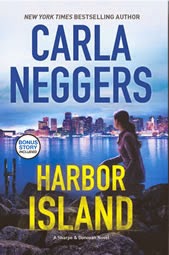
Classic Mystery Puzzle With Dash of Romance: HARBOR ISLAND, Carla Neggers

The new Sharpe and Donovan mystery from Carla Neggers, HARBOR ISLAND, came out just as the garden demanded harvesting and pickling, but I managed to stay up extra late and keep reading -- because Neggers is a storyteller who constantly nudges the next "and then ..." into place.

FBI Agent Emma Sharpe's new status as fiancée of another FBI agent, Colin Donovan, hasn't yet been announced to her family, and there's always a fresh conflict of interest for her on the job: Which is more her core, her agent status or her family's profession in solving art crimes? Added to that, Colin's still wondering how she'll handle the engagement, considering that her past includes a season in Maine as a postulant -- not quite a nun, but to Colin and his brothers, there's not much difference.

True to classic Neggers style, the author juggles Emma and Colin's uncertainties with the way each of them is called to step into danger to chase the art thief they've hunted for in Ireland in a preceding book. And now the thief seems to have followed them home to New England and may be turning violent -- a sudden death by gunshot of an informant can't be a coincidence, can it?

HARBOR ISLAND is also a traditional puzzle mystery, as it sets up a small cast of characters and moves the question around the group: Motive? Means? Opportunity? Will it be Emma or Colin who finally cracks the case?

A big part of the charm of this series is its settings, from Boston to Maine to Ireland and back again. Count on each clue holding some meaning, neat twist of plot, and tidbits about Irish whiskey tucked in often. This isn't quite a "cozy" mystery, as the sleuths are professionals, not amateurs, but between the romance and the landscapes, it's a gentle read, ideal for unwinding by an autumn woodstove with a cup of tea and a cat. Or something even sweeeter.

14th Peter Diamond Investigation: THE STONE WIFE, Peter Lovesey

Peter Lovesey's nicely paced British crime fiction takes the old-fashioned taste for classic Agatha Christie, and updates it with quirky humor and just enough staff friction to make Chief Superintendent Peter Diamond tear out a bit more hair. Lovesey begin his crime writing in 1969, winning a 1970 award for Wobble to Death, which combined his knowledge of Victorian athletics (who knew!?) with neat plot twists and likeable characters.

With this season's release, Lovesey steps onto the hallowed ground of Chaucer's Canterbury Tales -- the "stone wife" is a relief carving of the Wife of Bath, one of Chaucer's more ribald narrators, and the book opens with the massive stone at auction. Who's pushing the price beyond twenty thousand? How can the lightweight Professor Gildersleeve hang in with the bidding? And, strangest of all, why are three robbers in black face masks trying to hijack the auction? Ooops -- a fierce gesture of courage from the otherwise ignorable professor leads to a shot fired, and suddenly there's a death to investigate, as the would-be robbers panic and take off.

The investigation jams up quickly with problems: Chief Superintendent Diamond literally falls on the stone carving, damaging his office in his tumble; he has a plan for Sergeant Ingeborg Smith to dig into the crime, while the youngest member of his team "takes initiative" and turns Smith's careful work into a dangerous disaster; and motives abound for an ex-wife, another professor, an art hound, and more.

Awarded the 2000 Cartier Diamond Dagger from Britain's Crime Writers Association, Lovesey (born in 1938, author of more than 30 books; I also like his Victorian series with Sergeant Cribb, which was a TV hit) hasn't slowed down, although his characters are a bit less fractured and a bit sweeter in their old age. THE STONE WIFE will entertain a reader for several autumn evenings, or can go in the "to be read" stack to grace the shorter days ahead. Kudos to Soho Crime for sustaining this stylish series.

Friday, September 05, 2014

A New Glasgow Crime Fiction Voice: Malcolm Mackay

Denise Mina. Tana French. William McIlvanney. Stuart Neville. Whether the setting is Ireland or urban Scotland, these authors authors bring us dark crime fiction that confronts the "other side" of British dominion: the long shadow of war and domination, whether invited or not, that seems to justify a bitter and violent response from a conquered culture.

On a recent trip "across the border" to Canada, Dave and I prowled the shelves at Brome Lake Books, looking for authors we might not have come across here in the States. The book I brought home was THE NECESSARY DEATH OF LEWIS WINTER by Malcolm Mackay. It's "Glasgow noir," told from the point of view of the criminal underworld -- but it's also a wonderful sort of "Heart of Darkness," tugging at the results of one "necessary" murder. There's an insistent intimacy to the way the characters show their lives, even told in the third person; who'd have guessed that sociopaths could seem so honorable and likeable? Ooops, it's fiction, right? (But think Whitey Bulger and you won't be far off.)

Mackay's books are spinning across the Atlantic, and at least the three that make up his Glasgow Trilogy are pretty easy to order; his fourth, The Night the Rich Men Burned, is harder to find at this point. But that's okay -- I devoured THE NECESSARY DEATH OF LEWIS WINTER and I'm glad to take my time adding the others to my shelf. Check out the author's website if you have a moment.

MARY: THE SUMMONING, YA Horror from Hillary Monahan

Campfire season lingers here in Vermont, through the crisp fall evenings. But the summer is over, and most of the sleepovers are, too.

But aren't those great memories? I still relish the story of the girl with the green ribbon around her neck, learned at an overnight with neighborhood kids. And there's the one with the voice that calls out, "Mary, I'm on the second step ..." Ooooh!

I wish I'd had a copy of MARY: THE SUMMONING at the start of the summer (or back in the days of those teen get-togethers). It took me a couple of days to shake off the shivers from this deftly written and quick-paced horror story featuring four teenage girls and a mirror -- and a malevolent spirit who won't leave them alone. And then, of course, I wanted to tell the story to anyone else who wanted to feel really scared.

This is Hillary Monahan's debut, but you wouldn't know from the writing, which is tight and exciting. It's based in part on the folklore of "Bloody Mary" -- which I looked up and found is every bit as shivery as this book (click here for the folklore). If you have a teen you'd like to impress or delight with a blood-curdling tale where determination and inner strength matter, pick up a copy.

Just make sure to leave time to read it yourself, first!

***

A glimpse of what Shauna discovers:
I wished Jess had known what could happen so she could have prepared us, so we would have known to run long and run far to get away from Bloody Mary.

Then it hit me. Maybe Jess had known. The pictures on the wall. She'd taken the pictures down. Why would she suspect Mary could be anywhere other than a proper mirror? She'd said safety, but that was a bizarre leap to make.

"Oh no. Come on," I whispered. "No."
And later:
Scree. Scree.

THUD!

I shot up in bed, the cuts on my back screaming. My vanity trembled. My plastic bucket of makeup tumbled over ... There was no way I could sleep in this house if she was in the mirror. I counted down from three and jerked the robe aside. There was no face there, but written backward in sludgy black tar was a single word that sent me falling to the floor and sobbing.

MINE.

New on This Week's Bookshelf: Neggers, Child, French, Turner, and Briefly, Penny

I purchased these and they came by mail this week, so count on reviews over the next few weeks -- I'm also working on a stack of advance review copies of other titles, and I'll probably interleave the two categories. But I wanted to let you know what I picked up most recently:

HARBOR ISLAND by Carla Neggers. Few realize this gifted author of romantic suspense is a Vermonter ... her multiple series span several police forces and take place on two continents. This one features Sharpe and Donovan. I always know a new Carla Neggers mystery means a deft plot twist, likeable sleuths, and a satisfying ending. I buy these "for me."

But I also can't resist Lee Child's Jack Reacher series -- where the pace drives me into staying up half the night, and Reacher has just enough honor and vulnerability to keep me wanting to know more. So I've picked up PERSONAL. Can hardly wait. (US cover on left, UK on right.)

The most depth and provocative ideas are sure to come in the Tana French book in my stack, THE SECRET PLACE. French rotates protagonists in her Dublin Murder Squad series and makes it clear how directly the crimes and sins of the past impact the present.

Which leads me to my fourth acquisiton: from poet and Iraq war veteran Brian Turner, the new memoir, MY LIFE AS A FOREIGN COUNTRY. Dave and I are already gently competing on who gets to read this one first -- we're passionate about Turner's writing, and the way he shows us both war and the human heart. No, it's not a mystery ... unless you count the enjoyable investigation of how Turner carries revelation and suspense and meaning into his pages.

Now, back to those other books I've already savored and want to mention -- oh yes, one more quick tidbit. I've changed my mind about something I mentioned a couple of weeks ago: I'm not going to review Louise Penny's new Armand Gamache mystery, THE LONG WAY HOME, in any detail. I think Penny dropped a lot of items in this one that should have been woven more effectively into the book, and I'm not happy with the way she tipped a crime into a book that otherwise reads as a series of personal investigations into art and creativity. Fans of the series -- and I am definitely a fan! -- will want this anyway for the sake of the Three Pines characters, but I think it's best viewed as a draft of a better book she could have written. Those who explore her website or follow her newsletters know she's had a hard year personally, and I tip my hat to her for completing her work within the yearly publishing schedule that her fame now demands. Everyone deserves a "pass" at least once in a writing career, and I'll let this book slide without further comment.

Monday, September 01, 2014

SHADOWS ON A MAINE CHRISTMAS, Lee Wait: Death, Deception, and Delightful Mystery

This is Lee Wait's seventh "Shadows" mystery featuring Maggie Summer, a dealer in antique prints whose New England escapades have included falling hard for another antique dealer -- but Will now lives in Maine, and Maggie in New Jersey, and both of them have reasons to think they won't be working the circuit of antique shows together in the future.

So Maggie's arrival in Waymouth, Maine, to join Will and his frail but indomitable Aunt Nettie, looks like trouble even before there's a hint of criminal activity creeping into the Christmas season. Maggie's implementing plans to adopt a daughter (maybe even two sisters!), and Will's made it clear he doesn't want any part of fatherhood. Despite the frictions the two had around personal secrets in the previous book (Shadows on a Cape Cod Wedding), Maggie hasn't been candid with Will about how steadily she's moving toward being an adoptive mom.

And Will's surprise for Maggie is the oversized house he's considering buying, one where he can open an antiques mall of sorts, and which will tie him down even further. It only takes a few pages to prove there's no ready solution to the complications in front of the twosome.

Still, Aunt Nettie and her friends have the kind of hard-earned life wisdom that Maggie needs. And when one of the circle turns up dead on Christmas morning, Maggie's own stubbornness and determination to help the elderly friends turns out to be what the small-town residents need most.

The Maine descriptions in SHADOWS ON A MAINE CHRISTMAS are a delight, from the details of the holiday with Aunt Nettie, to the tourist-style trip Will creates in downtown Portland for Maggie. Lee Wait's own passion for her adopted state comes through beautifully, along with Will's intent to show Maggie a wonderful, magical time for her holiday.

But a death on Christmas day? Just as Maggie had declared to Aunt Nettie that the day had been perfect? It's Will who breaks the news of caregiver Carrie Folk's death to the two women after taking a phone call from his police officer friend:
"Was there an accident?" Aunt Nettie asked. "She seemed well last night."

"No. Worse than that. She was murdered. Nick's calling everyone who was [the friends'] party yesterday, in case someone noticed anything he should know about. Anything unusual."

Aunt Nettie nodded slowly. "Will, would you call Nicky back? I know it's Christmas Day, but I think he should come over here. I have something he needs to see."
When Aunt Nettie reveals that the victim, Carrie, attempted recently to blackmail her, and that the caregiver may have had other targets as well, Maggie's curiosity is quickly fired up -- even as the police take over. After all, one woman listening to another, well, that's a powerful exchange. Soon Maggie suspects that the blackmail story isn't quite the whole truth of what's in Aunt Nettie's past.

I loved discovering what Aunt Nettie and her friends were really hiding, along with Maggie as she persuades the ladies to reveal the twists of their past, involving even the Bath Iron Works and effects of the Second World War. And Maggie's thinking fast on her feet: "How would Carrie Folk have known what you did so long ago?"

Even as she starts to work with the circle of older ladies, Maggie's under pressure to "behave" as a proper out-of-town girlfriend on the scene, rather than the experienced amateur sleuth she has become, as Nick orders her, "And don't do anything dangerous. Anything which might be even remotely hazardous to anyone else's life. All right?"

Right. That's not going to solve the case very quickly, is it? Still, some undercover sleuthing may keep Maggie's mind of what she suspects is going to be a painful collapse of her tender romance with Will. Ouch.

And what she discovers -- well, I think it's one of the best and most intriguing plot twists that Wait has created for this plucky and outspoken newcomer to the fiercely protective community of Waymouth, Maine. In fact, I think I'll put my copy of Wait's book on the shelf near the holiday books, so I can read it a second time as December arrives. And of course I'll keep an eye on the author's website at www.leawait.com, as there's a new Maine series coming from this author in January.

What a great way to fill the bookshelf! And let's see, who's on my holiday list to get a copy of this quick-paced and charming mystery ... naughty and nice, that's SHADOWS ON A MAINE CHRISTMAS, for sure!

Tuesday, August 26, 2014

The BIG Questions of Our Lives: SUMMER OF THE DEAD, Julia Keller

It's publication day for Julia Keller's newest West Virginia mystery featuring scrappy county prosecutor Bell Elkins and her team -- especially Sheriff Nick Fogelsong. And I have two copies arriving in today's mail, because another Bell Elkins book means another hard look at the tragic forms that love and passion can take, the ones that lead to crime.

Keller, who was born in West Virginia, offers us the hardscrabble town of Akers Gap and its surrounding mountains, where coal is not just a resource but a lifeline and also crippling. In this third in the series (after A Killing in the Hills and Bitter River), Bell Elkins is faced with what looks like a serial killer in her territory, someone making the nights terminally unsafe. That's high pressure on her and the sheriff. And as the public pressure rises to find the killer and stop the murders, Bell's badly handicapped by her commitment to house her sister Shirley, still on probation after release from a prison term for the death of the sisters' father many years ago.

And Shirley's making things really tough on Bell's professional standing: Swept up in an investigation of a low-life bar knifing, Shirley makes a point of having a "get out of jail free" card in her relationship to Bell. Cut the tie? No -- there are reasons Bell feels like she owes more than she can pay, to her dodgy, emotionally broken, and unpleasant sis.

So in addition to investigating the murders -- yes, of course there will be connections to the drug trade in the region, which Keller has already painted so vividly during Bell's two previous investigations -- Bell is chasing her sister and reliving the early trauma of her own life. And she's got to do it without her usual anchor of taking care of her teenaged daughter.

Keller spins the risks and dangers at a ferocious pace. We're inside some other characters too, including Lindy Crabree, a coal miner's daughter doing the best she can to keep her failing father comfortable in a very bizarre way. As clues and twists pull Bell back toward Lindy and this outwardly different father-daughter relationship, personal risk to Bell rises drastically.

But Keller also pulls the reader firmly onto Lindy's side. And her descriptions of mountain life braid a love for the region with an understanding of what we all sacrifice for the people and places we love -- even when those people and places may kill us. Keller's deft touch allows her to insert startlingly vivid chunks of description, even while Bell races toward a confrontation with the killer or killers involved:
Freddie's long white Silverado truck was still parked in front of the house. He always parked it there, leaving the driveway free as a a workspace for his loving labors on the Thunderbird, which he kept at the upper end of the concrete slab, next to the house. The high polish on the Thunderbird's tubular flanks gave it a sleek, missile-like look. You could tell how much Freddie Arnett loved this car, how much he'd fussed over it, gushed over it, pampered it; it had been unconditionally adored. Same was true for his grandson, Bell guessed. She knew how tempting it was to give everything to a beloved child, to make any sacrifice. It wasn't always the right thing to do -- it was almost never the right thing to do -- but you did it, anyway. Couldn't help yourself.

"Okay, old man," Bell murmured. Even if someone had been standing right next to her, they couldn't have made out the words; her voice was soft and filled with grim wonder. "What happened here? Who the hell did this to you -- and why?"

It took her a moment to realize that she was talking to the dead. And another moment to realize that it didn't bother her one bit.
Keller's mysteries earn high praise from crime fiction pro Michael Connelly, and it's well deserved. Deeply conflicted characters that are worth caring about; hard lives that lead some to crime, and some (like Lindy) to powerful self-sacrifice; a region of West Virginia that's been left behind in many ways but that suffers from the same pressures of our cities and suburbs; all of this, Keller puts on the table.

And she reminds us that whether in crime or in our own lives, scars are rarely a sign of a closed door on our past. Sometimes they cover shrapnel that has to emerge in its own time, as painful and dangerous in its removal as in the original explosions that lodge it within us.

Sunday, August 24, 2014

Intriguing Radio Interviews with Louise Penny: "There Is No Peace Without Courage"

If you'd like to hear Louise Penny discussing her new August 26 release, The Long Way Home, here are two links:

-- The NPR interview that aired this morning: click here.

-- The CBC interview that aired Saturday morning: click here. (My favorite quote from Louise: "There is no peace without courage.")

And of course, we hope you'll enjoy our notes from Saturday afternoon's pre-release launch party in Brome Lake, Quebec: here.

Brava, Louise!

Louise Penny and Brome Lake Books, A Rare Partnership

Yesterday Dave and I drove eagerly north, across the border into Canada, for the pre-release book party for Louise Penny's new Armand Gamache investigation, A LONG WAY HOME. I'll write about the book later -- today I'll share some of the event instead, hosted in Louise Penny's home neighborhood by Danny McAuley and Lucy Hoblyn of Brome Lake Books.

There can't be many partnerships of author and local bookshop as close as the one that Louise and Danny and Lucy share. Louise tucks bits of description of the shop into her Three Pines books; Danny and Lucy provide a special section of their shop in honor of this author, complete with a pair of comfortable reading chairs and an inscribed book table, as well as the cozy wall decor shown here.


And the respect and intelligent understanding between Louise Penny and Danny McAuley was especially evident in yesterday's on-stage conversation, where Danny asked the questions and Louise provided thoughtful responses that kept us riveted. Here are some examples:

[Danny recalled listening on the radio on the day when Louise announced her departure from a 20-year career at CBC, the Canadian national radio broadcasting firm.] Louise, smiling: "I don't think it's a complete coincidence that I spent 20 years at CBC and went on to write about murder. I also think the more screwed up you are, the better writer you are -- again, the CBC came in handy." She then turned serious and spoke of the "amazing acts of forgiveness" that she also witnessed in that job.

[Danny probed her time and efforts with research.] "A lot of it is good luck, I have to say, or grace." But it also involves following chains of interesting information. For example, the mention of the "Balm in Gilead" in Penny's new book was originally based on her visceral reaction to a long prayer expressed by a father in Marilynne Robinson's literary novel Gilead. But then she heard the hymn "There Is a Balm in Gilead" chanted, and it moved her in a new way. "I heard it when I needed to hear it, and I made note of it." The results are in the pages.

[Danny noted the use of a Canadian artist's work for the book jacket and asked about her connections to art and her research in that area.] Penny immediately confessed that her own upbringing focused on books, not art -- which instead comes into her life through her husband Michael, who is both an artist and a well-educated art appreciator. She watches her husband look at art, and listens hard to how he speaks of what he sees. "And that's what I write about -- I write about the emotions that art invokes, not about art itself."

[Likewise, Penny borrows her cooking expertise through both book research and the people around her.] "I don't cook -- at all, as Michael will tell you -- but I love eating, and I love food." So she writes with cookbooks around her, as well as poetry. "I want the books to be sensuous."


[What about the wonderful way in which significant bits of earlier books in her series come up in later titles and turn out to be related to the underlying plot?] "There are bits in Still Life [the first Armand Gamache investigation] and others that don't come to fruition until much later." But it isn't always because Penny planned it that way -- she also goes back to earlier books looking for details that she notes with "Oh, I could use this!"

[Danny's pursuit of what lies under this newest book led to Louise's reflections:] "The Long Way Home is really inspired initially by Homer's The Odyssey." She went back to re-read it, contemplating "the hero's journey" in it, as well as in her own high school love for Conrad's Heart of Darkness. In the newest book, Clara the artist persuades Gamache to help her try to find her missing husband Peter, and, says Penny, "the search for Peter is most of all the search for ourselves."

Many thanks to Danny, Lucy, and their team, as well as author Louise Penny, for an amazing afternoon. (Looking for a signed copy of the new book? Watch our ABE listings (link in right-hand column); Dave will be adding some this evening, and more on Monday and Tuesday, with the book's official release on August 26. Or, of course, you could treat yourself to a trip to Canada to visit Brome Lake Books -- where, Danny admits, lost wanderers sometimes arrive, looking for Penny's fictional town of Three Pines. They are pretty close together!)

Friday, August 15, 2014

Espionage in Turkey: A COLDER WAR by Charles Cumming

Charles Cumming brings back Thomas Kell for a second time in A COLDER WAR, the sequel to A Foreign Country  -- and it's a solid work of espionage suspense, playing off the secret forces of Britain, the United States, and Russia, in an irresistible setting, modern Turkey, especially Istanbul.

The death of Paul Wallinger, head of the MI6 operation in Turkey, opens a puzzle that begins to focus on a possible double agent (mole) in the British secret service. Under the micromanaging aegis of the agency's head, Amelia -- code-named C, and unfortunately, one of Wallinger's lovers -- Tom Kell gets a chance to resume his duties by investigating Wallinger's death. It's a dodgy assignment: If he succeeds, he may also topple a number of operations and individuals. And anything that goes wrong will be hung on his badly tarnished reputation, which has held him out of active service for too long already.

Cumming's work is often compared with that of John Le Carré, but other than sharing the same Service, MI6, there are few parallels. Tom Kell is much younger and less wounded, as well as less skilled, than George Smiley. Cumming offers him not just a chance to re-enter his career, but also a jump-start of the heart, as Kell fears his work has hardened him and has mixed feelings about the recent end of his marriage. Cumming also weaves in far more male-female interaction, from lust to love, than the older fictional spymasters have done. Meanwhile the work has none of the despair underlying Alan Furst's approach to the European conflicts, for example, or the sense of history's burden that Furst and similarly dark authors like Stuart Neville connect so potently to their plots.

Still, A COLDER WAR is a good read, with a plausible villain, several surprising twists, and a protagonist who is more likable than many a fictional spy and mole-chaser has been in the past. This won't linger on my read-it-again shelf, but I enjoyed it -- and perhaps most of all, the unexpectedly ominous foreshadowing of its ending.

Amateur Sleuth with Synesthesia: MURDER WITH A TWIST, Allyson K. Abbott

The second book in Allyson Abbott's "Mack's Bar" series is out! And there's still a chunk of summer left for reading it. That's double-good news, because MURDER WITH A TWIST is a well-written, neatly plotted, and thoroughly enjoyable addition to the hammock-or-chaise-lounge reading list. Abbott is a pseudonym of Wisconsin emergency-room nurse Beth Amos, a confessed adrenaline junkie who brings the quick pace and logical consequences of her double careers into spinning a tale.

Gender clarification first: Mack's Bar is owned by Mackenzie Dalton, whose father brought her into the business in downtown Milwaukee. Since her dad's death, she's sole owner, and doing well enough to expand her floor space, making room for a crowd of local crimesolvers who gather to solve test cases, pose crimes for each other to consider, and incidentally help out the local police force. Mack herself is a "secret weapon" for Detective Duncan Albright, who -- as detailed in the previous title, Murder on the Rocks -- has come to believe in Mack's special abilities, and wants to try using them to sort out criminals and their crimes. Mack can be, he proposes, a sort of human lie detector.

And she'll do this with her special perceptions formed by synesthesia. It's a neurological condition that makes a person's senses get tangled up: Sounds become colors, people become music and smells, and more. Because Mack picks up different sounds when someone's lying, for instance, she could be helpful on the latest case -- if she can handle the gruesome death of a mom, and the residual sense of pain and fear of her kidnapped toddler. Mack lays out the problem when Duncan takes her on a test case before that one, a possible suicide ... or not:
I had thought our little crime games, along with all the preparations I'd been making with Duncan over the past six weeks, would make a real crime scene easier to take. But that wasn't the case ... the hanging man before me that morning was real, frightening, and all too dead. 
While Mack focuses on narrowing the cascade of sounds and smells coming at her, the corpse overwhelms other evidence:
The sight of that bloated, purple face kept triggering a veritable locust plague of reactions. I shook my head, sighed, and looked down at the floor.
Eventually she sorts out impressions and turns out highly valuable to the investigation -- which ought to make the next case simpler, right? Except between the gruesome bloody killing and the child at risk, nothing's simple. Neither is the chemistry between Mack and the detective. And there are perils ahead, neatly layered with action at Mack's Bar.

This is the second synesthesia-based sleuth I've run into this year, so I paused to check on whether synesthesia is more common than I realized. From the Boston-based Synesthia Project, I found this:
How common is synesthesia? The short answer is that no one really knows. The long answer is anywhere from one in every 100,000 people to one in every 5,000 people, but it's difficult to get a good count because of the nature of synesthesia.
Well, that's good enough for me -- I may never have (knowingly) met a synesthete, but I'm willing to have them among the sleuths and especially to buy into the confusing and sometimes debilitating version of it that Abbott, aka Nurse Amos, portrays.

It turns out that a bar full of amateur sleuths is a great device, too, and I'm looking forward to reading more in this series. Amos also writes under a second pseudonym, Annelise Ryan, a forensics pro; I'll be watching for those also. Just goes to show what Dave and I rediscover every month: You think you know a lot of mystery authors and titles, right? But there's always a new good one to discover. Or, in the case of Beth Amos, two of them!

Friday, August 08, 2014

"Slasher Film" Plus Courage = WELCOME TO THE DARK HOUSE

Okay, 'fess up: Don't you sometimes feel just a little nervous when you get home alone to a dark house and something feels "funny" about the door, or the streetlight being out, or the light you thought you'd left on for yourself that isn't ... Or maybe for you it's when thieves hit the neighbor's house and you see it in the paper the next day and realize it was the same night you thought something was scratching outside your downstairs window but you couldn't wake up enough to check. Or -- you in the suburbs, maybe that 2 a.m. walk back home on a street you know well, but that suddenly has an eerie side to it?

Now go back 15 years (or 30, or 45), to when you were a teen and had your own particular nightmare, one that lingered maybe from when you'd been little. Something involving the closet, or your parents disappearing? I hope you don't have the real-life horror that Ivy Jensen has lived through as WELCOME TO THE DARK HOUSE (by Laurie Faria Stolarz) opens: the murder of her parents, in which she actually met the murderer, who called her "Princess" and who could be searching for her or even watching her now.

Ivy's stepping into a reality-show-in-the-making, hosted by horror film director Justin Blake and his creepy Nightmare Elf. Her motive for taking part: She thinks the e-mails she received about the adventure out in the country have promised she'll finally be free of her nightmares. But it turns out all seven of the teens called to the very creepy film set have earned themselves a place through their graphic descriptions of their own nightmares, and ... they are each about to face what they fear most. Alone.

WELCOME TO THE DARK HOUSE is the first book in a horror series for teens, one that repeatedly refers to slasher films (yep, gratuitous violence, from knife to ax to flesh-eating creatures) and that tilts from one character's point of view to the next, including screenplay segments from would-be filmmaker Parker Bradley, and lustful cheer from Shayla Belmont, not to mention the goofy but dangerous exploits of Garth Vader (care to guess what his dad liked?). And more.

I'm no fan of slasher films, but ... hey, I like this book! Every voice is distinct, every teen suffers from both a "nightmare" and a deep misunderstanding of what the world is going to do for her or him, and there are as many kinds of courage and folly as there are characters. The only down side is, this is the start of a series, and the ending is absolutely a hanging one ... How long do I have to wait for the next book from the amazing Laurie Faria Stolarz? (If you're a teen or purchasing books for teens, check out her website here: http://www.lauriestolarz.com.)

The adventures in this book are NOT what you want in your "how I spent my summer vacation" essay. On the other hand, reading this lively and fast-paced horror mystery is sure to give you fresh perspective on what really happened (or might have)!


Timothy Hallinan's Junior Bender Series: A Thief Who Solves Crimes


I ran across Timothy Hallinan's mysteries in his Poke Rafferty series, set in Thailand -- a series that includes all the best of international crime fiction, from exotic setting to eccentric characters to humor and affection. And it's a great series to collect, read, and enjoy.

But if I could take only one Hallinan series to a desert island, it's the Junior Bender series that I'd pack.

In this era of "everybody is writing some YA if they can," the series name and covers spark some confusion -- this is NOT a series for "young adults." "Junior" happens to be the name (and his real first name, thanks to his long-gone father) of Bender himself, initiated into the world of elegantly committed theft at the age of 17, by legendary southern California burglar Herbie Mott. Bender's immaculately conceived crimes involve careful scoping of a high-end Los Angeles-area home, meticulous timing (never staying too long inside), and following Herbie's advice: Never take something away that the owner can't afford, emotionally, to give up.

As an expert thief of fine items, Junior Bender also cultivates knowledge of the art world and its values, and of course a very specialized set of fences where he's known for bringing top material and being a savvy negotiator.

But Junior's career has two peculiar quirks to it. First, he has an ex-wife and a teenage daughter, both of whom he loves and respects, and he takes care to not embarrass them with his work. And second, he's burdened with a second career: Private investigator on behalf of crooks in his area.

It's in some ways an accidental second career. His friends need his help, is what it boils down to. But when Irwin Dressler, most powerful and wealthy criminal leader in California, takes an interest in Junior's (nonexistent) business plan, this "help out the criminals" line threatens to take over Junior's life, no matter his own disagreement with the notion. Dressler is not one of those people you can safely say "no" to. "
"Junior, I'm disappointed in you."

If Dressler had said that to me the first time I'd been hauled up to his Bel Air estate for a command appearance, I'd have dropped to my knees and begged for a painless death. He is, after all, the Dark Lord in the flesh. But now I'd survived him once ...
That's the start of the third in the series, THE FAME THIEF. And Irwin Dressler's point is, Junior is the only person in this line of work -- he has a solo franchise: "That whole thing you go going? Solving crimes for crooks? And living through it?" Dressler is sure Junior should capitalize on this monopoly, and expand.

Of course, it's inevitable that Dressler himself has a task he wants Junior to tackle: restoring the reputation of a once-glamourous Hollywood actress who lost her own career in a sting operation during decades ago. Why is Dressler so concerned about Dolores La Marr? Don't ask. By the time you realize Dressler's motive, it's way too late for Junior to get out of this complicated situation where it seems like a lot of people want to kill him. Such a "nice burglar boy" -- how come he's in so much trouble (again)?

Soho Crime cast aside all current publishing expectations, to pull all four of the books in this series into the market within a mere 18 months -- so when you finish devouring the fun and cleverness of THE FAME THIEF, you can backtrack to Crashed  and Little Elvises. Or just jet straight ahead to book 4, which hit the shelves a couple of weeks ago: HERBIE'S GAME.

You know how John Le Carré captured the longing of British spies to respect themselves and have a country worth being loyal to? (It's okay, not everyone's mystery reading ranges into espionage ... mine does, though.) How Tony Hillerman wove his Western Indian detectives in a blanket of hungry friendships, loyalties, and spiritual search? Or Michael Connelly put onto the pages the detective whose roots involve self-sacrifice but who can't bend enough to stay on good terms with his employer? How about Louise Penny's Chief Inspector Gamache, who insists that there's goodness worth honoring and fighting for, even as his own police force and his retreat in the almost perfect village of Three Pines are repeatedly undermined by the forces of evil, in ways we recognize from our own efforts to make something good from our lives?

Heavens, don't assume from that long paragraph that Hallinan is writing "literary stuff." He's definitely not -- his mysteries focus on crime capers in the spirit of Donald Westlake and even Janet Evanovich (although there's more love than lust in Hallinan's books, actually).

But here's the startling part. HERBIE'S GAME, the fourth (and for the moment final) in the Junior Bender series, takes the best darned path I've read in years into struggling with what our fathers want for us, how we sometimes lose the connection with them on the surface, how we almost never lose the important ties to them, and why it's all worthwhile in the long run.

Of course, it's not his dad that Junior's having to exhume and explore here -- it's Herbie Mott, the man to brought him into his life of crime, nurtured his skills, taught him his values, and who ... oddly ... seems to have done that with a number of other fatherless young men. He taught Junior to be like Robin Hood. Sort of. Showed him why it's important to wear booties while burglarizing ("they have that DNA now"). And helped him to deal with his own past:
"Let me tell you something. ... Don't think you know everything about your father. You loved him at one point, I can tell, because you wouldn't be so angry now if you hadn't. Well, the father you hate now is the same person as the one you loved. Just don't -- put people in boxes like that. You have know idea whether you really know someone."
Turns out, Herbie himself is one of the people that Junior didn't know as well as he thought he did. And suddenly, Junior Bender is tangled up with a team of professional killers for hire, female and male, as he struggles to discover what Herbie's final scheme had been, and how it got the master of the trade murdered. There's some time pressure, too: If Junior can't solve this really quickly, it seems likely he'll either be killed himself or end up in jail. Or both.

I know I'll be re-reading the series. But most of all, HERBIE'S GAME is the book I'll be going back to. It's a great ride as crime fiction, as entertaining capers in Los Angeles, as insight into professional theft (I am definitely upgrading the house locks!). And it's one level more. Thanks, Tim Hallinan (and Soho Crime). Good one.


Thursday, July 31, 2014

In or Near Vermont This Weekend? Come Meet Eliot Pattison!

Edgar Award-winning mystery author Eliot Pattison will again visit Kingdom Books for conversation about his research and writing, which range from Chinese-occupied Tibet (in his Inspector Shan series) to colonial America and Native Americans (the Bone Rattler series). We hope you can join us this Sunday Aug. 3 at 7 pm, to welcome Eliot back to Vermont and enjoy his insight and discoveries.
We'll have many of the Pattison books on hand (call Dave to reserve one if you like, at 802-751-8374), but no purchase is needed; it's your conversation we want!

Monday, July 28, 2014

A Little "Longmire" News

This is pretty far in advance to say so, but ... we are planning to have signed copies of a number of Craig Johnson's "Longmire" mysteries available in mid November. We've been preparing for months, and can hardly wait to meet this Western author whose books have now become a popular television series.

And Dave found a fun article recently on the changes that TV fame has brought to the author and his Wyoming locale. Check it out, here.