[NOTE: With the lamented closing of the New York Journal of Books last month, I am returning to reviewing crime fiction, mysteries, thrillers, and more on this blog site. Welcome back!]
How strange that a novel that opens in 1994 should feel like historical fiction—and yet the tender exploration of MILO'S RECKONING by Joseph Olshan reminds us of how much has changed in the past three decades.
Graduate student Milo Rossi, an expert in both Italy's language and its literature, confronts the sudden death of his menor, Lenny D'Ambrosio. Though the death is ruled a suicide (but why?), Milo can't believe Lenny would do this. After all, the two of them had in-depth and emotional discussions of Italian and Jewish writer Primo Levi, whose inability to leave behind the "survivor's guilt" of the Holocaust led to a self-imposed death. Suicide wasn't a taboo subject between them! And Milo had spent the evening before Lenny's death with him, intending to reach a topic Lenny wanted to share.
"So what did you want to tell me?" Milo had questioned him while they were driving to the train station, looking over at Lenny, who seemed about to explain and then faltered. "Let's talk about it in the morning. Call me when you get to your office." If Lenny had been contemplating suicide, why would he have asked Milo to call him the following morning, knowing full well that he would never answer the phone?
Milo's somewhat sheltered life hasn't equipped him to discuss this with police detectives. Maybe it's a sign of the time that the man questioning him actually knew Milo's deceased father, a golfer. But the real issue 25-year-old Milo can't resolve, and that pushes its way into the investigation of Lenny's death, is the recent death of Milo's own brother.
Here's where the culture-change aspect hits hard: Milo's brother Carlo's death imposed a halt to Milo and his mother ever understanding that handsome family member. Beset with questions around Lenny's death (what if it were murder? who would benefit?), Milo begins to pull back the coverings of his own brother's life, slowly and with a persistent throbbing of horror and doubt -- because the more he learns, the more he faces the certainty that his brother had been gay, something that would have devastated their traditional Italian mother. Rose Marie is still Milo's own "number one," with a life that revolves around cooking and home. Thirty years later, with same-sex love much more open (although once again being framed as "other" by a powerful social force), it's frightening to confront the pain that families endured over less accepted forms of love and attraction. Is that time returning?
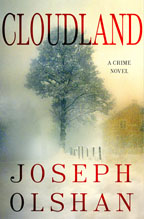
If Olshan had only taken the book this far, MILO'S RECKONING would be a literary novel, its part-European languor periodically fizzing with moments of attraction (say, to Lenny's sister) and possible escape routes from being Mama's boy forever. But those familiar with Olshan's earlier novels, like Cloudland and Black Diamond Fall, know that his elegant prose is likely to dip abruptly into potential danger, and even criminal activity. That's the case here also: Terrified that Lenny's possession of a sexually disturbing videotape may mean his mentor's been involved in international trafficking and exploitation, Milo flees to Italy with hope of unraveling what led to his mentor's death. But at the same time, he is desperate to find answers to his own brother's life and to the family structure that failed to support that.
Olshan's writing is direct and evocative, and at times feels as though it's been newly translated from the Italian tongue that Milo embraces. That's not the case — Olshan has New York City roots and has lived on both American coasts — but this gentle tilt of language underlies the explorations Milo commits to. When he faces his own life's shadows on several levels, he carries with him the literary discussions that have framed his beliefs. Must he abandon what's precious to him, in order to accept both his brother and his friend?
Green City Books, release date June 10, 2025, hardcover, 284 pages.