Showing posts with label Bavaria. Show all posts

Sunday, May 27, 2018

The Hangman's Daughter Series #7, THE COUNCIL OF TWELVE by Oliver Pötzsch

It's time for this year's Bavarian hangman mystery set in the 1600s, from mystery and thriller author Oliver Pötzsch -- and it's a wild ride!

As THE COUNCIL OF TWELVE opens in 1672, hangman Jacob Kuisl, a true specialist in a time that needs his skills, is preparing for a journey to Munich, with his family. That includes daughter Barbara, who needs to get engaged, and daughter Magdelena, a crime-solver of unusual courage and determination (highly motivated by the need to protect and survive for her child).

It will be Magdelena who eventually takes the greatest risks in trying to solve a rash of young women's deaths in Munich. But she comes by her investigative side directly from her father, who's working the crimes from another angle, the basic autopsy, before the term was well known:
"Then let's do it." Kuisl pulled the girl's dress up. He got out his knife, which he sharpened as frequently as his executioner's sword, and made the first insertion from the breastbone downward.

The hangman had cut open dozens of bodies in his life. Like Deibler, he was fascinated by the inside of humans, of which very little was known as yet. Kuisl believed he had more medical knowledge than most studied physicians from here to Schongau. He was the proud owner of a small Latin library at his house, hundreds of medicines, and countless surgical instruments, which he sometimes lent to his son-in-law.

Because he's the physician and I'm just a dishonorable hangman, Kuisl thought.
Yet Jacob Kuisl knows a belly full of deadly nightshade when he finds it (in fact, he'd already suspected it), and just like that, he's making progress on the case in front of him.

Too bad Magdelena doesn't have as easy a route to her part of the investigation. Yes, she learns a lot, very quickly, while being held captive at threat of life and other losses. But cut off from her husband and her father, what can she actually do to protect herself and prevent other deaths?

Pötzsch (with translator Lee Chadeayne) spins a fast-paced tale with abundant risk, suspense, and twists -- while smoothly carrying the 1600s into all possible details of setting and crime. And when a colleague complains about how the hangmen's association is being treated during the hunt for the criminal, saying, "In good old Bamberg, folks still appreciate a hangman and don't chop off his hands and feet," Jacob Kuisl quickly replies, "In good old Bamberg, folks were hunting for a werewolf only a few years ago." He's got quite a challenge in trying to persuade his colleagues that the serial killer who's been murdering young women might come after them, too, for what they may already know or guess.

At close to 500 pages, THE COUNCIL OF TWELVE is a long romp that transports summer reading into fresh terrain, with humor and clever detection. In addition, as I mentioned when reviewing last year's title in the series (The Play of Death), you may have extra reason to grab a copy if any of the following pertain to you:

1. You collect the reading experience of mysteries set in Bavaria.
2. You pursue fiction set in the 1600s.
3. You're planning to see the Bread & Puppet Theater in action in Vermont (or treasure having done so in the past, especially in the 1970s and 1980s).

And in addition, there's a dog at stake in this one. Talk about diverse! The series is published by Houghton Mifflin Harcourt, and THE COUNCIL OF TWELVE is available May 29.

PS:  Looking for more mystery reviews, from cozy to very dark? Browse the Kingdom Books mysteries review blog here

Thursday, June 01, 2017

Brief Mention, Medieval Mystery by Oliver Pötzsch, THE PLAY OF DEATH

Three reasons to read number six in Oliver Pötzsch's "Hangman's Daughter" series, THE PLAY OF DEATH:
1. You collect the reading experience of mysteries set in Bavaria.
2. You like fiction set in the 1600s.
3. You're planning to see the Bread & Puppet Theater in action in Vermont (or treasure having done so in the past, especially in the 1970s and 1980s).
At the heart of this somewhat awkwardly translated mystery (reminds me of the translation of P.J. Brackston's books, also set in Bavaria) is the annual passion play in Oberammergau -- which in many ways is a precursor to the grand spectacles that Bread & Puppet created. The second strand is what life is like in a caste-conscious society when you're part of a hangman's family.

And the third, of course, is a murder and finding the dangerous criminal responsible.

I'm not going to cover this one in depth -- seems to me if you have one of those reasons, you'll pick up the book, and otherwise, skip it -- but here's the formal description from the Munich-born author's website:
It is 1670 and Simon Fronwieser is in the town of Oberammergau to bring his seven-year-old son to boarding school. As he bids his boy a tearful farewell, news comes of a shocking murder: the man who was to play the part of Christ in the town’s Passion play has been found dead, nailed to the set’s cross. As there is no doctor in town, Simon is brought in to examine the body. The opportunities to spend more time with his son and to investigate the murder quickly convince him to stay.

Soon he is joined by his father-in-law, Jakob Kuisl, the Schongau hangman, and the two begin piecing together the puzzle of the actor’s death. Was he murdered by a jealous rival? Are the recently arrived and unpopular immigrant workers somehow involved? Or is it a punishment from God for the villagers’ arrogance in trying to schedule the play four years earlier than prescribed by ancient custom? Once again it looks like it is up to the Kuisls to unravel the mystery and bring a town’s dark secrets to light.
Brought to the US by Mariner, a Houghton Mifflin Harcourt press. (A quick note: Yes, I realize that strictly speaking the 1600s are beyond the medieval period. But trust me, not in this landscape.)

 PS:  Looking for more mystery reviews, from cozy to very dark? Browse the Kingdom Books mysteries review blog here.

Sunday, July 19, 2015

Crime Is Serious - But Not So Much, in Gesternstadt, Bavaria: P. J. Brackston

Humorous mysteries come in wildly diverse shapes. There are the capers that Donald Westlake gave us, burglars and other petty criminals dashing around cities, slipping on figurative banana peels as they struggle to complete their crimes. There are the very dangerous Stephanie Plum investigations from Janet Evanovich, with the threat of pulling a muscle from laughing too hard at this Jersey Girl's detective work and allies. Not yet well known, but wonderful, are the "Junior Bender" books written by Timothy Hallinan, a cross between a Westlake caper and a heartbreak (no, I won't explain now -- but click here to know more).

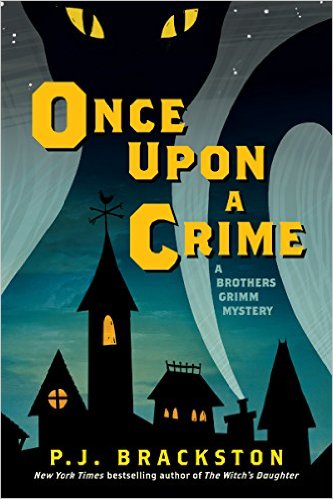
But there is nothing, absolutely nothing, that compares to P. J. Brackston's marvelous "Brothers Grimm Mysteries" featuring, in 18th-century Bavaria, the amazing Gretel (yes, that Gretel) and her eating-disordered but charming brother Hans, still sorting out their PTSD from that disastrous episode with the witch and the gingerbread house. Gretel is a very successful private investigator herself, weaving deftly among the political realities of kings, princesses, and "Kingsmen" (the police) -- but even with her local background in Jack (the one who planted the beans and climbed the beanstalk) and his family, she's had no preparation for coping with what this particular investigation demands, in ONCE UPON A CRIME.

It sounds simple enough at first -- Frau Hapsburg swears three of her cats (among more than two dozen) have been kidnapped and she has plenty of money to pay Gretel to take the case of tracking them down, even rescuing them. But after accepting a hefty deposit, Gretel checks in with a fortune-telling friend who's pretty accurate with a Tarot deck. The mention of a tall handsome stranger in the reading is something she figures is a put-on; it's the mention of a troll that has her worried. Good thinking.

I delayed several serious chores, in order to stick with Gretel in her perils. Is the king's executioner really going to take off her head? What was that about torture on the rack? Is that tall, dark stranger really interested in her? And how on earth did Hans come up with some real skills to assist Gretel in her work?

Come on, let go of any prejudice against a fairy-tale environment -- if you've read Jasper Fforde, you already know it's great grounds for crime and crimesolving, and Brackston's writing won't demand the literary background of Fforde's; those half-remembered stories will do you just fine for case background. I promise the plot makes sense, the characters (when not covered with mud) are endearing, and the insights into Gretel's thinking are good detective work, no matter how the costumes appear. Consider this moment as Gretel gets a good massage to make up for a trying visit to said troll:
She now knew someone was snatching the cats, or, more accurately, having the cats snatched. She knew also that this person lived over the mountains one day hence. Furthermore, she knew that the troll knew who this person was. In addition, she had a rare insight into the life, habits, and singular desires of trolls, but she decided against counting this as a plus of any sort. She had also deduced that the troll was more involved than he was letting on, given the missing finger on the corpse ... the only way to discover the identity of the cat collector was to obtain a human finger and take it to said troll.

"Argh!" she cried, as the masseur found a particularly sensitive spot.

"Fraulein, you have been overworking these muscles. It is important to build up stamina before attempting any serious activity."

Gretel groaned. "Needs must. Besides, I'm not sure what the recommended training would be before encountering trolls."
 Oh, I know, you're still skeptical. I can't blame you -- if Pegasus Books hadn't started me on Brackston's series with Gretel and the Missing Frog Prints (not a typo) last winter,  I might have missed out. This series sounds more than a little crazy, right?

But Brackston's books are fun, lively, well-written, inventive -- and they honor all the expectations for a well-knitted mystery, with a great balance of red herrings (or capes, or shoes) and useful clues and entertaining distractions. Didn't you promise yourself that you wouldn't take life so seriously? Here's a great way to start!