Showing posts sorted by relevance for query Eliot Pattison. Sort by date Show all posts

Tuesday, August 05, 2008

Behind the Inspector Shan Novels of Eliot Pattison


When author Eliot Pattison arrived here at Kingdom Books on Sunday evening, he had a quiet glow of satisfaction that he soon explained -- Thursday evening he'd completed his new (sixth) Inspector Shan novel, of which he'll only hint that one theme involved is climbing Mt. Everest.

That's an exciting bit to hold onto. Pattison's first novel in this series was SKULL MANTRA, for which he won a well-served Edgar Award. He describes each of his books as having such a focus: for BEAUTIFUL GHOSTS it's art thefts, for WATER TOUCHING STONE it's reincarnations, for BONE MOUNTAIN it's exploitation of minerals, and for his most recent published one, PRAYER OF THE DRAGON, it's parallels with American Indian culture. While here, he read from the section where Shan begins to get acquainted with a Navaho whose unlikely arrival in Chinese-occupied Tibet has confused all the factions circling around Shan.

"I always had a great interest in Eastern religions," Pattison explained, as he told the story of how he began the series. He studied those religions at Bloomington University, where he was especially drawn toward Tibetan Buddhism (which he doesn't practice -- he has a mixed American Christian background). "In a lot of ways it's not a religion, it's a phenomenon," he mused. After a few years of exloring and "drifting," Pattison entered law school; his legal career turned out to be a springboard into international travel. Soon he was visiting China, including "the lands of traditional Tibet." He began to seek out Tibetan temples, which were all over China at the time (the 1980s), a residue of the days when Chinese emperors respected the Tibetans and had lamas as members of their courts.

Touring today's China and Chinese-occupied Tibet, Pattison became increasingly disturbed at what was happening there. He'd always been a writer -- of book reviews, and of two legal books -- and had always wanted to write a mystery. One day he realized he could combine that desire with his longing to talk about what the Chinese were doing in Tibet. He emphasized that he's never exaggerated any of what the Chinese are doing -- and now that he's written so much about it, he can't go back to visit Tibetans, as his very presence would mean they'd be imprisoned by the occupying force.

The Tibetan situation, he said, "is something we could fix if we really want to. We can do something about it if the governments would wake up!" He added, "What the Chinese have done is one of the great crimes of civilization -- period."

At the end of 2007, Pattison's second series, set in Colonial American and reaching into Native American spirituality as well as his usual crime solving, was published and shocked the readers of his Shan series by how different it is. And yet this ardent student of 18th-century America points out, "If you've read BONE RATTLER, there are an awful lot of the same themes." Its protagonist, like Shan's Tibetan friends, is an exile from a traditional society -- the Gaelic Scots -- whose home has been destroyed by an occupying force (the English). "I have a lot of Scottish blood," Pattison explained, "and believe me, there's an awful lot of spirituality woven into the Scots. ... Broadly, there's this theme [in BONE RATTLER] of natural justice, and people ignored by governments, having to make up their own culture."

A fairly private person, Pattison gave few other details of his own life, other than that he lives in Pennsylvania with his family, but feels at home here in Waterford, Vermont, because it happens to be where he married his wife! He did, however, share some of his own favorite reads: Martin Cruz Smith (especially GORKY PARK), John Le Carré, and a lot of historic fiction, especially Dorothy Dunnett.

Dave and I feel very much honored by the visit from Eliot Pattison; we had a shop full of readers who expressed much the same. Check in again next year -- maybe the Pattison travels will again lead through the Green Mountains of Vermont.

Wednesday, July 24, 2013

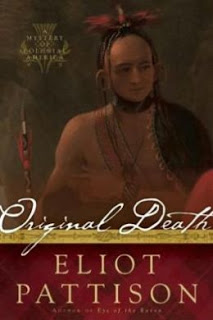
Armies, Power, Murder, Manipulation: Eliot Pattison's New Bone Rattler Mystery, ORIGINAL DEATH

Is it true, as Lord Acton wrote in 1887, that "Power tends to corrupt, and absolute power corrupts absolutely"? If so, the many forces entering battle in Colonial America must have hosted a lot of corruption -- because each of them struggled wildly to seize power in the New World. The French, the British, the newly developed Colonists ... But what about the Native Americans?

In author Eliot Pattison's hands, the tribal forces of 1760 may demand an exception to the rule. Knowledgeable about their land and its seasons and weather, wise in the movements of animals and growth of plants around them, and carefully balanced against each other's tribes -- or clans, as Scottish exile Duncan McCallum sees them -- the tribes of the Iroquois federation want power over themselves. But not over the Europeans. Without that hunger for absolute power, they'll avoid the depths of corruption already sweeping through the military forces around them.

At least, it seems that way to Duncan, traveling north toward a village by Lake Champlain with his aging but gentle and wise friend Conawago, who may be the last of the Nipmucs. That's how others know this sage. Yet Duncan knows the contents of the letter Conawago has, the one that's pulling him north. It says there are two other Nipmucs alive, in a settlement of Christian Indians.

Heartbreak! The pair of travelers arrive to find a murdered settlement -- including Conawago's nephew -- and increasing evidence that robbery and more murder have spread among the Scottish forces working for the British. Duncan even discovers a roped and drowned clansman under the lake's waters: "Duncan could not bring himself to touch the body, but he gripped the wheel to study it wuth the more deliberate gaze of the doctor he had trained to be. ... The death had a slow, organized aspect to it."

This is the frame Pattison has used in Bone Rattler and Eye of the Raven to turn Duncan McCallum into a forensic expert and investigator. Skilled in "hearing the voices of the dead," McCallum's observations and experience add up to a hyper-awareness of the evil that people can do. Wouldn't it be nice to blame it all on the British, or at least on the French, reaching down with other Native allies -- especially the Huron -- to challenge the ownership of the rich lands of New England?

Pattison, who also writes a series that involves Tibetan Buddhist lamas in Chinese-occupied terrain, crafts a many-layered plot that hinges on evil being possible for anyone, no matter what their origin or "clan." Soon McCallum and Conawago find themselves chasing a tribal leader named The Revelator. And the Iroquois council puts an added burden on them, one that McCallum discovered and would have embraced anyway. They are to rescue a group of kidnapped children.

Turning the tables on classic "Indian Wars" tales of white settler children being kidnapped, Pattison instead reveals a daring plot that involves holding the young children of tribal leaders, for ultimate leverage. Then he winds McCallum in accusations from so many directions that it seems everyone is willing either to kill him or capture him (or both). As evidence of criminal activity gradually adds up so do the deaths of McCallum's friends and allies. Battle is about to begin, and it's unlikely that rescue of the children can take place in the midst of such death and destruction: that absolute form of corruption of life, after all.

Parallel to his Inspector Shan/Tibet series, Pattison's Bone Rattler books dare to compare forms of spiritual wisdom and pathways, looking not just at evil (crime fiction, after all!) but at the nature of good. This third Bone Rattler "mystery of Colonial America" raises intriguing questions and insight into the clash of cultures in the New World -- even as it sets up McCallum and Conawago to risk everything for the chance to keep the Native tribal cultures viable for a generation longer.

A good read -- and one that's left me thoughtful and ready for a long, long walk in the forest.

MEET ELIOT PATTISON at Kingdom Books on Sunday July 28 at 7 pm; or if you can't be here, reserve a book or two, signed, and we'll ship them to you the next day. Also featured in this event is Pattison's newest book in his Inspector Shan series (see yesterday's review). We'll have copies of both of his newest books -- Mandarin Gate and Original Death -- but in limited numbers, so please contact us (802-751-8374 and KingdomBks at gmail.com) if you'd like to reserve copies of these or other Pattison mysteries for signature and purchase.

Monday, July 18, 2011

Calendar Reminder: Eliot Pattison Here, July 31

Eliot Pattison's 2009 visit to Kingdom Books
Presenting the first book of his new detection series, set in America after the nuclear bombs, is Eliot Pattison -- here to discuss ASHES OF THE EARTH. He'll be at Kingdom Books on Sunday July 31 at 7 p.m., and we are excited and honored to welcome him again.

Pattison's first mystery series features Shan Tao Yun, a former Beijing police inspector, now ardently protecting -- as best he can -- the remaining monks of Chinese-occupied Tibet. The first book in the series, The Skull Mantra, won a prestigious Edgar Award.

His second series, the "Bone Rattler" books, takes place in Colonial America. When an exiled Scotsman and a Native American shaman forge a friendship out of shared need -- and shared survival of their battered spirits -- forensic detection becomes a tool to manage the effort against evil around them.

With ASHES OF THE EARTH, Pattison dares to imagine communities struggling with the after-effects of radiation poisoning, the collapse of urban America, and the loss, within a generation, of necessary knowledge and wisdom. For survivor Hadrian Boone, the colony of Carthage is as much a prison for the soul as it is a remnant of home. The book probes the emotions of midlife, of loss, of grief -- and of that pure anger that insists on fueling the struggle for community and long-term peace in a ravaged landscape. Here's our earlier review.

Please join us to welcome Eliot Pattison back to Vermont. Contact Dave to reserve your book (802-751-8374 or KingdomBks@gmail.com). And if you can't be here in person but would like a book signed and shipped to you, we're glad to do that, too. Just let us know.

Wednesday, February 01, 2012

Justice: Eliot Pattison Reflects on His Three Detection Series

Great news: Not only is Eliot Pattison's Ashes of the Earth (first of his post-apocalyptic detection novels) being released in softcover this April -- but also, there's a new interview with Pattison available through Blog Talk Radio: http://www.blogtalkradio.com/conversationslive/2012/01/28/author-eliot-pattison-on-conversations-live

Pattison describes his protagonist Boone in this series as someone who's "lost all hope" and says he's provoking readers to consider what it's all about, "who are you when you strip away your television, your automobile, your electricity, your technology ... what really is important, and how do you cope when everything else is gone?"

But fear not, Pattison (an international attorney) threads the demands of investigation and crime-solving just as insistently in this series as he has in his Inspector Shan series and his Colonial America series.

For a longer look at Ashes of the Earth, click here; other Pattison reviews are also on our blog.

Sunday, July 29, 2012

Newest from Eliot Pattison (Releasing in Nov.) Is MARVELOUS

I won't give a full review until the fall, since Eliot Pattison's MANDARIN GATE won't be published until November. But I finished the "advance reading copy" (ARC) this weekend and it's one of the best books I've read this summer, with a shocking first chapter and an intense and complex plot.

Dave and I are very excited that Pattison is visiting again at Kingdom Books a week from today (Sun. Aug. 5) at 7 pm to discuss his three mystery series. Pattison rarely makes any public appearances at all, so we're especially fortunate to be in the area where he takes his summer vacation. Hope you too can stop in!

Details for the season:


Mystery Authors at Kingdom Books
Mark your calendar for August 5, September 9, and October 20, and come meet these authors!

ELIOT PATTISON: Author of three best-selling mystery series, including the Edgar Award winner THE SKULL MANTRA, set in Chinese-occupied Tibet. Eliot will talk about the connections among his series (the second is in Colonial America; the third series, after a nuclear war), as well as the upcoming November release of the newest Inspector Shan detection suspense title, MANDARIN GATE. Join Elliot Pattison at Kingdom Books on Sun. Aug. 5, at 7 pm for a thoughtful evening. Books available. (Note from Dave: This author rarely makes public appearances; we are delighted that his ties to the Northeast Kingdom bring him to the neighborhood.)

CARLA NEGGERS: Picture the drive and creativity that have led to more than 70 books already for this author, whose Vermont residence isn’t well known – because she’s a national phenomenon. A specialist in “Romantic Suspense,” like Mary Stewart and J. D. Robb, she writes four series currently. Her newest release, this summer, is HERON’S COVE, a page-turner featuring deep-cover FBI agent Colin Donovan and FBI art-crimes expert Emma Sharpe – both expecting some time off at home in coastal Maine, until three significant Russians show up in the small tourist town. Meet Carla Neggers on Sunday Sept. 9 at 1 pm and enjoy the presentation that she makes across the country. Books available. (Beth says, “I mark on my calendar each new release from Carla Neggers, for the deep pleasure of her clear, bright writing and lively suspense.”)

ARCHER MAYOR: Autumn in Vermont: crisp air, red-and-gold leaves, and the newest in the Joe Gunther police procedural based in Brattleboro, Vermont, from Archer Mayor. What could be better? This time, Joe and his team, heavily relying on Willie Kunkle, extend their reach to Northampton, Mass., to track down a jewelry ring. With Joe and Willie both having long-standing personal issues, can the operation still succeed? PARADISE CITY is the 23rd Joe Gunther. NPR says of this New York Times bestselling series, "Even in beautiful Vermont, Archer Mayor finds shadows . . .  and his detective, Joe Gunther, finds a way to beat them back." Catch Archer Mayor here on Sat. Oct. 20 at 2 pm and get your copy of the new book – as well as signed copies of any of the earlier 22 that you’re missing.


KINGDOM BOOKS is your mystery shop, with thousands of the latest and the classics – from thrillers to classic mysteries, to espionage, “cozy” village mysteries, international intrigue, comic caper plots, even such early gems as Sherlock Holmes and “The Saint.” Call or e-mail ahead of time to reserve a copy of a book. Seating limited to 25. At a Kingdom Books author event, you really get to know the author.

Kingdom Books, 283 East Village Rd, Waterford (half a mile from Route 2 – turn at the East St Johnsbury bridge). 802-751-8374. Beth and Dave Kanell, KingdomBks@gmail.com. Reviews at kingdombks.blogspot.com.

Sunday, May 20, 2018

Forensics and Detection, 1768 Style, in SAVAGE LIBERTY from Eliot Pattison

Available this week, the newest "Mystery of Revolutionary America" is the fifth in Eliot Pattison's series that was originally called the Bone Rattler books, after the first title in it. An international attorney (still practicing) and master of three vastly different series with three entirely separate cultures -- the other two are Chinese-occupied Tibet, and a post-apocalyptic version of a nuclear frontier -- Pattison crafts an immersion experience of hardships, crime, investigation, and dramatic changes. And SAVAGE LIBERTY perches at a fierce point in history, as colonists with diverse background and motives began to realize that rejecting the British king's power over them could be possible.

Most compelling in Pattison's books are his wounded heroes: here, the Scottish medically trained Duncan McCallum, bound under a punitive indenture contract that prevents him from committing to the love of his life, Sarah Ramsey. Ramsey is herself an outrageous figure for the time, trying to craft a peaceable community of Judeo-Christians, frontier folk, and Native Americans at the edge of the East Coast's strip of "civilization." But by binding McCallum for long-ago "criminality" and a few recent misjudgments, Ramsey's father effectively prevents the couple from a balanced and equal relationship.

This is part of McCallum's motive for taking off into the wilderness in search of a rogue collaboration of British and Abenaki warmongers -- they've pushed his bonding further and put a bounty on his head. But as always in Pattison's books, the emotional depth comes with McCallum's identification with members of a threatened culture: in this case, the Native Americans being brutally evicted from their lands. One of the most moving scenes in the book involves McCallum witnessing a heartbreaking farewell to the trees and forest, by his Nipmuc friend and ally, Conawago. Pattison's strongly drawn parallel of the outlawed Scottish Highland clans and the Native American tribes provides McCallum with some of his passion for the Nipmuc and his allies. Yet, as in Pattison's Tibet series, it's the underlying spiritual commitment that most deeply connects these men.

McCallum's usual care in decision making goes off track in SAVAGE LIBERTY. With the unsettling of his belief in the king's right to rule the colonies also comes an unsettling of some of his loyalties and convictions. And his beloved isn't pleased, telling him, "Stealing muskets from the king! Bribing army guards. This is how you will prove yourself innocent of treason! I beg you, Duncan, leave this behind before it is too late."

But Duncan McCallum is forming a new commitment, to the Sons of Liberty, a group that's clearly fomenting revolution. It's troubling him:
He lay on a comforter beside Sarah's bed, listening to the slow, quiet breathing of Sarah and Will, recalling prior conversations in Boston. The arguments with the king would never come to violence, Hancock and Sam Adams always insisted. King George would soon recognize that the inhabitants of his most valuable colonies had to be given the same respect as Englishmen in the home country, and all would then rally around the monarch. But the terrible visions of the innkeeper's dying wife now visited him, vivid images of ill-trained colonists being massacred by British regulars, the massed bullets of their. Brown Besses mowing down farmers and shopkeepers like the blade of a bloody scythe. Whenever a colonist fell, an Abenaki materialized to rip away his scalp.
Pattison's choice of Abenaki for the most dangerous criminal in this book (in a revenge motif based on the massacre of the St. Francis group of the tribe) disturbed me, as it seemed a choice that could tar an entire group of people with a label of irrational and uncontained violence. I kept pausing to check details, finding that small parts that rubbed me wrong -- scalping, displays of scalps -- had ample historical backup, but still ill at ease. I also missed the more deliberate investigative direction of earlier titles in the series.

That said, Pattison does a masterful job of keeping his red herrings afloat and his competing rationales for crime and violence well sorted out. Most vitally, he illustrates the slow and irreversible turn from an angry but heartfelt loyalty to the monarch, toward the possibility of independence. I look forward to how he'll carry Duncan McCallum into the very forces of liberty in the next book of the series. And, of course, to how this deep-probing author will illustrate the ongoing death of tribal occupation of the new America. "Savage" liberty, indeed.

Publication is by Counterpoint, and the book's release date is May 22.

PS:  Looking for more mystery reviews, from cozy to very dark? Browse the Kingdom Books mysteries review blog here.

Wednesday, November 28, 2007

Mystery in Tibet: Eliot Pattison, Prayer of the Dragon, Fifth Shan Mystery


Through THE SKULL MANTRA, WATER TOUCHING STONE, BONE MOUNTAIN, and BEAUTIFUL GHOSTS, Philadelphia-area author Eliot Pattison has taken Shan (Shan Tao Yun) through layers of agony and wisdom, in the struggle to preserve the remains of Tibet's monks, monasteries, and holy knowledge. Sometimes it seems Shan is very much alone in his quest: A Chinese national himself, but one who has fallen from the exalted political ranks of Beijing special investigator, into the dreaded gulag of the Chinese prison system, Shan's attachment to the monks in his life has come as a counterforce to his own fears and repeated nightmares. Once he had great power; now he seeks comfort, or at least some release, at the feet of the most powerless. For Tibet is under Chinese occupation, and the monks -- who can draw followers simply by their humility and prayers -- are enemies of the all-potent state.

Pattison's earlier Shan books have taken the fallen investigator through both success and failure as a student of the wise. Shan's failures are nearly always rooted in the skilled investigation that he has mastered to the point of having it be an automatic part of how he sees the world around him. In this fifth book, PRAYER OF THE DRAGON, Shan repeatedly walks circles around scenes of murder and loss, ironically imitating the movement around a mandala or holy sand painting. He is consumed with his effort to protect his beloved monastic friends Lokesh and Gendun. Yet the two holy men are shamed by Shan's attachment to healing the world, to solving murders, to tracking down killers.

PRAYER OF THE DRAGON lands Shan in double spiritual trouble. Not only are Lokesh and Gendun urging him to let go of the latest scene of corruption that he has noticed so clearly -- those long-honed instincts and skills of both investigator and gulag survivor always at the front of his interactions -- but also his path tangles with that of two Navajo seekers on a holy Tibetan mountain. Lightning strokes, thunder, and entryways to heaven and hell appear as Shan struggles upward.

In an author's note at the end of the volume, Pattison admits that his decision to pair the Tibetan and Navajo/Dine spiritual traditions -- to the point of asserting that today's American Navajos may share common genetic stock with the early Tibetans -- can be seen as a aromatic fancy. In a short defense of the notion, he outlines overlaps in the two forms of sacred wisdom, and adds wryly that because Tibetans are often exiled from their land, some are now settling among the Navajos in the American desert.

Whether the sciences of anthropology and genetics ultimately support this connection is not crucial to the book, however. What matters most is whether Pattison's weaving of the tale carries sufficient veracity and authority. What indeed will we believe as Tibetan monks meet a singer of the Navajo Blessingway? And how much will this collision of worlds distract us from the vital quest taking place in Shan's life?

For me, the answer was, with a tip of the hand back and forth, "perhaps it's a bit distracting." I find it hard to envision Tibetans borrowing pollen and sweat rituals from a visiting Navajo, no matter how much terror their village has endured. Likewise, I am not sure that a Navajo without an undue amount of political savvy could enter Chinese-occupied Tibet and make sense of his experience.

But Pattison crafts far more than a who-walks-where, and more than a contrast-and-compare of rituals and wisdom. It's Shan's personal struggles with trust, with loyalty, and with the awkward blessings and pain of friendship that are the strong, resilient skeleton of PRAYER OF THE DRAGON. His investigations make sense (although they are a bit heavily loaded with explanations in this volume), his skills match the tasks in front of him; most of all, his griefs and angers resonate across the worlds of culture. Once again, Pattison offers a compelling novel; accept a willing suspension of disbelief about the Navajo/Tibetan premise, and the forces that move Shan forward will likewise propel a reader through the pages and dangers, to a classic Pattison resolution.

[European cover version]

Tuesday, July 23, 2013

MANDARIN GATE, An Inspector Shan Mystery by Eliot Pattison

"The end of time was starting in Tibet." That's what the Buddhist monks, the old lamas, around Shan asserted, as Chinese occupation of their "autonomous territory" continued to bring political oppression -- and punishment and death to the believers. For Shan, the Chinese bureaucrat turned prisoner and then uneasily paroled in Tibet, what the lamas said might be true. But did that mean he should let the occupiers harrass and kill his friends?

In the titles before this one -- the Edgar Award-winning Skull Mantra, then Bone Mountain, Beautiful Ghosts, Water Touching Stone, Prayer of the Dragon, and The Lord of Death -- Shan's determination to protect his friends has meant repeated capture and torture for him. The meditation and other routes to inner equanimity, even laughter, that he learned from the lamas helped him to sustain his loyalty and the physical pain he's endured. Then again, there's the peril his grown son remains in, such that any independent action by Shan can mean the death of his imprisoned son. We readers have seen Shan's determination and integrity tested repeatedly in this situation.

But now -- is the world ending? The shocking death of one of the monks as the book opens might be evidence toward "Yes."

Shan's uneasy position as one who can read the evidence of death, but also grasp the ways in which the worst of the Chinese are spiritually dead, pulls him into investigating a vanished monastery, hidden monks and nuns, and corruption among the Chinese army officials. A killing of three people, including a Tibetan nun, turns out to relate to a government plan that's as brutal as it is powerful, and Shan must stop it, as well as protecting an American woman who's witnessed some of the underlying puzzle. Time and again, he needs to act on the potent scrap of wisdom he has shared with his son, Ko: Push down your fear. It is the greatest power a prisoner can have.

MANDARIN GATE paints the grimmest portrait that author Eliot Pattison has ever offered of what takes place in Tibet today. At the same time, ironically, it also engages with spiritual strengths and teachings more fully than any of the earlier novels. As Shan races from one imperiled friend to the next, he rarely doubts what he must do. And the tension of the book steadily increases, as more risks must be taken.

In his Author's Note at the end of the book, Pattison writes, "Tales of those who have been thus abandoned by history are so plentiful at the roof of the world that they almost seem ingrained in the landscape. While there is much ugliness to be found in the behavior of the government in today's Tibet, the power of that rugged landscape sometimes seems to eclipse it -- and certainly the stark beauty of their land is only enhanced by the enduring strength of the Tibetan people.

* * *

MEET ELIOT PATTISON at Kingdom Books on Sunday July 28 at 7 pm; or if you can't be here, reserve a book or two, signed, and we'll ship them to you the next day. Also featured in this event is Pattison's newest book in his Bone Rattler series (see review tomorrow).

Saturday, August 06, 2011

Collector's Corner: Eliot Pattison's BONE RATTLER Mystery Mystery!

No, that's not a typo ... Here's Dave's exploration of a collecting conundrum:
Eliot Pattison’s Bone Rattler Mystery Mystery

Eliot Pattison for the last few years has made a summer author appearance at our shop Kingdom Books in Waterford, Vermont. Because of Elliot’s busy schedule, he makes few author appearances. So we were more than glad to have him sign and to read from his newest book Ashes of the Earth on July 31. (We still have some signed copies for purchase.)

Over the summer we gathered some books for Eliot to sign that we have now placed on the shelves, including his first book, the Edgar Award winner, The Skull Mantra.

I also purchased over the summer a green-colored softcover Advance Readers Copy (ARC) of the start of Eliot’s second mystery series, set in Colonial America: Bone Rattler. And here is where the collector's mystery starts. Advance readers copies are given to reviewers and to bookstores, usually months before publication of a hardcover edition. I already had an Advance Readers Copy of Bone Rattler in pictorial covers that was published by Counterpoint in my collection. The edition that I found this summer was published by Carroll & Graf Publishers, and I couldn’t find any information about them publishing Bone Rattler. So, after the customers left and Eliot generously signed some additional books, I handed him the green copy of Bone Rattler to sign. And the mystery finally was explained: Carroll & Graf was to be the original publisher and they went out of business. Counterpoint picked up the contract and published the series. Eliot said that the green ARC is scarce and he didn’t think he had one in his own collection.

The final cover art.
So now we have two Advance Readers Copies of the same book by two different publishers. Another mystery solved. -- DK

Saturday, April 04, 2020

Sixth Mystery of the American Revolution from Eliot Pattison, THE KING'S BEAST

A few months ago, one of my Manhattan grandsons, this one age 11, mentioned to me that he was studying the Haudenosaunee. That moment set into perspective the stunning leap in two generations of the teaching of American History as a field. When I was his age, I knew Indians as the people who fought the Cowboys on the Western shows ... and could name a couple of East Coast tribes, sometimes with their colonized names.

But this youngster, seriously devoted to learning and experiencing the diversity around him and "behind" him, speaks the tribal name and has firm opinions about modern racism as well as the historic forms. I couldn't be more pleased -- for both my grandson and his teachers, as well as the world he perceives.

Part of the charm of historical fiction is the way it can swiftly teach readers, by immersing them in a world they enter emotionally as well as descriptively. Eliot Pattison's Tibet series, featuring Inspector Shan, began with an Edgar Award-winning title, The Skull Mantra, and probed the spiritual and religious background of Tibet at the same time as it fingered meticulously the Chinese occupation, adoption, and immigration into that landscape that was once a "Forbidden Kingdom" of mystic significance. And may still be.

With the end of that series, there is now room to focus intensely on Pattison's other growing series, the Bone Rattler books (named for its first title). Set in Colonial America, the series began with a striking premise: that a displaced Highlander (Highland Scot), exiled while mourning the death of his clan at British hands, might connect at soul-deep level with a Native American from a tribe that's been similarly destroyed, the Nipmuc, down to its last few members. So begins the difficult and rewarding friendship of Duncan McCallum and Conawago, in the uncertain landscape of a not-yet-formed nation of settlers, exiles, and the peoples who knew the land best and longest: its earliest known inhabitants, or, as they are called in Canada, its First Peoples.

THE KING'S BEAST opens in the Kentucky wilderness in the spring of 1769, with Duncan McCallum eagerly -- yet with some level of fear -- witnessing the excavation of skeletal remains of what modern readers will recognize as a mammoth, and later a sabertooth tiger. Duncan's on hand to make sure the fossilized bones reach the great Dr. Benjamin Franklin, a journey that only should extend as far as Philadelphia and amount to little more than being transport security for some scientific "curiosities."

But that plan goes quickly awry, with two major complicating factors: what the remains represent to the Seneca people at the "dig" site, and Dr. Franklin's deep intentions for the remains -- which in turn are seeing violent opposition from others on the new continent.

About a third of the way into THE KING'S BEAST, Duncan finds that Conawago is missing. The search for his friend and mentor becomes a rescue mission that whips Duncan across the ocean to London, England, and into an even more complex network of interacting political forces. The true stakes for Duncan involve his friend's safety. But as he comes to grips with the real Dr. Benjamin Franklin, he also has to confront what's emerging politically from the land that's become his own—the land that in a few short years will declare its independence.

Readers of the series know that Duncan is a trained medical doctor who has become, in his new land, a forensics resource and thus a "speaker for the dead." Pattison uses this skill to engage Duncan in sorting out crimes, especially murders, and that is certainly the case in this sixth title in the Bone Rattler series. But this hefty volume (more than 400 pages) also represents Pattison's effort to portray the forces leading toward Revolution, and their counterforces. Add to this his infusions of the sciences of that time and the economic forces in play, plus the decision to set the larger part of the book in England, and there's a potent load of information in the pages. At times, inevitably, it drags at the pace and passions of the story. With that in mind, here is one of the last American scenes unfolding:
Duncan weighed the words. "The bones are important, or the killers would not have tried to steal them on the Ohio. But," he added with a nod, "we should sleep in shifts, switching when the ship bell rings the change in watch," he suggested. He touched a pocket of his waistcoat, which held a slip of paper that he had been given in Philadelphia. He had long since memorized the address on it. 7 CRAVEN STREET. He prayed the powerful Dr. Franklin could protect them once they reached London.

Ishmael noticed Duncan's motion. He well knew what was in the pocket. "We have nothing to fear," he declared with a hollow smile. "We'll soon have the wizard of lightning on our side."
But their rescue mission involves entering an insane asylum that seems designed to torture, maim, and further demonize its inhabitants, and Franklin may not be as effective as hoped for.

Taking Duncan and his Nipmuc friend Ishmael out of the New World and into a sinister urbanity increases an unfortunate tendency for Duncan to react to forces, rather than to make choices. Not until the final scenes does he undertake independent action. Oddly, this gives the book some of the feel of a "cozy mystery" in which the protagonist flails against situations and tries repeatedly to suspect various criminal possibilities, until finally stumbling against the most dangerous person and having to exert physical and mental stamina to escape life-threatening peril .... and hence at the same time solving the crime in play.

The book's also clearly setting up for the next titles in this series. Another historical mystery author, James Benn, has moved his investigator Billy Boyle slowly through the years of World War II, and this fall will see the 15th in that series. Pattison's increments of historic time headed toward the American Revolution may likewise last for many more Bone Rattler books, and I look forward to them, even as my heart, as a willing reader, clenches to think of the vulnerability of Conawago and the fate of the tribes, in what lies ahead.

[Published by Counterpoint, available April 7.]

PS:  Looking for more mystery reviews, from cozy to very dark? Browse the Kingdom Books mysteries review blog here. (But if you're specifically looking for earlier Eliot Pattison reviews, click here as a shortcut.)

Wednesday, July 22, 2009

Dave's Mystery Musing 1: Eliot Pattison


Dave hits the keyboard today to pass along views and information:

Kingdom Books is very fortunate to have the Edgar Award-winning author Eliot Pattison appear on August 2, 2009 at 7 pm. Eliot makes less than a handful of author events in any given year and thus his appearance at our tiny shop last year was a delight to the folks who came to meet and hear him. On a personal note, I have given a number of copies of The Skull Mantra to mystery friends who read the book and became fans and readers of the entire Inspector Shan series. The Inspector Shan series is published by SOHO PRESS, which also publishes some of our favorite crime and detection authors: Leighton Gage, Garry Disher, Martin Limón, James R. Benn, Matt Beynon Reese, Colin Cotterill, and Peter Lovesey.

Kingdom Books has a full selection of Eliot Pattison's books.

Bibliography:

Inspector Shan Series

1.The Skull Mantra (1999) Edgar Award from the Mystery Writer’s of America for the best first novel. A finalist for the prestigious British Golden Dagger Award for Best First Novel.
2.Water Touching Stone (2001)
3.Bone Mountain (2002)
4.Beautiful Ghosts (2004)
5.Prayer of the Dragon (2007)
6.The Lord of Death (2009)

Bone Rattler Series:

1.The Bone Rattler (2007)
2.Eye of the Raven (to be released in 2009)

[PS from Beth: If you can't be here in person, you can still purchase copies of the Pattison books, signed -- e-mail Dave directly at dknel@charter.com for prices. We'll have signed copies of THE LORD OF DEATH at cover price for a limited time.]

Tuesday, January 05, 2010

Exile, Apprentice, Crime Investigator: Duncan McCallum Returns in EYE OF THE RAVEN, by Eliot Pattison


It's the plaint of the child isolated on the playground, the adult alone and ashamed about it: Nobody else is like me. Nobody understands.

For the exile, it can be reality. I think of the first "Lost Boy of the Sudan" taking refuge in snowy Vermont, and the first Nepalese to travel here at the invitation of an American climbing buddy. I think of Chinese exile Shan Tao Yun in Tibet, struggling to protect the remaining lamas in the mountains while accepting abuse for being obvious Chinese -- and a number-tattooed prisoner of the local gulag system, liable to be returned to his cell whenever the occupying powers aren't getting enough satisfaction from watching him squirm.

Inspector Shan's story began with THE SKULL MANTRA, for which Eliot Pattison won an Edgar award. The exiled police investigator has continued to struggle in further books, most recently THE LORD OF DEATH (2009). Pattison, as author of such an anti-occupation series, can no longer visit friends in Tibet; if seen with him, people find themselves arrested.

Two years ago, Pattison started another series, set in pre-Colonial America: BONE RATTLER. Duncan McCallum, last survivor of a Scottish Highlands clan, emerged from English imprisonment via a ship to the colonies. Grief for his lost family and home shadow his life; peril stalks him in the form of a sadistic overlord who claims to own him via indenture; and yet his medical training in Edinburgh drives him to seek answers as if every twist of action in front of him had its roots in a specific failure of the flesh, and a remedy could be sought.

In Pattison's newly released sequel to BONE RATTLER, the year is 1760 -- and the most powerful art within the colonies is that of the surveyor, whose pins and lines mark off wealth for landholders and claimants. Although Duncan McCallum is following, studying with, and attempting to protect his friend Conawago (a shaman caught in the New World equivalent of a clan war), his ignorance of the powers and histories around him make him helpless. Conawago survives threats from another tribal clan, but in an act of mercy toward a dying European, is captured and labeled a killer. McCallum's protests are based in being able to see many "Natives" as wise and honorable people. Unfortunately, many settlers choose not to look that way at the people whose homes they are taking, with violence and craft.

Although Major Latchford would prefer to kill or imprison McCallum with Conawago, the medical skills being offered win the Highlander a limited freedom -- to treat wounded soldiers. McCallum desperately argues for negotiations that maintain "relations" with the tribes, but the major can make better progress by holding to the accusation of murder. Who was the dying man over whom Conawago had stooped near a significant trail?
"The captain? Winston Burke? Commander of the militia? Second son of the greatest landowner in the valley of the Shenandoah. His father is a member of the House of Burgesses. We will have a hanging a get on with the work of war," Latchford declared in a matter-of-fact tone. He aimed the pistol at Duncan and pulled the trigger, sneering as Duncan flinched at the spark of the empty weapon.
Duncan's investigation begins as an effort to free his friend. It soon tangles in ritualistic murders that seem obviously connected to the shamanistic beliefs of the Iroquois natives. Although Duncan has absorbed enough from Conawago to be sure this is a fraudulent pattern, he lacks power and allies. Soon he perceives that it's the treaty status, the land lines, the power network around him that's trembling with threat from the murders. Yet all this is nearly meaningless to the shaman, who might otherwise call together allies in some way. Duncan, last of his kind, wants to lead but can't communicate across the cultural barrier; Conawago, driven by commitment to an obscure quest, declines to take a leadership role. It's the kind of situation where sadists and murderers thrive, in the crevices of lust and desire.

The darkness and despair that enfold McCallum repeatedly turn this tale into a form of pre-Colonial "noir," much as the favorite American Thanksgiving myth is now being turned inside out to reveal the losses and threats that Native Americans suffered from the 1500s onward. Pattison isn't riding a cause here -- no revisionist mantle over his shoulders -- but he paints the dark determined Calvinist spirituality side by side with the Iroqois, so that Duncan recalls word that his grandfather would repeat from the Ninetieth Psalm: "We spend our years as a tale that is told."

Repeatedly, the Highlander terms of survival overlap those of the tribes of the Colonies. At one point, Conawago sends Duncan into the darkness to play on the Highland pipes, ragged though they've become:
Conawago knew well the solitary communion Duncan now needed as he unpacked the bundle wrapped in tattered muslin. With slow, reverent motions he laid the intricately crafted pieces in a pool of moonlight before assembling them. The first test of a reed brought a reply from a whippoorwill. ... "Never mind that we will never see the Highlands again," an exiled countryman had said to him the year before. "Your clan is all those under the boot of the world."
There are deep questions at stake here, and McCallum's detective work will stumble against many of them. Is it right to "save" the Natives through Christianity, or does this simply transplant Hell from the Old World to the New? What is the price of wealth? How can an exile intervene in what the people of power are doing to those who fail to grasp the evil designs forming around them?

Pattison spins and weaves a dense and intricate fabric of imagination, history, loss, grief, loyalty, and survival. McCallum's investigations may yet provide hope for Conawago and for Duncan himself. But what about the others whose lives are being risked without their knowledge?

Examining a rarely portrayed period through magnifying lenses and the language of belief and ritual, Pattison provides a compelling tale worth reading slowly. But the plot is so tight, the characters so emotionally at risk, that it's hard to slow down. I've read it twice now, and I still get carried away in the intensity. Here's a new form of historical mystery -- as irresistible as a thunderstorm.

Friday, April 01, 2011

Urgent: ASHES OF THE EARTH by Eliot Pattison

International attorney Eliot Pattison already has two powerful detection (and spiritual search) series underway: one sent in Chinese-occupied Tibet, more or less "now," and the other set in Colonial America, tying together the despair and strength of a Scottish exile and a Native American shaman.

In ASHES OF THE EARTH, Pattison dares to stare forward into a ravaged world, one torn and decimated by the horror of a nuclear holocaust. Although survivor Hadrian Boone is dealing with a fragile remnant of population -- so fragile that the very idea of abortion, for instance, is more than heresy, since the need for repopulating the earth is so extreme -- and although cities have shattered and fallen, still, evil in its most common forms of lust, covetousness, and cruelty looks likely to prevail.

How could the author have guessed that the week of the book's release would see a real world still uncertain about radiation and fallout from a catastrophic collapse of four nuclear plants poised in an earthquake zone in Japan? "Hardened" robots, enormous machines capable of burying sites in water or cement, experts in the mass health crisis formed by radiation in a massive urban area's water supply: all these are headed to the Pacific Rim at this moment.

Hadrian Boone's world is far simpler, mechanically, because so many of the urban structures failed and collapsed in the global holocaust of his time. But emotionally, it's at least as complex. Local children are feeding each other myths of a "better world" reached through suicide, where what they suspect are unreal, never-seen luxuries -- toys, cars, abundant food -- will greet them. Moreover, murders of colony leaders keep occurring, and Hadrian begins to see a plan behind the deaths. Criminal elements, blessed by the protective concrete walls of prisons, have survived the holocaust, along with the dogged pioneers with whom Hadrian identifies. Stronger and with few qualms of conscience, the criminals are close to their goal of overrunning the colony and forcing it into submission.

Readers of Pattison's other two series will recognize in Hadrian Boone's fragile psyche the damaged mid-life souls of protagonists Shan Tao Yun (survivor of the Chinese Tibetan gulag) and Duncan McCallum, unwilling outcast. These are men who have lost "everything": family, home, safety. But they are enriched by friendships with older men who have learned how to love the earth and its creatures in ways that make a difference in who we can become. In Hadrian's case, the losses are made more poignant by the absence of that "teacher" figure: Boone's friend Jonah, a leader who had understood how to empower and embrace the struggling colony, has died. And although a woman police officer, Sergeant Waller, appears to offer Boone support, she's a frail reed -- so ignorant of her own past and present that she betrays Boone and his cause repeatedly, mostly unintentionally but sometimes out of a childlike vindictiveness and refusal to mature.

Some of Boone's struggles have an inevitable "MacGyver" quality as he fights to make his way around and through the tangle of loyalties and collapses that make up his Carthage. But if you stop to consider how we'll manage if the Japanese power plants go into complete meltdown, or how your friends in Tokyo are getting through brownouts, food shortages, and transportation snags, Boone's Carthage begins to make ominous sense.

The question is, can Boone -- and can we -- summon the inner resources needed to make survival into a life worth pursuing? Or are the suicidal children the smart ones after all? "Hadrian wearily rose, searching for something on the young faces, on the magazine pages, that might explain the mystery these children guarded. He should have been angry, yet all he could feel was a deep sorrow."

Pattison dares to turn us toward confronting the mysteries of more than our past: We are building our future in every step. While Hadrian solves the workings of a criminal enterprise and tries to stop it, we as readers listen to his friend Emily, the group's most skilled doctor:
Emily frowned. "Lost world. Lost technologies." She paused and tilted his head, holding the bottle to his mouth.

Hadrian watched the doctor in silence, seeing not just exhaustion and anger there now, but an edge of something that could be fear. "There were a lot of types, a lot of names -- speed, ecstasy, acid, meth, fly powder."

"This is Carthage, Hadrian. This is the other twenty-first century." ...

He was finding no answers, only more questions. Smugglers. Drugs. Murder by jackal. Munitions. 
It's not a "brave new world," but a dire one. Only courage, loyalty, love, and laying one's life on the line -- in collaboration with willing friends -- may take Hadrian Boone and his community out of the ashes that remain.

Read it first as a taut, tightly plotted detective novel, human and agonized. Then let it rest in your thoughts. What Pattison offers us is a dose of courage for ourselves, disguised as a rattling good story.

Saturday, August 15, 2009

Petroglyphs: Follow-Up to Eliot Pattison's Visit


When crime fiction author Eliot Pattison (at right, above) visited Kingdom Books on August 2, every seat was filled, and discussion ranged from Pattison's Inspector Shan series set in Chinese-occupied Tibet (he presented the newest in this series, THE LORD OF DEATH) to the rock carvings in America created by Native Americans -- known to explorers as petroglyphs. Pattison talked about the startling number of petroglyphs in his home state of Pennsylvania. To follow up on this, check the article from the Pennsylvania Historical & Museum Commission, as well as www.pennsylvaniaarchaeology.com; the topic applies to Pattison's second series, which began last year with Bone Rattler and continues in January 2010 with Eye of the Raven. Below: a petroglyph photo from the article. Yes, there are petroglyphs in Vermont, too -- the best known are at Bellows Falls.

Sunday, February 03, 2008

Tibetan-Native American-Scottish Spirituality: Following Eliot Pattison into the New World


Impassioned admirers of Eliot Pattison's Shan detective series, set in Chinese-occupied Tibet, will understand why I hesitated to read the first volume of his new series: BONE RATTLER, a historical mystery set in 1759 in Colonial America. The change of genres seemed an abyss. I resisted.

But Kate Mattes at Kate's Mystery Books assured me it was worth the plunge, so I clipped a chunk of time off the calendar and waded into the first few chapters. And was I ever stunned: Pattison has created another lonely, angry, kind, and spiritually seeking protagonist, every bit as heart-piercing and compelling as Shan. And the issues that displaced Scottish Highlander Duncan McCallum wrestles with have as much command on his soul as the life-threatening mystery that surrounds him.

Virtually kidnapped via an English courtroom and an avaricious Army, McCallum sails to the New World as a prisoner. But his skills in medicine -- the field where he'd just been about to be credentialed -- and his pursuit of knowledge and truth pull him out of the cells after all. Unfortunately, the people doing the pulling are about as crooked and avaricious as possible. Deaths multiply, sacrilege erupts, and McCallum's own lost brother has reason to hate him -- despite the fact that the two brothers are the remnant of their persecuted clan.

McCallum's hunger for knowledge equips him with rudiments of Iroquois language, and soon with clues to the powerful mystic symbols and rituals that lie underneath the culture of the Six Tribes. On these, his life depends repeatedly. But it's the loyalty to the lost Highlanders around him, to friends, and to his own clan ancestors and traditions -- even his ability to play the bagpipes, the pibroch -- that are his strengths at the edge of the deep and frightening forests that face him.

As Pattison has done with Shan, straddling a Chinese heritage and a deep longing for the teachings and peace of the Tibetans around him, he does here with McCallum. One powerful scene unfolds after McCallum's been partially scalped, then rescued. In early recovery he doesn't quite put together the gentle English voice of his healer/rescuer and the Indian he sees near him when he regains vision, and he attacks the Indian, desperate to recover or avenge the presumed death of his tender caregiver:

Duncan stared at the man, his jaw agape, looking about the small clearing, then into the forest and back to the stranger again. The man's face was as worn as a river stone, and his bright, intelligent eyes fixed Duncan with a steady, if sad, gaze. Around his neck hung a necklace of glass beads from which hung a small fur-bound amulet. [...]

When the stranger lifted his hand, Duncan thought it was to make a gesture of warning. But instead he slowly extended one finger, first to his lips, then to a shrub at the edge of the clearing. Duncan followed the finger to a bird, with scarlet body and black wings, that burst into a light melody as it studied the two men. They listened without moving for over a minute, until the bird flitted away.

"In the tongue of my boyhood we called him Firecatcher. I have never heard an English name for it. You English have so few names for the important things."

Duncan looked back at the man with the same curious gaze the bird had used. "I am called Duncan McCallum. In the tongue of my boyhood I would be called ungrateful."

A small grin stirred on the man's face.


Though there are no references within BONE RATTLER to Pattison's "other world" of fiction, McCallum's authority in solving the mystery and bringing events to a satisfactory plateau draws on the same ground as Chan's:

"There are other motives to consider [...] And there is the science of their deaths. Science does not lie. [...] Science, like justice, instructs the truth."

I recommend the book highly. Don't think of it as a historical, if that's going to get in your way. Think of it instead, like the best of Tony Hillerman, as a seeker's mystery. And a book that follows knowledge toward wisdom, and loss toward hope.

Sunday, October 20, 2019

Brief Recaps: Eliot Pattison's BONES OF THE EARTH, Ang Pompano's WHEN IT'S TIME FOR LEAVING, Michael Stanley with SHOOT THE BASTARDS

"Life on life's terms" meant missing out on some reviewing earlier this year. So here are some brief recaps of books you may want to stock in for the cold weather!

BONES OF THE EARTH (Minotaur) is the tenth and final Inpector Shan Tao Yun mystery from Eliot Pattison. Pattison's first in this series, Skull Mantra, won an Edgar. Both of those, plus the locale in what was once the Hidden Kingdom and remains a controversial region taken over politically by China, are great reasons to read this finale.

Shan's position as a former Chinese official who's become a determined Buddhist places him at a spiritual sweet spot for the investigation of ancient shrines underlying the criminal efforts that soon threaten him and his son. It's fascinating to watch the threads drawn together, and there's hardly a moment without suspense, as Shan navigates a series of traps and investigates on both the mundance and the spiritual level. Pattison's deft twisting of the plot strands to reach a fitting resolution of the series makes for an excellent read.

Ang Pompano is a long-time active member of Sisters in Crime, nationally and in the New England chapter. Yes, there are "brothers" in the organization! His stories have been anthologized, and he's developed academic themes, too, including on detective fiction. WHEN IT'S TIME FOR LEAVING (Encircle Publications) is his debut mystery novel. And what an exhilarating, well-paced adventure it provides! Disgruntled police detective Al DeSantis, leaving behind multiple discouragements in New Haven, CT, plans to relocate to sunny Los Angeles. But a phone call from Mrs. Greenleaf at the Blue Palmetto Detectie Agency in Georgia topples his assumptions of life by letting him know his long-gone father is still alive, and entering a nursing home. "You own a detective agency and a home on Ava Island," Mrs. Greenleaf says. Oddly, though, even though he now owns it ... it seems like she's in charge.

While Al tries to work out what's going on, murder moves into his life, along with Max, an attractive and very sharp female detective who seems to be his official boss. Meanwhile his father, with rapidly increasing dementia, repeatedly goes AWOL from the nursing home. In a series of side-splitting scenes reminiscent of Donald Westlake at his best, Al and his dad become partners in trying to stay alive. Grab a copy of this (hopefully) first of many more to come, and enjoy the sense of being ahead of the crowd in spotting a strong new talent.

Michael Stanley (pen name for a writing duo) already has an award-winning series featuring Detective Kubu. With SHOOT THE BASTARDS (Poisoned Pen/Sourcebooks), Stanley launches a new protagonist: investigative journalist Crystal ("Crys") Nguyen, of Vietnamese heritage but raised and based in Minnesota. In a classic "Livingston searches for Stanley" move, she persuades National Geographic to assign her to complete the rhino poaching story of her missing colleague, Michael Davidson -- and, if possible, to locate Davidson (dead or alive) as a sidebar to the main investigation.

Crys is soon hopelessly muddled about who's a good guy and who's not, and in a chase for information that takes her into the South African bush, north to Geneva, Switzerland, off to Vietnam, and finally back to African landscape that's already become part of her. She's strong and skilled with a light bolt-action rifle, from training at home in winter biathlons -- but how will that stack up against organized criminals with automatic weapons and a huge cash incentive?

Great to see this lively new series, and to know in advance that Michael Stanley's seasoned mystery writing will carry Crys into high risk and tension, challenging all her thinking and action.

Watch for a few more of these, before reviews of the November releases ahead!

PS:  Looking for more mystery reviews, from cozy to very dark? Browse the Kingdom Books mysteries review blog here.

Tuesday, July 23, 2013

Calendar Alert: Eliot Pattison, Sunday July 28, 7 pm at Kingdom Books


Eliot Pattison must have an amazing work ethic: He writes three mystery series, while also maintaining his career as an international attorney. How does he do it? What's next for this much-acclaimed but private author?

Find out in a rare conversation with Pattison, here at Kingdom Books, on Sunday July 28 at 7 pm. We'll have copies of both of his newest books -- Mandarin Gate (an Inspector Shan mystery, set in Chinese-occupied Tibet) and Original Death (third in the Bone Rattler series, set in Colonial America with both Scottish and Native American components) -- but in limited numbers, so please contact Dave (802-751-8374 and dknel at charter.net) if you'd like to reserve copies.

We also have many of Pattison's earlier books; click here to see the list.

Thursday, June 20, 2013

Coming to Kingdom Books: Eliot Pattison -- and Congratulations!


Warm congratulations to Eliot Pattison, whose third book in his Colonial mystery series, ORIGINAL DEATH, was just awarded a starred review from Publishers Weekly! We are looking forward to reading the book, which will be released July 25 -- just in time for us to have copies here at Kingdom Books for Pattison's visit!

That's right, this outstanding Edgar Award-wining crime-fiction author (of three series -- the other two are set in Chinese-occupied Tibet, and in a postapocalyptic America) is again coming to talk with readers and collectors in a rare public appearance. Mark your calendar for Sunday July 28 at 7 pm, and be sure to ask Dave to reserve you a copy of the new book to be signed -- we will have only a limited number. We'll also have copies of Pattison's 2012 Inspector Shan (Tibet) book,  Mandarin Gate, and limited numbers of earlier books (again, make sure to reserve with Dave): dknel at charter.net or 802-751-8374.

Saturday, July 31, 2010

Eliot Pattison at Kingdom Books, Sunday August 1, 7 p.m.

Eliot Pattison's Edgar Award is for the first book of his Inspector Shan series, The Skull Mantra. I don't expect to reach Tibet in person -- so I treasure the chance to sample the paradoxes of this Chinese-occupied land that was once autonomous, and that still represents the original spiritual and physical home of the Dalai Lama and other great Buddhist leaders.

The Shan series continues (and I wouldn't miss a one of these!). Meanwhile, Pattison created a second series, the Bone Rattler sequence, set in colonial America and pinned to the haunting and loss-riddled friendship of an exiled Scotsman and an Iroquois shaman. With this year's release of Eye of the Raven, we follow Conawago and Duncan McCallum as their differences become acutely apparent, even though both are members of tribes/clans threatened with extinction under the hand of the land-hungry English. Murder, suicide, political maneuvering? McCallum's efforts to understand the people and landscape that he's desperately adopting enrich this crime novel in unexpected directions.

Pattison's visit to Kingdom Books on August 1 will include him reading from Eye of the Raven and also discussion of his other work. Come if you can -- and for those who can't be there, I'll post some notes afterward. Signed copies are of course available.

Sunday, May 24, 2009

Inspector Shan Embraces Tibet's Highest Peak in Eliot Pattison's New THE LORD OF DEATH


It had to happen eventually: Although Shan Tao Yun, mostly referred to as Shan or Inspector Shan, is Han Chinese, his loyalty in Eliot Pattison's award-winning sequence is with the Buddhist Tibetans surviving under Chinese occupation of their land and holy places. Starting with THE SKULL MANTRA (winner of an Edgar award) and continuing through WATER TOUCHING STONE, BONE MOUNTAIN, BEAUTIFUL GHOSTS, and PRAYER OF THE DRAGON, Pattison evokes the beauty and integrity of the tradition of lamas and holy men (and occasional women) of this often harsh land. Shan, in turn exiled as a criminal by the occupying force and then taken into sanctuary by his friends among the Tibetans, has deepened steadily in both his religious practices and his complex relationships. Like a concentration camp survivor, he bears a tattoo of his prisoner number. But if he can convince people to give him a chance, he soon proves his "criminal" past is in fact the best proof of his distance from the Chinese.

So in this sixth investigation, Shan at last arrives at Mount Chomolungma, the mother goddess mountain that Westerners know as Mount Everest. Selected as a corpse carrier by the local astrologer, Ama Apte, he doesn't understand why she has chosen him to retrieve the local dead from the mountain where so many Western bodies also linger. To the Chinese who watch him, he's descended into an untouchable caste by doing this. To the Tibetans, he is courting spiritual danger. And underneath all his actions is a compulsion he can't turn from: the desperate desire to rescue his son, who has been imprisoned and is in overwhelming danger at the hands of the Chinese.

Why has Ama Apte chosen Shan for the tasks of death that keep following him? Is it simply that, as she tells him, she saw something in his eyes - "You are one of those the dead speak through. The threads of your life become entwined with the dead you touch." And what is forcing the Western mountain climbers to attack the local holy places, and to lose lives in this, as well as in the climb?

Through Shan's eyes, the climbers carry death with them:
Entering the base camp below the North Col of Everest was like entering a war zone. Stacks of materiel for doing battle with the mountain lay under tarps fastened with rocks and ropes, each labeled with a trekking company name. Clusters of tents were scattered across the rocky landscape -- some elaborate, brightly colored nylon structures, others, from less well endowed expeditions, affairs of tattered canvas. Porters -- the ammunition carriers of the annual spring war -- scurried about under heavy loads, weaving in and out of small groups of climbers. The foreigners could instantly be identified as new recruits or veterans. The haggard veterans, back from the oxygen-starved, frigid upper slopes, looked as if they had come from weeks of artillery barrage. ... Two weeks earlier, Shan had seen a man writhing in agony on a stretcher, half his face dead from frostbite.

In this war zone, Shan is at risk of being not just someone's soldier but even someone's explosive ammunition, aimed against his friends and his son. His fragments of relief are small, precious, and almost entirely interior, and are necessary to the problem solving that his roles as investigator and ally require:
He sat long ..., watching the fire dwindle to ashes, driving the world from his mind the way Gendun and Lokesh had taught him. Finally he went to the lip of the high ledge and folded his hands into the diamond of the mind mudra for focus, looking over the sleeping town and the snowcapped sentinels on the horizon. After an hour he found a quiet place within. After another hour he began to let each piece of evidence enter the place, turning it, twisting it, prodding it, looking for and finally finding the one little ember that was smoldering under it all.

Pattison's language is elegant and vivid, and the relationships that he probes among the land's past and present residents, human and of spirit, are integral to Shan's investigations. Only a sound comprehension of the way his adopted compatriots think and worship can bring Shan to valid answers. Courage and stamina must root themselves in the skills of listening and paying attention -- the root skills of all investigators and all seekers for wisdom.