Wednesday, August 28, 2013

TAMARACK COUNTY: Minnesota Mystery from William Kent Krueger

One of his grown children finds the Ojibwe spiritual path most important; another is committed to becoming a nun. Or is she? Investigator Cork O'Connor walks the uncomfortable parental line of accepting and letting go, trusting his kids, but it's not easy.

And it's even harder when, in TAMARACK COUNTY, the attacks of a serial murderer keep coming close to his family. In the northern Minnesota community where Cork is now officially not a cop, but still tied in with them, everyone has connections. The first presumed killing is of a judge's wife -- at least, she's been missing too long in this severe winter region to be alive. The second, a dramatic horror, strikes a friend's beloved dog. Cork's son Stephen may even need to seek a vision, to grasp the evil erupting in the close network of friends. Stephen's girlfriend and her mother are among those targeted, and Cork's getting drawn into all of it.

This taut and polished traditional investigative mystery keeps the pace intense, the emotions trembling, and there are fierce questions of love and loyalty throughout. Could love itself be what's compelling the killer? Snowmobile chases, Search and Rescue teams, and threats abound. Stephen's wise Ojibwe mentor, Henry Meloux, comes home to help -- because it's clear there's a majimanidoo, an evil spirit, involved. And Cork is tracking two possible connections to earlier crimes, as well.

Twelve earlier Cork O'Connor mysteries have created loyal fans of this series, but William Kent Krueger makes it easy to step directly into this one -- no previous reading needed. Cork's search for why this person, and why now, extends to his family and his own heart. The book is a darned good read, a deeply satisfying chase to stop a criminal while honoring the ties that matter most.

Tuesday, August 27, 2013

Total Opposite of John Le Carré: Mick Herron Delivers Gritty Espionage With Heart

Yes, I know, saying Mick Herron's British MI5 series that's now two books long -- the first was Slow Horses, reviewed here, and the second is this year's DEAD LIONS -- is "gritty espionage with heart" doesn't sound as though it's the opposite of John Le Carré. But I can't fit the rest of the description into the title bar: funny, clever, ironic, poignant, twisted, and populated by a crew of espionage "failures" whose ability to succeed seems almost accidental. Or, more to the point, they succeed as a by-product of their misplaced loyalty toward each other.

The denizens of "Slough House" -- by the way, "slough" is pronounced to rhyme with wow, leading to the nickname "slow horses" -- are disgraced MI5 spies who know they've been shunted out of the real effort as punishment for their mistakes. Tedious tasks like making lists and building Internet-style archives get assigned to them, in hopes they'll quit on their own and save management the cost of providing for their retirement. Slow Horses introduced them, and it's hard to say that there's a single main protagonist among them. But publisher Soho Crime is calling this the River Cartwright series, so River -- the only one of the team to actually get to the field in this go-round -- might as well be the center. Yet the other characters are at least as memorable, especially Catherine Standish, not-quite-recovered alcoholic, and Jackson Lamb, filling his top-floor shambles of an office with farts. (Now do you see why it's the opposite of Le Carré? I don't think his spies even "belch." Or use the "water closet.")

River has few illusions about the losers he's trapped with at Slough House. But he's already had some surprises in the Slow Horses and keeps them in mind in DEAD LIONS:
River studied [Catherine], an old-fashioned creature whose pale colouring spoke of an indoor life. Her clothes covered her wrist to ankle. She wore hats, for god's sake. He guessed she was fifty-ish, and until the business last year he hadn't paid her much attention; there was little in a wall-hugging woman her age to interest an uptight man of his. But when things had turned nasty she hadn't panicked. She'd even pointed a gun at Spider Webb -- as had River. This shared experience made them fellow-members of a select club.
But is this new awareness enough to get the Slough Horse crew working together? In fact, if the "real" MI5 finds out that the "Slow Horses" are tracking a potential sleeper cell of former Russians n Britain, they won't be allowed to work at all. Who could expect any success?

Well, Jackson Lamb expects it. So, oddly enough, does River, even if he's no longer expert at dealing with things that go right.

From the inside-the-group extortionate moments, to the dangers of messing around behind official channels, Herron sets up a dry and wry chuckle every few pages. And sure, farts are juvenile, but Jackson Lamb may, after all, be using them effectively.

For a book that opens with a cat, ends with a mouse, and serves up what Spider Webb most deserves, this is also a weirdly realistic espionage romp. I'd read another Mick Herron in this series any time.  I'm hoping they'll keep on coming. This one already made a nomination list for the 2013 Golden Dagger ... So, while I wait for the next in the series, I plan to check out Herron's other work, the Sarah Tucker/Zoë Boehm books. But I suspect they won't have the same bittersweet humor and tenderness of Slow Horses and Dead Lions ... hmm, I think Herron's approach has me hooked.

Tightly Spun Traditional Mystery, British, 1933: Barbara Cleverly, A SPIDER IN THE CUP

This week the new Barbara Cleverly title in the Joe Sandilands Investigation series reached publication via Soho Crime -- good news indeed! A SPIDER IN THE CUP is the 11th in the series, and the steady, sane, compassionate character of this inspector, by now Assistant Commissioner, anchors this fast-moving and suspenseful crime novel.

It's 1933 in England: a time of recovery from the Great War, and of enthusiastic embrace of the playfulness coming across the Atlantic: madcap dancing, women with short hair and short skirts, and the amazing movie King Kong -- even Joe can quote the movie's famous line spoken over King Kong's dead body: "Oh no, it wasn't the airplanes ... it was Beauty killed the Beast."

Joe adds lightly to the line, "A lesson we beasts should take to heart, Bill," as his irritation with former a former colleague rises. Bill Armitage had another name when Joe knew him last, but the man's peculiar mix of capability and betrayal has Joe on edge just as much now as before.

And this time, they're supposed to be working together, protecting an American senator attending political talks in England. But Senator Kingstone is a risk taker, as well as a passionate man, and when it appears that his lover has been kidnapped, perhaps tortured, Kingstone and Joe Sandilands struggle to name the perpetrator. An Englishman, probably, from the Shakespearean quote that arrives as a threat -- one to which the senator adds another part of a speech from that political suspense classic, Julius Caesar: "Then I, and you, and all of us fell down, / Whilst bloody treason flourished over us."

Significantly, the conference Kingstone is attending, where he's struggling to grasp and affect relationships among European leaders, is also starting to confront the possibility of a second German power rising from the ashes of the previous war. This ominous shadow is as present as the evil that's sparking the crimes Sandilands confronts. Cleverly, as in her other 10 books in this series, adroitly paints the temper of the times as backdrop to her detection drama. Treason seems all too likely.

You don't need to read any of the other books in the series before this one -- it has few connections to the preceding volume. But readers who are already fond of Joe's loyal family members and their "very English" lives can expect some delights, as Joe takes steps to keep Kingstone safe, then lays an old-fashioned trap of his own for the international criminals on his track. Agatha Christie fans, Jacqueline Winspear readers, and those following one or both of the Charles Todd series may also find A SPIDER IN THE CUP deeply satisfying.

Cleverly's books are among the ones I look forward to each year, knowing I'll get a good read with believable twists and suspense, and an investigator whose character inspires me to be a bit braver, more committed, and more effective. If you can't fit this one into your summer reading, I hope you add it to the stack by the reading chair, for intrigue and adventure in the weeks ahead.

Tuesday, August 13, 2013

Preparation for a December Release: Ellen Larson, IN RETROSPECT

One of the biggest topics among authors is suddenly Promotion -- a task that the fortunate used to delegate to their publishers. Now everyone is expected to work at this, and even create the plans for it. I've read some agonized author rants recently where people have talked about how uncomfortable they are with the effort and the public face that's needed. Some are even threatening to stop writing!

Taking a different and quite lovely path this year has been Ellen Larson, author of the sci-fi mystery crossover IN RETROSPECT, which will be released in December. With a long-term plan, Ellen started work early this year to develop and have created a work-of-art book trailer. In the process, she learned how to "crowdsource" via Kickstarter. I think her postmortem of the Kickstarter experience is fascinating: click here for her Kickstarter story.

If you'd rather skip her words and just  see the elegant and haunting trailer, check it out on YouTube.

And finally, here's a link to preorder the book from FiveStar, via that notorious online retailer that makes it so easy for all of us to instantly get gratification. I hope there will be many an independent bookstore carrying the book as the release date approaches!

Last but not least, a reminder of why mystery readers and writers may have an extra incentive to follow Larson's writing career: Her other "hat" is as editor of Poisoned Pen Press's new "young adult" mystery imprint, The Poisoned Pencil.

Wednesday, July 24, 2013

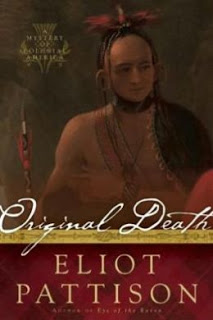
Armies, Power, Murder, Manipulation: Eliot Pattison's New Bone Rattler Mystery, ORIGINAL DEATH

Is it true, as Lord Acton wrote in 1887, that "Power tends to corrupt, and absolute power corrupts absolutely"? If so, the many forces entering battle in Colonial America must have hosted a lot of corruption -- because each of them struggled wildly to seize power in the New World. The French, the British, the newly developed Colonists ... But what about the Native Americans?

In author Eliot Pattison's hands, the tribal forces of 1760 may demand an exception to the rule. Knowledgeable about their land and its seasons and weather, wise in the movements of animals and growth of plants around them, and carefully balanced against each other's tribes -- or clans, as Scottish exile Duncan McCallum sees them -- the tribes of the Iroquois federation want power over themselves. But not over the Europeans. Without that hunger for absolute power, they'll avoid the depths of corruption already sweeping through the military forces around them.

At least, it seems that way to Duncan, traveling north toward a village by Lake Champlain with his aging but gentle and wise friend Conawago, who may be the last of the Nipmucs. That's how others know this sage. Yet Duncan knows the contents of the letter Conawago has, the one that's pulling him north. It says there are two other Nipmucs alive, in a settlement of Christian Indians.

Heartbreak! The pair of travelers arrive to find a murdered settlement -- including Conawago's nephew -- and increasing evidence that robbery and more murder have spread among the Scottish forces working for the British. Duncan even discovers a roped and drowned clansman under the lake's waters: "Duncan could not bring himself to touch the body, but he gripped the wheel to study it wuth the more deliberate gaze of the doctor he had trained to be. ... The death had a slow, organized aspect to it."

This is the frame Pattison has used in Bone Rattler and Eye of the Raven to turn Duncan McCallum into a forensic expert and investigator. Skilled in "hearing the voices of the dead," McCallum's observations and experience add up to a hyper-awareness of the evil that people can do. Wouldn't it be nice to blame it all on the British, or at least on the French, reaching down with other Native allies -- especially the Huron -- to challenge the ownership of the rich lands of New England?

Pattison, who also writes a series that involves Tibetan Buddhist lamas in Chinese-occupied terrain, crafts a many-layered plot that hinges on evil being possible for anyone, no matter what their origin or "clan." Soon McCallum and Conawago find themselves chasing a tribal leader named The Revelator. And the Iroquois council puts an added burden on them, one that McCallum discovered and would have embraced anyway. They are to rescue a group of kidnapped children.

Turning the tables on classic "Indian Wars" tales of white settler children being kidnapped, Pattison instead reveals a daring plot that involves holding the young children of tribal leaders, for ultimate leverage. Then he winds McCallum in accusations from so many directions that it seems everyone is willing either to kill him or capture him (or both). As evidence of criminal activity gradually adds up so do the deaths of McCallum's friends and allies. Battle is about to begin, and it's unlikely that rescue of the children can take place in the midst of such death and destruction: that absolute form of corruption of life, after all.

Parallel to his Inspector Shan/Tibet series, Pattison's Bone Rattler books dare to compare forms of spiritual wisdom and pathways, looking not just at evil (crime fiction, after all!) but at the nature of good. This third Bone Rattler "mystery of Colonial America" raises intriguing questions and insight into the clash of cultures in the New World -- even as it sets up McCallum and Conawago to risk everything for the chance to keep the Native tribal cultures viable for a generation longer.

A good read -- and one that's left me thoughtful and ready for a long, long walk in the forest.

MEET ELIOT PATTISON at Kingdom Books on Sunday July 28 at 7 pm; or if you can't be here, reserve a book or two, signed, and we'll ship them to you the next day. Also featured in this event is Pattison's newest book in his Inspector Shan series (see yesterday's review). We'll have copies of both of his newest books -- Mandarin Gate and Original Death -- but in limited numbers, so please contact us (802-751-8374 and KingdomBks at gmail.com) if you'd like to reserve copies of these or other Pattison mysteries for signature and purchase.

Tuesday, July 23, 2013

MANDARIN GATE, An Inspector Shan Mystery by Eliot Pattison

"The end of time was starting in Tibet." That's what the Buddhist monks, the old lamas, around Shan asserted, as Chinese occupation of their "autonomous territory" continued to bring political oppression -- and punishment and death to the believers. For Shan, the Chinese bureaucrat turned prisoner and then uneasily paroled in Tibet, what the lamas said might be true. But did that mean he should let the occupiers harrass and kill his friends?

In the titles before this one -- the Edgar Award-winning Skull Mantra, then Bone Mountain, Beautiful Ghosts, Water Touching Stone, Prayer of the Dragon, and The Lord of Death -- Shan's determination to protect his friends has meant repeated capture and torture for him. The meditation and other routes to inner equanimity, even laughter, that he learned from the lamas helped him to sustain his loyalty and the physical pain he's endured. Then again, there's the peril his grown son remains in, such that any independent action by Shan can mean the death of his imprisoned son. We readers have seen Shan's determination and integrity tested repeatedly in this situation.

But now -- is the world ending? The shocking death of one of the monks as the book opens might be evidence toward "Yes."

Shan's uneasy position as one who can read the evidence of death, but also grasp the ways in which the worst of the Chinese are spiritually dead, pulls him into investigating a vanished monastery, hidden monks and nuns, and corruption among the Chinese army officials. A killing of three people, including a Tibetan nun, turns out to relate to a government plan that's as brutal as it is powerful, and Shan must stop it, as well as protecting an American woman who's witnessed some of the underlying puzzle. Time and again, he needs to act on the potent scrap of wisdom he has shared with his son, Ko: Push down your fear. It is the greatest power a prisoner can have.

MANDARIN GATE paints the grimmest portrait that author Eliot Pattison has ever offered of what takes place in Tibet today. At the same time, ironically, it also engages with spiritual strengths and teachings more fully than any of the earlier novels. As Shan races from one imperiled friend to the next, he rarely doubts what he must do. And the tension of the book steadily increases, as more risks must be taken.

In his Author's Note at the end of the book, Pattison writes, "Tales of those who have been thus abandoned by history are so plentiful at the roof of the world that they almost seem ingrained in the landscape. While there is much ugliness to be found in the behavior of the government in today's Tibet, the power of that rugged landscape sometimes seems to eclipse it -- and certainly the stark beauty of their land is only enhanced by the enduring strength of the Tibetan people.

* * *

MEET ELIOT PATTISON at Kingdom Books on Sunday July 28 at 7 pm; or if you can't be here, reserve a book or two, signed, and we'll ship them to you the next day. Also featured in this event is Pattison's newest book in his Bone Rattler series (see review tomorrow).

Calendar Alert: Eliot Pattison, Sunday July 28, 7 pm at Kingdom Books


Eliot Pattison must have an amazing work ethic: He writes three mystery series, while also maintaining his career as an international attorney. How does he do it? What's next for this much-acclaimed but private author?

Find out in a rare conversation with Pattison, here at Kingdom Books, on Sunday July 28 at 7 pm. We'll have copies of both of his newest books -- Mandarin Gate (an Inspector Shan mystery, set in Chinese-occupied Tibet) and Original Death (third in the Bone Rattler series, set in Colonial America with both Scottish and Native American components) -- but in limited numbers, so please contact Dave (802-751-8374 and dknel at charter.net) if you'd like to reserve copies.

We also have many of Pattison's earlier books; click here to see the list.

Wednesday, July 17, 2013

Carsten Stroud, THE HOMECOMING: Niceville II, Crime + Horror


One of the epigraphs to Carsten Stroud's crime horror novel Niceville is from "Tartuffe": "Malicious men may die, but malice ... never." After that moment of high culture, the book sweeps into nonstop small-town action and suspense, told from multiple viewpoints -- most of them, through the eyes of clever and emotionally frozen criminals who seize opportunities and don't care who gets hurt along the way. Some of these sociopaths are trim and elegant, like Coker, the police sniper, a "Clint Eastwood" figure with silvery hair and compelling gaze; others, like Byron Deitz, look nearly as ugly and creepy on the outside as on the inside.

And then there are Nick Kavanaugh and his wife Kate Walker, a family-practice attorney. Maybe their exteriors aren't as clearly painted. But they are the smart, kind people here -- along with Native American (Maiami tribe) Lemon Featherlight, whom all the women warm up to. Of course, Nick has a crimp in his military past that's preventing him from going back to active duty, and Lemon has a rap sheet that's turned him into being a CI, a confidential informant. And Kate? You could say she gives her love and loyalty so passionately that she complicates life.

Or, like Nick, you could admit she's simply standing for honor, something he holds just as dear as she does.

So, where does that leave Rainey Teague, whose probably distant relatives keep turning up in the threatening situations that surround Kate and her allies -- but who is (at least on paper) just a half-grown kid fresh from a year of a coma, welcomed by Kate into her home and heart -- what side is Rainey on, anyway? Kate's? Or, umm, the dark shadowy threat that keeps interfering in his life but seems to be attached to him?

This week is the release of book II in the Niceville trilogy: THE HOMECOMING. Reading it was the bravest thing I've done this year. It's so darned good ... the action is so swift, the twists so unexpected yet fitting, and the determination that Kate and Nick show is so irresistible. But -- and this is a big but -- I knew as I devoured it (407 pages!) that nothing big would resolve or clarify by the end, because (groan) there's still another 400+ pages to go, in 2014, in The Reckoning. OMG!!!!

Maybe you've already had the good fortune of staggering through Tanya French's or Stuart Neville's Irish crime fiction, where the weight of a violent past -- of a person, a family, a country -- cripples and haunts the living women and men who grapple with crime (on both sides). Stroud crafts the U.S. version, and evil's presence in THE HOMECOMING is vicious, hungry, and dark. A Florida resident, he's set the scene in a Southern town called Niceville, which dates from 1764 but takes its undercurrents from events during the Civil War (a.k.a. the War of Northern Aggression) and the decades afterward, including World War I. Something about the interactions of Niceville's four founding families is so saturated with shame and rage that there's a dark force stalking the town's prominent citizens even now.

Stroud's writing is rich and colorful, and took me instantly to the Deep South (Niceville is within a night's driving distance of Metairie, Louisiana). That restless growth and fertility, the bitter enduring heritage of slavery's brutality, abuses of power by class, gender, and race -- they all surround Kate and Nick. Even with the tribal knowledge that Lemon Featherlight adds to their grasp of the forces around them, chances look pretty slim that they'll escape unharmed. Each one even wonders whether their marriage will hold up as they struggle with Rainey Teague's terrible heritage.

So here's the deal: You can pick up a copy of Niceville (the first book) in hardcover now, or wait until mid August when it comes out in softcover. But I suggest getting THE HOMECOMING right away. Stroud is a deft and powerful writer -- he gives enough detail in this second book to cover for the first one, without spoiling anything major in it, so it will work fine (in this rare case) to read the books in reverse order if that's how you access them.

And then you can join me in the agonizing wait for June 2014 and the third book in the Niceville series. (Here is Stroud's website to reassure you.) Misery loves company, they say. I wonder whether malice would say the same?

Shiver. I'm shaken by Stroud's very personal version of evil and malice. But I trust Kate and Nick, and most of all, Lemon. I want to read the third book.

If only I were enough of a Stroudian sociopath to go steal the manuscript from whatever publishing safe it's waiting in. Oh wait -- is the dark presence in Niceville affecting me now?

PS -- I see I've left out the details of how amazingly funny the situations can be that Stroud's villains create around themselves. I only want to add, though, that the black humor never spoils the tension. Not even when the Chinese get involved. The Chinese in the American South? Think fancy Lear jet. Really.

Wednesday, July 03, 2013

Our First Online Sale: 35% Off All Listings (Mysteries, Poetry, More)

We're honored that ABE Books selected Kingdom Books for its new program in allowing some small (boutique!) booksellers to offer a discount through its online listings of our books. From now through July 27, 2013, all our yummy mysteries, poetry (yes, we re-listed hundreds of poetry books, many signed, because we knew this was coming), and quirky eccentric delights that we couldn't resist -- they are ALL 35% off.

Hope you're ready to browse. Here's an easy link: http://www.abebooks.com/kingdom-books-waterford-vt-u.s.a/1498832/sf

I've saved up boxes for shipping, and Dave is ready to answer any questions about condition, authors, and more.

Reviews coming ASAP—on Carsten Stroud's amazing new thriller; plus a book in the new genre of "Thuglit"; and more.

Wednesday, June 26, 2013

Jeffery Deaver, THE KILL ROOM: And Have You Read the Nero Wolfe Mysteries?

I won't give a full review of Jeffery Deaver's THE KILL ROOM today, as he's had plenty of press for this newest Lincoln Rhyme detection novel. It features both Rhyme and Amelia Sachs, and the most significant killing in it takes place in the Bahamas.

And that's what makes this an intriguing book in the series. Rhyme's quadriplegia limits his travels sharply, as well as what he can "put his hands on." He depends on an intimate group of police and forensic investigators to find his way to a solution.

But in THE KILL ROOM, Rhyme leaves Manhattan and flies to the scene of the crime.

And that makes the book strongly parallel to The Black Mountain, in which Nero Wolfe -- limited in his travels by both his large size and his personal preferences -- unexpectedly leaves Manhattan for Montenegro. If you haven't read the Wolfe detection series, written by the late Rex Stout, I recommend them now. Read a few as "summer reading" for the pleasure of the narrative and to get the feel of the characters, before opening The Black Mountain.

I'll look forward to hearing what you think in terms of parallels and sharp differences.

Thursday, June 20, 2013

Coming to Kingdom Books: Eliot Pattison -- and Congratulations!


Warm congratulations to Eliot Pattison, whose third book in his Colonial mystery series, ORIGINAL DEATH, was just awarded a starred review from Publishers Weekly! We are looking forward to reading the book, which will be released July 25 -- just in time for us to have copies here at Kingdom Books for Pattison's visit!

That's right, this outstanding Edgar Award-wining crime-fiction author (of three series -- the other two are set in Chinese-occupied Tibet, and in a postapocalyptic America) is again coming to talk with readers and collectors in a rare public appearance. Mark your calendar for Sunday July 28 at 7 pm, and be sure to ask Dave to reserve you a copy of the new book to be signed -- we will have only a limited number. We'll also have copies of Pattison's 2012 Inspector Shan (Tibet) book,  Mandarin Gate, and limited numbers of earlier books (again, make sure to reserve with Dave): dknel at charter.net or 802-751-8374.

Tuesday, June 18, 2013

HOUR OF THE RAT, Lisa Brackmann: Suspense and Danger in the Real China

RELEASED TODAY!
So, you're reading international crime fiction, right? And you definitely can picture the art, canals, and food (even almost smell it) in Donna Leon's Venice mysteries; you're getting worried about gray-sky days because in the Scandinavian mysteries they mean more killings and more depression; and you can't decide which African crime fiction you like better, the almost cozy ones by Alexander McCall Smith or the edgy and dangerous ones by Jassy Mackenzie.

So, what are you going to do about China?

I promise, I don't usually talk or write like that -- but Ellie McEnroe, age 27 and a long-term injured Iraq War veteran living in China, definitely does. Lisa Brackmann's adventurous American in Beijing keeps getting into controversy, though, and in modern China, mouthy Americans are mostly not welcome. Americans who support, hide, and have contact with anti-government artists are even more not welcome. Even with her connections, and now her mom living with her, Ellie is in trouble.

Readers who caught Brackmann's first Ellie McEnroe title, ROCK PAPER TIGER (2010), already know Ellie's war wound has left her vulnerable to pain-easing drugs, and her refusal to play things safe has set her against the Chinese government when it chases after her artist friends. Especially intriguing is the way Ellie finds herself caught up simultaneously in an online gaming world that has odd connections to who she's seeking and who's chasing her. (Shades of William Gibson, really.)

HOUR OF THE RAT takes Ellie out of Beijing -- she's burning out in a lot of ways, and it's time to get to other locations. The opening scene, an art opening event, captures her situation:
Guests and artists mill around, drinking Yanjing beer and eating yangrouchuanr, which normally I'd be all over, but the meat on these is so small and gristly that I wonder if it's actually mutton and not dog instead. Or rat.

I was born in the Year of the Rat, and eating my birth animal seems like it would be bad luck. So I stick to the beer.

"Why are we here, again?" I ask.

"I'd heard good things about the painter," Harrison says, flicking his hazel eyes at one of hte giat canvases, one where a fat naked guy whose face is done up in Peking Opera makeup lies sprawled across a red Ferrari, his guts spilling out of his sliced-open stomach. ... "I agree with you, it's disappointing."

... He's my boss, sort of.

I manage the work of a Chinese artist. An important one. Which is pretty funny, considering that I know f***-all about art. Which is why, I guess, Harrison keeps trying to get me to learn.
In addition to this sense of burnout, two nearly irresistible forces are on Ellie's case: (1) Somebody keeps trying to purchase her client's art, which oddly enough is not a good thing because he's in danger with the government and any sale will bring people after him right now; and (2) Ellie's mom, who seems to have run away from her American life, is trying to direct Ellie's life instead (while bringing her own Chinese boyfriend into the mix).

But when Ellie goes on the run -- with her mother and said BF in tow -- a third and maybe even a fourth factor (both political/police related) press into her life. And the places she ends up running to and through are some of the scariest in modern China, because they are the most heavily polluted and poisoned and -- you knew this was coming -- doggedly made invisible by the government.

Brackmann, musing on how she developed HOUR OF THE RAT, says, "Many in the West tend to think of Chinese as passive and uninvolved when it comes to politics, and while it’s true that the CCP does not look kindly upon activities that threaten its monopoly on power, Chinese people have been very vocal when it comes to environmental issues. Many of the approximately 180,000 “mass incidents” in China last year were provoked by pollution or other environmental concerns. Tens of thousands of people have protested polluting factories in places like Ningbo and Xiamen. These are issues that unite poor peasant farmers and well-to-do urban dwellers alike."

In terms of Ellie's life, that means there are people who may give her some support and information as she tries to escape whoever is chasing and threatening her and the ties to these polluted places. But it also means nobody around her can afford to go on the record.

Brackmann's crime fiction is exhilarating and compelling, and I had no regrets about trading in my preconceptions about China, to absorb both the current issues and the clear passion that Ellie has for the place and its diversity. Readers don't need to read Rock Paper Tiger first, but -- why not get both books for double enjoyment? Brackmann is definitely sustaining the strong narrative voice and deft weaving of plot and character that brought her huge praise for the first Ellie McEnroe adventure, and I hope she's planning more. I'm in for this.

More from Brackmann, here: http://www.lisabrackmann.com/books/hour-of-the-rat

Our review of Rock Paper Tiger, here: http://kingdombks.blogspot.com/2010/07/when-global-gets-dangerous-lisa.html

And if you've been reading this while also trying to remember whether you were born in a year of the rat, or dragon, or horse ... check here: http://www.ofesite.com/spirit/chinese/animal2.htm

Thursday, June 13, 2013

With Sorrow, News of Joan Parker's Passing

Alerted by Hank Phillipi Ryan, we have news today that Joan Parker, loyal and loving wife, partner, and teammate of author Robert B. Parker, has died. An obituary from the Boston Globe announced that her death took place Tuesday, and recognizes Joan for her philanthropy. We are thinking of Joan's family and the many friends of this wonderful couple, in this time of loss.

We're also thinking of when we last saw Joan: at the New England Mobile Book Fair, as she initiated the Robert B. Parker Award there. Here are a couple of our photos.
Joan and NEMBF owner Tom Lyons.

Joan reading from a letter written by Robert B. Parker.

Do look at the Boston Globe's online obituary, for a particularly lovely photo of Joan Parker.

Wednesday, June 12, 2013

Strong, Savvy, Sensitive, and Yes, Very Scary: Vanessa Michael Munroe Returns in THE DOLL by Taylor Stevens

I'm one of the gazillions of female readers who look forward to a new thriller from Lee Child, or an intense espionage investigation from Olen Steinauer or Alan Furst, and of course a regional police procedural from Archer Mayor or Craig Johnson ... and in fact, it wasn't until a few years ago that I realized that all the characters I identified with for years in the Lord of the Rings trilogy were guys. Honestly, I think it's easy for most of us to connect with a protagonist who makes emotional sense for us, no matter the gender.

And there's something about Vanessa Michael Munroe -- better known just as Michael to her friends -- that catches me at the heart level and makes me enormously proud of her. She's an information specialist (Taylor Stevens's earlier books in the series are The Informationist and The Innocent), a born linguist, and a wealthy business co-owner. Her work takes her all over the world, and as a single and slender woman in the realms of power, she's got to be able to defend herself with more than just words. She knows how.

But along with Munroe's strength, defensive skills, and fancy knife work come the weight and horror of a past rife with abuse, where she learned to fight off abusers in order to survive. Keep her busy and she's tops in her field; let things slow down, and the darkness of the past can knock her into deep and crippling depression. (Can you relate?)

THE DOLL opens with a shockingly impossible moment: Michael's partner Miles Bradford, watching from the office window, witnesses the highly unlikely -- and therefore impeccably choreographed -- kidnapping of Munroe right in front of him. Horrified and at first scrambling against a glassy surface of lack of information, Bradford has little chance of racing to Munroe's rescue; only if she finds a way to contact him will he know what to do.

Meanwhile, the kidnap team is having second thoughts, and the thoughts are that whoever lined this up has a bunch of ridiculous rules about Vanessa Michael Munroe:
Do not let her hear your language, the source had said, she will use language as a weapon. Keep the area around her free of objects, everything will be used as a weapon. Stay clear of her reach, she doesn't need a weapon to kill you. Don't use restraints, she will find a way out of them, and they will only give a false sense of safety. Do not touch her, the source said. Leave her in peace, and treat her respectfully, only then will the violence stay muted. Disrespect these and make no mistake, she will kill you.
It's easy to assume Munroe's fragile and frightenable; she's female and small and pretty. But that's not who she is on the inside. Inside, she's a tornado, an earthquake, an irresistible force with brilliance of mind and a compulsion to solve problems.

Soon enough, Munroe meets the depraved but highly intelligent and well-informed person behind her capture: the Doll Man, a merchant who feeds the hunger of collectors of real women, through turning them into dolls who can then be abused, abased, kept in captivity. Can he keep Munroe? It doesn't seem likely, but he's come up with carrots and sticks that involve the people she loves -- and soon she'll take his orders, in order to save her friends and family. Wouldn't you?

And there is the catch, the hook, the way that Taylor Stevens binds us to this protagonist unforgettably. What we value most -- our commitment to the people we care about -- is what Vanessa Michael Munroe can't escape. How hard can she fight, and how much can she risk, in order to bring the global criminals around her to justice?

I'm not always comfortable with Munroe -- just the way I stop to ask myself whether I'd let Lee Child's Jack Reacher into the house. Stevens twists this intense thriller so effectively that Munroe's questions become the ones the reader faces, too.

Oh, you don't need to read the two preceding books in the series before reading THE DOLL. But I'd recommend it, because then you'll notice how Munroe is growing, in the hands of a powerful novelist. Be sure to check out the author's website, but not until you've read at least one of the books: http://www.taylorstevensbooks.com/index.php.  Or, if you've got to peek first, remember Leonard Nimoy telling Star Trek fans, "I am not Spock." Taylor Stevens is not the same as her protagonist; if you have a moment, add your comments here, and give this author the gift of seeing her fiction as creative work, far beyond the pain of her own past. Come to think of it ... that's what she asks us to believe of Vanessa Michael Munroe, too.

CROSSING JACK BROOK: Love and Death in the Woods, by Paul Lefebvre


[A particular note to readers beyond Vermont: This book may be exactly right for you, in spite of being set in a very small place. Read all the way through the review, and you may see possibilities.]

There are places whose names evoke powerful images and memories: San Francisco, or the route of the Circle Line Ferry around Manhattan, or the coast of Alaska. As the locations narrow, they call up more specific reactions: the weather station at the top of Mount Washington in New Hampshire, or a waterfall hidden in the woods of childhood. Even a kitchen chair.

Paul Lefebvre's third book, CROSSING JACK BROOK: LOVE AND DEATH IN THE WOODS, is set almost entirely in Vermont's Northeast Kingdom, a rural and in many ways isolated region where there's room for people to be themselves, as kindly and generously and sometimes "brokenly" as they wish. (Yes, this is the second review in the past week to talk about the Northeast Kingdom; the other is at http://kingdombks.blogspot.com/2013/06/vermonts-northeast-kingdom-suspense.html.)

And Lefebvre narrows the focus further, to the "Upper Kingdom," the section of Orleans and Essex counties -- mostly Essex in this book -- where the Interstate isn't part of daily life, the mail carrier knows your family, and your management skills can be measured by the amount of dry wood you've split, stacked, and covered for the next heating season.

Time also narrows here: Lefebvre's weekly column in the Chronicle, an award-winning neighborly newspaper in the area, can ramble in a mellow way through an episode on a farm, in a forest, or leaning on the counter at the general store. But as he explains at the start of the book, "When the woman I lived with became ill with cancer in 2005, I began writing about it in [that] column." Through the nine months that followed, which led to the death of that woman, artist Elin K. Paulson, the column made it possible for a wide community to treasure the connection to Elin, as well as to Paul himself. And then, in the way that loss can capture life, it also captured the column, living onward after Elin's death, commenting on what the couple's shared lives had been and how Elin's absence continued to affect the writer and the widening circles of friends.

Stained glass by Elin K. Paulson
For CROSSING JACK BROOK, Lefebvre took segments of his published columns from August 1994 to May 2010, and enfolded them in commentary and reflection. In some ways it's a journal within a journal -- love on the inside, with the struggles that it takes to craft and honor a working relationship, and love/loss, a different garment, on the outside. Lefebvre makes it work well, coupled with another pairing: a time that was (including the early idealistic years of the area's most noted communal group), and a time that is and that continues. In that sense the book is a poem, and also a place of its own, a brook of moments that flash in the sunlight, then shatter.

The couple also inhabited two homes: their shared one that is still Lefebvre's, and a cabin in an area now mostly uninhabited but once a busy logging village: Lost Nation. The cabin was Elin's, not just her home for many years before joining Lefebvre, but also her work of art and a display place for paintings, sculpture, and collections of stone, metal, wood. Jack Brook lay between the working world and the cabin.
To cross Jack Brook was to enter a world that had been shaped or colored by an imagination nearly always in gear. "This is where we find the essence of Elin," I said to one of the boys from Island Pond who had come with me to Lost Nation a few days after her death to see what had to be done in preparation for the [planned life-celebrating] tribute. No doubt the loggers who had once inhabited the space wouldn't have recognized the grounds or the cabin. Never locked, the screen door to the cabin was fastened shut with a simple hook and eye screw, while the inner door, homemade and somewhat crude, held a geometric painting in pastel colors and a pad of paper on a string.
Lefebvre's "now" commentary, framing the earlier columns, suggests that the twosome had to "mature and become more of ourselves" before they could settle into living together. The commitment that they forged saw them to a harder crossing than the one over the brook.

In both layers of the book are conversations, the small exchanges of questions and responses that make up a relationship. To see Elin through Paul Lefebvre's eyes is to see an artist who pushed the edges of vision and color, while remaining practical and matter-of-fact about herself and her life. It is, in a sense, to travel the road that fortunate lovers walk, discovering what makes the beloved so irresistible, so "meant" to be there.

Reading CROSSING JACK BROOK conveys several gifts: a reassurance of how direct love and art can be, a caring terrain of grief, an admission of how much we all don't know about how to handle the later years of life, as lovers and friends die and the world changes around us.

Lefebvre writes near his conclusion, "Writing is the only strength I have; I have no idea how my words might strike those who read them. But a friend, who is also a writer, told me that wasn't important. What is important, he said, is for a writer to open his heart."

So if your bookshelf has few items that focus so tightly on a small segment of Vermont, but you have savored the writing of, say, Gretel Ehrlich or Edward Hoagland or Terry Tempest Williams, CROSSING JACK BROOK could be your delight this season. Copies can be found at northern Vermont bookstores (including Green Mountain Books in Lyndonville, Vermont, where there's a reading and signing on June 14; 802-626-5051 and greenmountainbooksmyfairpoint.net) and through the Vermont Historical Society (http://vermonthistory.org/shop/all-store-items/product/878-crossing-jack-brook-love-and-death-in-the-woods; ignore the rather lame book description there). I wish you time to enjoy this one. Maybe it's a good idea to purchase two copies -- so you have one to give to a friend who'll share the experience. It's worth the investment of the heart.

Victoria Houston's New Loon Lake Mystery: DEAD INSIDER

Rain clouds are moving across the valley as I write; we are in for another drenched afternoon, and it's becoming "ordinary" to see flood warnings ticking across the TV screen in the evening. What a great season to dip into the newest in Victoria Houston's Loon Lake mystery series, though: DEAD INSIDER, where a catastrophic August rainstorm in northern Wisconsin includes the revelation that, neatly wrapped like butchered meat, parts of a human are floating through the Loon Lake run-off.

Loon Lake Police Chief Lewellyn Ferris knows how to recruit her friends and colleagues to assist her crew in coping with the threat to health, tourism, and safety -- but the media circus that erupts when the victim's identity is revealed goes way beyond her expectations. After all, not only was the murdered woman running for the U.S. Senate, but someone is going to inherit her fortune. Along with the money comes a family heritage that's darker than most, and the possibility of multiple motives.

"Lew" makes a good choice pulling into the case retired dentist "Doc" Osborne. In many ways he's already involved -- much of the action unfolds from his own point of view -- and he's a low-key Watson to her investigation:
During Osborne's first stint as the deputy coroner for the Loon Lake Police Department, Lew had discovered he could be an unexpected asset during the questioning of suspects. The reason? Men and women hear differently. Depending on the listener -- emotions, facts, even words can have ambiguous meanings.

More than once each had surprised the other with an interpretation of a response that changed the direction of the investigation.
Stakes are high, financial, political, powerful, and by pushing into the flood of events and desires around her, Lew raises the risk level as well.

Houston weaves a neat traditional mystery with up-to-the-minute recognition of how small-town life has changed in an era of global politics. This one goes on the "keep it" stack for summer reading (flyfishing! suspense!), regional interest (northern Wisconsin), and well-crafted female police chief (still a rarity). I can already see I'll be watching for the earlier books in the series, which is:
Dead Angler
Dead Creek
Dead Water
Dead Frenzy
Dead Hot Mama
Dead Jitterbug
Dead Boogie
Dead Madonna
Dead Hot Shot
Dead Renegade
Dead Deceiver

Dead Tease

Dead Insider 
The official release date for DEAD INSIDER is June 18. Luckily, there's no need to read the other titles beforehand ... but, like me, you may decide you'd like to gather a few more for the shelf.

Sunday, June 09, 2013

Scottish Noir: William McIlvanney's LAIDLAW Is Back in Print

The Canongate re-issue.
A number of blog reviews are showing up this year for William McIlvanney's LAIDLAW, first of his three noted Glasgow (Scotland) crime novels: Laidlaw (1977), The Papers of Tony Veitch (1983), and Strange Loyalties (1991). The fresh attention is due to reprinting of the first (and presumably the others will follow) as a paperback, by Canongate, in Edinburgh, Scotland. A few copies are floating across the Atlantic, and I hope there will be more.

For newcomers to this pivotal work credited as the launch of today's "Scottish noir," here's a thorough article by Beth Dickson at the Association for Scottish Literary Studies (don't let the organization name put you off, as she provides a good summary of the three books): http://www.arts.gla.ac.uk/scotlit/asls/Laverock-McIlvanney-2.html

And last Thursday the noted blog The Rap Sheet gave us part of a new interview with McIlvanney: http://therapsheet.blogspot.com/2013/06/mcilvanney-calls-it-as-he-sees-it.html

If you're already a fan of the crime fiction by Quentin Jardine or Denise Mina, here's a good chance to check out the roots of their work. And if all these names are new to you, Kingdom Books provides an oveview here: http://kingdombks.blogspot.com/2008/06/scottish-mysteries-mcilvanney-mina.html

Hurrah for summer -- the season that justifies making a reading list and indulging!

Saturday, June 08, 2013

Vermont's Northeast Kingdom: Suspense Thriller from John Vibber, KINGDOM COME

The northeastern wedge of Vermont that wings away from the north-south thrust of the state is called the Northeast Kingdom -- specifically, three counties that add up to about 65,000 people and a lot of second-growth forest. The region has a gentler landscape than the rest of the state; the Green Mountains fade away here, and though the rivers brought early trade and industry (along the same byways that the Abenaki tribe and its forebears traveled), towns formed late and even today are small, where neighbors know you by name. And a neighbor may live four or five miles away.

The most rural part of this landscape, the town of Canaan, Vermont, hosts the action of John Vibber's second mystery, KINGDOM COME. The first printing of the book ran last summer, but two corrected versions knocked me off schedule for a review. So here we go: Now's a good time to consider picking up a copy for the summer-cabin bookshelf, or as a gift to your hosts where you're spending some vacation time. Though there are some rough edges (as expected for a self-published mystery), Vibber knows a good tale and spins a complex one here -- one that involves a militia, violent plots to overthrow the local peace, and casual murder by psychopaths who enlist each other in a tightening net of threat and danger.

Cleverly, Vibber sets the book a few years back, instead of forward -- 1997, at the time when the approaching Millennium, the year 2000, brought global concerns that involved computer networks crashing, power grids failing, and political chaos, thanks to presumed issues with software and the change from the 1990s dates. Investigating a rogue group that seems to be operating out of a printing business just across the river in the wildest part of New Hampshire is Reilly Bostwick, familiar from Vibber's first mystery. Settled harmoniously with Adele Clayton (the couple has knitted well together, after the murder that put them at such risk in Shadow on Cant-Dog Hill, Vibber's first book), Bostwick has no intention of putting his family in danger again.

But his daughter and Adele's, Amy Bostwick and Lottie Clayton, aged 19, need summer jobs after their freshman year of college "away." When their former babysitter, Nicole, is murdered, they have no clue there's a link to the print shop where they're seeking work. And terms like "Tribulation" and "the Rapture" don't sound dangerous, even when they're part of some odd documents that the print shop issues.
"But what do these Miller Press pamphlets mean?" asked Amy. "Are they trying to make the chaos happen or trying to take advantage of it?"

"I think that there'll always be huge world problems and some people trying to profit by scaring others," said Reilly [Amy's dad]. ... "I think that Miller Press is trying to stir up fear and profit from it. I don't know if this is dangerous or just ugly."
Turns out it's both. Vibber's deft twisting of strands and the narrative's swift dodging from investigator to criminal and back again keep the action lively. And once the FBI gets involved, the risk actually rises for Lottie and Amy.

Clear some summer hours for this adventurous local read -- John Vibber's retirement career as mystery author is providing a lively local thriller with lots of connections to what could really be happening at the next cabin up the lake's shore. Available as both softcover and e-book through that big online retailer, but you'll have more fun (and get more into the spirit of local authors!) if you ask your independent bookstore to order in a copy or two. One to keep, one to share with a summer friend.


Friday, May 31, 2013

Becky Masterman, RAGE AGAINST THE DYING: Intense Investigative Thriller, Emotionally Gripping

I picked up a copy of Becky Masterman's debut thriller, RAGE AGAINST THE DYING, thanks to a review by another author. From the first chapter, this one never let go of me.

Brigid Quinn, age 59 and noticeably white-haired, is reluctantly retired from her FBI position where she hunted sexual predators. Haunted by what she's seen over the years, she's trying to fit into a new role: wife to the gentle and unquestioning Carlo, a former priest who hasn't asked her to go beyond her usual reply to people who ask what she used to do: investigate "copyright infringements," she'll tell them, ready for their baffled blink and a change of topic.

But Quinn's long-time psychologist friend David Weiss, nicknamed Sigmund, isn't afraid to analyze Quinn and her choice to settle in Tucson, Arizona, where her effort to catch a Route 66 predator went very wrong. It's the case she never quite solved and can't let go. And it's rotting something inside her in a way that doesn't bode well for marriage or even for retirement.

So when Floyd Lynch confesses to the string of crimes, and Quinn becomes persuaded that the confession is flawed, she's suddenly investigating -- without badge or authority, and with some truly awful judgment calls.
Who knows how they all thought I'd react? His mission accomplished, [police investigator] Max relaxed his spine and let himself get sucked a little into the overstuffed couch. "Don't worry.  We're waiting for verification before we do that, but it was time to let you know. Your involvement in the case, I mean."
But Max has also alerted David Weiss, and nothing is as it seems -- not even Quinn's homelife.

A gripping thriller, well paced and worth the read. I wasn't totally convinced by the very last details of Quinn's path here (a slightly incongruous note compared to the rest of the book, I thought), but I am totally ready for sequels. Becky Masterman has the right stuff.

Margaret Maron, THE BUZZARD TABLE: Crafted by a Grand Master

THE BUZZARD TABLE is the 18th of Margaret Maron's Judge Deborah Knott mysteries, and a crackling good one. Series followers will grab and gobble; for me, the book was a reliable treat, waiting for a calm moment when I could just keep on reading . . . I knew I wouldn't want to put this down very often.

And that's what it is for a writer to become a Grand Master. There are a goodly number of these strong, steady authors who know pace and character the way they know breakfast, and who braid unexpected strands and glittering red herrings like extra courses of dinner. But Maron's writing is more than this -- she is a recognized Grand Master, thanks to her 2013 Edgar Award, as well as recognized in her home state of North Carolina, where she sets much of her writing. And she has the patience to work with a story until its layers are satisfying and rich. Without carrying the metaphor too far, I could say Maron knows her workroom and insists on making the dish come out right.

In this case, Deborah Knott, judge in Colleton County and married for a long time to Sheriff's Deputy Dwight Bryant, isn't as young or adventurous as she once was. Her life balance is now heavier on wisdom and experience. But there are still things that take her into new terrain, like the unexpected reactions she's getting from her young stepson, Cal -- whose mother is dead. She's also puzzled by a visitor to the area, a long-lost cousin of the dying Mrs. Lattimore (that scent in the air is money, plus jewels). Cousin Martin Crawford is an ornithologist. Prickly and defensive, he's set up a "feeding table" for buzzards. Just for photographs -- or for other reasons?

And there is the disturbing core of what's going on in Colleton County: Who's waiting to feed off what corpses, and why?

Deborah's interest in the situation is supplemented by that of her husband Dwight, and by Sigrid Harald, an investigative lieutenant from New York and the granddaughter of the soon-to-be-late Mrs. Lattimore. Dwight and Sigrid get their own chances to narrate the action, but most of the insight and control are in Deborah's voice and view. Maron readers will recognize Sigrid from her own series, btu this book is great as a stand-alone -- you don't need to be caught up on any of Maron's long-standing narrative strands to enjoy THE BUZZARD'S TABLE.

Maron writes traditional mysteries -- death happens, but there are no interludes inside the minds of deviants, and the solution, when it comes, is the result of skilled people working hard to uncover the disturbing secrets around them that may have led to violence. I found the conclusion well crafted and appropriate -- then was haunted afterward by a few provocative strands of moral doubt that Maron leaves dangling.

I'm shelving this one on the "read it again" shelf, and look forward to working back through some of the earlier Maron titles, as well as the ones yet to come.