A little more edgy than a "cozy," a little less did-I-lock-the-doors than a thriller -- romantic suspense fits into a comfort zone. DECLAN'S CROSS, from the deft Vermont/Ireland/Maine author Carla Neggers, provides an escape to the lush and rugged hills of the Emerald Isle. Following her usual path, Neggers centers the crime detection efforts on a pair of characters from her earlier books, this time FBI agents Emma Sharpe and Colin Donovan. But she also weaves in other characters we haven't yet grown to know as well, like Julianne Maroney, in love with another Donovan brother and trying to get over it.
Julianne is in Ireland on impulse, expecting her two-week visit to connect her with the start of a marine lab and to give her a restored sense of independence. Emma and Colin, on the other hand, are wrestling with how their intermeshed careers can make room for a relationship -- not easy, especially since Emma still has confidences to keep from her family's art theft investigations.
But Colin in particular senses irregularities in the invitation that Julianne has accepted and the FBI agents head across Ireland to check things out. And when a murder (thinly disguised as an accident) takes place within the marine lab situation, neither Colin nor Emma will leave the Irish village of Declan's Cross until Julianne is safe and the crime has been resolved. Emma may even need to bring her secretive grandfather into the solution -- and Colin isn't keeping any of this away from his brother in Maine, who's very worried for Julianne.
Cleverly plotted, with ample helpings of scenic luxury and warm generosity of heart, DECLAN'S CROSS is a gem of a diversion from winter's arrival and the holiday stresses. No need to read the previous title in the series (Heron's Cove) beforehand, but for a special treat, pick up both at once and indulge.
Mysteries and crime fiction reviewed here with knowledge and delight. Classic to cutting edge.
Tuesday, October 29, 2013
Saturday, October 12, 2013
Vermont Police Mystery: Archer Mayor, THREE CAN KEEP A SECRET
Archer Mayor's Vermont includes the fictional but very reasonably created Vermont Bureau of Investigation, the VBI -- for which Brattleboro resident and former local police officer Joe Gunther holds the command post. THREE CAN KEEP A SECRET is a twist on the old expression, "Two can keep a secret if one of them is dead." And in this 24th Joe Gunther investigation, long-buried secrets are reopened thanks to Hurricane Irene as the storm creates havoc and catastrophe around the Green Mountain State.
Riding along with Gunther, north and south, east and west, covers most of Vermont in this round. I was on scene during the storm, and what Gunther discovers in terms of its ravages -- swamped downtowns, smashed homes, rivers that rose, ripped, and retreated -- matches my own memories, with extra mud and sewage dished up on the side. Joe even dons a haz-mat suit to enter the underground tunnels of the state's most haunting health care site, trying to help the local police force locate a missing patient from the state's central psychiatric hospital.
The escape of that patient -- a petite and apparently harmless lady who calls herself The Governor -- is one direct result of the hurricane. Another is a coffin, exposed in a washed-out cemetery, filled with rocks instead of a body. And then there's the suspicious death of a politically powerful senior citizen in a care facility that's got major strings attached.
In THREE CAN KEEP A SECRET, Archer Mayor dishes up a marvelous sequel to his 23 earlier books, and brings a highly satisfying cast of favorite characters back: not just Joe's "work family" of the irascible Willy Kunkle and blunt-spoken Sammie Martens, along with ultra-responsible Les Spinney, but also Joe's family of origin steps up: his brother Leo and their aging mom, who haven't appeared for a while in the series. It's great to have them here. And watching Sammie and Willy deal with assignments that compete, while parenting their infant daughter, adds extra interest to the setup.
Neither the rock-filled coffin nor the missing psychiatric patient gives up secrets easily. When they do resolve, though, Gunther and his team reach a surprising finale on each strand of this quick-paced traditional mystery. Clear the weekend calendar and settle down for a rousing good read.
And may the hurricane season be a lot gentler in the future!
Labels:
Archer Mayor,
Joe Gunther,
mystery,
police procedural,
series,
Vermont
Catching Up on William G. Tapply's Mysteries
Emma at Open Road Media sent this along a few weeks back, and I just made time (finally!) to visit the website for William Tapply at Open Road Media. What a great idea -- Tapply's books were challenging to find at times even when he was still "among us." Since his death, I've thought of his series from time to time, and wished I'd collected all of his books when I still had the chance to meet him. Now, with this "Tapply library" so accessible, I can at least indulge in reading the Brady Coyne titles I never did add to my shelves. Here's Emma's message:
We are thrilled to announce the ebook publication of seventeen Brady Coyne legal mysteries by William G. Tapply. Written between 1984 and 2009, Tapply’s beloved mysteries begin with the Scriber Crime Novel Award–winning Death at Charity’s Point, and feature the avid fisherman and Boston lawyer, Brady Coyne. The Washington Post claims Brady Coyne is “one of the most likeable sleuths to appear on the crime scene in quite a long time.”William G. Tapply (1940-2009) was the author of over 40 books, including over two dozen Brady Coyne mysteries. He was a frequent contributor to outdoor magazines, such as Field and Stream and American Angler, as well as an English professor at Emerson College and Clark University.We hope that by making these novels available as ebooks, they will reach the wide audience that they deserve. I’d be delighted if you shared the news on your site or through your social networks, and I encourage you to check out the new cover art, available on the author’s page here.
Labels:
Boston,
Brady Coyne,
legal mystery,
mysteries,
New England,
Open Road Media,
William G. Tapply
Monday, October 07, 2013
Florentine Detective Mystery: Magdalen Nabb Excels With THE MONSTER OF FLORENCE
THE MONSTER OF FLORENCE is the final Marshal Guarnaccia investigation that Soho Crime expects to publish; author Magdalen Nabb died in 2007. It is one of the most provocative and unusual mysteries I've read this year, and I highly recommend it for any collection of international mysteries, detective series, and crime fiction.
That said, brace yourself for a reading experience that takes you inside the mind of an aging, humble, and insecure detective who knows he is easily confused and, in his wife's absence, handicapped by his inability to cope with simple tasks like making sure he has enough to eat, or laundering his clothes, or -- most essential for an investigator of serial murder -- discharging the disturbing images from his work, in order to sleep. In fact, Marshal Guarnaccia is plagued by nightmares and the sense of having half seen a significant clue or connection. And when he is forced to stay in Florence over the Christmas holidays, while his wife Teresa and his sons go to Sicily for the annual visit with both his and her relatives there, the Marshal's insecurities and night disturbances mount up in proportion to the twisted psychology of the suspects around him. And then, of course, there are the twists and manipulations of the politically prominent detective leading the task force to which he's been assigned.
That assignment, to a group trying to round up evidence to imprison the main suspect in a decades-long series of murders of couples in their cars after lovemaking, frightens the Marshal with its irrationality and uncertainties. Why should he be given standing on a high-profile case? As he tells Teresa, "I've never been on an important case. The only case I ever solved was when that poor creature Cipolla shot that Englishman. And he only did it by accident and after that he was just hanging around waiting for me to arrest him."
What the Marshal does have, though, is both integrity and an enormous sense of responsibility, especially to young men suffering injustice. Even as he struggles to catch up with reading and digesting the copious files of the case against the Suspect -- files that seem to have been edited to enforce a particular conclusion -- he's trying to help a young friend who's inherited a piece of art that may be a forgery. And then the contortions of the task force, and the probability of injustice, take the Marshal exactly where he knows he shouldn't go: into re-investigating the murder cases, going to the scenes himself, and questioning some of the witnesses and possible other suspects.
What Nabb does that feels particularly disturbing is spin the Marshal's thoughts and efforts within his personal crisis of faith in himself, his aging thought processes, his "man-lost-without-his-wife" handicaps -- and take the reader into the mists of confusion and fear. And all this in Florence, Italy, far from the despair-filled settings of Scandinavian noir!
THE MONSTER OF FLORENCE is not noir, anyway; hope, love, and friendship glimmer in it unexpectedly and sweetly, like carefully shielded candles in a storm. By the end of this satisfyingly thick and rich mystery, I recognized that I was also grieving: for the loss of Nabb, and of her struggling yet persistent and committed and deeply humane Marshal Guarnaccia.
A note for those who follow European crime: This book is indeed inspired by seven double homicides in the area around Florence from 1968 to 1985. What Nabb does with that inspiration, however, is intended as fiction -- fiction well worth reading.
And here are the preceding Marshal Guarnaccia titles , from oldest to newest (not necessary to read the first, but you may want to gather them later):
Death of a Dutchman
Death of an Englishman
Death in Springtime
Death in Autumn
The Marshal and the Murderer
The Marshal and the Madwoman
The Marshal's Own Case
The Marshal Makes His Report
The Marshal at the Villa Torrini
Some Bitter Taste
Property of Blood
The Innocent
Labels:
crime fiction,
detective,
Florence,
Italy,
Magdalen Nabb,
Marshal Guarnaccia,
Soho Crime
Debut Mystery: THE SÉANCE SOCIETY, Michael Nethercott
Looking for a traditional mystery with memorable characters and clever twists of investigation and plot? Vermonter Michael Nethercott provides a cozy read in his debut detective novel, THE SÉANCE SOCIETY, set in 1956 Connecticut and introducing willing but inexperienced detective Lee Plunkett and his unusual sidekick, the Irish and bearded Mr. O'Nelligan.
Lee Plunkett is an accidental detective -- not quite a true amateur sleuth, he's fallen into the business role by inheriting it from his father but hasn't ever quote committed to it. The same applies personally, as he's more or less in love with his long-time fiancée, Audrey, and it's her connection with Mr. O'Nelligan, her neighbor, that brings the older gent into Lee's casework.
Hired by a police detective who's about to retire and doesn't want a poor result to his last case, Plunkett is soon investigating an untimely death, perhaps accidental electrocution, within a cadre of spiritualists -- whose performance he's already witnessed, in company with Mr. O'Nelligan and Audrey. Plunkett isn't convinced that the death is particularly significant or interesting, either. He comments to Audrey as he reads of the death, "Well, the man's bought his own ticket to spiritland." When she challenges his "rather callous" remark, he adds that it's "ironic that someone who's put so much effort into seeking out the company of ghosts --" and Audry caps him, "Should turn himself into one with some stupid mistake?"
Séances are performance art, Plunkett knows (and he's not the sort to contemplate big issues like Life Beyond Death anyway, so being a skeptic comes naturally to him). But he's no Sherlock Holmes, and lacks craft and flair. Instead, he's gifted with a stubborn refusal to accept what doesn't make sense -- and with the company of Mr. O'Nelligan, who is not going to let Audrey's boyfriend fail on this assignment. Between quotes from Irish bard Yeats and snippets of Irish parables and mottos, the older man shoves Plunkett into decisive action after all.
Nethercott provides a clever twist to "motive, means, opportunity" and insight into the machinations of spiritual fakery along the way. He also paints an enjoyably innocent time and place in America by choosing the 1950s. And he clearly has his mystery positioned for a series: goaded by career, fiancée, and Mr. O'Nelligan, Lee Plunkett shows promise as a detective after all. And maybe he'll even get around to marrying Audrey!
Labels:
American,
cozy mystery,
detective,
Irish,
Michael Nethercott,
Vermont
Friday, September 27, 2013
We Met the Author and She/He Graciously Signed This Book ...
Dave and I recently spent four days with 1200 mystery lovers -- maybe a third of them authors! -- at this year's Bouchercon in Albany, NY. It was a fantastic experience, and we'll think (and maybe write) about it for years to come, I'm sure.
We are especially grateful to the many kind and generous authors who took time to sign books for us. Some are for our own collection, and many are for Kingdom Books. If you treasure signed first edition mysteries, please do look through our ABE listings. Dave is adding more books each day.
Meanwhile, here are a few photos of some of the authors at work. Again, thank you!
| Louise Penny |
| Tess Gerritsen |
| Margaret Maron |
| Matt Clemens and Max Allen Collins |
| Harlan Coben |
| Joe Lansdale |
| Lisa Brackmann (with coffee!), Cara Black, Juliet Grames |
| Sue Grafton |
| yours truly, Beth Kanell |
Labels:
Bouchercon,
Cara Black,
Harlan Coben,
Joe Lansdale,
Juliet Grames,
Kingdom Books,
Lisa Brackmann,
Louise Penny,
Margaret Maron,
Max Allen Collins,
mysteries,
signed books,
Soho Crime,
Sue Grafton,
Tess Gerritsen
Sunday, September 15, 2013
Sherlock Holmes in Fresh Fiction: Two Baker Street Gems
There are four major sources of literary common ground that I've watched people build from, for friendships or long conversations. The two classics are the Bible and the works of William Shakespeare; the third links two or even three generations through J. R. R. Tolkien; and the fourth, peculiar to a subgroup but ardently dissected and repeated, is the stories of Sherlock Holmes.
The more I think about what goes into an American or European mystery, the more I see the Holmes stories as a pattern that's still in use, or still being inverted, depending on the feel of the tale. And there have been many take-offs from the classic stories of Holmes and Watson and the Baker Street Irregulars. Laurie R. King writes one of the better known series today, featuring a late-in-life wife of the great detective -- a woman partner in detection, sometimes ahead of her husband's perceptions, sometimes rapidly catching up, and always close in some fashion.
But because the original Arthur Conan Doyle tales are so well known and so identifiable, it's challenging to write "continuations."
Even Holmes-related humor writing can fall flat, easily.
So I was very pleased to find two new Sherlock books this year that engrossed me and gave me moments of thinking, "Yes, this sounds almost right -- and I'll keep reading!" (In my opinion, "almost right" is the closest anyone can get to Doyle's voice. So far, anyway.)
The first, BASKERVILLE: THE MYSTERIOUS TALE OF SHERLOCK'S RETURN by John O'Connell, is a particularly clever because it's not in the voice of either Holmes or Dr. Watson, but rather that of Bertram Fletcher Robinson -- a man who meets the author "Dr Arthur Conan Doyle" while waiting to board a steamship, to sail from Cape Town, South Africa, back to England. Robinson is headed "home" to become managing editor of the Daily Express. At that time, Holmes was known world-wide to have died while in pursuit of his arch enemy -- yet Doyle on shipboard reveals to Robinson that the great detective has merely retired. And of course, one might return to work, not caring for retirement's pace, yes? By the time the two reach Southampton, they have a bond as writers. And Robinson embraces a chance to work with the famous Doyle in creating, together, a new Holmes tale.
What I didn't realize until the end of the book, when I found the Afterword, is that this fiction is based on recorded events. There was indeed a potential co-author named Robinson, and there has been a steady thud of rumors that "The Hound of the Baskervilles" might have been his work in the main. At least, some of the names in it belong to Robinson's life and location. Much controversy erupted and continues.
For me, as a Sherlock Holmes fan, the true pleasure was in following O'Connell's sideways entrance into this detection epic. I enjoyed the book, and found it surprisingly close to that Baker Street life that I've explored so often through the original Sherlock Holmes books.
Second, I welcome a collection edited by the prodigious Loren D. Estleman: SONS OF MORIARTY AND MORE STORIES OF SHERLOCK HOLMES. Some of the six stories and one novella collected here will be familiar to modern Baker Street fans -- such as "The Case of the Double-Bogey Man: by Robert L. Fish, featuring his entertaining buffoon Mr Schlock Homes and his sidekick Watney (and brother Criscroft!). Others, although published earlier, hadn't crossed my own path: I liked the tale by John Lutz, "The Infernal Machine," and the Solar Pons story from August Derleth, "The Adventure of the Frightened Baronet." Estleman's own novella, "Sons of Moriarty," incorporates an admirable twist.
The other authors with material in this collection are Anne Perry, Al Sarrantonio, and Lenore Carroll -- whose "Before the Adventures" struck me as so enjoyable that I rambled online, seeking her other work. SONS OF MORIARTY is going on my "read it again" shelf -- and with the weather changing so rapidly, I look forward to long evenings in which to indulge that comforting journey to Holmes's world once again.
[A note to collectors: BASKERVILLE by O'Connell is the same book that was released in 2011 in the UK under the title The Baskerville Legacy.]
The more I think about what goes into an American or European mystery, the more I see the Holmes stories as a pattern that's still in use, or still being inverted, depending on the feel of the tale. And there have been many take-offs from the classic stories of Holmes and Watson and the Baker Street Irregulars. Laurie R. King writes one of the better known series today, featuring a late-in-life wife of the great detective -- a woman partner in detection, sometimes ahead of her husband's perceptions, sometimes rapidly catching up, and always close in some fashion.
But because the original Arthur Conan Doyle tales are so well known and so identifiable, it's challenging to write "continuations."
Even Holmes-related humor writing can fall flat, easily.
The first, BASKERVILLE: THE MYSTERIOUS TALE OF SHERLOCK'S RETURN by John O'Connell, is a particularly clever because it's not in the voice of either Holmes or Dr. Watson, but rather that of Bertram Fletcher Robinson -- a man who meets the author "Dr Arthur Conan Doyle" while waiting to board a steamship, to sail from Cape Town, South Africa, back to England. Robinson is headed "home" to become managing editor of the Daily Express. At that time, Holmes was known world-wide to have died while in pursuit of his arch enemy -- yet Doyle on shipboard reveals to Robinson that the great detective has merely retired. And of course, one might return to work, not caring for retirement's pace, yes? By the time the two reach Southampton, they have a bond as writers. And Robinson embraces a chance to work with the famous Doyle in creating, together, a new Holmes tale.What I didn't realize until the end of the book, when I found the Afterword, is that this fiction is based on recorded events. There was indeed a potential co-author named Robinson, and there has been a steady thud of rumors that "The Hound of the Baskervilles" might have been his work in the main. At least, some of the names in it belong to Robinson's life and location. Much controversy erupted and continues.
For me, as a Sherlock Holmes fan, the true pleasure was in following O'Connell's sideways entrance into this detection epic. I enjoyed the book, and found it surprisingly close to that Baker Street life that I've explored so often through the original Sherlock Holmes books.
Second, I welcome a collection edited by the prodigious Loren D. Estleman: SONS OF MORIARTY AND MORE STORIES OF SHERLOCK HOLMES. Some of the six stories and one novella collected here will be familiar to modern Baker Street fans -- such as "The Case of the Double-Bogey Man: by Robert L. Fish, featuring his entertaining buffoon Mr Schlock Homes and his sidekick Watney (and brother Criscroft!). Others, although published earlier, hadn't crossed my own path: I liked the tale by John Lutz, "The Infernal Machine," and the Solar Pons story from August Derleth, "The Adventure of the Frightened Baronet." Estleman's own novella, "Sons of Moriarty," incorporates an admirable twist.
The other authors with material in this collection are Anne Perry, Al Sarrantonio, and Lenore Carroll -- whose "Before the Adventures" struck me as so enjoyable that I rambled online, seeking her other work. SONS OF MORIARTY is going on my "read it again" shelf -- and with the weather changing so rapidly, I look forward to long evenings in which to indulge that comforting journey to Holmes's world once again.
[A note to collectors: BASKERVILLE by O'Connell is the same book that was released in 2011 in the UK under the title The Baskerville Legacy.]
Labels:
Anne Perry,
British,
detective,
John Lutz,
John O'Connell,
Loren D. Estleman,
mysteries,
Robert L. Fish,
Sherlock Holmes,
stories
Heartache and Sorrow, Inside and Outside the Book: Siân Busby, A COMMONPLACE KILLING
Siân Busby's second novel came out in the United Kingdom at the beginning of the summer, and is released in the United States this coming week. Clearly a murder mystery from the start, A COMMONPLACE KILLING is also a carefully crafted work in two or maybe three voices -- principally that of British investigator DDI (Divisional Detective Inspector) Jim Cooper, and that of the woman we believe almost immediately must the murder victim he's investigating: Lillian Frobisher, an unhappy wife. It's 1946, and Lil's husband is home again safely from the war -- but there's almost nothing good in his return for Lil, who's now trapped with a bitter and unpleasant spouse, a manipulative upstairs boarder, and her dying mother whose bedclothes are soiled multiple times per day. Life during the war was much easier for her, and a lot more fun.
DDI Cooper isn't living the good life, either; deprivations in England after the war affect city residents the most, and Cooper lives with nearly incessant hunger, sleeplessness, and worn-out clothing. Small wonder that he starts to fantasize in a gentle way about the lovely young assistant provided by his department -- someone who sees his exhaustion and provides tea and sandwiches and the admiration he's so starved for.
Busby, whose death from cancer in late 2012 seized the compassionate attention of much of her nation for her widower, a BBC business editor, never had the chance to complete her polishing of hte manuscript; her husband Robert Peston did his best to present the book anyway, with a somewhat sketchy finale and a long personal introduction. I would have preferred the intro material to be much shorter, but it was certainly the start of the sorrow in the softcover volume. The rest emerges in the mystery itself, which paints a nearly sympathetic portrait of Lil in her naive search for attention and release from distress, and a tender one of the aging and weary Cooper, still working extra hours in the postwar shortage of police labor.
The third voice in the book, appearing rarely, is that of the presumed murderer -- yet another victim of the war's violence.
This is not an entertaining or escapist mystery. To read it is to weep, inside or out, for the voices heard and the sorry state of England in 1946. Yet with its careful pace, steady stream of revelation, and enormous compassion, it's a memorable book and well worth reading. And as a mystery, it's well plotted and neatly twisted, despite the warning that each voice provides en route to the finale.
Those already reading Charles Todd, Jacqueline Winspear, Peter Lovesey, and even the "Regeneration" trilogy of Pat Barker will find this exploration of an island nation compelling; I expect there will be other authors who find their way to setting mysteries in the years soon after World War II. Busby has made a bold and honorable entryway for them. Shelve this with your London noir collection -- and for more on the author, try this bio on Wikipedia.
Saturday, September 14, 2013
Connecticut, Dogs, Savvy Women, Good Writing: Laurien Berenson, GONE WITH THE WOOF
I love discovering a strong writer whose mysteries I haven't read before, and this past week, it was Laurien Berenson. Although she lives in Kentucky, her Melanie Travis mystery series is set in Connecticut, which she clearly knows well -- and although the book (and series) is labeled a canine mystery, dogs don't solve or give major clues to the crime and criminal in GONE WITH THE WOOF. But they're enthusiastic participants in family life for Melanie Travis, and in the shows where her family's Standard Poodles work for their awards.
Most delightfully, Melanie's Aunt Peg, a dog-show judge and poodle breeder, is the sort of strong, opinionated woman who not only sniffs when someone says something foolish, but takes action to correct what she sees as problems her family -- particularly Melanie -- may indulge.
I had a great time reading this one, and I'll be watching for Berenson's 15 earlier titles in the series. Cozy? Hmm, not quite ... and I wouldn't say it's particularly a pet mystery either. It's a strong traditional mystery, generously spiced with humor, and well paced for enjoyable evening reading. I already have a long list of people I know who'll appreciate GONE WITH THE WOOF!
PS -- The title, you ask? Got me on that one. I think there was one small mention of a heroine who'd just as soon deal with a problem tomorrow. But nothing Southern, no Tara, and no Civil War. If you figure out any strong reason why the book has this name, let me know with a comment here. Better yet, let me know which tricky and yet entertaining situation in Melanie's investigation gave you the best smile.
Most delightfully, Melanie's Aunt Peg, a dog-show judge and poodle breeder, is the sort of strong, opinionated woman who not only sniffs when someone says something foolish, but takes action to correct what she sees as problems her family -- particularly Melanie -- may indulge.
Aunt Peg had been waiting for this opening since she'd arrived an hour earlier. Now she swiveled her seat around to face me.Turns out Aunt Peg's idea is for Melanie, whose stay-at-home-mom life for the past 18 months was a reaction to threats and crime she'd investigated, should become co-author for a book of dog-show memories by another judge who's retiring. And when the effort to get the book underway pushes Melanie back to her amateur sleuth skills, Aunt Peg is delighted to lend a hand with that, too.
"You've become boring," she said.
You know, just in case I'd missed that insult the first time. ...
"You're stuck in a rut," Aunt Peg persisted. My easy acquiescence didn't event slow her down. "I can help with that."
I had a great time reading this one, and I'll be watching for Berenson's 15 earlier titles in the series. Cozy? Hmm, not quite ... and I wouldn't say it's particularly a pet mystery either. It's a strong traditional mystery, generously spiced with humor, and well paced for enjoyable evening reading. I already have a long list of people I know who'll appreciate GONE WITH THE WOOF!
PS -- The title, you ask? Got me on that one. I think there was one small mention of a heroine who'd just as soon deal with a problem tomorrow. But nothing Southern, no Tara, and no Civil War. If you figure out any strong reason why the book has this name, let me know with a comment here. Better yet, let me know which tricky and yet entertaining situation in Melanie's investigation gave you the best smile.
Labels:
dogs,
Laurien Berenson,
Melanie Travis,
mysteries
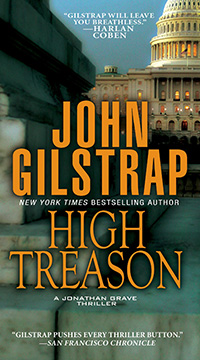
When the Contract Security Goes Official: HIGH TREASON, John Gilstrap
A few weeks ago the fourth Jonathan "Digger" Grave thriller by John Gilstrap went live, and the good news is, Gilstrap still isn't as well known as, say, Harlan Coben, Jeffrey Deaver, Joseph Finder, or Tess Gerritsen, all of whom have praised his books. Why is that good news? Simple: It means you'll be able to pick up HIGH TREASON in a first printing for a while longer. That's a huge plus for collectors -- although the minus for collectors is, the books only come out in paperback and e-form, not in hardcover. This would be a good moment to tell Gilstrap's publisher, Kensington's Pinnacle imprint, that it's time to put out harcover copies of all of these, and of any future Gilstrap titles.
Because this is a series worth collecting.
HIGH TREASON takes Jonathan and his supersized partner in hostage rescue, the Big Guy, a.k.a. Boxers, into an uneasy partnership with the FBI. The previous books have shown clearly why it's an advantage in hostage rescue to be unofficial -- even if well connected. But there isn't much choice: The hostage who's been kidnapped is the First Lady, and even if she and the President are known to be fighting with each other, the snatching can't be allowed. It's pressure on POTUS, the President of the United States, and Jonathan and Boxers are the best equipped to unearth the criminals, rescue the First Lady, and return national politics to what it should be. Irene, the FBI director better known to series fans as Wolverine, hopes to persuade them.
HIGH TREASON is a fast-paced thriller, and Gilstrap's writing is smooth and incisive. The working twosome of Jonathan and Boxers isn't just an action team, though; there are questions of who gets to make what kind of decisions, and how Jonathan in particular deals with the moral choices and consequent guilt. Gilstrap has managed these elements with care and skill since the first in the series, No Mercy, and he's moving to intriguing ground with them in HIGH TREASON.
Don't expect to get much else done while you're reading this one -- it's really hard to put down! You don't need to read the other three first, and the series is good in any order. Here's the author's website for more info and his other work: http://www.johngilstrap.com
Because this is a series worth collecting.
HIGH TREASON takes Jonathan and his supersized partner in hostage rescue, the Big Guy, a.k.a. Boxers, into an uneasy partnership with the FBI. The previous books have shown clearly why it's an advantage in hostage rescue to be unofficial -- even if well connected. But there isn't much choice: The hostage who's been kidnapped is the First Lady, and even if she and the President are known to be fighting with each other, the snatching can't be allowed. It's pressure on POTUS, the President of the United States, and Jonathan and Boxers are the best equipped to unearth the criminals, rescue the First Lady, and return national politics to what it should be. Irene, the FBI director better known to series fans as Wolverine, hopes to persuade them.
"Jesus," Jonathan turned to Irene. "And last time I checked, you have a few ambitious people working for you, too."Expect plenty of gunfire and explosives, as well as the high-stakes negotiating at which Jonathan and Boxers excel. But there are major surprises in store for the team, including what happens when they have to rely on hostages to take an active role in rescue -- plus the complications of the First Lady's past, and the risks for the team in going "official" for any activity at all.
Irene held up her hands. "Don't think I haven't offered."
"We can't risk it," Winters said. "The news is just too big. To do what we have to do would require the involvement of courts and other law enforcement agencies. There's just no way the secret wouldn't leak out."
"And the secret is more important than Mrs. Darmond's life?"
"Of course not," Winters scoffed.
"But kinda?" Jonathan prompted.
Winters set his jaw and took a loud, deep breath. "Are you willing to help us or not?"
HIGH TREASON is a fast-paced thriller, and Gilstrap's writing is smooth and incisive. The working twosome of Jonathan and Boxers isn't just an action team, though; there are questions of who gets to make what kind of decisions, and how Jonathan in particular deals with the moral choices and consequent guilt. Gilstrap has managed these elements with care and skill since the first in the series, No Mercy, and he's moving to intriguing ground with them in HIGH TREASON.
Don't expect to get much else done while you're reading this one -- it's really hard to put down! You don't need to read the other three first, and the series is good in any order. Here's the author's website for more info and his other work: http://www.johngilstrap.com
Labels:
FBI,
hostage rescue,
John Gilstrap,
Jonathan Grave,
mystery,
thriller
Friday, September 13, 2013
Quick Hurrah: Lee Child, NEVER GO BACK
If you're already a fan of Lee Child's Jack Reacher, you don't need to know more about book 18, NEVER GO BACK, except it's out, it's top notch, and what are you waiting for? If you've never dipped into the series, though, here's a quick summary: Jack Reacher is a former MP (military police) from the 110th MP unit, and in the most recent books of the series -- 61 Hours, Worth Dying For, and A Wanted Man -- he's been doing his best to get back to his former HQ in northeastern Virginia, out of curiosity: A woman officer there, reached by phone, has been his ally as he tries to stick up for underdogs, take a stand against brutality, and do so with his own curious blend of math, history, precision fighting moves, and fast car chases.
Yes, a Jack Reacher thriller is "testosterone candy" -- but it's also spiked with moments of warm connection and a liking for what makes humans worthwhile. Last details on NEVER GO BACK: Yes, Jack meets her, yes, she was worth the trip, and yes, it's a page turner. It was exactly the antidote I needed to a week of overwork. Here's hoping you feel the same.
Author website here, but it won't tell you a lot more: http://www.leechild.com/books/never-go-back -- it's a good adventure with a clean, just ending.
Hollywood Glamour, With Murder: Cheryl Crane, THE DEAD AND THE BEAUTIFUL
This is Cheryl Crane's third Nikki Harper mystery, and once again this Hollywood-raised author (she is Lana Turner's daughter) proves she knows how to braid chic, performer-style high life with a tightly paced amateur detection plot. Nikki Harper, a real estate salesperson (like the author!), knows how to flash "the smile" as needed in social and business moments, taught by her amazing mother, actress Victoria Bordeaux. But Nikki's not just a pretty face on a trim body dressed in classic fashion -- she's hard-working, determined, curious, and above all, loyal to her friends.
Which explains why Nikki tackles trying to prove that drably garbed Alison, the sister of one of her friends, shouldn't be a suspect when one of Alison's dog-owning clients is found dead. To untangle the half-truths and outright lies around her, Nikki delves into the show-business record of four actors who'd been Disney child stars ... and whose adult lives are still very, very close. Too close to be healthy, perhaps.
Crane's mysteries have become one of my annual treats, a reliable evening of entertainment spiced with wit, compassion, and courage in just the right doses. I'd love to have a BFF like Nikki (well, actually I have two, although they don't have her outfits). She balances "beautiful people" with smart ones, and when things get tough, she has the good sense to trust her mother's long experience for advice and insight. There's a lot of gentle and generous humor in Crane's murder mysteries, too. Take this conversation between Nikki and her mother Victoria, with Nikki asking her mom to help snag a pair of tickets to an appearance by the Dalai Lama (as a thank-you to a source), and hearing her mother's take on what the Buddhist leader is up to:
"His Holiness is busy ... doing whatever it is that a Lama does. ... He's reached enlightenment. He cant be reincarnated as a fly or a beetle."Quick action, Hollywood gossip, strong friendships, smart detecting, and oh yes, well-managed dogs and reliable friends and family -- what's not to like in a Cheryl Crane book? THE DEAD AND THE BEAUTIFUL was scheduled for September release but it wriggled out a big early, at the end of the summer. You don't need to read the other two Nikki Harper mysteries first (The Bad Always Die Twice and Imitation of Death), and I do think Crane is getting better with each book in a very satisfying way, but you still might want the others once you have this one. It's a series with a lot of fun in an upbeat, fresh, savvy way, and deserves to be well known. And it will make terrific holiday gifting, too.
Nikki couldn't resist a chuckle. "Mother, how do you know about Buddhist Lamas?"
"Well, Richard, of course."
"Richard?"
"Heavens, I don't remember his name. He was in that sweet film where Julia Roberts played the prostitute."
"Richard Gere?"
"That's him. ..." Victoria paused and then went on. "I'm not friends with the Dalai Lama, but I've met him. When I was in India, years ago. He was very kind. He had a pleasant smile. And he knew who I was ... though I can't imagine he would have seen any of my films," she mused.
Labels:
Cheryl Crane,
Hollywood,
mystery,
Nikki Harper
Quirky Debut Mystery Series, British: Anne Cleeland, MURDER IN THRALL
Anne Cleeland has three new books in publication in 2013, and I'm an ardent fan of MURDER IN THRALL, the first of a modern-day Scotland Yard series featuring two gifted detectives: Chief Inspector Michael Sinclair, whose reputation makes him a star on the force, and first-year detective Kathleen Doyle, dreading that her abrupt Irish ways and habits are likely to have her sent "back to CID headquarters to submit to yet another session of retraining in basic protocol."
Yet Doyle's strong intuitive skills make her a very good partner for the Chief Inspector, whose emotional life is far more straight-laced -- at least on the surface. As the book opens, the unlikely pair are tracking a possible informant in hopes of breaking open a murder case. Money laundering, a syndicate, Home Office involvement ... this case could make careers leap forward. "If she didn't get the sack, that was," Doyle reflects while trying to ignore her freezing toes.
The young detective's care and determination, her willingness to view taped footage, beg for forensics results, pursue interviews -- all these are in her favor. But there are quirks in the case right away: Someone's killing off witnesses before Doyle and Sinclair can reach them, and seems to have an eye on the investigation from way to close an angle. And it's clear from segments that Cleeland tucks into her chapter openings that there's a man who's obsessed with a woman involved in the case.
This book is so darned good, and the twists among investigators and case are so unexpected and delicious, that I've actually got to stop right there, for fear of giving away one of Cleeland's unexpected but wonderful maneuvers. So I'll just add: Scotland Yard, Irish heritage, class issues, male/female dynamics, and ... how can you tell the difference between the criminals and those who've wrapped their life around understanding their thinking?
Cleeland's series should be a winner in many ways; here's a chance to catch the first book and ride the wave with this strikingly good author (an attorney and court researcher from California) as she opens a partnership in crime-solving that will surely be both memorable and highly entertaining. AUthor website and sample here: http://annecleeland.com/murder-in-thrall
Labels:
Anne Cleeland,
British,
detective,
mystery,
Scotland Yard
Spanish Literary Mystery: THE INFATUATIONS, Javier Marías
Translations: Mystery readers suddenly have access to work from other languages, other cultures, and the passion for Scandinavian noir has pushed along the process for many other writers recently. THE INFATUATIONS from Javier Marías is one of thirteen novels from an accomplished author who chooses to write regularly for Madrid newspapers as well. And it begins with a death -- the death of a husband, in a couple that the narrator, María, has long admired from a distance as a "perfect couple."
But don't let that wave of suspicion make you expect a quick investigation of the death. María doesn't expect things to move quickly, and the author's long sentences, rich language, and massive paragraphs -- some more than two pages long! -- insist on a slow descent into knowledge and revelation.
Life conducts a slow and uncertain flirtation with María, and with the reader. Weeks in her life turn out to be stage preparation for a small detail that turns upside-down her view of the widow, Luisa; of the author for whom she labors in a literary agency; of her own life. Here is a taste of her observations:
So THE INFATUATIONS won't release anything in a hurry. But the steady tension and the book's deepening current of loss and revelation for María are engrossing. If you're a fan of Carlos Zafón's mysteries, this will fit well for you. But it's also a true descendant of Wilkie Collins, with a taste of that "other time." And puzzle solvers will appreciate the appearance of names and other wordplay that reveal the author's deliberate call for attention.
Other names raised with Marías are Nabokov, Faulkner, Joseph Conrad, J. D. Salinger. It's no accident that these are male, deceased, profoundly literary narrators of their time. Marías fits well in this company -- but with the piquant tilt toward murder in THE INFATUATIONS and, inescapably, to the dangers of naive love.
If you "have some Spanish," take a look at the author's blog for further revelation: http://javiermariasblog.wordpress.com
But don't let that wave of suspicion make you expect a quick investigation of the death. María doesn't expect things to move quickly, and the author's long sentences, rich language, and massive paragraphs -- some more than two pages long! -- insist on a slow descent into knowledge and revelation.
Life conducts a slow and uncertain flirtation with María, and with the reader. Weeks in her life turn out to be stage preparation for a small detail that turns upside-down her view of the widow, Luisa; of the author for whom she labors in a literary agency; of her own life. Here is a taste of her observations:
I noticed that Díaz-Varela had suddenly gone very silent and serious, and for precisely the same reason that Luisa had taken three steps toward the sofa and sat down on it before even inviting the two men to do so, as if her legs had given way beneath her and she could no longer remain standing. She had gone from the spontaneous laughter of a moment before to an expression of grief, her gaze clouded and her skin pale. Yes, she must have been a very simple mechanism. She raised her hand to her forehead and lowered her eyes, and I feared that she might cry.That's actually from one of the more quickly moving scenes.
So THE INFATUATIONS won't release anything in a hurry. But the steady tension and the book's deepening current of loss and revelation for María are engrossing. If you're a fan of Carlos Zafón's mysteries, this will fit well for you. But it's also a true descendant of Wilkie Collins, with a taste of that "other time." And puzzle solvers will appreciate the appearance of names and other wordplay that reveal the author's deliberate call for attention.
Other names raised with Marías are Nabokov, Faulkner, Joseph Conrad, J. D. Salinger. It's no accident that these are male, deceased, profoundly literary narrators of their time. Marías fits well in this company -- but with the piquant tilt toward murder in THE INFATUATIONS and, inescapably, to the dangers of naive love.
If you "have some Spanish," take a look at the author's blog for further revelation: http://javiermariasblog.wordpress.com
Tuesday, September 03, 2013
THE HARD BOUNCE, Todd Robinson: Who Says Scandinavians Write Them Darker?
You don't have to live in a land where the midnight sun appears at one end of the year, and a full day of darkness at the other end, to write grim and gritty crime fiction. In fact, American writers and screenwriters have done it for decades -- think Andrew Vachss, and Psycho. But maybe the feast of Swedish, Danish, and Finnish translations has been so awesome that we've forgotten to check the local versions surfacing.
Now that THE HARD BOUNCE by (American) Todd Robinson is in print (thanks to Tyrus Books), that shouldn't be a problem.
Robinson's nickname in his editing role has been Big Daddy Thug, and he invented the label Thuglit -- fiction where the protagonist has grown up fighting for life and is way too familiar with the various forms of abuse. (Also see Thuglit.com, his publishing venture.) Has even inflicted quite a few of them, when angry. And since anger is a totally rational reaction to other people crashing through one's personal boundaries, thuglit folks tend to have anger issues ... well, no, actually, rage issues. Dave Zeltserman's crime novels, based in an eerie level of connection with the Whitey Bulger mentality, catch this tendency perfectly.
Todd Robinson provides another twist to this darkness in THE HARD BOUNCE with Boo Malone -- that's Boo as in Radley, not Caspar -- whose friendship with Junior, forged under attack at the vicious Saint Gabriel's Home for Boys, is his only obvious redeeming feature. But Robinson rolls Boo Malone over to show his soft spot: a desperate desire to find and save his long-lost little sister. When Boo and Junior agree to search for a missing girl, Cassandra, there's a tragic and poignant drive involved. No matter how violent they are, these two "thugs" have a fragment inside that's still a sobbing child, and the search for Cassandra activates that fragment.
Not that Boo makes it easy on anyone -- his first reaction to the woman trying to hire him is:
THE HARD BOUNCE takes a grim route into why crime is so ugly. But it also has a steady strand of human decency underneath, and the small triumphs along the way gleam like stars on a velvet sky. I ended up really, really liking this book. In fact, I'm even looking forward to the next one, from Big Daddy Thug. (Just don't bring those guys into my village, okay?)
Curious about the author? I like this interview; check it out.
Now that THE HARD BOUNCE by (American) Todd Robinson is in print (thanks to Tyrus Books), that shouldn't be a problem.
Robinson's nickname in his editing role has been Big Daddy Thug, and he invented the label Thuglit -- fiction where the protagonist has grown up fighting for life and is way too familiar with the various forms of abuse. (Also see Thuglit.com, his publishing venture.) Has even inflicted quite a few of them, when angry. And since anger is a totally rational reaction to other people crashing through one's personal boundaries, thuglit folks tend to have anger issues ... well, no, actually, rage issues. Dave Zeltserman's crime novels, based in an eerie level of connection with the Whitey Bulger mentality, catch this tendency perfectly.
Todd Robinson provides another twist to this darkness in THE HARD BOUNCE with Boo Malone -- that's Boo as in Radley, not Caspar -- whose friendship with Junior, forged under attack at the vicious Saint Gabriel's Home for Boys, is his only obvious redeeming feature. But Robinson rolls Boo Malone over to show his soft spot: a desperate desire to find and save his long-lost little sister. When Boo and Junior agree to search for a missing girl, Cassandra, there's a tragic and poignant drive involved. No matter how violent they are, these two "thugs" have a fragment inside that's still a sobbing child, and the search for Cassandra activates that fragment.
Not that Boo makes it easy on anyone -- his first reaction to the woman trying to hire him is:
"Let me explain something to you, Kel. I don't know whether you've seen too many spy movies or just have a hard-on for old noir, but I don't work for phantoms and this cloak and dagger bullshit you're feeding me is going right up my a**. So you can cut the sh** and talk to me straight or you can go p*ss up a rope." I stood from the table, ready to walk. It was partly my sh**b*lls of an afternoon and another part poorly repressed class rage. Either way, it felt good to let her have it."Class rage"? Yes, Boo is smart and self-educated and literary. But you definitely don't want to cross him when he's having a bad day. (Sorry about the asterisks, but you know how it is.)
THE HARD BOUNCE takes a grim route into why crime is so ugly. But it also has a steady strand of human decency underneath, and the small triumphs along the way gleam like stars on a velvet sky. I ended up really, really liking this book. In fact, I'm even looking forward to the next one, from Big Daddy Thug. (Just don't bring those guys into my village, okay?)
Curious about the author? I like this interview; check it out.
Labels:
American,
crime fiction,
noir,
Thuglit,
Todd Robinson,
Tyrus Books
Monday, September 02, 2013
Vet School Mystery: AN ANIMAL LIFE by Howard Krum
Last month's "Bookstock" festival in Woodstock, Vermont, brought an unusual new book to me: AN ANIMAL LIFE: THE BEGINNING, first in a series from three veterinarians (and illustrated by a fourth). Described by the authors -- Howard Krum with Roy Yanong and Scott Moore, plus art by Patty Hogan -- as "a scientific medical mystery (animals and people are dying)," the book is far from a traditional who-dun-it. There is no sleuthing plot to speak of, there are few clues, and the focal point of the story isn't really the hunt for what's causing the deaths (a real discovery, by the way, from the late 1980s).
And there is definitely a taste of "first book" here, plus some structural issues betray the team aspect of authorship. The first few chapters wobble, and the pace has issues.
The good news, though, is that this book is so much fun, and so much a period piece -- an updated version of Zen and the Art of Motorcycle Maintenance crossed with Mash and taken into veterinary school -- that I never did put the book down for much longer than it took to get a fresh glass of iced tea.
THE ANIMAL LIFE opens with two aspects of vet life: first-year vet college featuring cop-turned-animal-intern Jack Doyle and courageous Anna Heywood, who's battling Lou Gehrig's disease, complete with therapy dog; and the political pressures on a prominent zoo vet, Dr. Violet Marie Green, who might seem to have it all but is being blackmailed and bribed simultaneously (the closest the book comes to expected mystery terrain). With a couple of romances in blossom, entertaining dynamics among various types of students and their more advanced peers, and entirely endearing interactions with horses, dogs, and more, the book provides a delicious jumble of entertaining scenes, quickly spilled forward over a school year.
And the authors' attitude toward their storytelling is captured at the start with this short insert:
Don't shelve it with mysteries, though. Put it on the shelf of rollicking fun in college form, and let your friends know it's there.
And there is definitely a taste of "first book" here, plus some structural issues betray the team aspect of authorship. The first few chapters wobble, and the pace has issues.
The good news, though, is that this book is so much fun, and so much a period piece -- an updated version of Zen and the Art of Motorcycle Maintenance crossed with Mash and taken into veterinary school -- that I never did put the book down for much longer than it took to get a fresh glass of iced tea.
THE ANIMAL LIFE opens with two aspects of vet life: first-year vet college featuring cop-turned-animal-intern Jack Doyle and courageous Anna Heywood, who's battling Lou Gehrig's disease, complete with therapy dog; and the political pressures on a prominent zoo vet, Dr. Violet Marie Green, who might seem to have it all but is being blackmailed and bribed simultaneously (the closest the book comes to expected mystery terrain). With a couple of romances in blossom, entertaining dynamics among various types of students and their more advanced peers, and entirely endearing interactions with horses, dogs, and more, the book provides a delicious jumble of entertaining scenes, quickly spilled forward over a school year.
And the authors' attitude toward their storytelling is captured at the start with this short insert:
People ask: "So what's this book about?"If you've ever dreamed of becoming a vet (I did, for years), or know someone who has (you'll want to give them a copy), or believe in treasuring the first efforts of promising authors who like to set up amusing moments in print -- zip over to the website AnAnimalLife.com and pick up a copy. You may also find the book at stores in or near Windsor, Vermont, where it's published.
We usually reply: "It's about 300 pages. . ."
Also, it's about life, death, and finding your place in this world. And veterinary medicine. But that's it, just those three things: a medical mystery, finding Love, and becoming a veterinarian. Promise.
Don't shelve it with mysteries, though. Put it on the shelf of rollicking fun in college form, and let your friends know it's there.
Labels:
animals,
medical mystery,
Vermont,
veterinarians
Armand Gamache #9: HOW THE LIGHT GETS IN, Louise Penny
Canadian author Louise Penny has pleaded with readers: Don't reveal too much about this book to others. A lot of threads are being woven, snipped, accentuated, resolved ... leave it to the next reader to discover all the complexity of this ninth in her amazing and compelling Chief Inspector Gamache mystery.
So here's a bit of Q&A instead:
1. Does the book take Gamache back to the Canadian Eastern Townships village of Three Pines, with its eccentric residents and its isolation from the rest of the world? Yes, absolutely -- although Gamache makes more trips back to the Sureté office than he's ever done before, revealing a new talent for rapidly driving himself to locations where he can follow up possible clues to what's rotten in his investigative organizaton.
2. Are there major roles for wild but insecure artist Clara Morrow and her husband Peter? One yes, one no. But Olivier and Gabri deliver both comfort and decisive action. And crazy poet Ruth Zardo abuses them all wonderfully with her acerbic tongue and her twisted sense of humor.
3. Is there a new set of characters that's important? Well, the non-Three-Pines investigation that leads off the story relates to the death of the last of a set of famous quintuplets -- yes, Penny had the Dionne quints in mind at first, but invented the rest (see her note at the end of the book) -- and Penny's portrayal of late-life Constance Pineault and her moment of self-discovery in Three Pines is poignant and memorable. I ended up wanting to visit Constance's grave (pinch, pinch -- these people are NOT real, hard to believe when they are portrayed with such nuance).
4. Do you need to read the other books by Penny before starting this one? For the first time ever, I'm answering YES. You don't actually have to read all eight of the preceding books, but at least start with The Brutal Telling (number 5) and work forward from there. Otherwise you won't appreciate the many forms of heroic choice taking place in the book.
5. (The question asked by all Louise Penny mystery addicts) Will there be more? Oh, you know this answer -- the author has repeatedly said she doesn't ever picture stopping the series! She has a great website and regular monthly newsletters (http://www.louisepenny.com), well worth reading. Plus, I saw at least two major threads here that insist on another book. So, no matter what you think you're seeing for Gamache, have faith -- I am quite sure there are more to come, and knowing Penny's work pattern, I'm also sure she's working on the next. But I refuse to speculate on who will be doing what, where!
So clear a couple of days on the calendar, pick up a copy of HOW THE LIGHT GETS IN, and satisfy your curiosity, as well as that very human hunger to see how "real" people work their way through terrifying problems and whether happiness can be retrieved after disasters.
Oh, the title? It's from a Leonard Cohen song, "Anthem." Read it all, here. You'll have a better idea of where Armand Gamache is going ... and why.
Labels:
Armand Gamache,
Canadian,
Louise Penny,
mystery
Wednesday, August 28, 2013
Delicious French Mystery Series: Bruno #5, THE DEVIL'S CAVE by Martin Walker
A delightful French mystery series came my way this summer, and I'm only sorry that I discovered it so late -- the "Bruno, Chief of Police" books by Martin Walker are already in the fifth title in the U.S., as THE DEVIL'S CAVE was released here in July. Title number 6, The Resistance Man, is already published in Europe and will reach the States in February 2014.
Bruno Courrèges may reside in rural France, but his passions are as sophisticated as any in Paris -- he cooks (the descriptions make my mouth water), enjoys the company of intelligent women (and makes love with them), and also savors building his own house, as well as hunting. Bruno's "St. Denis" is located in the Dordogne in southwestern France, and both tourism and sport center on its river.
But in THE DEVIL'S CAVE, the two significant features of the region are its potential for upscale lodgings, and its potential for increased tourism at the local attraction known at the Devil's Cave, where pedal boats, a café, and a souvenir shop await visitors. "Smaller chambers led off from the main space, and the eerie formations of stalagmites and stalactites had been carefully lit to justify the rather-fanciful names thay had been given, such as Our Lady's Chapel ... or Napoléon's Bedchamber."
Now, unfortunately, a dead woman found floating down the river in the heart of town -- naked -- appears to be linked to Satanism in the town, perhaps in a chamber of the cavern. As Chief of Police, Bruno investigates the possibilities, while simultaneously coping with an apparent case of spouse and child battering; a possible entry of prostitution in an element of the new tourism; emerging aspects of the murder that may have links to the past (this is France; the German occupation and the mistresses of past kings seem to have equal significance in affecting the present).
I enjoyed Bruno's steady and determined investigation, but equally enjoyed the diversions of his life: at least two women who want to spend time with him, and his tendency to cook for any guest, male or female, in his home. (They also prepare feasts for him.) Even the smallest menu item attracts a culinary complexity that American mysteries -- other than those featuring the great Nero Wolfe -- seldom indulge. As the case begins to crack open and the charges in front of the procureur are prepared, Bruno juggles phone calls and replicates a black-market-prepared dish from the war years:
Bruno rang J-J's mobile to alert him but had to leave a message. He'd wait for Fabiola's next call before informing the procureur. He finished the potatoes, peeled some shallots, set the table for two and lit the fire. Back in the kitchen, he opened a can of beer, drank half of it and then used an opener to punch some more holes in the top of the beer can. He took a large chunk of butter and began working it with a knife and mixing in the chopped garlic. He added some fresh rosemary from the garden and then began pushing the buttery mixture under the skin of the chicken as far as he could reach ... Gilles would arrive soon.
Martin Walker, himself a half-time resident of the Dordogne and a think-tank senior director, vacillates a bit in how intimate he allows the reader to become with this police investigator, whose kitchen-friendly ways are coupled with athleticism and a strong attraction for and attractiveness to women. While I found myself very familiar with Bruno's cuisine, I was less certain of how he'd respond to the stresses of the investigation, including to what extent he'd resist the political pressure. After all, a murder case isn't good for tourism! Nor is it politically wise to threaten to shut down a new architectural project that includes a sports hall for the region.
I haven't read any of the others in this series, and I will soon do so, to get a better feel for Bruno. Meanwhile, the website of this unusual author provides both a personal blog and insight into both the kitchen and the (wine) cellar of the Chief of Police: http://www.brunochiefofpolice.com.
Fans of Donna Leon's Venice mysteries will find similarities here. I recommend adding Martin Walker's mysteries to the shelf of internationals that may be growing into a full--size bookcase or even a wall, depending on how you're pursuing them. When the power of dark Scandinavian crime fiction makes you yearn afterward for a hint of fresh sunlight and easy loving mixed into your crime reading, Bruno, Chief of Police, will fit the bill.
NOTE: Interested in more insight about the author? I like the interview with Martin Walker provided here.
Labels:
Bruno,
caves,
Chief of Police,
France,
Martin Walker,
mystery,
the Dordogne
BLIND GODDESS: New Billy Boyle WW II Mystery from James Benn
I marvel at each new Billy Boyle World War II mystery from James R. Benn: We all know how the war ends, and we recall some of the prominent moments along the way -- yet Benn provides enormous suspense within each of his mysteries, by delving into the details of life at the front and behind the scenes.
A BLIND GODDESS opens in March 1944, with an estranged friend of Billy's, Tree (nicknamed for his height), uneasily asking for a hand in England as the troops gather for the promised upcoming invasion of France. Sergeant Eugene "Tree" Jackson doesn't want to ask Billy Boyle for anything; their friendship, back in Boston, ended very badly, tilted by Tree's black skin and Billy's Irish connections. But there's been a dire miscarriage of justice in the rural town where the Black forces are waiting for their part in the invasion, and the victim is the gunner for Tree's Tank Destroyer Battalion, and the unit needs him back right away, before the orders for Europe arrive.
This eighth in the series digs into race relations at mid century, plainly and boldly. Negro units in the American forces experienced the bite of segregation, name-calling, and abuse even as they prepared to give their lives with their White compatriots. In fact, at the opening of A BLIND GODDESS, White Americans have just smashed every barroom drinking glass in the town, as they prepare to take over where the Black ones have recently been served -- "So they wouldn't have to drink from the same glasses as Negros had," Billy immediately perceives.
Billy's close partner in his investigations -- which he does for his vaguely related "uncle" General Eisenhower -- is Kaz, a Polish officer, Lieutenant Kazimierz, and as the Americans explain the particulars, Kaz is moved to comment (just in time to keep the "frenemies" from more friction):
A side track that will interest those already following the series involves Billy's long-time girlfriend, Diana Seaton, in her struggle to get British politicians to acknowledge the factory-style killings in the concentration camps in Germany, so that urgent action can be taken. But there's no need to have read any of the preceding seven books -- this one stands well for itself, and I'm looking forward to a second reading, still marveling at how clearly Benn has used his mystery plot to point to the largest miscarriage of justice Americans have experienced: that of the color line.
A BLIND GODDESS moves at intense pace to a highly satisfying ending -- with one thread still dangling, and a strong suggestion that the next book in the series will be back on the European continent, in the action of the trenches and the invasion. I can hardly wait!
NOTE: Publication release of A BLIND GODDESS is scheduled for Sept. 3.
A BLIND GODDESS opens in March 1944, with an estranged friend of Billy's, Tree (nicknamed for his height), uneasily asking for a hand in England as the troops gather for the promised upcoming invasion of France. Sergeant Eugene "Tree" Jackson doesn't want to ask Billy Boyle for anything; their friendship, back in Boston, ended very badly, tilted by Tree's black skin and Billy's Irish connections. But there's been a dire miscarriage of justice in the rural town where the Black forces are waiting for their part in the invasion, and the victim is the gunner for Tree's Tank Destroyer Battalion, and the unit needs him back right away, before the orders for Europe arrive.
This eighth in the series digs into race relations at mid century, plainly and boldly. Negro units in the American forces experienced the bite of segregation, name-calling, and abuse even as they prepared to give their lives with their White compatriots. In fact, at the opening of A BLIND GODDESS, White Americans have just smashed every barroom drinking glass in the town, as they prepare to take over where the Black ones have recently been served -- "So they wouldn't have to drink from the same glasses as Negros had," Billy immediately perceives.
Billy's close partner in his investigations -- which he does for his vaguely related "uncle" General Eisenhower -- is Kaz, a Polish officer, Lieutenant Kazimierz, and as the Americans explain the particulars, Kaz is moved to comment (just in time to keep the "frenemies" from more friction):
"It is interesting, you know," Kaz said, in a casual conversational tone. "The Germans have the same rule in Poland. Poles have to stand aside when any German walks by, upon pain of death."Because Tree's request is an unofficial one, Billy can't put official time into looking for the real criminal to replace Tree's gunner in prison. Moreover, Billy's direct superior, Major Cosgrove, wants him to tackle a new case of murder where an American soldier is involved, and where there's some hidden reason to treat all investigation very carefully. Soon he's enmeshed in what looks like a German/English politically charged tangle of possible espionage, murder, and threats -- while trying to clear up the racist coverup that's snagged Tree and his men.
"Yeah, but there's one big difference," Tree said. "I'm going over there to kill those god-damn Nazis who make you step off the sidewalk. But when I go home, white men will still want me in the gutter."
A side track that will interest those already following the series involves Billy's long-time girlfriend, Diana Seaton, in her struggle to get British politicians to acknowledge the factory-style killings in the concentration camps in Germany, so that urgent action can be taken. But there's no need to have read any of the preceding seven books -- this one stands well for itself, and I'm looking forward to a second reading, still marveling at how clearly Benn has used his mystery plot to point to the largest miscarriage of justice Americans have experienced: that of the color line.
A BLIND GODDESS moves at intense pace to a highly satisfying ending -- with one thread still dangling, and a strong suggestion that the next book in the series will be back on the European continent, in the action of the trenches and the invasion. I can hardly wait!
NOTE: Publication release of A BLIND GODDESS is scheduled for Sept. 3.
Labels:
Billy Boyle,
James R. Benn,
mystery,
World War II
YA Mysteries Worth Reading from Michelle Gagnon and Jacqueline Mitchard
With a stack of standard mysteries here to review over the next week, I'm moving the two compelling "young adult" (YA) titles to one of my other blogs -- bethkanell.blogspot.com -- because I want to probe their relationship to teen readers, and it fits better "over there." Watch for them this evening: STRANGELETS from Michelle Gagnon, and WHAT WE SAW AT NIGHT from Jacquelyn Mitchard.
Labels:
Jacquelyn Mitchard,
Michelle Gagnon,
mysteries,
young adult
Subscribe to:
Posts (Atom)