Showing posts with label John Le Carré. Show all posts

Saturday, September 09, 2017

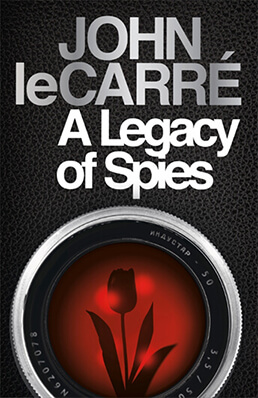
Brief Mention, John Le Carré, A LEGACY OF SPIES

British cover
Lovers of British espionage know about each new John Le Carré book long before publication. So this brief note, a few days after the American release of the newest from this master of character-focused revelation, is more or less a bookmark ... and a reminder that if you're a fan of the genre or this author, it's time to pick up your first printing.

Word on A LEGACY OF SPIES before publication tended to focus on either the "follows The Spy Who Came in from the Cold" or the presence as main protagonist of Peter Guillam, long-time loyal team member for British chief of the global espionage network George Smiley. Smiley's position as reluctant but ever-caring planner of spy take-downs and infiltrations has been so large in Le Carré's work that one of the titles in the series is Smiley's People. It is, in fact, George Smiley's grasp of human love and beliefs that makes him such an expert in planning operations. But that same affection and respect for the people he maneuvers makes George vulnerable and wounded, in ways that compel affection from his staff members -- and from many a reader.

In fact, A LEGACY OF SPIES is both a follow-up to the tragedy of Alec Leamas, and an exploration of Guillam's position in retirement, which he spends -- when possible -- on his family's old farmland in French Brittany. Most of all, it's a probing test of how Guillam functions without Smiley's presence. Has he been deserted, left alone to face accusations about Leamas's long-ago betrayal and death, and possibly a high-stakes trial? How does he judge his own actions of the past -- which include many a liaison of the heart?

US cover
Le Carré engages in a book-long probe of the family dynamics of his extended spy network, testing and revisiting its connections and emotional costs. Much of the first part of the book is slow going, especially because it's framed in Peter Guillam's first-person voice, which doesn't work quite as well as the haunting third-person novels earlier in this oeuvre. But for any fan of George Smiley's fictional life and career, the book is a must-read ... with the added reward of some final words on where "England" was and is, and a little bit of grounding for today's British choices. At least, as far as these characters may see.

Worth the time spent reading it, and worth keeping on the shelf.

PS:  Looking for more mystery reviews, from cozy to very dark? Browse the Kingdom Books mysteries review blog here.

Saturday, March 14, 2015

From Espionage to Literature (or Vice Versa): Olen Steinhauer, ALL THE OLD KNIVES

Olen Steinhauer's espionage books have made him one of my favorite writers, as his "Tourist" series forges a significant exploration of what it is to feel deeply human emotions (i.e., not be a sociopath) while tackling a job that requires lies, performance, and edgy loyalties. I recommend his books to all who've enjoyed books by John Le Carré, Alan Furst, Charles Cumming, Charles McCarry, and more.

The newest Steinhauer is more of a novella, and closer to Graham Greene than to these others. And the author provides warning of this direction in his front-of-the-book acknowledgments, which explain its genesis: The author watched a gripping dramatization of a Christopher Reid poem turned play (see the poem here: http://cbeditions.com/userfiles/file/reid-the-song-of-lunch.pdf), about two once-were-lovers meeting for lunch, carrying with them their pasts and the division that has made them "old flames." Steinhauer then challenged himself to "write an espionage tale that took place entirely around a restaurant table."

The result does diverge from the tabletop a bit -- to the height of Henry and Celia's romance when they both worked for the CIA in Vienna, Austria, and the dramatic hostage event that each relives daily (or at least in dreams, nightmares). But the heart of ALL THE OLD KNIVES is this: They are about to meet, after five years of not seeing each other, and their conversation is to take place at a California seaside restaurant. (I'm not sure whether there's a traditional expression about old knives for the title -- I don't know one and didn't find one -- but the New York Times review of the book refers to Celia sticking verbal "needles" into Henry, and surely there's a sense of a thousand cuts here.)  Each agent arrives on scene with a different version of that hostage event in mind, and with different motives and deceptions.

If you're looking for the usual espionage plot (secrets hunted, secrets revealed, lives at stake, dark-and-stormy-night chases, some success and some bitterness), pass over this one and go back to the series. But to probe the agony and costs of being a field agent and government operative, as well as the inhumanity of government manipulations, ALL THE OLD KNIVES can be your book of the week -- or year.


At the heart of the conflict: Celia fails to grasp Henry's depths as an agent runner. And Henry never understood Celia-the-person or the relationship they almost carried forward. Layers of revelation peel away with each turn of the pages. John Le Carré has shown us how, as individuals, we are chewed up by international power struggles and forced to confront their inherent corruption while we struggle for integrity. Olen Steinhauer shows instead how the global can be decomposed, such that even the "big events" turn out to be formed by individuals and their passions, their attempts to love, and their points of fracture.


Sunday, July 27, 2014

New Nonfiction on Spy Kim Philby: Two Lively Reviews and an Interview

The espionage novels of John Le Carré, for me, are more than classic spy fiction -- they are the material I go to repeatedly when I want to analyze for myself how a gifted storyteller can deepen a sentence or passage, open a character, revel in rich description without slowing the action.

So I listened eagerly to this morning's National Public Radio interview with author Ben Macintyre, whose new book is A SPY AMONG FRIENDS: KIM PHILBY AND THE GREAT BETRAYAL. And it's a sign of how fiction can become part of us that I thought, "Amazing! The way Macintyre described him, Kim Philby was enormously like Le Carré's character Bill Haydon!"

And that's almost exactly backwards. Le Carré built Bill Haydon, nemesis of his loyal British spymaster George Smiley, after considerable research into Kim Philby. Tinker Tailor Soldier Spy (1974) was the result, ten years after the end of Philby's espionage career.

The review of A SPY AMONG FRIENDS in today's New York Times book review section uses a quote from Le Carré at the end of the review, in a very satisfying way. In fact, the novelist adds an afterword to Macintyre's new book, sharing notes from his 1986 interview with Nicholas Elliot, a fellow spy (loyal in this case to the British) who hero-worshipped Kim Philby until Philby's shocking life as a double agent, working for the Soviets, was revealed.

What makes Macintyre's book especially appealing to me is his willingness to dive into Philby's psychology -- as well as Macintyre's established record of portraying the English with nine previous books that unearth and vividly capture betrayal and crime among the "well-dresssed British men in danger" (Boston Globe reviewer Matthew Price's phrase).

For a delicious set of view of the book, check out today's review and the interview (which will be available as an audio file after noon today). As NY Times reviewer Walter Isaacson wrote, "I had to keep reminding myself that it was not a novel." This book will be a great treat for fans of espionage fiction, and for those who love a classic British mystery.

The New York Times review is here.

The Boston Globe review is here.

And for the NPR review, click here.