Wednesday, June 09, 2010

Letters to/from Home: W. S. Merwin, PRESENT COMPANY

In a pond or small lake, you can let your boat drift -- the ripples are small, the currents gentle, and a breath of wind moves you idly across the bay toward waterlilies or along the nesting grounds of families of ducks or geese. It's the essence of a summer dream, and I recall being desperate to escape my younger siblings so that I could take the rowboat out on Lake Gerard and just linger in this way, without their eagerly splashing oars.

There are still such places within literature, especially within the poetry of established authors. And they are rich with image, with thought, with the scented wine of long mulling. For today, let the rivers of change wait for us -- W. S. Merwin's 2005 collection, PRESENT COMPANY, flutters its ribbons of poems in the soft breeze.

Each title in this collection begins with "To" and Merwin even allows a bit of humor with one title, "To ---." But for the most part these are thick, resonant ribbons of meditative discourse, of assertion from the pinnacle. And though the first entry is "To This May," the second asserts the terrain: "To the Soul":
Is anyone there
if so
are you real
There is no answer embedded in the rest of the poem, only a wave of the hand in dismissal even of the large question. And this is significant, because it is the smaller questions and notes, the niggling ones, that erupt in detail here. "To the Face in the Mirror" speaks to "you" -- "you with the white hair / now who still surprise me /day after day / staring back at me /out of nowhere."

This ribbon of aging, of surprised discovery, threads through the collection. I like "To the Grass of Autumn," where:
now you are as the fog
that sifts among you
gray in the chill daybreak
the voles scratch the dry earth
around your roots
hoping to find something
before winter
and when the white air stirs
you whisper to yourselves
without expectation
or the need to know.
For those of us marveling at what time has done, is doing, here is a poet and set of poems, rarely formal but always as measured as a long stride, to capture the colors and chills, the soft and hard, of these years. 

Of course, it's tempting to pick up a "new and selected" of Merwin's work, but this is a volume I'd recommend in its fullness -- all 100+ missives out to the universe and in to the heart.

Tuesday, June 08, 2010

World Universe Poetry Tour: Sam Taylor, Tung-Hui Hu, and Khaled Mattawa

One of the pleasures of poetry, unlike, say, the latest topical novel or political treatise, is that there's no "expiration date." Here are three slender volumes, not newest but delicious, that make up a world tour, without leaving the back porch.

1. BODY OF THE WORLD by Sam Taylor

Here's a debut collection from a poet whose East Coast beginnings and Texas/New Mexico existence are nearly invisible, as he probes love, strangers, and the resonance of form and line. Consider this portion of the poem "Arc":
And soon
you have forgotten that the world is new.

And in the middle, you will be a two piece suit
between traffic signals,
but in the end, the underside of ambrosia
and the breath of green tea.
In the middle, women will come to you naked

with hair clips given to them by their grandmothers,
a sari from the Indian coast,
a limp from when they fell running through the park.
2. MINE by Tung-Hui Hu

This 2007 collection won the Eisner Prize and is blurbed by Mark Doty; Hu lives in San Francisco and had an earlier career as a computer scientist working on Internet architecture. The poems tremble on the edge between blocks of free verse and chunks of prose, and they swirl above a sense of "where" to sample instead the sense of coming to know life and love. Here is the first portion of "On Power Outages":
Knowing someone by touch is like being able to move around a dark city without power or signs. And even when it is easy to move around it is always awful to be inside. One man proposed during the blackout, it was reported on the news. Another is inside, sitting quietly -- everybody can hear him thinking to himself, trying not to move, waiting for the morning to rise.
3. ZODIAC OF ECHOES by Khaled Mattawa

Dreams and not dreams, home and distance, the South and also North Africa: Mattawa's second collection also follows his translation of three volumes of Arabic poetry. Born in Libya, he arrived in the United States in his teens. I like especially when his poems dip into his childhood, as in "Home Front," which concludes:
Aisha's baby will not sleep
and I am a monkey and I am good.
A cat meows. Ibrahim barks.
Who did the zebra bray?
Please trumpet like an elephant.
Please, please the owl's hoot.
And to satisfy that longing for a journey, here is the start of "Echo & Elixir 7":
The stories you believe are the stories you make.

So one enters a room alone.
People there and they see the dust
and they hear the echo of travel.

They remember distances and songs,
they read a script that befuddles the page:
trains, airports, short-term leases,

hawkers and dingy bars.
Last and perhaps best, surely most amazing in this volume, is the long "Dark Anthem" that concludes it. I quote here just one triplet of lines, one sequence that rings in me tonight: "my fingers loose but firm, / picking the air's locks, / unchaining a miracle from the dark."

Compare and Contrast: Poet Chase Twichell, DOG LANGUAGE and HORSES WHERE THE ANSWERS SHOULD HAVE BEEN

Poetry in translation is one of the "hot" topics for conferences and anthologies now. But it's always been a great route for exploring words and structure: taking something in another language and trying to draw it home, or expressing lines with a tongue that's not rooted in childhood but rather in passion for the differences and dreams of another language.

For Chase Twichell, long-time publisher of Ausable and now an editor at Copper Canyon, the publication of DOG LANGUAGE in 2005 plumbed not the woofs and barks of her four-legged companions, but more the sense of herself as she ran with them or considered them from the poignant distance of friendship across species. In the opening poem, "Skeleton," her dogs dig in the snow for relics of what once was -- and the poem expands in a final stanza:
I asked Truth what to worship,
and Truth said Death,
looking up from licking
the caviar of moments
from Death's hand.
So here are the bones
in the exploded view,
pelvis and vertebrae,
thrown dice of hands.
Look at the skull.
I'm its voice.
Ah! Not only are we translating each other's languages, but the poet can become the voice of the skull. Twichell follows up on this promise with "Sorry" as she details the sensations of using both hands to break the skeleton of a trout; and with "Auld Lang Syne," when the grown-ups at the gathering rise from their cocktail-blurred selves to remove porcupine quills from a dog:
They use pliers, and afterward
the dog wags in apology
and the drinking resumes.
Twichell explores childhood and drug use and especially the distance a child is from a parent, naming the hesitant touch "animal caution" as she reaches toward stones "marking the summit of one of my parents." I like particularly the poem "Dog Biscuits" that tongues the gap in the inner teeth left by the loss of a father to death, ending:
It'll be just us, the three inheritors,
on a raw windy day in Death's kingdom,
lifting our eyes from the hole
to the mountains hazed with sping,
saying, In perpetuum ave atque vale,
minor god of our father.
Let's each of us drop a few
dog biscuits into his grave.
This year, a new collection from Twichell gathers selections from this and four other earlier collections, in HORSES WHERE THE ANSWERS SHOULD HAVE BEEN (Copper Canyon, 2010). These poems reach back to 1981, well before her marriage to novelist Russell Banks. And they extend to fresh animal forms: horse, mule, pony, centaur.  From "The Long Bony Faces of the Mules":
I knew nothing of the fences words make
in the mind, or that I would devote
the first half of my life to building them
and the second half to tearing them down.
Twichell tongues her Zen Buddhist practice in the final poems, sampling silence while speaking, so to speak. She tests the nature of meditation, concluding, "I must not want to be fully enlightened, / since I do not devote myself entirely to it. / I like distraction."

And at last she takes us back to her animal languages, as she writes in "From a Distance,"
Of all the selves I've invented,
the ones most fixed in memory
are the horse-child startling
the dog-child sniffing the still-warm ashes
where the smell of food has almost been erased.
And with the gentle sombre probing that is more and more present in her work, she wraps up this poem with: "Death will come / and take me to them, and a new self will begin / to ask these questions as if for the first time."

If this is what the second half of Twichell's poetry will continue to bring to us, as it "tears down" the fences of words, then another answered question becomes: What can the second half of life bring, besides the inevitable loss of aging pets, loss of friends, loss of parents? And the answer is: Grace.

Poetry Worth Reading, Now in Softcover: James Richardson, INTERGLACIAL; Adrian Blevins, THE BRASS GIRL BROUHAHA


Summer has arrived (in spite of some wild weather here in Vermont); the strawberries are ripening, the birds feed nestlings, thunderstorms erupt in glory.

And because these two striking collections are now available in softcover, they're ideal for taking to the beach or up the mountain:

INTERGLACIAL by James Richardson is subtitled "New and Selected Poems & Aphorisms." The hardcover came out in 2004 through Ausable, now part of Copper Canyon Press.  Selections from five earlier books by this award-winning Princeton poet range from narrative work like "In Touch" -- burying a cat-killed bird and digging toward death -- toward the rhymes and rhythms of "A Measure," which opens with:
Now that my hands are full, the world, anyway, on the fly,
and there is not time enough even to know what I know,
I take the heft of things by eye.
Richardson opens an "us" that extends well beyond the persona of the poem and its beloved, to the wide sense of being human that we all share. He tastes life as if it were his calling, and calls forth its savor and shivers.

New work makes up the final quarter of the volume, for which "Spellbound" gives a satisfying example:
And what of the child Bad Magic,
clanged shut in a bluebird,
who sat half-lit in the re-leafing arbor,
listening for his old name in the family hubbub,
who meant to cry out ...
With this hint of summer family, the bluebird becomes one of us, trembling among the familiar evening sounds of the back yard, "coffee on the lawn, / their voices lowering and slowed" -- until his thoughts are ours also:
and he meant . . . but too-swift heart,
flit like forget and South like a soft downstairs
and something sang him something flew him away . . .
This startling blend of familiar and luminous lays the ground for the second subsection of "Interglacial," called "Half-Measures" -- and these intricate puzzles of six to ten or a dozen lines each become crystals in formation, like this second half of "Paused":
I was rounding the marshy point
when I confused
sinewy wind in reeds
and froze,
snakeshy. All these years.
When the third subsection, "Vectors 2.0: More Aphorisms and Ten-Second Essays," offers 150 pithy composites of language and twisting thoughts, they blossom like wildflowers. Here's number 28, one of my favorites: "28. When it's clear on Saturday, who notices? When it rains, it always does."

This summer would be a good time to let all of this volume slide down the throat or into the ear. It's almost time for a sequel; "By the Numbers: Poems and Aphorisms" is scheduled for publication this fall.

In 2009, Wesleyan brought out a new Adrian Blevins collection, "Live from the Homesick Jamboree," that braids her Southern background into her recent arrival in Maine, where she now teaches at Colby College. I like in particular this list of her "areas of expertise" from the college web page:
  • Writing Poems, Writing Stories, and Writing Essays
  • Contemporary American Poetry and Fiction
  • Teaching Creative Writing
  • The Comic Vision (in contemporary American poetry and fiction)
  • Southern Literature

Her preceding volume, THE BRASS GIRL BROUHAHA (2003), was another Ausable pick and is now in softcover. For an example of how Blevins spins those "areas of expertise" into poetry, consider this opening from "Life History":
I got this nose-shaped bruise on my left arm from falling into a rack of dolls at Wal-Mart.
The scar on my ring finger came from when I put my hand into a beehive when I was two,
a calamity about which I wept into Daddy's lissome clavicle for three and a half months.

As for the stretchmarks, don't ask about the stretchmarks. There are men who like them,
but men are liars making lairs, body-shaped soul-boats of stretchmark-making  liquids
and big ideas about the beauty of women.
Other titles include "Hansel on the High Road," "Failing the Republic," and "Mid-Divorce Weather Report." There is so much fun embedded in the life and losses here that if you read these on the beach, people will keep staring at you as they wonder why you're snickering. (Well, at least that's what happened to me, more or less.) And yet the depth and sorrow resonate in these also, sometimes simultaneous with comedy. A long piece that reaches for life's redeeming threads, while also plunging into what "America" feels like, is "Channel 88" where
Thinking about Sodom and Gomorrah
does remind me of the 1960's,
when people were just trying to get their sorry hearts
together

or wake up somehow somehow somehow
though from a certain child perspective (meaning mine)
it looked like the drug overdoses and psychedelic orgy
that it was.
Reading this before the "current" Blevins collection offers roots from which to savor "Jamboree" -- and reading it afterward is just as good. Hurrah for softcover editions!

Dave Zeltserman Does Horror: THE CARETAKER OF LORNE FIELD

With the recent release of KILLER, the third book in his "out of prison" series, Dave Zeltserman is gathering enormous praise -- "Spare prose and assured pacing place this above most other contemporary noirs," said Publisher's Weekly.  We praised KILLER, too, and we're excited to see the attention this darkly funny (and twisted!) Boston-area novelist is getting nationally and internationally.

KILLER follows SMALL CRIMES and PARIAH, and the three pack a good dose of nightmare as well as darkness. But it's wise to reserve the word "horror" for the next Dave Zeltserman novel, THE CARETAKER OF LORNE FIELD,  his true horror offering of the year. If you're putting in a garden or have ever been awestruck and a little creeped out by how rapidly and voraciously the weeds can grow -- think rainforest, think Scott Smith's THE RUINS -- then THE CARETAKER OF LORNE FIELD is going to ride those images right into your subconscious. At least, it has for me, as well as for Publisher's Weekly and Booklist, both of which call the new work "superb."

The novel starts as a classic New England piece: Jack Durkin is complaining about breakfast, which is corn flakes for the twenty-third day in a row. His wife Lydia is trying to make a point: "Get a job that pays money," she nags, and then maybe you'll earn a good breakfast.

Actually Durkin is being paid a modest stipend plus free rent on his home, and Lydia isn't nearly as broke in terms of groceries as she's pretending ... but it's true that the honorarium for Jack's work looks pretty small after inflation, since it was established generations ago and the town isn't interested in raising the payment. In fact, most of the town, like Jack's wife Lydia, has forgotten what exactly Jack is being paid for. He says, "I spend every day saving the world, and don't you forget it!"

But what's the truth about Jack's work? He's been pulling weeds called Aukowies from Lorne Field, and burning them, for the sake of saving the planet, literally. To hear Jack tell it, those weeds can think -- and they hunger for human flesh and their chance to take over. Just a few days of neglect from the weeding, and the ultimate disaster could erupt for the world. Jack mulls it over:
He could teach them all a lesson. If he bought a bus ticket, he could be in California in three days. Probably take eight, maybe nine days for the Aukowies to mature, another week or so for them to ravage the land and make their way to the west coast. That's give him more than two weeks of peace and quiet. Two weeks without some raisin-faced shrew picking the flesh off his tired old carcass. Two weeks without his ungrateful boys rolling their eyes and smirking at him. Best of all, two weeks without any condescending looks from those townsfolk as he walked past them. Oh boy, would that teach them! Let them see how funny their jokes were when Aukowies shred them into mincemeat! Of course the Aukowies would get his wife and boys first, not only because they were closest but 'cause of the grudge they held against him. They'd make 'em suffer. Probably take their time too, at least as much as an Aukowie could.
Bottom line, though, is that Jack does care about his wife and sons, and even more, he cares about the family honor and obligation to keep on deferring the end of the world through this painful daily labor in the field. And when the town's powerful newcomers, who have no reason to believe in Jack's mythically crucial assignment, decide to undo the "covenant" binding them to respect his work, it's a terrible shock to him.

Zeltserman excels in telling the tale from Jack's point of view, just as he does when he's inside the screwed up brains of a serial killer. It's clear what Jack sees and believes. But the haunting suspicion that maybe Jack is crazy can't be avoided. And the only way to know for sure seems to be if Jack fails in his daily efforts to kill the growing, hungry, malicious weeds. They may even be smart enough to fool others who confront them. Or is it that Jack himself is a menace?

Comparisons with Stephen King's horror novels are inevitable, and this fine writer is surely as good.  Zeltserman packs his tale densely, though, so that instead of a massive volume, THE CARETAKER OF LORNE FIELD is a novella, where each paragraph bites more deeply into the New England ethos of hard work and caring for the community's future -- as well as into Jack's personality and the raw mockery of the townspeople. Are there no allies for Jack in all this? Will his own sons add to the menace attacking him?

Readers of other books by this wonderfully twisted author know there's going to be a moment that turns Jack's inner and outer worlds upside-down. CARETAKER provides a blackly funny bite that's irresistible. And it may send you out to weed your garden, more determinedly than ever -- and with an edge of uneasiness in whether that little patch of heaven might have an inner core that's not so pretty after all. Is green the best color after all??

Thanks, Dave, for another wild ride and great read.

SPECIAL NOTE FOR NEW ENGLAND FOLKS: Dave Zeltserman visits Kingdom Books at 2 p.m. on Saturday June 19. He'll introduce both KILLER and THE CARETAKER OF LORNE FIELD. And we have plenty of copies of KILLER and of its two predecessors, SMALL CRIMES and PARIAH. But because CARETAKER won't yet be available -- it comes out in hardcover in August -- its publisher, Overlook, has generously agreed to provide some "advance reading copies" for people attending this event. We'll draw names to determine who receives these free copies. Let us know if you're coming!

Friday, June 04, 2010

In the Midst of Love, Horror: Mihaela Moscaliuc, FATHER DIRT

New from Alice James Books is the first collection from Romanian-born Mihaela Moscaliuc, and life will never be the same.

FATHER DIRT captures a stunning amount of the differences in cultures, languages, literally in tongues, as Moscaliuc binds together a childhood embedded in myth, Cold War, and richly historied families. Opening with "How to Ask for My Hand at My Grandmother's Grave," this poet makes it clear that the narrower life of her beloved, presumably a Western (American?) one, would be seen through her grandmother's eyes as deprived:
Don't tell her about ashes thrown to winds, don't say
you've never spilled red wine onto the earth
to quench your father's thirst, or that you never read him
the Sunday paper.
Then, by braiding bleach-slaughtered kittens, teen pregnancy and suicide, racist attitudes toward a gypsy boy in school, and more, Moscaliuc summons the scent and sounds of another life in another world. It is the Old World, in multiple ways. Yet it is also the seedbed of the new.

Moscaliuc doesn't hesitate to pair moments from the two worlds: a pregnant friend bathing with delight and caressing her beautifully swollen body, and the round golden shape of her own small son's belly as he bathes and discovers his "pupa," his penis. Or the insight of an immigrant adult, with the memory of an orphanage. The sting and venom of bees, with their honey. This is intense craft from a person who knits garments out of her own spinnings, a warm and colorful fabric that doesn't shrink from displaying either love or cruelty. Rape of a puppy; treatment of pinworms; the thoughtless malice of untaught children -- these poems, in their fierce ragged forms, form a cage of muscle and nerve to hold the strange sacrifices of life.

One of the last poems is called "You Ask Where These Poems Come From" and begins:
my motherland's hunger lines and secret
lairs, shepherd coats and Russian hats

on deer hooks, abandoned flesh
propped against ravaged trash bunkers

vaguely familiar graves which I feed
fresh daisies and pickled rain
And here is the heart of this marvelous book: the notion that rain itself can be pickled, sharp, salted, so that all the memories and insights here have flavor and sting, as well as grief and grimness and the exaltation of survival.

FATHER DIRT allows us to see what happens when we choose to keep the doors to our past open, and gaze on our selves and our worlds, and then open the pathways to our tongues. How fortunate we are that Moscaliuc brings us hers.

Lee Child, 61 HOURS -- Well Worth the Read

When an author reaches his or her 14th book, there's always a risk that the protagonist will have gone to cardboard or the plot devices will be way too familiar. Thank goodness, Lee Child avoids those pitfalls and has crafted an intense thriller in 61 HOURS. Since Janet Maslin's review of the book is so darned good, I'll just add a couple of points:

1. What grips me the most in this book (I live in the far north, so it isn't the South Dakota winter details) is Jack Reacher's struggle between his desire to "move on" and the commitment he finds growing from his respect for two or three of the people he meets here. I keep running through the scenes in my mind's eye. And yes, they are that vivid.

2. When, oh when, will US jacket art capture the intensity of UK versions? I'm pasting both of them here; see for yourself.


The next Lee Child book is following quickly, this fall; I think I'll pre-order a copy. At least the wait won't be as grueling as the time between the Stieg Larsson books.

Maine Crime Fiction: Paul Doiron, THE POACHER'S SON

Mike Bowditch is a good game warden -- and a bitter disappointment to his father Jack, whose scratched-together forest-based life in the Maine North Woods never amounted to much, often included some out-of-season hunting (yes, that's poaching), and always stood in opposition to the forces of law. Especially the wardens.

So when it looks like Jack's violent ways have erupted in killing Deputy Bill Brodeur, a county police officer whom Mike knows and respects, everyone accepts Jack's guilt at first, even Mike. Yet there are some pieces that don't fit. Most powerfully of all, Mike's father, after all these years, asks his grown son for help. The policeman's slaying is secondary to another death, that of a corporate rep whose company is about to unseat all the hardscrabble woodsmen: That landscape of loggers and hunters will be worth a lot more when it's scheduled for some kinds of development. Squatters and casual lease-holders won't be allowed to stay in place. No wonder Mike's dad would have resented the company.

But Mike quickly finds others with far more significant motives than his father's. And his father's girlfriend says Jack is innocent of this crime.

Paul Doiron is writing what he knows in THE POACHER'S SON: A Maine native and editor of the state's established publication Down East: A Magazine of Maine, Doiron is also a Registered Maine Guide. Whether it's gutting a deer, being eaten by black flies in the summer woods, or chasing down a bear that's become dependent on suburban handouts, Doiron nails the details.
After a few steps, I was through the green wall of bushes and saplings at the edge of the wood. Beneath the trees the air was still and heavy with the smell of growing things -- as humid as a hothouse. I made an arc with the bull's-eyed flashlight beam along the forest floor, looking for drag marks. But the soft carpet of moss and pine needles had absorbed all traces of the bear's passing, and I saw no more blood drops.

I found the pig a hundred yards in.

It lay on its side in a puddle of congealing blood. Its throat had been torn out, and its haunches had been chewed into a red pulp. The bear had not attempted to bury the carcass or cover it with leaves. It was possible it had heard me coming.
He also proves to have a tight sense of plot and twists, so that this novel can hardly be set down while Mike is still chasing his father and the truth.
My greatest fear was that the searchers would corner my father in the woods and there would be a standoff ending in gunfire. In a few hours the case might be closed forever and I would live the rest of my life knowing I did nothing to save him.
Even more significantly, Doiron carves out what a father-son relationship can look and feel like at its worst and at its best. For Mike Bowditch, dealing with the brutality of his father Jack's life becomes even darker when contrasted with what retired warden Charley Stevens offers -- if Mike can manage to see Charley straight, considering that this is the same warden who despised his father way back when.

There's evil in here, and there's violence, as well as betrayal. But THE POACHER'S SON also offers a realistic glimpse of what goodness and strength can turn out to be. And it's a compelling read, well written, tautly paced, and making every page count.

Paul Doiron's author tour so far includes only stops in Maine. If you go to meet him, let him know the rest of northern New England -- and other places that offer conflict between rural life and oncoming change -- could use a visit from this author, too.

Tuesday, June 01, 2010

Next Chief Inspector Gamache Title from Louise Penny: BURY YOUR DEAD

We're hooked on this dark and complex series from Canadian author Louise Penny, so I want to give a heads-up that Penny's latest e-newsletter talks about the plot of her fall 2010 title, BURY YOUR DEAD. I recommend signing up for the e-news. The image here is the Canadian cover, from Penny's website. Check back later for more.

Walk on the Wild Side: A Poet's Garden

Can you guess which Vermont-resident poet hosted a young bear for a birdseed snack earlier this season? Hint: The bear's nickname is Mishka.

Writing for Stage and Screen: Registration Opens Today

[Chestnut Hill, MA]  The Solstice Low-Residency MFA in Creative Writing Program of Pine Manor College is pleased to announce open registrations for “Writing for Stage & Screen,” a Solstice Seminar, beginning June 1, 2010. Designed to build upon and expand the concentrations of the Solstice MFA Program, the Solstice Seminars are two-day intensives that offer writers the opportunity to explore and deepen their knowledge of craft.

“Writing for Stage & Screen” will take place on the Pine Manor College campus from October 29–30, 2010. Participants will learn playwriting or screenwriting basics, generate new material, and revise newly created scenes for a staged reading. In addition, participants will attend a play in nearby Boston, and enjoy a screening of a film with commentary by special guest Richard Wesley.

Playwriting faculty member Anne-Marie Oomen has written and produced seven plays, including the award-winning “Northern Belles.” Her most recent, “Whaddaya Give,” a play with music, continues her dramatic series inspired by Michigan’s history. Anne-Marie is also author of a new collection of essays, An American Map, as well as two memoirs and a collection of poetry..

Screenwriting Faculty member Lesley Alicia Tye’s film and television credits range from Costume Designer for the feature Two Coyotes to Casting Assistant with Apryl Prose Casting and Below-the-Line Agent with Casala, Ltd.  She has written several feature length screenplays, was co-writer for the television pilot Devin’s Chronicles for Caspian Sea Entertainment, and was the recipient of the Stephen C. Gentry Award for Excellence in Screenwriting.

Guest Director Bob Owczarek has taught theatre at Pine Manor College, Dean College, the Boston Conservatory, and Boston University. He has appeared on stage, film, radio, and television.  He is a member of the American Federation of Radio and Television Artists, the Screen Actors’ Guild, and Actors’ Equity Association.

Special Guest Richard Wesley, Associate Professor in Playwriting and Screenwriting at New York University, is currently the Chair of NYU’s Department of Dramatic Writing. He is author of the plays The Black Terror and The Mighty Gents, and his big screen credits include Uptown Saturday Night, Let's Do It Again, Native Son, and Fast Forward. He has written extensively for television, most recently as the co-writer (with Jacqueline Woodson) of the teleplay for Miracle’s Boys, directed by Spike Lee.

As an undergraduate institution consistently ranked among the most diverse in the country, Pine Manor College emphasizes an inclusive, community-building approach to liberal arts education. The Solstice MFA in Creative Writing reflects the College’s overall mission by creating a supportive, welcoming environment in which writers of all backgrounds are encouraged to take creative risks. We strive to instill in our students an appreciation for the value of community-building and community service, and see engagement with the literary arts not only as a means to personal fulfillment but also as an instrument for real cultural change.

For  more information, go to www.pmc.edu/mfa.

Monday, May 31, 2010

Poet Brian Turner: Memorial Day

If you missed this morning's Public Radio broadcast that included Brian Turner, you can still listen to this poet (and the other commentators) at http://www.onpointradio.org/2010/05/in-memoriam-of-war-and-poetry. Well worth it. I'll provide a review of Brian's new collection PHANTOM NOISE later this week. I've been taking my time, thinking about what this fine poet is doing with the soul-deep images of war and sacrifice, fear and comradeship, achievement and loss.

Calendar Alert: Poetry, Moscaliuc and Brown, June 3

On Thursday, June 3, at 7 p.m., poets Mihaela Moscaliuc and Nickole Brown will read as part of the Collected Poets Series.  Entrance, $2– 5. sliding scale. Mocha Maya's Coffee House, 47 Bridge Street, Shelburne Falls, MA 01370, 413-625-6292. Wheelchair accessible.  See www.collectedpoets.com for more information.

Mihaela Moscaliuc’s first poetry collection, Father Dirt, won the Kinereth Gensler Award in 2008 and was published by Alice James Books in 2010. Nickole Brown is author of Sister: Poems (Red Hen Press, 2007) and the anthology Air Fare (Sarabande Books, 2004) which she co-edited with Judith Taylor. [NOTE from Beth -- These poets are worth quite a drive to hear/meet!]

The Collected Poets Series highlights the work of established and emerging poets. Each event showcases the remarkable local poets of Western Massachusetts and the finest regional, national, and international talent. The series is usually held every first Thursday of the month.

Debut Mystery from Ellery Adams: A KILLER PLOT

Oyster Bay, North Carolina, is going through big changes: Home-town girl Olivia Limoges is back, all grown up into a wealthy entrepreneur whose classy and generous impulses have already brought a fine restaurant to the town. And there's a new bookshop, with a yummy owner that's making Olivia think of romantic possibilities -- with even a bit more edge than the comfortable relationship that seems possible for her as she gets to know the local chief of police.

But Olivia's unlikely to have time for either gentleman, and it's not just because of the time she spends running her restaurant and taking care of her constant companion, a black standard poodle named Captain Haviland. When Olivia accepts an invitation to join the Bayside Book Writers and get some peer reviews and help for her budding novel, murder is already underway -- the horrifying death of the sweet and stylish man who'd invited her into the group, celebrity gossip columnist Camden Ford.

And with that provocation, this capable and energetic woman with a long and complex local history is suddenly on the trail of a criminal; she's willing to have the police do their share of work, but she's already thinking things through, taking chances, and seeking motive, means, and opportunity. 
"I could certainly do with some scotch," Olivia murmured in relief. She removed the blanket from her shoulders and folded it into a neat square. "Thank you, Chief. I really have nothing useful to tell you at the moment, but I'll gather up the other writers and try to come up with a comprehensive statement." She pushed the blanket toward him and gazed at him intently, her navy blue eyes black, mournful pools. "Please find out who did this to Camden."
A KILLER PLOT: A BOOKS BY THE BAY MYSTERY is the debut for author Ellery Adams, and there are clearly more appearances of Olivia and Captain Haviland ahead. But don't be fooled into expecting the soft spots of a "first novel" from this author -- she's written ten other books under other names (I won't reveal which! -- but if you got to her author events, you'll know!) and this one is tightly plotted, often dark, and hints at deep troubles that will feed future volumes. Although the book fits the "cozy" subgenre -- plenty of details of food and decor, and even some sticky little children -- Ellery Adams brings the insight of a Southern, well-funded Miss Marple to the pages. It's a pleasure to see this series underway, in the form of a Berkley Prime Crime mystery softcover.

Coming in July: John Gilstrap, HOSTAGE ZERO

How fast can you make a decision? If it's a small one -- chocolate or vanilla -- it's almost instant. But when it's a huge one, with someone's life at stake, are you willing to risk being wrong?

Jonathan "Digger" Grave, level-headed fixer and planner, returns in John Gilstrap's newest thriller, HOSTAGE ZERO (scheduled for July release). Teaming up with "the Big Guy," best known as Boxers to his friends, Grave is working what should be a simple retrieval of a pair of kidnapped children. With the explosives capacity of his buddy, and the computer skills of Venice Alexander behind them both, Grave should be able to resolve the situation quickly. Yes? Umm, no.

The trouble is, this is no simple grab-for-money caper. The two boys seized in a raid on the school Jonathan cares fiercely for, Resurrection House, aren't the orphans that many think live at the school, either. Even more grimly, as the team digs into what's happened to the boys, it appears that one of them has been captured for long-term leverage on people of national importance. And where would you hide a boy that you needed to keep for, umm, years??

Hint: You wouldn't hide him anywhere that's easy to get to. Or safe.
Jonathan slammed the table with his palm. "Stop!" Everyone jumped. "Box. Gail and Ven. Let's be clear we understand what we're doing here. Look at the screen." He pointed, but they continued to stare at him, startled. "Look at him, goddammit."

Their heads pivoted to the projected image of Evan Guinn. His face seemed small under his thick helmet of white hair. His blue eyes blazed. "Evan Guinn was my responsibility," Jonathan said. "He continues to be my responsibility. If Ven is right -- and Ven is always right -- that boy has just been folded into luggage. Luggage, people. Like so much dirty underwear. We need to fix this." He wondered if his hands might be trembling.

Heavy silence devoured the room. Boxers dared to be the one to speak. "Calm down, Dig. We're all on the same team. We'll get the job done. This isn't the first time we've rescued a kid."

His anger continued to burn. "It's never been one of my own," he said.
This fiercely suspenseful action thriller is packed with violent maneuvers, clear lines between "our side" and "them," and situations that insist that the light stays on for reading another chapter, even though the clock is steadily heading toward morning. Don't read it on a night when you've got to get eight hours of sleep ... this one is really tough to put down. And if the finale is a bit wilder than Grave and his team had planned, well, that's no surprise, is it?

This is a classic John Gilstrap novel, the second featuring Grave (the first was NO MERCY), and a great addition to the thriller shelves.

Friday, May 28, 2010

Summer Arrives ... and Summer Reading

Sorry to have been rather silent this week, but as usual, it's because I struck a large pile of books that I wanted to read. Reviews coming this weekend, starting tonight.

Meanwhile, a quick mention: I enjoyed Olen Steinhauer's last book, THE TOURIST, and the new one, THE NEAREST EXIT, showed up in last weekend's New York Times Book Reviews -- not in Marilyn Stasio's "Crime" column but facing it, in a review written by Joshua Hammer. Now here it is again in a piece by Janet Maslin, recommending the vision of "beach reading" as a way to approach the stack of books with a light heart. Maslin's list for the summer is:

BLOOD OATH by Christopher Farnsworth.
THE NEAREST EXIT by Olen Steinhauer. 
THEODORE BOONE: KID LAWYER by John Grisham.
I’LL MATURE WHEN I’M DEAD by Dave Barry.
STAR ISLAND by Carl Hiassen.
ME, THE MOB, AND THE MUSIC by Tommy James, with Martin Fitzpatrick. 
WHEN I STOP TALKING, YOU’LL KNOW I’M DEAD by Jerry Weintraub with Rich Cohen. 
SHE AIN’T HEAVY, SHE’S MY MOTHER by Bryan Batt. 
CHELSEA CHELSEA BANG BANG by Chelsea Handler. 
TELL-ALL by Chuck Palahniuk. 
ARM CANDY by Jill Kargman.
SEVEN YEAR SWITCH by Claire Cook. 
HANNAH’S LIST by Debbie Macomber.

Monday, May 24, 2010

A Permeable Wall Between Crime and Family: Donna Leon, A QUESTION OF BELIEF

The nineteenth Donna Leon mystery featuring Commissario Guido Brunetti arrived in time to lure me away from the garden. Ardent sunshine, nights that are finally free of frost, and the threat of dandelions taking root everywhere drive me to spade up the vegetable garden's crumbly soil. There's a lot less pressure to read the next mystery -- but a new book from Leon exerts a quiet allure, a promise that somewhere in the world, stewardship and forgiveness extend to humans, as well as to the earth.

Venice is baking in summer heat as A QUESTION OF BELIEF opens. The Commissario, like everyone else in the city, longs for a vacation in some cooler place, and this time he's put the pieces together to take his family to the mountains. He only needs to clear his desk to some degree, as he fantasizes about whether "crime" itself might take a summer holiday -- after all, the tourists aren't thronging Venice at this season, so the pickpockets must have gone elsewhere. Even murder might take time off.

Yet two quirky situations arrive in the hands of people Guido respects, and although he's not sure they represent crimes, he'll investigate to some degree. One is a curious pattern of delayed cases at the local court, brought to his attention by his old friend Toni Brusca, who has spotted the paper trail of what may be more than just favors among lawyers and judges. Most attractive in this case is the willing participation of Signorina Elletra, nominally the administrative assistant to the unpleasant Vice-Questore Patta (the political creature who runs the police force) but actually the brains and heart behind much of the Questura's investigative and personal strengths. Even Guido exerts extra effort to win Signorina Elletra's half smiles and approval.

He's not alone in this -- one of his men idly speculates on how good life might be if this woman ran the Questura -- and his colleague Inspector Vianello has been learning computer search skills from Elletra. But Vianello is helpless in the face of a family problem: his aunt's increasing faith in and fiscal support of an astrologer. Trust built from years of collaboration allows Vianello to bring the issue to Guido's attention. And after all, if the astrologer is bilking one old woman, might he not be defrauding others?

Inevitably, threats, risk, and murder arise from these humble beginnings -- but not until the Commissario is literally on the train to his vacation retreat with Paola and their two teenaged children. Friends of this series already can guess that Paola will send Guido back to the city to deal with the disaster, as well as with the probability that his gentle probing has backfired horribly. It's part of the enduring charm of this series that almost all of the stress and intensity of Commissario Brunetti's life are at the Questura and in the pursuit of criminals. His family remains his shelter, his predictable comfort and strength. And this makes the reading of a Donna Leon mystery gentle and soothing, even as crime itself turns grim and malicious in front of Guido and his team.

Moreover, what Guido and Paola discuss in terms of how they are raising their children turns out to shape the Commissario's approach to his work-life conundrums:
On his way back to the Questura, again taking the vaporetto to avoid the sun, Brunetti considered what he and Paola had said to one another and what Paola had not said to the children at lunch. How many times had he heard people use the phrase, 'Governo Ladro'? And how many times had he agreed in silence that the government was a thief?
So the contemplations that root in a solid and intelligent homelife become the ground for Guido's decisions as the cases in front of him unfold. Signorina Elettra will approve.

How rare is it that a well-plotted crime novel reinforces a bent toward kindness, courtesy, and honor? Leon does it again and again. Thank goodness. Or ... grazie.

Friday, May 21, 2010

Book Trailers: The Moby Awards!

Book trailers are on my mind lately, so it seemed only fitting that as a hundred mystery books arrived at the shop this morning, the person carrying them in said, "I've been waiting for the Moby awards!" Most particularly, this person wanted to know who had won the category of "Book Trailer Least Likely to Sell the Book."

The whole story of the awards and last night's ceremony is here in this dandy Wall Street Journal blog article (who knew?!).  For those in a hurry, here's the list:
Best Cameo in a Book Trailer:
Zach Galifinakis in Lowboy
Best Performance by in Author:
Dennis Cass in Head Case
Best Big Budget/Big House Book Trailer:
Going West by Maurice Gee
Best Low Budget/Indie Book Trailer:
I am in the Air Right Now by Kathryn Regina
Least Likely Trailer to Sell the Book:
Sounds of Murder by Patricia Rockwell
 Actually it's been a winning book-trailer week here, too, as my own recent effort is a finalist in the ForeWord Reviews Book Trailer Contest, and if you attend BookExpo America (nope, not me this time), you can pick up a CD with mine on it, for The Darkness Under the Water. Or just peek here on YouTube instead.
 
All this lead-in chat is a way of working toward the bigger questions for mystery lovers: How much of an effect do these alternate media visions have on a person's desire to buy or read a good mystery? I have to confess that the movie trailer for Shutter Island lured me to the theater sooner than I would have gone to see this adaptation of Dennis Lehane's novel. (I like the film for Gone, Baby, Gone the best of Lehane's book adaptations.) I think film and video trailers had a huge effect on sales for Dan Brown's sequel to The DaVinci Code. But ... for me anyway, it's the written word -- the review, the word of mouth, the author's promise of what's coming -- that lures me into a book. How about for you?
Last but not least, I'll pin up on this spot a pair of book trailers for two very different mysteries: one by  Michael Connelly and one by Laurie King. Careful -- these are LONG (the Connelly one is almost 10 minutes) so don't click on them unless you've got time to spare or have good instincts for when to disconnect and get back to your other life. Comments, anyone?

Thursday, May 20, 2010

Poet Gerald Stern Honored by American Academy of Arts and Letters

Some days keep tipping over into poetry. We meant to purchase mysteries this morning but came home with poems, and then Dave found this great news in an ad in the NYTimes: Gerald Stern is this year's winner of the Award of Merit Medal for Poetry from the American Academy of Arts and Letters. Actually, today is the opening day for a grand exhibit of work by newly elected members of the Academy and of the recipients of honors and awards (try saying that one quickly). It's in New York City; here are the details.

Every time I open one of Gerry's books of poetry, I'm struck all over again by the fresh language and the irresistible settings. Here's his poets.org page.

I love Stern's poem "The Dancing," which can be found on the poets.org link -- especially the last line, "oh God of mercy, oh wild God." Congrats, Gerry -- here's looking at you.

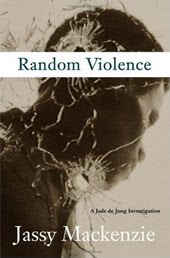
Debut Crime Fiction by Jassy Mackenzie: RANDOM VIOLENCE

Soho Crime has done it again: brought us a crime fiction author from far away and made us sit up and pay attention. Jassy Mackenzie's debut is RANDOM VIOLENCE, set in South Africa, powerful, dark, and well worth the reading.

Private investigator Jade de Jong is back in Johannesburg, where razor-wired fences, security systems, and private guards are part of middle-class life, thanks to the extremes of poverty and violence in the city. Corruption is about as common as you'd expect, and fueled by the city's constant growth and the profits to be made (although, as usual, "it takes money to make money"). Jade is back to witness the end of a case she'd been part of, a decade before, but that's her private knowledge. On the surface, she's simply signing up to help an old friend, Superintendent David Patel, who used to work for Jade's policeman father. And the random acts of violence that have overwhelmed David's office have no apparent connection with each other -- or with Jade.

Yet from the moment she gets home, Jade realizes she's being watched, and violence seems drawn to her. Actually, it's more that she seeks violence, with some determination:
Jade walked back and climbed into her car. Behind her, she heard the man revving his engine in triumph. She pushed in the clutch. Then she popped her car into reverse and hit the accelerator.
Her car shot backwards. There was only room for it to travel a few feet before her rear bumper collided with the front bumper of the luxury car behind her. It was a small impact. She barely felt it. But for him, it was more serious. Because his airbag deployed.
Looking in the rearview mirror, she saw his body whiplash backwards as the powerful bag shoved him out of the way, and then slump forwards again as the bag deflated. His expensive dark glasses fell out of the window and shattered on the tarmac. [ . . . ] Jade put her car into first gear and drove on.
Mackenzie paints a bold portrait of a woman whose unfinished business can endanger any goodness left in her life. Whether Jade can help David depends on whether she can stay alive. In Mackenzie's hands, there's doubt at every step, risk in every decision, and a vivid sense of evil lurking in the past, present, and future. There's no feel of a "first book" here -- this Rhodesian-born South African pounds the pages with skill and vigor. I'm delighted to know that Soho often nurtures sequences of books from its authors; I want to read more Jade de Jong.

PS - In my opinion, the book jacket is awful. Don't sweat it -- go for the book instead.

Monday, May 17, 2010

Stieg Larsson, The Girl With the Dragon Tattoo: The Film

Brilliant screenplay. We watched the film this evening, Swedish with English subtitles (and after a while your ear adapts and you're half getting the Swedish too). Lots of great choices in which material was immaculately reproduced in the film version and which bits were cut. We've already decided we'll purchase the DVD when it's available.

This has to be one of very few occasions when the film actually complements the book.

Sunday, May 16, 2010

Quick Notes: Dave Zeltserman, Carla Neggers

Coming soon: a review of Dave Zeltserman's late-summer release, the quirky and compelling CARETAKER OF LORNE FIELD. We hope to have copies here in time for Dave's June 19 visit here -- and we'll definitely have copies of KILLER.

I mentioned earlier this week that Carla Neggers has four series of books/characters going. Well, I indulged myself yesterday afternoon -- and much of last night and today -- by taking time to read NIGHT'S LANDING from her U.S. Marshal series. And it is delicious: well plotted, with a very believable set of crises, characters that ring true (what an adventurous and intelligent woman Sarah Dunnemore is! and hurrah for Nate Winter as he learns to appreciate her), and a fine sense of timing.

One more series to go ...

And because no Vermont conversation is complete without a bit of weather: Thank goodness, the season of snow and ice seems to have finally ended! The blue-sky world outside the office window is windswept and sixty-eight degrees. And the purple finches, northern waterthrushes, and chipping sparrows that have been desperately cramming seed from my window feeder are all out in the greenery instead. I'm planting peas this evening after supper. But (oh my) our "Eye on the Sky" weather forecasters are still insisting we could have frost again tonight. Reminds me uncomfortably of Vermont's "Eighteen Hundred and Froze to Death," 1816, when crops were decimated by at least a frost in every month.

Thank you, Howard Frank Mosher ...

What a delight to savor the slideshow that author Howard Frank Mosher brought here yesterday, showing the inspiration for WALKING TO GATLINBURG. I liked hearing about the Nashville muse who leans over this author's shoulder, too.

Friday, May 14, 2010

Catching Up With Carla Neggers

What a satisfying read!

I've just enjoyed THE MIST, which is the third in the Boston Police Department (BPD)/FBI series that Carla Neggers began with The Widow and then The Angel. So I'm about ready for the fourth book in this series, which hits the shelves in July -- The Whisper.

Reading a Neggers series is like moving into a neighborhood: You get close to one family/character, then ease back a bit and get to know another, and come to see how they link with each other.  Then someone else stops in with a cup of sugar and after an hour of chatting, you realize they know your ex or one of your kids.

THE MIST opens with hotelier Lizzie Rush quietly undercover in a bar in Ireland, trying to catch up with FBI agent Simon Cahill (familiar from the earlier books). She's trying to make an end run around the threats posed by a multi-billionaire criminal:
Simon, Lizzie reminded herself, was the reason she was in Ireland. She'd heard he was here with Keira on the Beara Peninsula while she painted and researched an old Irish story. As much as Lizzie hated to disturb the new lovers, she fetl she had no choice. She had to act now, before Norman Estabrook could make good on his threat to kill Simon and his boss, FBI director John Marsh.
And only Lizzie realizes how direct those threats are. Events throw her into more direct action herself, and soon she's showing her own skills, from martial arts to rapid thinking. Lizzie's best assets are her cool analytic mind and her intensely networked family.

Neggers provides a rich emotional subtext to her action novels, and while Lizzie's affections were getting engaged, so were mine --  with the entire Rush family of young and older men, who combine capability and tenderness in an alluring ratio.

If you jump into the series with this book (which came out in softcover six weeks ago), you may find, as I did, that the references to the action scenes of the earlier two books can sometimes be distracting. So I'd recommend reading these in sequence, to get extra enjoyment from the way Neggers braids one book's characters and events into the next, and the next. Think of it as weeks of vacation, sliding along with the narrative, and sampling the poignant and powerful Ireland that Neggers portrays.

In fact, for a special treat, check out this author's "photoblog" through her web site, www.CarlaNeggers.com -- I especially like the mist shots, as well as the stone circle that evokes so much history, myth, and passion.

This series is a good fit for readers who find Patricia Cornwell, say, too dark and disturbing but still want to see strong women defend their home, their families, and their friends against criminal forces. Notice that doesn't mean it's "chick lit" -- the crime-solving and pursuits in Carla Neggers's books are professional and absorbing. I'd vote this series as one of the best for beach reading or rainy afternoons.

PS: Carla Neggers comes to Kingdom Books on July 17.  If you're close enough to get to Vermont that day, come ask her how she balances four sequences of books and characters!

Lee Child, 61 HOURS

Janet Maslin at the New York Times has a good review of the latest Jack Reacher.

Wednesday, May 12, 2010

Two Good Choices from the Young Adult Shelves: Kimberly Derting, THE BODY FINDER, and Eric Luper, BUG BOY

It's a new genre, but right from the first moment I heard of it, I've been fascinated by YA -- that is, "young adult." The classification arose through librarians frustrated in finding the right books for teens who were adult in their reading levels, but who weren't really interested in some of the crises that adult novels focus on. When you're in the midst of breaking away from home while also hanging onto it, depending on your friends but also sometimes hating them, scared about what you're going to do for the rest of your life but determined that it won't be the same as what you've seen around you ... well, those are good times to read YA books. Come to think of it, we're all in that boat sometimes, no matter our ages.

A really good read for mystery lovers who enjoy a hint of the paranormal (but without vampires) is Kimberly Derting's THE BODY FINDER. Violet Ambrose has always sensed death -- even the deaths of the mice that cats kill -- and can follow the imprint of a particular death on the killer, too. Her family knows; they've always protected her from exposure, and cared for her emotionally. But when a serial killer terrorizes her small town, at the same time that her feelings for Jay Heaton are turning her insides upside down, her family can't completely shield her from the consequences of being different. And of being needed to help find the killer. Derting holds the plot strings, tense and tough, and everything depends on Violet's choices. Share this with the teens you like best.

Eric Luper's BUG BOY isn't exactly a mystery -- and yet there's death, extortion, and ohmigosh dieting (you'll never guess how jockeys trim off weight in a hurry to ride the best horses), all in the Great Depression summer of 1934 as Jack Walsh scrambles for a career at the racetrack in Saratoga, New York. Jack's family is the opposite of Violet's: He's almost entirely on his own, or worse. And at age fifteen, he's a lot less experienced than he realizes in terms of dealing with really nasty characters and pressures. There are some striking surprises here, and Luper shows in his second novel that he knows how to dig into the past for a tale that resonates with today's choices in the recession. This one will be better for younger teens, or for anyone who's "horse crazy." A good find, and a good summer choice.

Tuesday, May 11, 2010

Robert B. Parker: A Joyful Memorial


Although some 600 people gathered at Boston University near its Howard Gottlieb Archival Research Center yesterday to say goodbye to mystery author Robert B. Parker, who died on January 18, only a few tears were shed -- because the emphasis was on the joy of knowing this author and on the pleasure of his books. The memorial gathering was instigated by Kate Mattes of Kate's Mystery Books, Parker's "hometown bookseller" and a long-time promoter of his mysteries. At the podium were the archivist of Parker's materials Vita Paladino; mystery authors Sue Grafton and Dennis Lehane; critic and friend Calvin Trillin; Parker's publisher and editor; and Parker's wife Joan and their sons David and Daniel.

Paladino credited Parker's wife Joan with encouraging her husband to do his doctoral thesis at Boston University, which in turn meant Parker taught there for two and a half years and managed to fit time for writing his first book into his schedule. The thesis "examined the classic detective fiction of Raymond Chandler and Dashiell Hammett," said the archivist. It was on display in the lobby (our photos show the glassed-in samples from the archive).

Sue Grafton spoke warmly of enjoying time with both Robert B. and Joan Parker. Dennis Lehane asserted that Parker moved American crime fiction into the 20th century, saying, "There is American crime fiction before Parker, and there is American cdrime fiction after Parker. It is true: He laid a stake in the ground, and after that, you always had to look back and see him standing there."

Calvin Trillin raised a chuckle as he recalled Parker's answer to why he wouldn't join the Mystery Writers of America: "The last organization I joined sent me to Korea." He added, "Like most mystery writers of the first rank, he had a great sense of place. When you read the Spenser books, you breathe in Boston."

Putnam president Ivan Held rose to the challenge to say where Parker resides in the publishing pantheon: "I thought about this and decided that he resides at the intersection of Old School and New School." He spoke of the fierce pace of writing that Parker established, too; in later years, Parker's schedule with G. P. Putnam's Sons meant a Jesse Stone book released each February, a Western in June, and a Spenser book in the fall. Chris Pepe, Parker's editor at Putnam, said the author only began to slow his public appearances after age 74.

Son David Parker's remarks were a shorter version of the eulogy he gave earlier this year, and the full text can be found at the Washington Post website. His brother Dan offered a moving rendition of Robert B. Parker's favorite baseball song, "What You'd Call a Dream," and added the final verse of "Danny Boy" in farewell. Joan Parker rose and said, "Can I just say, are my kids great, or what?" And of course she won applause for that, and a warm standing ovation when she completed her own remarks about the 53-year marriage that she and "Bob" enjoyed.

Also on hand to pay tribute to Parker's memory were actor/director Ed Harris, who directed the film Appaloosa made from one of Parker's Westerns; and Parker's long-time agent Helen Brann (in our photo, you see the back of her head as she listens to Dennis Lehane).

Monday, May 10, 2010

Calendar Alert: Poet Wesley McNair at Dartmouth, May 13

This is the culmination of a competition at Dartmouth and will feature Wesley McNair reading his work. A good chance to enjoy meeting this Maine poet, as well as connecting with the new poets at the college. Here's the invitation:
Please join us on Thursday, May 13 at 4 pm in Sanborn Library for our annual creative writing awards ceremony.  Our guest reader and prize judge, is Wesley McNair. Wesley McNair's latest book is "Lovers of the Lost: New and Selected Poems."  Also reading will be this year's student winners of the creative writing prizes.

Wesley McNair is the recipient of fellowships from the Rockefeller, Fulbright, and Guggenheim Foundations, a National Endowment for the Humanities fellowship in literature, two National Endowment for the Arts Fellowships for Creative Writers, and in 2006 a United States Artists Fellowship of $50,000, fifty of which were awarded across the arts to a selection of "America's finest living artists." Other honors include the Robert Frost Prize; the Jane Kenyon Award for Outstanding Book of Poetry (for Fire); the Devins Award for poetry; the Eunice Teitjens Prize from Poetry magazine; the Theodore Roethke prize from Poetry Northwest; the Pushcart Prize, and the Sarah Josepha Hale Medal (also awarded to Robert Frost, Donald Hall, Maxine Kumin, Robert Lowell, May Sarton, Arthur Miller, Richard Wilbur, et. al.) for his "distinguished contribution to the world of letters". Wesley McNair has served four times on the Nominating Jury for the Pulitzer Prize in poetry, and is a two-time recipient of residencies at the Bellagio Center of the Rockefeller Foundation in Italy. A television series aired over affiliates of PBS on Robert Frost for which he wrote the scripts received an Emmy Award. Featured on National Public Radio's Weekend Edition (Saturday and Sunday programs) and several times on Garrison Keillor's Writer's Almanac, his work has appeared in the Pushcart Prize Annual, two editions of The Best American Poetry, and over fifty anthologies and textbooks.
Directions at the Dartmouth College website: http://www.dartmouth.edu/~maps/directions

Sunday, May 09, 2010

New Voice: Irene Ziegler, ASHES TO WATER (Florida Crime Fiction)

ASHES TO WATER brings a new and skillful voice to the mystery scene this summer:

Annie Bartlett's father has been murdered. The loss drags her home, where she hasn't been lately and doesn't want to be -- to central Florida, where the wildlife can't compare with the teeth that her family's past can sink into her.  And after facing her father's battered body, she gears up to visit the local jail, where the murderer is awaiting trial. The accused murderer, that is: Della Shiftlet, final lover and nearly wife in Annie's dad's life. There's little doubt about who battered Ed Barlett -- Della was found standing over the corpse with a bloodied boat oar that matched the damage to the body.

Annie's a gifted photographer, haunted by a presence of her mother; Helen Bartlett drowned when Annie was a child, just nine years old, and her coping mechanisms since then included talking to her mother in her thoughts, and maybe a bit more reality than that, in a long and sorrowful haunting. Nothing in her life, though, has prepared her for what happens at the jail when Della is led into the visiting room in an orange jumpsuit that sags around her ankles.
Annie didn't move. ... Why hadn't the sheriff warned Annie that Della Shiftlet looked exactly like her dead mother? ...

"Look, you're the one who requested this visit," said Della. "So why don't you say what you have to say, and let me get back to my knitting?"

She needed a second, just a second, to work this out. Over the last twenty years, her mother's appearances had blended with Annie's reality, but Annie knew Helen wasn't real, had always known. Her mother was dead, drowned in Widow Lake. That Annie still communicated with her mother was, as one medical text had put it, "a grief-engendered coping mechanism, triggered by sudden loss at a young age." Cumbersome babble, but Annie understood, accepted.

But this.

This was no coping mechanism. This was Ed's killer, and the resemblance to Helen rattled Annie to the bone.

"So, are you going to tell me why you're here, or am I supposed to guess?"

"I wanted to see what a murderer looks like."

Della shifted uneasily under Annie's scrutiny. "Honey, I promise you, I did not kill your father."
Over the next few hours and days, in spite of the evidence, and Della's obvious motive -- to inherit the house and property that are rising in value thanks to a casino plan -- Annie begins to see reasons to doubt Della's guilt. But between her drug-addict sister, the callous violent men cutting into the scene, and the hard feelings in town about Annie showing up for the funeral after ignoring a nice man who missed her for years, well, things are confused. And increasingly dangerous, too.

Ziegler's tight plot, deft descriptions of mood and place, and willingness to dig into both small-town life and the pain of a child's losses, add up to a striking debut mystery that's worth adding to the shelf. Dark and haunted, the book does what I like best in a plot: lays the responsibility for straightening out the mess onto Annie, who needs to test the friendships, loves, and memories that surround her. Only if she can line them up accurately will she have a chance to save her sister, herself, and the past held hostage to the bitter present tense.

Although this is Ziegler's first crime novel, her story collection RULES OF THE LAKE came out in 1999 and includes the roots of this novel; an actor and dramatist, she also is the author of the play "Full Plates." Raised in central Florida, she now lives in the Richmond area of Virginia.

Note to collectors: Although Gale/Cengage Learning is a mostly library-oriented firm, it is publishing this book under its Five Star imprint -- which has also published Zeltserman, Westlake, and other crime authors. But I always wonder just how it all works! (If someone from the publishing house would care to add a comment to explain to us, that would be great.) At any rate, I'd suggest picking up a copy of ASHES TO WATER in hardcover as soon as it hits the market in early June. Oh yes, that title -- think about what you might do during a funeral by a lake. Yes, that's it ...

A Little Mother's Day Bragging

No, neither of my sons is writing mysteries. But that doesn't mean I can't introduce their specialties now and then. My older son, Kiril Savino, is co-founder (with Ted Sullivan) of Fungo Media, Inc., where the Game Changer app for iPhones, iPads, and more is bringing Little League games off the field and onto the desktops (or into the pockets) of parents and other fans who can't be at the field -- and also managing stats for the teams in ways that shoulder some of the tough responsibilities of Little League team managers and coaches. Way to go, Kiril!

My younger son, Alexis Savino, is an actor and filmmaker and also a skilled portrait photographer who works with people who need compelling images of themselves for media and promotion. Alexis is currently editing film and video for his feature film, "Loss Control." I like his poetry, too. And he's been our connection with Café Grumpy, the NYC roaster and brewer of fine "joe" -- so just for the fun of it, we carry that coffee link on the right-hand side of our blog, too, especially since Grumpy is now shipping mail order (hey Dave, do we need to re-order?).

Priorities of my life: enjoy my sons (and their families) and my husband; keep Kingdom Books well nourished with reviews, commentaries, and events; and write good stuff myself, here in Vermont. It's been a great Mother's Day weekend.