Wednesday, December 13, 2006

Write It: Galway Kinnell and "When the Towers Fell"


Late last summer, before his new collection STRONG IS YOUR HOLD came off the press, Galway Kinnell gave a reading locally, for the northern Vermonters who claim him as one of their own. (Some of them came from New York City, too...) That is, he tried to read -- and to his consternation, he lost most of his voice, and between that and the heat and the crowd, it was a tough event.

So this evening, he graciously offered a second chance, in the high-ceilinged glory of Athenaeum Hall in St. Johnsbury, where many a poet, novelist, biographer, politican, even the traveling speakers of the 19th century like Russell Conwell ("Acres of Diamonds") have spilled forth rich language. In the audience were other authors, a book designer, a magazine editor, professors, high school teachers, an innkeeper, a contractor, a marketing pro, retirees -- and a handful of high school students. And whether it was the comfort of reading "at home" or the sight of the neighbors or their enthusiastic questions, the grand poet responded amply.

He told a bit about Rilke before reading his popular new poem "Dinner Party," said that Rilke believed the moment of the poem could easily be missed, and hence one shouldn't go out to be with others, but should simply wait at the desk for the muse. "Are you like that?" one listener asked him.

"I don't actually agree with Rilke," Kinnell replied. "Although I've translated a large bulk of his poems -- I don't like him." He continued, "Rilke's work is greatly marred by his inability to love."

"Strong is your hold O mortal flesh / Strong is your hold O love," wrote Whitman in "Last Invocation," from which Kinnell drew the title for the new collection. Much of the work in it recounts incidents that only love brings about: moments with his children, and with his wife, some stunningly intimate.

Another neighbor (and up here, a neighbor is someone who lives within visiting distance) asked Kinnell why he'd written so much about the Vietnam war, but not yet about the current one in Iraq.

"When that war started, I felt like I was the only person in the country that knew what was happening," Kinnell mourned. Invited to a dinner party of doctors in the neighboring town then, he spilled his passion about the war and against it -- and felt the silence of the room and the gradual withdrawal, one by one, of the fellow guests.

He admitted to writing poetry as a teenager, but without seriousness. Then, "I realized that poetry was central to my life. I was writing, but I wasn't writing well." He thought perhaps he'd become editor of POETRY magazine or something like that. Gradually his writing changed, and he now says his habit, good or bad, is to strive for perfection. So when a teen asked him whether that ever pushed him toward maybe revising something that he felt he didn't have quite right, he exclaimed to her with a tender smile, "Oh, my dear!" Then he held out his copy of the "new" book -- already marked in ink with a rewritten final line to the poem "Field Notes."

Although he regularly reads aloud many of the poems from STRONG IS YOUR HOLD at his author events, the central poem,"When the Towers Fell," the one that focuses the book, is one he doesn't often provide to audiences. It's too long, for one thing. Six pages. This evening he took "author's privilege" and condensed it, reading about half the stanzas, and carefully delivering the Middle French and German sections in translation.

Prompted by more questions, he explained that he had started writing the poem because of the classes he taught at New York University at the time. His students were breathing the disaster, walking through it, crying; they came to him and said, "How do we cope? What do we do?" He told them, "Write about it," and set an example by penning three lines -- lines that he now calls "quite bad." He enriched them with observation, sitting for a morning in a food stand erected by McDonald's for the firefighters and rescue crews. The first publication of the poem took place in THE NEW YORKER at the one year anniversary of the attack of September 11, 2001. An audience member asked him whether he'd mixed narrative and lyric in it, and he said yes, calling the work (as it now stands) a series of moments rather than a narrative. "And I think it's better in poetry to get as much narrative as possible out of it. Maybe better for all writing."

Gently, he confirmed that more revisions would take place. He added, "Sometimes one doesn't get everything right the first time, but then when it's published in a book, it has an objective reality that allows you to see what needs to be changed."

And then, steering the conversation back from theory and poetics to love, he read aloud his "Shelley," which turns away from both the early poet's ways and some of his own youth, and wrapped the evening and the audience in the delicious love poem "Field Notes":

.., in the taxi on the way home we kissed
a mint from the maitre d's desk
from my mouth to hers,
like cedar waxwings.

...

I slid around the foot
of the bed and climbed in
and slid toward the side lined
with the warmth and softness
of herself, and we clasped each other
like no birds I know of.

Our cries that night were wild,
unhinged, not from here,
like the common loon's.

Saturday, December 02, 2006

On the Tip of the Tongue: Arguing With A Collection of Poetry


I've never met the poet Lesle Lewis (that's right, her first name has an unusual spelling), but the photo on the back of her 2006 poetry collection LANDSCAPES I & II looks like a nice person, relaxed, dressed in sweatshirt and corduroys if I see the detail right, with a tousle of short fair hair, a wide grin. Still, if she tried talking to me the way these poems read, I'd explode: "Why can't you stick with one topic for longer than a sentence? What do you mean by talking about an alligator, Milwaukee, love, and summer, all at once (in the poem "Bumblebee Love")? How am I supposed to understand that prose poem called Story?"
In fact, "Story" begins, "You, my girl, I don't dislike. Faith is a male. This is a love story."
Honestly, I thought I'd go crazy. But I kept reading. Lines like "You've had some accidents and some illnesses and some lovers" grabbed me. or "There was a singing by the river, and no one but me was thinking of me." (That's from a two-paragraph prose poem called "Wrapping Paper.") And it began to feel like being immersed in a new language, where at first the only phrases you're sure of are the ones that borrow from the English you've always spoken, and then you begin to recognize the words that mean "please" or "too bad" or "awesome." One night you wake in the darkness and realize the voices in your dream were speaking in that other language, too.
So Lewis's carefully chosen sequences build to inner recognition of how conversations happen, inside the mind as well as spoken; of love and its absurdities ("For me it's always you, you, you"); of what a creator might really be if our minds were that stretched, that elastic.
By the time I reached the book's finale, a ten-section poem, "The Moon Is Over Alstead," I knew that Lewis inhabits the same rock-and-water-and-weather New England that holds my own heels and heart. I even had a sense that it might make sense to put heels and heart into the same stretch of poem, and not to worry too much about which bones or blood vessels linked them. This collection is fresh language for me, and although I struggle for footing among its unexpected twists and bumps, I like the energy and the challenge.
And that's what leads to my recommendation: Pick up this book and set it aside for an afternoon of cabin fever or depression. That's when the line "You keep your soul in your dog" will bless your day with laughter, and a couple of poems later, you'll hit "Abstraction puts on her cowboy boots. Who else would walk the boundaries with you and photograph your pears?" Ah. The world is more free than it seemed before, while Lewis spills its phrases and images into her poems.

'Tis the Season for Poetry


I get serious seasonal confusion disorder in December. Our household celebrates the Festival of Lights, better known as Hanukkah. My individual path takes me toward Christmas -- but I struggle for a clearer vision, stripped of the images of white people of the Middle Ages, more a sense of Jesus the Jew coming out of his wilderness experiences with fresh leadership. Yet the hill-walker that's my everyday self is most attuned to weather just now: snowstorms, wind, plunging numbers on the thermometer, glimpses of blue sky or bright moon or the wide shoulders of the constellation Orion. I count the days until the Solstice, need to notice the changes in daylight and darkness.

Hence it's a huge relief to be able to recommend the following, as poetry to seize for oneself, one's friends, one's dreams:

From the moment the first snow clouds hover over the landscape, Vermont winter is a season of longing: for tender snowfalls, for sparkling beauty, for the exhilaration of the cold, and also for comfort, warmth, protection, assurance. So it's a good season to read Kevin Goodan's first published collection of poetry, IN THE GHOST-HOUSE ACQUAINTED, which came out through Alice James in 2004. Goodan's second collection is on a publisher's desk; catch up now and be ready for the new book when it arrives.
The title poem opens, "I close the simple flowers / and bid the moon now rise / for Death is not my harbor." Walking through a quiet nighttime pasture, Goodan evokes the haunting and threat of the evening: "as frost presses down / with equal weight and terror." Shadows, moonlight, a sense of the earth at its beginning: "I remember that world / pouring into this."
Those well acquainted with West Coast Native American legends may recognize the ghost-house as an anchor of the Tsimshian world, though it's also a thread in Sioux explanations, and in another form in Cherokee language about the worlds of life and death. I find in Robert Frost a New England sense of ghost house, in the barren foundation of a house long uninhabited. It's fair to let all these threads braid while reading Goodan's work, for he draws from them in turn. Raised on the Flathead Indian Reservation in Montana as white stepchild in a strong family of Native American leaders, his spiritual vision mingles animism, the Lord, the land. Into the cradle of his childhood he pours his adult labors with animals, in the cruel winters of Montana and the damp chill ones of western Massachusetts, where he lives now.
This mingling of hauntings erupts in language like the close of his "Almanac of Caliber and Distance": "I want to build my house / in you, phantom in the song-light. // Starlings unsilence, / jay-crows gloss a bone-stack // and I will not close my eyes / to the flame held before me, // O fire -- of human / And not."
After this, the poems trek from llama raising (including the sorrowful weight of them when they die) to birds ("O, my soul is a hermit thrush"), to horses that crowd up against a fence and the ghostly vision of a white mare, summoned: ""In field, in bone / You white mare / In rain that peens a curved world flat -- ... Through every weather between us / Come O come you white mare," Goodan cries out.
Here are calls to a Lord, as well as sobs of frost and lambs and owls. By the time the collection wraps up, winter itself peals forth meaning and sustenance, even as the land groans under the ice.

Friday, November 24, 2006

Poems for the Ear in the Heart: Linton Kwesi Johnson, MI REVALUESHANARY FREN


Language and poetry: if there's a way to separate them, I don't know it. But despite the heartbeat meter underlying most lyric poetry, and the sensuous slide of alliteration and rhyme plaiting the lines together, and the laid-in pauses and rhythms of the page, the line, the spacing -- well, despite the way one hear's a poem as one reads it, MI REVALUESHANARY FREN demands a different kind of reading. A reading aloud.

Intrigued by the unexpected gift of an introduction by novelist Russell Banks (the book's published by his wife Chase Twichell's Ausable Press), I pressed into reading this September 2006 release. Poems like "All Wi Doin Is Defendin" seemed straightforward enough, but hard on eye-brain linkage as I sounded out the Jamaican Creole on the page:

war ... war ...
mi seh lissen
oppressin man
hear what I say if yu can
wi have
a grievous blow fi blow

wi will fite you in di street wid we han
wi hav a plan
soh lissen man
get ready fi take some blows


And so it goes on, line after line, stretching the inner eye-ear to make sense of the page, with the finale:

all wi doin
in defendin
soh set yu ready
fi war ... war ...
freedom is a very fine thing


AH! Revolution to achieve freedom -- it's an American virtue, and from war in the streets, I translate at the final stanza to why so many of us react so strongly to, say, the Rodney King beating, hate crimes against gays, the double binds of victims of domestic violence (need I mention OJ's family?), desperation on Native American lands, laws that punish immigrants for having roots elsewhere.

But to be American and middle class and white is a hard place to be when identifying across color lines. Even to fully recognize what generations of enslavement-via-skin-color did to our nation's ideals and humans take hard work for those living the presumed easy life.

Linton Kwesi Johnson, better known as LKJ, born 1952 in a small town in rural Jamaica, arrived in London in 1963, for secondary school and later studies in sociology at Goldsmiths' College, University of London. Here he joined the British Black Panthers and helped organize a poetry workshop within the movement. His published poems and his music erupted together through the 1970s, bringing him recognition that came by definition internationally: You can't separate him from either England or Jamaica. By the 1980s he'd entered radio journalism. The awards piled up momentously: associate fellow of Warwick University (1985), honorary fellow of Wolverhamption Polytechnic (1987),an award from the city of Pisa (Italy) for his contribution to poetry and music.

Under the conventional list of awards and achievements (his own record label; "the second living and the first black poet to have his selected poems published in England in the Penguin Classics series" -- says Banks in the introduction) is a concentrated focus on oppression and resistance. People are killed regularly within the "revolutions" that demand freedom and rights.

there are sufferers with guns movin breeze through the trees
there are people waging war in the heat and hunger of the streets.
("Song of Blood")

I'm seized by "sufferers with guns, and by "heat and hunger." This isn't revolution as an intellectual excercise; it's revolution as survival. As necessity. As breath, and as chilbirth. I remember what I did to make sure my kids were fed (stomach, heart, mind); I would do it again. LKJ's lyrics remind me of how some things just have to be done, no questions, no "I can't" -- you move, you go to the front lines.

Poems here that stay with me include "Inglan Is a Bitch" (opening with work, as an immigrant, in the Underground/subway), "Reggae Fi Radni" (in memory of hate crime victim Walter Rodney), "New Crass Massakah" (about the racially motivated arson in 1981 that killed 14 young blacks at a 16th birthday party, 1981), and in the Nineties Verse that makes up the final section of the book, "If I Woz a Tap-Natch Poet" and, especially, "Hurrican Blues," which opens:

langtime lovah
mi mine run pa yu all di while
an mi menbah how fus time
di two a wi com een--it did seem
like two shallow likkle snakin stream
mawchin mapless hapless a galang
tru di ruggid lanscape a di awt sang


But it wasn't until I captured my husband at a moment when he could listen, and began reading awkwardly aloud to him, that I felt, heard, saw the drums and pounding feet and bass guitar and breathing in and under the words.

When the students at Kent State were attacked, there were new openings in the revolution, for white middle-class college kids like me. When the revelations of My Lai and Abu Ghraib unfolded, there were more places. When I hear a small child in my beloved Vermont landscape say, uncorrected, to her father, "Chinese people say chinky-chinky-chong," the revolution calls again.

And on every page of MI REVALUESHANARY FREN, there is another clang of the bell.

Sunday, November 19, 2006

The Young Adult Novel: Sweet or Dark?


Here's a quick question for those who read (and write) "YA" novels -- that is, novels intended for adolescents. As I mull over the teens on my holiday list, I see that the ones who've reached driving age are ready for just plain good writing, never mind the YA qualifier. But for the ones between 10 and 15 years, the magic of YA fiction makes the list. And the question is:

Is YA fiction better when it's sweet (that is, has a good ending that the protagonist works hard to achieve), or dark (that is, carries the harsh tang of unpredictable disaster)?

My favorites for this year's "satisfying ending" category include Katherine Paterson's BREAD AND ROSES, TOO and the paperback edition of Natalie Kinsey-Warnock's AS LONG AS THERE ARE MOUNTAINS. David Stahler, another Vermont author, brings out volume 2 of The Truesight Trilogy next spring and I just devoured an advance copy (THE SEER), so if you haven't started these, now's a good time to pick up the first one (happily now in softcover), TRUESIGHT.

But Stahler always has a frisson of horror, something that the warm friends in his work help the protagonist to bear and supercede. In his 2006 stand-alone, DOPPELGANGER, Stahler went all the way to the dark side, much as DRACULA and even THE WIZARD OF OZ did (and Barry Moser's illustrated editions bring out the shadows brilliantly). And knowing some downright ghoulish 12-year-olds, I'm wondering -- will they prefer the scarier stuff?

Discussion invited. And if you're under 16, your opinion matters even more.

Saturday, November 18, 2006

That Holiday Feeling: The "Must Buy" Poetry of 2006

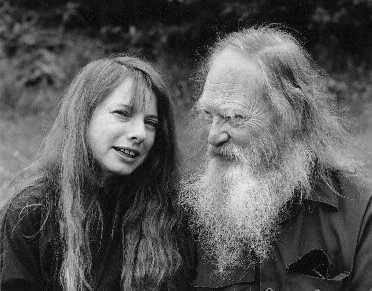
[Hayden Carruth and Jo-Anne Laughlin, poets; courtesy of their "family album"]
The catalogues have been pouring in. Here on our ridge in northeastern Vermont (the Northeast Kingdom -- hence Kingdom Books) the air has a fierce clarity, and snow hesitates just beyond the curtains. Dave complains about shop displays, mounds of holiday decor and gifts to navigate past. But I'm thinking of it as the American season of declaring the importance of friends and family. So here's my first pick of the season for poetry:

TOWARD THE DISTANT ISLANDS, by Hayden Carruth.

Edited and introduced by Sam Hamill, this is Copper Canyon's brilliant compact book, small enough to tuck into the pocket of a generous handbag or wedge next to the laptop in the carrying case. I keep it on a shelf in one of the workrooms of the house, to grab and nibble at will.

Carruth is still not as well known as he deserves, despite awards and, in the past few years, a sincere effort by Vermont to promote him as Poet Laureate. When financial need tugged him past Lake Champlain into upstate New York, Vermont only assumed he was on some sort of stretched out tether. He'd nailed the rural conversation and the endless struggle with wood and weather that's unmistakeably the real Vermont, where maple syrup isn't a "branding effort" but rather the mere end result of eight weeks of break-your-back labor, which itself is sweetened not so much by the size of the woodpile (Thoreau) or the quarts of syrup, but by the hours spent in conversation with friends and neighbors. (Even if they're not in the room with you.)

For every reading Carruth does here, the "iconic poem" that's in demand is Johnny Spain's White Heifer. The hunt for the four-legged, four-quartered (that is, four-teated) version of Moby Dick is masterminded by Johnny himself, a beer in one hand, a walkie-talkie in the other: ""Me boys is up in the hills, looking. / I'm di-recting the search."

To hear Carruth read it aloud is to hear generations of half foolish, half wise, three quarters wet and cold fellowship out in the hills. And though there are precious few females in the narratives, the ones that slip in are also slipping into someone's heart, usually Carruth's. As Sam Hamill wrote in the introduction:

He has stripped himself bare as he has constantly resurrected himself -- often with the aid, both finanical and pyschological, of strong women, loyal friends, and a good doctor (of whom he has written). But his "shamelessness" is not in the tradition of "confessional" poetry; rather it is the result of unblinking and sometimes scarily honest encounters with himself.


Hamill in fact compared Carruth more closely to Chinese and Greek classical poets than to, say, Frost, who of course is always present in any gathering around New England poetry. Frost isn't exactly absent from his own poems -- I'm thinking in particular about when he compares himself to the tree at his window, or moans at the ache of his feet after harvesting apples -- but his "I" is often the rather formalized one of, say, "But I have promises to keep, and miles to go before I sleep." Carruth's, on the other hand, has hands stained from truck bearing grease, knees patched or damp, overalls hanging loosely over a softened belly. You can smell the outside air or the woodsmoke as he peers around the corner, still talking over his shoulder with someone who just stopped in. "Almost 500 bales we've put up // this afternoon, Marshall and I," he rambles, in a pause after the declaration of:

Coming home with the last load I ride standing
on the wagon tongue, behind the tractor
in hot exhaust, lank with sweat

my arms strung
awkwardly along the hayrack, cruciform.


So I'm recommending TOWARD THE DISTANT ISLANDS for a stocking stuffer or gilt-wrapped packet next to the menorah or to treat yourself to a few hours of separation from the shopping malls. And it will lift you into a place where the politics and pressures seem worth bearing, too -- as the final poem in the "new and selected" collection, "A Few Dilapidated Arias," denies the minimizing title and takes up arms against folly.

"Never say the earth is not extraordinary!"

Likewise for these poems.

Wednesday, November 15, 2006

Freedom of Speech: OJ's and Ours

I was horrified this afternoon to learn that OJ Simpson is releasing both a book and a Fox TV special next week on "how he would have killed Nicole, if he really did." I've just contacted the offices of Vermont's three Congressional reps, our governor, Howard Dean, and the President, and also left word on Katie Couric's blog: Sure, OJ has freedom of speech, but so do the rest of us. At the very least, let's all push for a TV special that runs during the same "sweeps" time slot as OJ's, a special that says, "Domestic violence should NEVER be a spectator sport or a source of commercial revenue." Please join me in adding your voice to any and all of the above.

Tuesday, November 14, 2006

Research and the Police Procedural: Archer Mayor and THE SECOND MOUSE

The crowd had gathered, clusters of friends claiming seats together, and a few loners staking out corners of the shop. Outside, the light was fading -- November in Vermont, dusky and gray with a hint of snow in the bank of clouds. Dave and I, knowing that Archer Mayor cuts his timing tightly, checked voicemail and e-mail to be sure there weren't any emergency messages ("I'm involved in an untimely death..."), glanced at the clock, which said a minute after four, and suddenly heard boots on the outside stairs. Exhaling in relief, I rushed to the door.

"Sorry I'm two minutes late," the author said at once, "but I'm kind of muddy and if I look a little beefy, it's the bullet-proof vest. I'll tell you all about it later."

And that was the start of the latest Kingdom Books author event, presenting the 17th Joe Gunther mystery, THE SECOND MOUSE, from Vermont's master of the police procedural, Archer Mayor.

Mayor hates to "read" from his pages, and launched into a well-tuned talk about the character interactions that prompted this latest novel. Starting with an urge to explore the "romance" between two of Gunther's police team members, edgily dangerous Vietnam vet Willy Kunkle and risk-taker Sammie Martens (she's blonde, tough, stunning when she wants to be), he paired their story and Joe Gunther's (recovering from a breakup) with a much nastier tale of three criminals. As Mayor described the writing process, he saw the two threads as the top two lines of a Y: and their eventual merging into the suspense and action of the book as the base of the letter. (I kept looking at his half-zipped bullet-proof vest and thinking, zipper.)

Volunteer firefighter, ambulance staff (EMT), and death examiner, he also recently joined the police force in the rough-and-tumble but slowly yuppifying town of Bellows Falls. Turns out, though, he had already started writing his series before all that. Now, the daily efforts become more material, clearly.

But what fascinated me was how he conducts research in, say, domestic violence, which somehow almost always enters his plots.

"I don't go to the conferences (on DV)," he said. "I go to the person who hosts the conference. And I don't interview rapists -- who'd want to give them the satisfaction of even a little extra attention? Instead, I go to the psychologist who treats hundreds of them and who knows what's going on."

That's the kind of incisive thinking and planning around each minute of his day that lets Mayor make time to write a book each year. He's about halfway into number 18 but not yet sharing its plot or title.

Oh yes, the mud, the combat boots, the bullet-proof vest? No, he wasn't being chased by a killer on his way north. But he had, in fact, been at a training with other police officers, shooting high-power ammunition and various guns, considering sniper attacks, arrests of violent perpetrators, working out demonstrations of stop, drop, shoot....

Now that's the kind of research that it takes to drive a real Vermont police procedural. THE SECOND MOUSE is a prime example.

Mayor is traveling with the sequel in his car, for moments of typing, parked at the side of the road between events around New England. Dave asked for a peek, a question Mayor admitted he knew would come from Dave, as the author grinned and said firmly, "No!" Well, that's okay, we can wait a bit to find out what's next; we want to chew on THE SECOND MOUSE some more anyway. I've got this holiday list of relatives who keep asking about "the real Vermont." I know what to give 'em.

Sunday, November 05, 2006

No Iconic Poems of the Boomer Generation of Poets?


{AP photo}
Donald Hall's own poetry series, the Eagle Pond Authors' Series at Plymouth State University (NH), billed today's presentation as Liam Rector reading from his new collection (The Executive Director of the Fallen World), to be followed by a discussion called Literary Generations. Rector's wife Tree Swenson, director of the Academy of American Poets, asked questions of the two men.

After Hall provided a number of memories of poets "of his generation" and posed them as reacting against the free verse of the modernists (a stance he said they all forsook at some point as they wrote in their own variants of free verse), he moved into recollections of meetings with T. S. Eliot and Ezra Pound. The Paris Review, he said, invented the contemporary author interview presented "as a play" in format, and called him into the adventure when it decided to move out to poets as well as novelists.

To Donald Hall's vision, his generation's iconic poems include Philip Levine's "They Feed They Lion." Hall asked Rector (who directs the MFA program in poetry at Bennington College and who was born in 1949, a "boomer"): "But Liam, your generation in poetry -- what have you done?"

Rector was silent a moment, then replied, "I don't think we've done that much -- there are no signature poems from this generation comparable to 'They Feed They Lion.'"

With this statement, Hall immediately agreed.

I can't agree. And I have a few candidates to offer for "signature poems": Brigit Pegeen Kelly's "The Peaceable Kingdom"; Carolyn Forché's "The Colonel"; Eric Pankey's "Reliquaries"; Martín Espada presenting "En la calle San Sebastián"; Anne Marie Macari's "Mary's Blood"; several by Mark Doty and Billy Collins; "Here, Bullet" by Brian Turner (although that may be of the next generation).

Suggestions? Arguments? Further discussion?

Thursday, November 02, 2006

The Poetry of Language: Ilan Stavans

Scrambling for pen and notebook, I missed the exact words, but the gist of what Ilan Stavans said casually last night -- before beginning his stunning lecture on dictionaries, Spanglish, and why bilingualism is an American paradox -- was this: The finest poets are the ones who cut to the heart of the language. They are the ones who know how to display the riches of the tongue.

Stavans writes over a wide range (two novels, eleven books of nonfiction) but is not a published poet. He is instead a reader of poetry. Moreover, he straddles two areas of expertise that draw on his personal and linguistic background as a multilingual Latin American Jew who, upon arrival in the United States, embraced and appreciated and analyzed the diversity of speech in America (north and south). He has a strong sense of story, collects the Jewish ones, and lectures vividly without notes.

Last night's talk was "On Dictionaries." Consideration of the Academie Française, Dr. Samuel Johnson's dictionary of the English language, and the Oxford English Dictionary, as well as Noah Webster's early American one, led Stavans directly to his own work with the emerging tongue that he calls Spanglish (he's published a dictionary of it). He points out that the 42 million Latinos in the U.S. are learning English at the same rate as any other immigrant group -- but that, in part because of the waves of immigration, they are not giving up their native language. Spanglish is hence a wonder of what's now called code switching and code mixing, zipping from one tongue to another as the topic and meaning fit better there (and occasionally to hide what one is saying from others, as immigrant parents have often done in the past!).

Moreover, digging into how the English language itself is going to change in our newly "global" world, Stavans asserted that "No language is ever pure, no language is ever static; they need to improvise. Just like jazz, they need to be contaminated."

He wasn't "going" into bilingual education in his talk. An audience member popped the question. The political insight that Stavans shared at that moment hits at the hypocrisy and poetic poverty of monolingualism (which, as one bumper sticker declared, "is curable"). Stavans said:

"In this country, if you speak two languages, such as Spanish and English, and are a member of the upper class, you can get a Rhodes scholarship. If you speak the same two languages and are a member of the lower class, you will be penalized."

Tuesday, October 24, 2006

Poet Sydney Lea Reads New Work


Newbury, Vermont, poet Sydney Lea is a dedicated outdoorsman (yes, that means sometimes hunter, but mostly these days just tramping the hills with a dog or two), Dartmouth professor, and author of some of the best collections of New England narrative poetry. His PURSUIT OF A WOUND was one of three finalists for the Pulitzer in 2000, and his eighth collection, GHOST PAIN, dips into the effort of "recovery" while also nailing the conversations of living in Vermont, word by word by heart by soul. Most recently, Story Line Press brought out a collection of his essays, A LITTLE WILDNESS: SOME NOTES ON RAMBLING. It's a perfect companion for this season of the year, when the flaming leaves have left the northern hillsides and "stick season" marches across the slopes, wet and gray and barren.

On Friday November 3 at 3:30 p.m., at the Grace Stuart Orcutt Library on the St. Johnsbury Academy campus (see www.stjacademy.org for directions or call Jean Fournier, library director, at 802-751-2100), Lea plans to read from his newest work, as yet unpublished but with the working title AMERICAN DREAM. He noted last weekend, with a wicked tilt of the head, that this collection is "more political." That may be the enduring legacy of the Bush Administration's actions: that poets, even the ones who'd normally immerse themselves, like Robert Frost, in the struggles of the hill folks and the mysteries of the land, are moved into the arena of American assertion.

More on this collection after Syd reads from it -- better yet, come hear him in person.

Sunday, October 22, 2006

Joe Gunther, Vermont Bureau of Investigation

Congrats to Archer Mayor, whose 17th Joe Gunther mystery, THE SECOND MOUSE, drew a warm and enthusiastic mention from New York Times crime fiction critic Marilyn Stasio in today's Book Review section. For a longer review of the book, check our web site tomorrow (www.KingdomBks.com) -- and mark your calendar for Monday November 13, 4 p.m., when Mayor visits Kingdom Books for conversation about the latest in Joe's career (and signing books, of course). We have most of the other Joe Gunther series here, signed, in case you're missing any. To reserve copies, drop an e-mail to us so we order enough... they go like crazy! Fun, good reading, smooth plotting, and set in Vermont -- perfect.

Friday, October 20, 2006

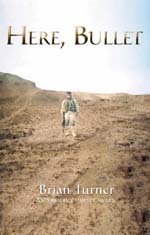
Brian Turner, HERE, BULLET: and the PEN Award


When I first thumbed through HERE, BULLET, the notable first collection of poetry from Brian James, I stumbled and had to sit down. This isn't amateur hour from the war, was my startled thought -- it's highly professional poetry from a poet who knows the field.

And that, in turn, is why I am delighted this evening to pass along news that emerged October 13, but just caught up with me: The PEN USA Literary Award for Poetry is going to Brian Turner's HERE, BULLET. The award ceremony takes place in December. It will probably wreak havoc with Turner's schedule, as he is much in demand for readings and interviews.

In a short, pithy essay for the New York Foundation for the Arts site (http://www.nyfa.org/level3.asp?id=418&fid=6&sid=17), Turner describes himself as having been an "embedded poet" in Iraq. Veteran already of an MFA program, he lived in South Korea for a year, then entered the armed forces (U.S. Army) for seven years (the same as the apprenticeship period for which the biblical Jacob labored to win his wife; hmm). Part of the service took place in Bosnia-Herzegovina with the 10th Mountain Division; the most significant, in terms of HERE, BULLET, was the final year, spent as a buck sergeant in Iraq.

This poetry is finely crafted, resonant with form, carefully shaped lines, spare language and rich images. The war reports are clean and clear; sorrow, shock, pain, and fear emerge without headlines or italics. There isn't even a lot of blood, although there is plenty of death. My current favorite example of this is the final stanza of "Hwy 1," which, like many of the poems, bears an epigraph from Arabic poetry (Turner determinedly immersed himself in poetry, people, language: "embedded" at its most complex.) The opening line of the poem is, "It begins with the Highway of Death," and the final stanza is:

Cranes roost atop power lines in enormous
bowl-shaped nests of sticks and twigs,
and when a sergeant shoots one from the highway
it pauses, as if amazed that death has found it
here, at 7 A.M. on such a beautiful morning,
before pitching over the side and falling
in a slow unraveling of feathers and wings.

Another facet of this collection to treasure is that despite the clearly personal impact, Turner hasn't tried to turn his sequence of poems into a time-labeled narrative of his year in Iraq. Only the reflective "Night in Blue," near the end of the volume, asking (among other hard questions) "Has this year made me a better lover?", suggests the transition back to civilian presence in a safer landscape. And instead of "me me me" there is a quiet unfolding of layers, of friendships, of loss and growth.

The PEN USA Literary Awards honor more than poetry; they honor a sense of outreach and commitment to the people of a beleaguered planet. Turner's HERE, BULLET is hence the obvious and valued selection for the 2006 award.

Tuesday, October 10, 2006

Sweeney St. George in the New York Times

Congrats to Vermont author Sarah Stewart Taylor, whose fourth Sweeney St. George mystery, STILL AS DEATH, earned a long complimentary paragraph from Marilyn Stasio in Sunday's New York Times Book Review section. Brava!

Crown Ring Press, Sara Owen


One delight of collecting poetry, mysteries, and fine press work is to catch something great in the first book, the one that others aren't yet aware of -- but that sends shivers down your back as you say, "I really LIKE this one."

So here's the good news: There's a brand new press with its first gorgeous offering, and Kingdom Books has three copies available. The press is Crown Ring; the book artist is Sara Owen; and her "fine press genealogy" goes directly to the Univesity of Alabama book arts MFA program, run by Steve Miller (studied with Walter Hamady; founde Red Ozier Press; now he's Red Hydra Press in Alabama).

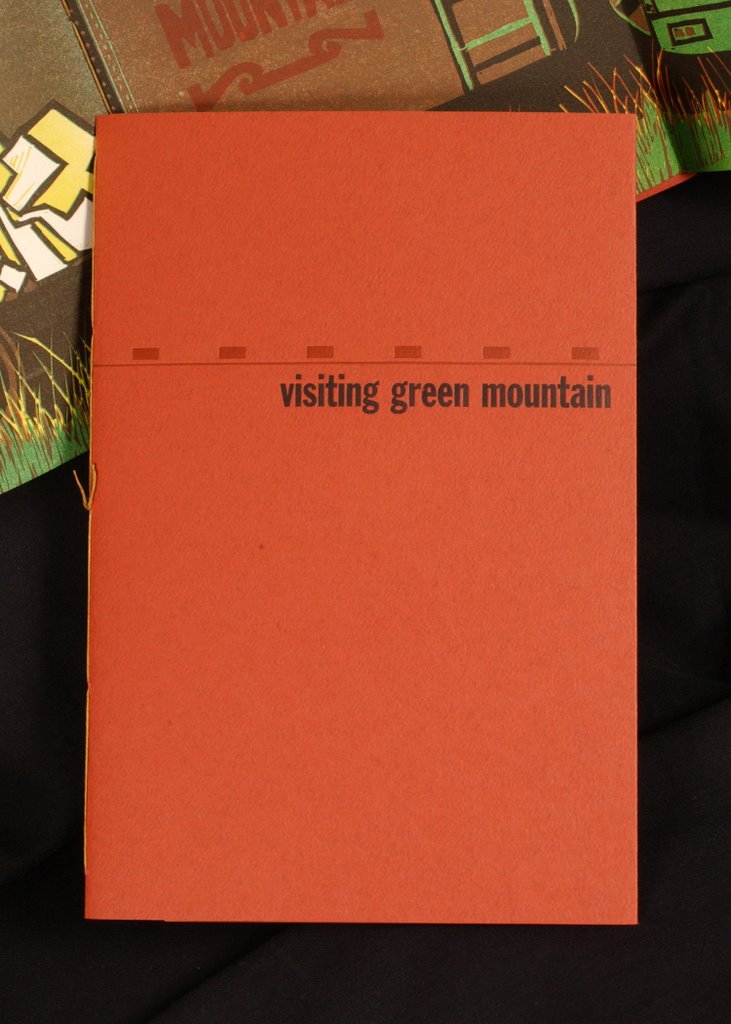
And the book is, Visiting Green Mountain. Printed in the winter of 2006 at U of A, in Walbaum type (letterpress) on Rives Heavyweight, it's a nostalgic mini-memoir of family, of Vermont, and of trains. Covered in deep red with black type, neatly stitched with golden cord, the front free endpages are chestnut brown and the title and closing pages (ivory) are pictorial. But the stunning heart of this limited edition (only 75 copies) is a double-width centerfold that spreads out to the width of four pages. I'll post images of the cover and centerfold here. It's $45 plus $4.25 postage (Priority Mail).

This is Sara Owen's first book. I look forward to adding subsequent ones ... and to enjoying that satisfaction of having spotted the first, when it was still a relative unknown.

Saturday, October 07, 2006

Writers, Readers, Voices: A Remarkable Festival of Books


The Brattleboro Literary Festival began Friday evening, and continues through Sunday October 8. From the strange coincidence mentioned at the opening of Friday's kickoff reading, a haunting and powerful spirit of conversation across cultures and languages fluorished.

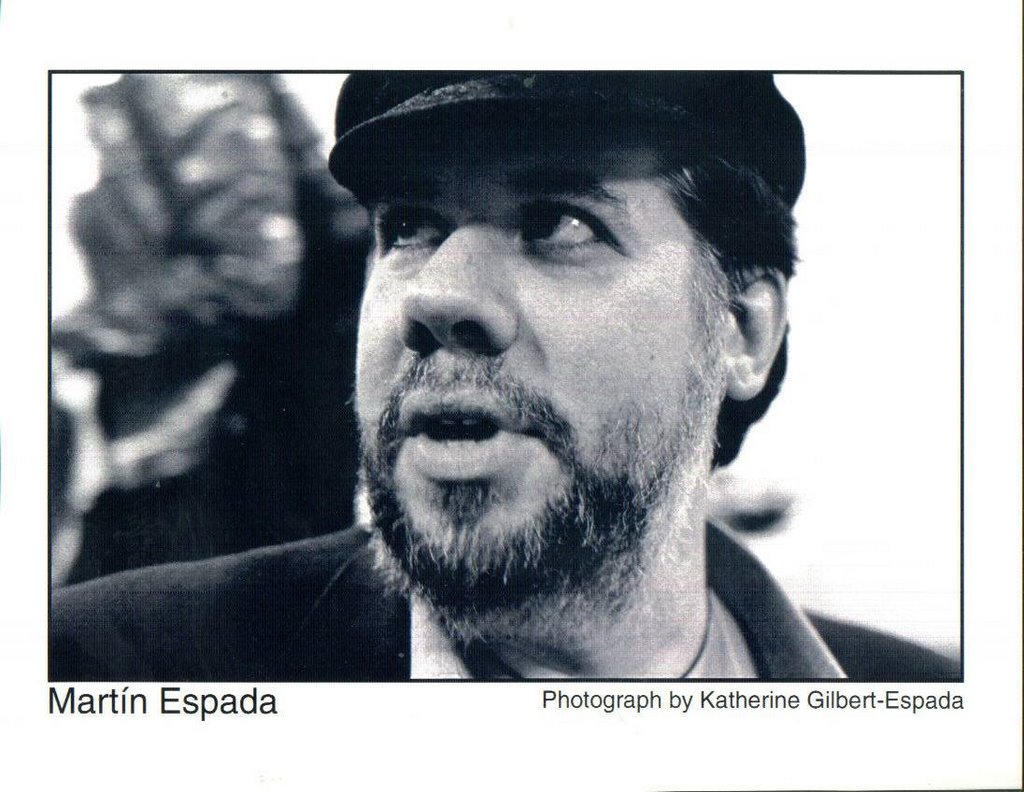
Here's the coincidence: Both Ilya Kaminsky and Martín Espada, the poets reading that night, became Legal Aid lawyers and worked for the rights and lives of those whose voices are rarely heard, and rarely strong enough.

Like many a coincidence, when you delve into this one further, it starts to make astounding sense. The two poets speak, in their writing, not just for themselves but also for those wounded and threatened. Kaminsky's award-winning book DANCING IN ODESSA begins with "Author's Prayer," opening:

If I speak for the dead, I must leave
this animal of my body,

I must write the same poem over and over,
for an empty page is the white flag of their surrender.


And Espada, in his newly released THE REPUBLIC OF POETRY, speaks for Chile and its people; for the beloved poet Pablo Neruda; and for the lost, the disappeared, the dead. From "The Soldiers in the Garden," set outside the home of the dying Neruda:

For thirty years
we have been searching
for another incantation
to make the soldiers
vanish from the garden.


Framing his reading Friday with poems from his earlier book ALABANZA, Espada also gave voice to veterans of the Vietnam war, in the context of the enduring wars in the Middle East.

Translation weaves its complex patterns through both poets' lives, also: Espada, a New York Puerto Rican, learned his Spanish as a second language and now it's part of his heart, just as his heart, corazon, is part of a throbbing, drumming voice of poetry that echoes the rhythms of Latin America.

And Kaminsky, who came from the Ukraine to the United States as a small boy and who "had to learn English or die," proclaims his poetry with both the heavy accent of his birth language and the rising call of one who has long ago ceased being able to hear "normally."

So one of today's extraordinary moments was Espada reading multilingually with Iranian poetry translator Niloufar Talebi. Talebi, lead poet in the afternoon's "Hearts of Spain" exploration of poetry and the Spanish Civil War, is engineering a global translation effort for the poems of Iran -- which has its "disappeared" just as Chile and Nicaragua and many Caribbean islands have experienced. Her presentation of Neruda quickly grew to include Espada and his booming voice, driving the Spanish words into the air like hammered beams, strong, true, visible. When Espada later commanded the podium on his own, working with the words of Vallejo, Hernandes, and more (including some of his own translation work), the packed room shook with his vehemence.

And one of last night's unforgettable visions was the four-way poetic performance of (1) Ilya Kaminsky, (2) audience members holding and sharing with each other copies of DANCING WITH ODESSA that Ilya provided to help them understand his voice, (3) a Sign translator for the deaf moving Kaminsky's poetry from the page to her hands and face seconds before Kaminsky spoke the words, and (4) a second translator for the deaf, picking up the text from her collaborator and echoing it, with dramatic gestures and expressions, for those able to lift their eyes from the printed pages.

Let not the distance in time and place, from the Spanish Civil War to today's Vermont festival, be considered so very wide as to defy translation. With Brian Turner, soldier/poet and author of the acclaimed HERE, BULLET also giving voice to the poetry of 1938 and 1939 Spain came the reminder that this war and the war in Iraq, where Turner served, share events, mishaps, shapes on the tongue and in the mind's eye, courage and love, and the same abiding and terrible losses. Turner's poem "Body Bags" begins with an image from any war, from all:

A murder of crows looks on in silence
from the eucalyptus trees above
as we stand over the bodies --


And Turner frames his sections of poems with much older work from the Qur'an and other translations from the Arabic: such as, "Do they not see the birds above their heads, / spreading their wings and closing them?"

To share all this -- ah, poetry. Ah, the festival. Ah, the poets. Or as Kaminsky wrote of World War II (multilingual) poet Paul Celan:

He writes toward your mouth
with his fingers.


[N.B. Espada reads at the St. Johnsbury Athenaeum on Sunday October 8 at 3 p.m. -- free and open to the public, and fully accessible. I would drive at least 200 miles again to hear him read.]

Friday, October 06, 2006

Brattleboro Literary Festival: Hearts of Spain, and More

Vermont is one of the "whitest" states in the nation, and tourism promoters encourage taking this to mean that the state is filled with white-haired wise elders in red-and-black checked wool jackets and jeans, varied by the addition of barn boots or flowery pocketed aprons.

This year's Brattleboro Literary Festival reminds us that there's depth and diversity way beyond the tourism imagery -- thank goodness!

Featured at the festival, which begins tonight, is poetry rooted in Russia, Spain, Latin American, and Iran. This evening's 7:30 reading kicks off the weekend with Martín Espada (sometimes called THE Latino voice of his generation) and Ilya Kaminsky (not yet as noted as he ought to be; a remarkable young Russian poet who's lived in the US much of his life but who speaks from another drama entirely).

Saturday, at 11:45, poet Niloufar Talebi brings the Iranian experience forward, thanks to The Translation Project. And the 3:15 panel "Hearts of Spain: Poetry of the Spanish Civil War" provokes fresh vision through readings by Espada and also the newly noted poet Brian Turner, author of Here, Bullet!

These are my top picks from a rich weekend schedule that also includes poets Maxine Kumin and Chard deNiord, novelist/musician Madison Smartt Bell, Vermont fiction crafters Mary Gaitskill and Jeffrey Lent, and on Sunday an appearance by Jamaica Kincaid.

For a full listing of events, check the web site: www.brattleboroliteraryfestival.org


Reminder: Martín Espada reads in St. Johnsbury, through sponsorship by Kingdom Books, on Sunday October 8 at 3 p.m. at the St. Johnsbury Athenaeum. All events are free and open to the public. We've posted a review of Espada's new book, The Republic of Poetry, on our web site, www.KingdomBks.com .

Saturday, September 30, 2006

Design Decisions: Pennyroyal Press Editions of Alice in Wonderland and The Wizard of Oz

Barry Moser talked on Thursday (at the Eric Carle Museum of Picture Book Art) about the parallels and perpendiculars of Alice's Adventures in Wonderland and Through the Looking Glass, and Dorothy's tale in The Wizard of Oz. Much of the talk matched, word for word, the essay "Shadow Plays in Black & White" in Moser's collection, In the Face of Presumptions. Pluses of the talk, though, were additional reflections on the role of illustrators -- including reference to the disservice that illustrators can do by fixing images and preventing readers' visions. Moser also identified many of the American political faces he used as models for the characters. Among them were Alexander Haig, Nancy Reagan, Caspar Weinberger, and Ronald Reagan. (Fear not, both Alice and Dorothy were modeled from Moser's own daughter, a dark-haired gentle face with quiet merriment.) Asked whether he was crafting deliberate political commentary, Moser admitted that he doesn't want story readers to "see" the political characters until or unless someone points them out; he uses them instead to entertain himself during the long hard work of crafting the books!

Designing and illustrating the three books (two for Alice) led Moser to reflect on their authors' close connections with death and its implications. Seeing each narrative as one of journeying, Moser quoted Eudora Welty from The Robber Bridegroom: "A journey is forever lonely and parallel to death." He also noted the vast difference in "feel" of the narratives, seeing the Alice work as taking place in "closed space" and te Dorothy as related to the openness of the American Midwest.

This significant difference became, in turn, a way to look at the choices in design for the University of California limited editions of the books. The two Alice books, in Moser's hands, evoked Victorian luxury through their half-leather bindings and decorative papers. For The Wizard of Oz, though, Moser and his collaborators used paper over boards, with simple gold stamping on the front panel and a blind stamp on the rear: "No tooled leather and marbled paper for this child of poverty, this child of the prairies, this child of dust."

Typography choices drew on similar senses: The page designs for Alice, with their sidenotes, colors, and inserted illustrations, give an effect that Moser describes as "decorated and calculated pandemonium." In Oz, though, he used typography based on the O and Z (presaging the choice Moser would later make with the first page of his Pennyroyal Bible). Blessed with "lots of white space" and executed in black and white, Moser's Oz only indulges in color for the running heads, which cue to the Map of the Marvelous Land of Oz drawn by L. Frank Baum.

As designer, illustrator, typographer, and maker of a multitude of choices, Moser exposes his own reflections about life and the texts, saying, "Death presages the feeling of loneliness which to me premeates all three stories."

Most of all, he relies on vision, in both senses: "It is through the act of seeing -- and I mean both inward seeing and outward seeing -- that I come to think what I think and make the judgments that I make."

Tuesday, September 26, 2006

Poetry Alert: Rachel Hadas

Maybe you already have a copy of the 2006 Rachel Hadas collection, THE RIVER OF FORGETFULNESS -- and maybe you heard one of its poems read on Garrison Keillor's Writer's Almanac (9/10/06). Or maybe you made it to the launch event for BEST AMERICAN POETRY 2006 (ed. Billy Collins; series ed. David Lehman), at the New School, with Hadas reading her work.

But there's more to come: Hadas reads at the KGB Bar (85 E. 4th St, NYC; a nice neighborhood place with great poetry events) on Monday November 6 at 7:30 p.m. She has a piece in the fall issue of THE COMMON REVIEW.

And, easiest of all, you can click here to read her new poem in THE NATION:

http://www.thenation.com/docprem.mhtml?i=20061009&s=poem

Tuesday, September 19, 2006

For All Readers of the Nancy Drew Series

I confess we're a bit "fried" after yesterday's double event: a 4 p.m. reading by Sarah Stewart Taylor from her fourth Sweeney St. George mystery STILL AS DEATH, followed by a political dinner (offered free to our guests, our fall 2006 "campaign contribution") for Taylor's husband Matt Dunne (running for Vermont Lt. Governor, Dem.). What great conversations! And it's good to see this strong author getting into her stride, even with baby on hip. (Their son Judson was born in the middle of this latest book's writing period, just over a year ago.)

One quick note: Taylor (whose full name always rings a faint bell for me on those old Mary Stewart romantic mysteries) credited a lifetime of reading Dorothy Sayers and Agatha Christie as her roots in mystery writing. Then she added, almost parenthetically, "And of course when I was younger, Nancy Drew."

The Nancy Drew series was the "milk" of childhood mystery reading for many women, and certainly was for me, with several other series and a quick jump to British mysteries, adult level, by age 10 or so.

Now I'm curious: What's the percentage of this experience? And for the gents out there -- what mysteries were your "training wheels" mysteries?