Sunday, August 30, 2015

Paranormal Mystery, DECEPTIONS, "A Cainsville Novel," Kelley Armstrong

The third novel in Canadian fantasy author Kelley Armstrong's Cainsville Series came my way this month, and it's a fast-paced thriller -- with the complication of two competing teams being Welsh mystical beings, one "fae" (not the sweet kind of fairy; picture instead carnival roustabouts), and the other "Huntsmen," drawn to the wild in the form of forests, animals, and their own lives.

At the center of a mythic confrontation between the two, however, is something more familiar to mystery readers: Olivia Taylor-Jones, strong woman equally capable with switchblade or firearm, delving into the crimes that her birth parents seem to have committed. Serial murders, to be precise.

And from there, despite paranormal forces and a generations-in-the-making competition between two suitors, two peoples, and one smart woman, there's a traditional crime investigation between the covers of DECEPTIONS. Olivia's determination to pry the truth from her birth parents and the people intervening is aided by her loyal defense-attorney friend Gabriel and her equally loyal lover Ricky, who's the heir-apparent of a major motorcycle gang with illegal enterprises and an antiquated code of ethics that frames women as belongings.

Obviously that's not going to fit Olivia. But she's self-confident enough to play along when it's necessary, as she figures out what Ricky's obligations to his own family are, and what the powerful attraction is between the two of them.

If the paranormal aspects were crucial to Olivia unfolding the secrets around her, or to her decisions about her life, I wouldn't pass along word of this book. But in fact, they're not -- they're the ethnic wallpaper for background. Consider this passage:
The dealership visit lifted Gabriel's mood immensely. I think my handling of the situation amused him. While I'd been following in the career footsteps of my philanthropist mother, I really was Daddy's girl. My father had turned the family business -- the Mills & Jones department store -- back into the Chicago landmark it'd been in the fifties, and he hadn't done that by letting salespeople tell him he couldn't get stock in until next month.

We had an hour before our appointment with Chandler, so Gabriel decided to swing by the office. ... It is relatively close to the Cook County jail. Given Gabriel's clientele, that may be the main attraction.
Nothing remotely "Harry Potter" about that passage, right? And Olivia's choices and actions are just as solid and strong and adult as all that. Consider this a crime fiction parallel to Diana Gabaldon's Outworlder series, with a bit more capability and friendship and a bit less graphic sexuality. A bit.

I enjoyed DECEPTIONS a lot. Maybe not quite enough to go out and search for the two preceding books in the series, Omens and Visions (those do sound a bit more magic-focused, don't they?). But I like Olivia, or Liv, very much, and I think Armstrong -- better known for her dozens of fantasy novels -- has a solid series going here. I would read the next one, and expect to enjoy it. Diversity is the spice of the reading life ... even for crime fiction.

Saturday, August 29, 2015

Maine Mystery: Lea Wait, THREADS OF EVIDENCE

Maine author Lea Wait is on a roll with the second in her new "Mainely Needlepoint Mystery" series, featuring Angela Curtis -- young (in her 20s), inquisitive, struggling to pull her grandmother's cleverly created needlepoint business into the 21st century, and best of all, formerly employed by a private investigator in Arizona, so she knows how to pry into crime scenes and police situations, and ... she carries a handgun when needed. Good thing, considering that she's prying into long-buried murders.

In the first book of the series, Twisted Threads, Angie's return from her 10 years "away" took place because her long-missing Mama had been found. Well, her body, anyway. And in spite of threats and risks, Angie settled into quaint, tourist-dependent Haven Harbor, Maine, and dug up the real story of her mother's disappearance and death.

So now in THREADS OF EVIDENCE she already has a bit of a reputation in town as a crime solver, even though she keeps explaining she was never a licensed PI -- she just did the legwork for one. Well, that's good enough. At least, wealthy and gracious actress Skye West thinks so, as she recruits Angie to discover the truth about another long-ago death, one from 1970, when Skye's best friend, a teen named Jasmine, died suddenly during a party at the Gardener estate in town. The actress needs someone who can speak directly with police officers, without cringing, and who'll go from one person to another, among the many town residents who might have seen or known something about Jasmine's death. Skye West has good reason to believe it wasn't an accident. And when her own drink is poisoned with arsenic during the first Open House at the estate, the actress is even more convinced -- and so is Angie.

I moved "paid work" out of the way to make room to finish this book last week, because it was so well written that I didn't want to put it down. (Yes, I read way too late into a couple of nights!) Angie's reactions and choices are spot on target. And although I hated hearing from one character after another that 1970 was a LONG time ago (hey, I still have a photo of my miniskirt and fishnet stockings from back then, and can hum most of the Vietnam War-era folk songs), I have to admit it's true -- and because of the distance in time, it works perfectly for Wait's deft creation of an "edgy cozy" series, where real deaths happen but "off stage" and there's no gore ... but look out for arsenic, fire, and other scary events that stack up when you're stalking someone who didn't have enough sense in the past to solve things normally, but killed someone instead.

A small extra that I especially enjoyed in THREADS OF EVIDENCE is the quotes at the start of each chapter, most of which come from needlework, like samplers, done in New England a couple of centuries ago. Readers of Wait's earlier series, the "Shadows" one, will recall this device from those books, and it works even better here, to dress the stories in mood and place.

Kensington Books, publisher of this lively series, must have a lot of faith in it, too: I see the next one is coming out in January, Thread and Gone. I'm glad I'll be able to have an extra dose of Angie Curtis sooner than the traditional "1 year" gap between books.

Oh, you don't need to read Twisted Threads (book 1) before this one -- Wait is adept at summarizing the important points to get the reader into the swing of the sequel -- but why not? The books are "paperback originals" (no hardcover) and fit nicely into a travel bag, with brief chapters ideal for waiting in line (or other challenges of modern outside-of-rural-Maine life). They'll make good gifts, too, full of a sense of community and friendship as well as Angie's determination not to let a killer get away with something. Thanks, Lea Wait and Kensington; what a way to wrap up the summer!

Monday, August 24, 2015

Reading Is Global -- Especially for Mysteries!

Sometimes I peek at the "statistics" for the Kingdom Books review blog. Thought you might enjoy seeing a recent batch of them, too -- the places our blog readers came from over a recent couple of days (with many thanks to Blogger for hosting the blog and making this available):

EntryPageviews
United States
422
Germany
114
United Kingdom
 32
France
26
Ukraine
24
Philippines
19
Canada
15
Russia
12
China
8
Japan
8

Sunday, August 23, 2015

New From Eric Rickstad, Releasing Sept 1 -- as an E-Book!

It's a Brave New World in book publishing, and here's one more item of proof: HarperCollins is reversing the "accepted" publication routine, and issuing Eric Rickstad's new Vermont mystery as an e-book before the print version!

LIE IN WAIT is already available for pre-order, and will launch on September 1. A classic police investigation mystery with a few twists, it's set in the fictional town of Canaan (ignore any idea that this matches the real Canaan, Vermont -- it doesn't, as mentioned for his previous Gothic thriller The Silent Girls) and takes place in 2010, during the height of the "Take Back Vermont" campaign (this too is a slight twist of "real" history, as the campaign happened in 2000; here's a link to a Wikipedia explanation). Some naive visitors to the Green Mountain State at that time misunderstood the lawn signs with the phrase, thinking it referred to a tourism effort (as in, buy Vermont products and take them back home with you). Actually it was a very bitter time in Vermont community life, as factions wrestled over whether the law creating "civil unions" for same-sex couples was a courteous and appropriate recognition of an established family form, or blasphemous and disgusting enabling of a sexuality that many considered "wrong," or at least "abnormal."

In real life, although the time was contentious and led to many public spats (and tears), the effort to keep conversations civil won out, and eventually, nine years later, Vermont made possible same-sex marriage as a legal entity. Tourism and same-sex weddings changed the minds of some who'd opposed the new law; others became quieter in their dissent; and many rejoiced.

Rickstad's fictional Vermont, however, is a dangerous place for a lawyer defending a civil suit brought by two men who want their union legalized. And as LIE IN WAIT opens, we find the entire town of Canaan up in arms over The Case that attorney Jon Merryfield is representing. Soon the domestic scene of the Merryfield home is marred by a brutal murder of the babysitter -- and the action rapidly intensifies.

At the heart of the book is Sonja Test, a detective on the town police force (Vermont residents, here's your cue again to recall that this is fiction). Eager to solve the crime and ensure justice, she's stymied right away by her position as a newbie and as a town detective -- because the state police, in the person of senior detective Richard North, rightfully takes ownership of the case. Test is so new at her job that she trips over her own feet, antagonizing both North and the witnesses.
As Test approached, North averted his eyes to the cellar stairs. Test could tell from the creases carved in his face by his scowl that whatever was down in that cellar was nasty. She'd not worked a murder scene. They were few and far between in Canaan.

She prepared herself by taking a slow deep breath through her nose; a technique she employed when running half marathons.

Her fist homicide and she would work it -- or support it, rather -- alone.

"It's not pretty," North said to Test without saying hello or shaking her hand. Had he thought she'd think it would be pretty? Was he patronizing her? She was uncertain.
Sonja Test is someone easy to identify with. She's passionate about her job, wants to stake out her turf, longs to make a reputation as an effective detective. At the same time, she has two small children and a husband, none of whom are getting much attention as she repeatedly puts the investigation first. Risks to her kids arise; soon she's afraid her job's on the line, too.

Rickstad chooses to display the minds of several other people as the case goes along -- from the babysitter on the evening of her death, to three or four possible suspects, all of whom are linked in a crime from years ago that was never prosecuted. (Note: If you can't abide reading plots that involve sexual abuse, let this one pass.) And there's serious confusion for some of the townspeople, who confuse gay sex of adults, with the abuse of sexual power over children.

Test is a compelling character, so painfully human that her stumbles along the way are almost endearing. Her persistence and determination and willingness to risk being wrong add up to the capacity to get close to the solution of the crime. But as it becomes clear that someone is being framed, will Sonja Test be able to spot the real hand behind the evil actions taking place?

If I could change one thing about the way Rickstad wraps up this crime novel, it would be in terms of how Sonja Test puts together the facts at last; I like to see a plucky protagonist make worthwhile choices when it counts, and maybe this fictional investigator doesn't yet have the skills to pull off the final surge of detection. See what you think -- and whether you feel she's earned her way here.

What a treat to have this come out as an inexpensive e-book first -- if you have a device for reading an e-book, or are willing to use the software available to read it on your computer, it's an easy pick for a Vermont thriller. Purchase directly from the publisher with this link, or use other e-book routes that work for you.

Just remember -- it's fiction! (We Green Mountain folks want you to feel safe to come visit us!)

Best Day of the Summer: Louise Penny Launches Her Newest Book

Somehow it's always a glorious summer day -- we cross the border into Canada and the magic of the "pre-release" launch of Louise Penny's new book makes the day sparkly.


Or, as Brome Lake Books bookseller Danny McAuley and his wife Lucy Hoblyn proclaimed yesterday, "Welcome to the Global Launch of The Nature of the Beast!"

Hosted by Danny and Lucy at the Knowlton Community Center, the event filled 250 seats plus standing room along the edges. Louise Penny's "patent pending" assistant Lise helped people prepare their books for the author's signature. Young French-speaking adolescents beamed at a table promoting the Alzheimer's Society (Societé), a cause dear to this author's heart and family. And I overheard in the front row two women swapping biographic details of this author whose Quebec-set mysteries, with their depth of human understanding, have become such a treasure for readers around the world. As the author herself noted,
Really, like most of [my] books, it's not really about murder -- it's about community and friendship and love and lots more ... it's about the stories we tell ourselves that allow us to get out of bed and that propel us forward.
Penny noted that the main plot point of The Nature of the Beast -- and she was very careful not to say much, wanting readers to enjoy the book without "spoilers" -- is something she found out about, some 25 years ago, and held onto. "I had to figure out a way to tell the story that would make sense, and also that would make it my own."

The one aspect of the book that she would confirm, prompted by a question from Danny McAuley, was that it discloses the back-story of much-loved character Ruth in the Inspector Gamache mysteries.

As usual, the event featured the charm of seeing Danny, a devoted bookseller and friend, interview this accomplished journalist and crime fiction author. Danny and his family and friends also entertained the crowd with three very effective and humorous skits from earlier Penny work, especially A Trick of the Light, on stage. After performing as "characters" from the books, the group then gave the author assorted "welcome to your new home" gifts, as she and her husband Michael have announced a move to the town of Knowlton. Among the well-chosen items were a "ducky" keychain (if you know the books, you know this reflects the character Ruth!) and a Knowlton High School sweatshirt.

Also mentioned: the team's current project on "The Real Places of Three Pines" (Louise Penny said, "It's kind of a virtual bistro!"), which can be followed at Gamacheseries.com; the need for protecting the author's privacy and writing time in her new location; and the human values of Penny's fictional town of Three Pines -- in Penny's words:
The books -- yes it's about terror and it's about violence, but it's also balanced with love and with the choices we can make. ... It takes so much more courage to be a decent human being than to make the cutting remark, and that's what [husband] Michael does, and [main character retired Chief Inspector of the Sureté] Gamache.
I'll post a review of the book later in the week. For today, Dave is scrambling to make a signed copy of this one -- and of the recently released anniversary edition, from Britain, of the author's first book Still Life -- available at our ABE site.

If I get a moment later today, I'll also pass along Penny's startling description of herself at age 8! Come on back for more.

Tuesday, August 18, 2015

Philippine Crime Fiction, SMALLER AND SMALLER CIRCLES, F. H. Batacan

A story within a story -- a no-holds-barred dark police procedural with brutal crimes and a very twisted criminal, and at the same time a remarkable publishing success created by two astounding women. Yes, that's the new crime novel SMALLER AND SMALLER CIRCLES from F. H. Batacan, whose work in a Philippine intelligence agency fueled the passions that feed this compelling work of suspense and salvation.

In an author interview provided by publisher Soho Crime, Batacan confirms grimly that injustice hasn't changed in more than a decade in her homeland. "The poor and disadvantaged have little hope of justice or redress of grievance, the politicians and lawmakers are still happily raiding the public coffers, and crimes go unsolved and unpunished by the thousands."

But seeing that situation through the eyes of a forensic researcher and a psychologist who happen to be Jesuit priests, Father Gus Saenz and Father Jerome Lucero, cuts more deeply than the plain statistics. Soon after SMALLER AND SMALLER CIRCLES opens, both men face the frustration of knowing another Philippine priest, at a higher level, still has access to children, even though he's a known molester and abuser. At the same time, they're caught up in investigating the gruesomely murdered bodies of children at the edge of society, from families so poor than the children's dump scavenging has to provide food and scant income.

The friendship between Saenz and Jerome is deep and complex -- the older man, Father Gus Saenz, was mentor to the younger, but Father Jerome is no longer a schoolboy, and his insights into criminal behavior the the adult consequences of child abuse are invaluable to Saenz. Still, neither of them realized how desperate the poverty around them could be, until they heard from one dead child's father, telling them how bad life's been, with one parent ill (lung condition) and the other an ex-convict:
"We depended on [the child's] earnings to get by. Often, he would bring food from the dump."

Saenz's eyes widened. "From the dump?"

"If he couldn't find metal or wood or paper to sell, he would look for food -- anything thrown away that could still be used. If it was too spoiled or rotten, he would mix it together for pig slop and sell it. If there were scraps that could still be eaten, he would bring them home. Vegetables, fruit. Moldy bread. Animal fat, animal skin. Bones to make soup." ...

Saenz isn't naive; he's always known that this is the sort of existence that the country's poorest live from day to day. But to hear about it firsthand, told with such apathy and resignation, is a different thing altogether.
But is someone harvesting organs from the fragile children of the mountains of trash? Or re-enacting a horrible abuse on the small bodies?

The warm and direct friendship of the two Jesuit priests, the snippets of revelation from the criminal, and the self-justifications of the empowered all weave together into an intriguing and well-paced book that I couldn't put down. The title is from the perpetrator's perception of the investigators: "I can feel them. Scurrying in circles around me, smaller and smaller circles like rats around a crust of bread or a piece of cheese. Waiting, waiting, waiting for the right moment. The moment when I slip up, when I make a mistake, when I get careless. ... The priest knows. He's coming for me."

In fact, the writing is so smooth, the story so well plotted and well knit, that it's hard to believe the tale of this book's discovery: After Batacan won a prestigious prize in the Philippines for a much shorter manuscript, a mere 40,000 words long (about 150 pages), Soho editor Juliet Grames overlooked it once, then happened to read it, at the same time when the author was read to expand it. "I realized the novel was rich with atmosphere and heroism, and simultaneously darkly noir and glimmering with faith in the better aspects of human nature," Grames reported.

Batacan's decision to expand the story to the full length of a Soho Crime novel succeeded so well that the book might have come this way from the start: well rounded, and uplifting, in spite of the grim brutality it portrays.

It's good to know that Batacan plans to give us more of these two investigating Jesuits. Their triumphs may not gain full justice in a land where so much is politically impossible -- but they have each other's back, and they know what they're called to do, and who is calling them to action.


Ellie's in Danger in China, in DRAGON DAY, Lisa Brackmann

If only this were the "old days," when the death of Sherlock Holmes could be reversed by reader pressure ... If only DRAGON DAYS were not the finale of Lisa Brackmann's cutting-edge Ellie McEnroe series ... Then again, knowing before opening the book that this is The End gives extra sharpness to the start of this fast-paced crime thriller set in today's Shanghai and beyond. But omigosh, I don't want to say goodbye to Ellie, or "Yili" as she's called by her Chinese friends. Nor do I want those strands of suspense and adventure from Rock Paper Tiger and from Hour of the Rat to finally be knitted up.

But that's what California author Lisa Brackmann announced, along with Soho Crime, and that's that. If you haven't read the earlier two books, you'll still be able to enjoy every crazy moment of DRAGON DAY -- but if you have the time, dive into them first. It will add to the sense of danger that Ellie can't avoid, as her underground artist friend Lao Zhang announces he's coming back to the Beijing to confront the dangers that Ellie's been handling on his behalf. Well, she was only supposed to handle his artwork, the way an agent would. But the art and its sales are banned, the government and police of at least one country, probably two, are watching her every move (and email), and as a result, business hasn't been great.

Moreover, unscrupulous and powerful (and murderous) art collector Sidney Cao has Ellie in his debt -- he saved her life in an earlier book -- and there are tasks he wants her to tackle for him, in terms of his overprivileged and even more unscrupulous grown children. Tasks that force her into uneasy and unpleasant collusion with the same secret police who keep trying to force her to betray Lao Zhang. Sheesh!

Actually, Ellie's a lot more, umm, direct in her language. An Iraq War vet with lasting pain and a Percocet habit to go with it, she's beyond blunt. Plus, she's in something suspiciously like an intimate relationship with an undercover Chinese cop. Oops. She nicknamed him Creepy John a long time ago, but he's a lot more supportive of her than, say, her mom who's mostly living with her. Maybe that's because he knows what's going on:
"Maybe I can find out what they want from Zhang Jianli, what they say he did," John says, and he's making an effort to sound calm. Like it's no big deal. "He's just an artist. Maybe it isn't so bad."

I  don't know who he's trying to convince: me or himself.

"It doesn't matter what he did." Suddenly I'm so tired that I can't even hold my head up anymore. "It's whatever they want it to be, right?"

Because if there's anything I've learned, it's that sometimes there's no reason for any of it. Sometimes it's just wrong place, wrong time. Somebody with power gets a bug up his a**. Like the musical where the hungry guy steals the loaf of bread and the cop gets the hard-on of all hard-ons over it.

John rests his hand on mine, just for a moment, then pulls it away, like he's embarrassed.

"Try not to worry, Yili."

Right.
If that's too strong for you, the rest of the book won't be a good fit, as Sidney Cao's demands force Yili into situations full of sexual perversion (which thank goodness she only has to witness), family menace, and more than one mutilated body of an otherwise nice person. But if you enjoy noir, and the grim politics of global power, interspersed with humor and even some tenderness, well, DRAGON DAY was released today -- there's a copy waiting for you. (I strongly suggest getting all three in this series; it will be three great rides.)

Brackmann's quirky preface in Ellie's voice, reminding us that she was born in a year of the sheep (in the Chinese zodiac) but that China itself is nearly synonymous with dragons -- could there be a dragon in the sheep, or a sheep inside the dragon? -- is fair warning of the knotted problems ahead, and the potential for explosion as Lao Zhang's reappearance comes closer.

And it's worth guessing whether the book will end with dragon fire or sheep warmth.

Now that I have Ellie McEnroe permanently under my skin, I confess I'm very curious about Brackmann's next direction. Knowing how the publishing world works, I guess it will be about six months until hints emerge. Guess I have time to re-read the series, before that happens!

Wednesday, August 12, 2015

French Art Mystery, THE COLLECTOR, Anne-Laure Thiéblemont

"Paris had a way of making even gray beautiful." That's Marion Spicer's observation, as she steps out of a mansion after examining a phenomenal art collection that could someday belong to her, and into a classy neighborhood from which she can head toward Paris's "Golden Triangle: Avenue Montaigne, with Dior, Chanel, Nina Ricci, wealthy clients, and prestigious auctions."

That neighborhood, and Spicer's profession as art examiner to detect forged or stolen work at exalted value levels, are alluring invitations into a newly released investigative novel, THE COLLECTOR, the debut by Algerian-born Anne-Laure Thiéblemont. Thiéblemont, a journalist, magazine editor, and art historian, grew up in Madagascar, Lyon, Paris, and Bogota. The South American slant appears immediately in the book, as Marion Spicer's challenges all connect to items of Pre-Columbian art from one of the continent's most inaccessible mountain villages. The art was collected by Edward Magni, whose recent death also became the announcement to Marion, at last, of who her father really was. 

Except ... who was Magni, really? His sneering and manipulative assistant Gaudin seems unlikely to help Marion track down the three other art items that she must locate in order to claim her inheritance -- three that Magni personally sold, even though he "never" sold his collected items. Moreover, they are clearly of excessive value, laden with extraordinary gems, as well as cultural significance.

It turns out that the Golden Triangle of Paris also represents top-level manipulation of the art market and its afficionados. Soon Marion, directed blindly by her dead father's specifications, is dealing with the dark underside of the greed and art lust of the global network of collectors and their nexus in Paris. 

All this makes THE COLLECTOR a must for a shelf of art-related mysteries, or French ones, or those featuring strong women, or, best of all, the wide scope of today's translated crime fiction. Le French Book brought out THE COLLECTOR this week, adding to its rapid expansion in translated mysteries with "French accents." This one, translated by Sophie Weiner, reads fluidly, and satisfies the traditions of a fast-paced international crime novel, with enough twists and red herrings to keep the pages flipping. 

I would have liked a bit more of a "French accent" to the dialogue, which lacks the zing of some other translations -- and the occasional misstep in slang (a career woman referring to another professional as a "dude"? I don't think so) can be a bit jarring. I would have enjoyed a more quirky ending, too, with Marion Spicer speaking out better from her expertise and experience. But I enjoyed the ride of action and investigation. Thiéblemont is a skilled storyteller, and the suggestion of a series ahead is good news -- this journalist's move into crime fiction is a fruitful one, and I already expect that she'll bring more French-speaking locales into the Marion Spicer art-action books to come.

Sunday, August 09, 2015

Western Crime Fiction, Action, Compassion, in MOUNTAIN RAMPAGE, Scott Graham

Living in northern New England, I look to the voices of established Western writers to test the premises of new crime fiction from, say, Colorado -- like MOUNTAIN RAMPAGE, the second in an exciting and ambitious series from Durango, CO, author Scott Graham. It's reassuring to find both Ann Hillerman (daughter of Tony Hillerman) and Michael McGarrity -- one my faves among the very dark Western crime fiction -- vouching for Scott Graham's work. This assurance sets me free to ride the wild action sequences in Graham's book without stopping to ask "Could this happen?" And that's great, because an abandoned mine, wildfires, shootings, and hunting-gone-wicked rock the pages of MOUNTAIN RAMPAGE and the life of the Chuck Bender, archaeologist.

You know how some forms of "cozy" or "traditional" mystery can often involve the development of love and intrigue in the investigator, often a woman, who's trying to get to the bottom of a crime? Graham's great gift as a writer is to turn the paradigm around, giving us insight into Chuck Bender's struggles as a relatively new husband and step-father within a Latina family. In fact, Chuck takes reponsability in every aspect of his work life, too: directing a summer camp of interns, watching out for the bodies and souls of young men and women on an "exotic" archaeological site, and tracking down a poacher when the local police take the evidence too lightly. It's not the best way to keep his new marriage on steady ground, though, as the local (and very feisty) research librarian points out:
"The minute I saw your wife and girls, I knew you were a lucky man." Elaine paused. "Are you sure you don't want to keep it that way?"

"What do you mean by that?"

She pointed at the baggie on the pavement beside here. "This stuff has some bad juju to it. I can feel it."

Chuck studied her. She didn't seem the type, not remotely, and yet she was talking ... as if she knew of the skeletal remains at the bottom of the mine.

"I've been lucky enough so far," Chuck said. "I'm willing to take my chances."

Elaine sighed, smoke escaping her lips. "Of course you are."
Elaine's right, and Chuck is gambling with far more than his own chances. From valuable animals to possible gold in those hills, to the lives of risk-taking teens and young adults, there's a lot at stake here. Chuck's family members also face consequences from his actions. But his agony over each wrong step makes the reading more than worthwhile, and Graham is sure-handed in both the plot twists and the growth of this intriguing amateur sleuth.

Torrey House brought out Graham's debut, Canyon Sacrifice,  last December. You don't need to read them in order, but I think the series will be more satisfying that way -- and will hint at what's ahead for Scott Graham and Chuck Bender.

Vidar Sundstøl, THE RAVENS, "Minnesota Trilogy 3"

Some books don't belong in the summer reading pile. THE RAVENS, the satisfying concluding volume of Norwegian crime fiction author Vidar Sundstøl's "Minnesota Trilogy," is one of these. It's solid, nuanced, complex -- and heavy. But what could you expect, after the heft and intrigue of the two earlier volumes?

As a quick recap, The Land of Dreams took Lance Hansen, a U.S. Forest Service ranger who should never have been involved in investigating a crime of murder, to the dark side of suspicion and spiritual distress. Hansen's hope of amassing an impressive genealogy of his family takes a nosedive as he stumbles across possible evidence of a deadly crime in his family's past -- while struggling to make sense of a brutal killing in "his" forest terrain, along the North Shore of Lake Superior. More details here. Both Scandinavian roots and the tragic past of Native peoples along the lake are soon entwined, along with Hansen's desperation to sort out the threats he's finding and the way his life is crumbling.

The second volume, Only the Dead, is unique among modern crime fiction, as it dwells within a single hunting trip made into a nightmare while Hansen and his brother maneuver in a killer ice storm in the dense woods. It shouldn't be read alone, in my opinion -- which makes it a very good thing that the entire trilogy is now available.

With THE RAVENS, Sundstøl binds together the deadly threads and soul illnesses revealed in the earlier books. And if the end result is a bit less haunted, and a bit more of a traditional crime investigation, it still has shocking moments that make it clear why this unusual crime trilogy is published by the University of Minnesota Press. To resolve his crisis, and eventually untangle the crime, Hansen grapples with his personal hauntings by both Swamper Caribou (the long-dead Ojibwe victim) and the women in his life. To reach the truth, he puts himself and his possible future at risk, and confronts the secrets within his nearest family circle. He even seeks his former father-in-law's instruction:
"The important thing is to fast."

"But I won't be able to sleep if I'm hungry."

"Hungry?" Willy sounded annoyed. "Do you think this has anything to do with going to bed hungry? I'm talking about self-deprivation, Lance. Torture. You need to suffer until you have a vision ... you have to choose to do this. And make it part of your reality."
Don't get just one book (unless you want to start with just the first one; and when you finish it, I think you'll want the others). It's handy in some ways to have this be three volumes, but it's one massive and intense story, engaging, compelling, and lingering. I'll never enter the winter woods, or an ice storm, or a news story about a killing, in the same way again.

British Crime Fiction Sails Across to USA, with THE WOMAN BEFORE ME, Ruth Dugdall

The road to crime fiction publication can be a slow one. Ruth Dugdall's deep-driving thriller THE WOMAN BEFORE ME won the Debut Dagger from the CWA (Crime Writers Association, the prestigious mystery writers' group founded in the United Kingdom in 1953 by John Creasey). It reached British publication in 2010 -- and was just released this month in the United States by Legend Press (imprint of Legend Times Group, Trafalgar Square Publishing).

It was worth waiting for.

Dugdall, after working as a Probation Officer in high-security prisons in the UK for almost a decade, turns loose her insight into high-risk criminals, in the person of Cate Austin -- reporting for her first day at work as a prison probation officer, after a ragged few years of poor work performance. Not her fault, really: what else do you expect from divorce in the midst of parenting a toddler, juggling child care, arguing with a thoughtless ex who makes things harder than they need to be? And that's why Cate needs to do well and make a really strong impression at her new assignment. Arriving late on the first day, and being "hit on" by co-workers, suggests it's going to be tough, no matter what.

Cate's debut assignment is to assess whether Rose Wilks, an accused child murderer, is ready for parole. No matter what Cate decides, it's going to be controversial -- who wants a baby killer released? And it's clear right away that Rose is a powerful prisoner within the pecking order of women inmates. Plus Rose has steadily denied her guilt. That's not a good way to go into a parole hearing, as it means she's not going to say she's sorry. Cate's first task is to get Rose to open up at the prison, and it might not happen.
Rose smiled, her shoulders dropping a little. "So I'm in good hands?"

Cate knew this was an attempt to draw her in, but she was practised at rebuttal. "I'm sure you know my job is to write a considered report, recommending whether or not you should be released on parole licence. You've been found guilty of manslaughter and that's my starting point. What I'm interested in is if you'll reoffend. If you're sorry for your crime."

"And how will you know that?"

Now it was Cate's turn to consider. This question struck at the heart of her job, the weighing up of words and emotions. ... When Tim left she'd sunk into despair, robbed of her self-belief. She told herself now it was just the illness making her doubt her abilities. She was better now, ready to be back. She could do this.
Dugdall's hard-won experience is directly transferred into both Cate and Rose: two faces of women facing enormous and risky social pressures. And there's another woman whose past Cate will have to unearth, Emma, whose life has been eerily parallel to Rose's, and whose child Rose is accused of killing. Manslaughter? Murder? Jealousy? Emma was "the woman before" Rose with the same lover ... and Rose's baby is also dead.

This is a potent psychological thriller, driven by Rose's casual malice and wickedness in the past. Yet in the long run, there's reason to see things her way, and Cate's soon entwined in a web of motives, means, and opportunities that puts her own family at risk. And herself.

The point of view of a seasoned probation officer makes the writing in THE WOMAN BEFORE ME engrossing and believable, and the plot twists and emotional slashes repeatedly challenge easy solutions, "normal" beliefs. I found the book to be one of the summer's best -- and was intrigued to discover that Dugdall's been a very busy writer since that 2010 award. I hope her other books (see her website) make it across the ocean a bit more quickly than this one!

Monday, July 27, 2015

Missouri Mystery: A DECEPTIVE HOMECOMING, Anna Loan-Wilsey

The fourth in the Hattie Davish mystery series, A DECEPTIVE HOMECOMING, is scheduled for release July 28 -- just in time to slip it into the summer reading stack. Here's a well-written "traditional" mystery with intriguing setting, likeable amateur sleuth, and neatly chosen plot twists that keep the solution to Hattie's murderous puzzle out of reach until the final chapters.

Hattie Davish is a professional private secretary -- her typewriter and her shorthand skills are less important in the long run than her discretion and absolute loyalty to her employer. In the first three books of this series (A Lack of Temperance, Anything But Civil, A Sense of Entitlement), Hattie's embrace of this profession has set her aside as an unusual woman in the 1890s: one who is confident in her value and willing to take risks to protect her employer's life or reputation. Thus, Anna Loan-Wilsey brings us an "amateur sleuth" whose motives for investigating crimes (or even just extreme social disgrace!) are strong and compelling on behalf of the wealthy persons who pay for her services.

In this fourth book in the series, though, Hattie is on her own -- her employer is away, and she's abruptly responded to a request to return to her own hometown of St. Joseph, Missouri, where she attended Mrs. Chaplin's School for Women and developed her self-reliance and skills. She believes she's been asked (discreetly) to support her old schoolmate and friend Ginny, whose father has died. But things feel "off" somehow":
Ginny didn't show any visible signs [of sorrow] that I recognized: red-rimmed, puffy sad eyes, and bowed, trembling shoulders. [Instead,] Her countenance bore deep-seated dismay or displeasure and not grief. She hadn't even been holding a handkerchief. The Ginny I knew would've been inconsolable, not simply put out.

Had she changed that much in the time that I was gone?
For Hattie, being on hand for her friend was reasonable, despite the trip of halfway across the country from home. "When I'd learned of her father's sudden death, I didn't hesitate to attend the funeral and do whatever I could to ease her pain." But chapter 1 ends with Hattie's remarkable statement: "Now, after seeing the wrong body in the coffin, I wish I had never come."

There's much more wrong that a misidentified death in St. Joseph. Hattie's former teachers recruit her to visit the students and set an example for them -- everyone knows something about her recent investigative adventures! -- and almost immediately, she learns the school is in chaos: financial troubles that may involve fraudulent bookkeeping, damaged textbooks, distressed staff members and overexcited students.

The unanticipated reappearance of Hattie's suitor from her student years unsettles things further, but Hattie isn't just independent: indomitable and determined are traits she embraces. Even insisting that the rather frightening staff of the local State Lunatic Asylum allow her to look inside is something Hattie can handle, though her own past makes the experience doubly frightening for her.

Loan-Wilsey threads gentle humor into the suspense, without ever diminishing Hattie's dedication to truth and justice. Like her earlier books, this one is an enjoyable, satisfying read, meeting all the best expectations for a traditional mystery: red herrings, mixed motives, characters who have secrets (and what about Hattie's own?). No need to read the others first, though -- the books are nicely independent (like Hattie!), and although they are clearly well researched, the history never gets in the way of Loan-Wilsey's best skill: spinning a good story with ample rewards in the reading.

Saturday, July 25, 2015

Amish Country Mystery, AFTER THE STORM, Linda Castillo

AFTER THE STORM is the seventh investigation featuring Kate Burkholder, chief of police in the part-Amish community of Painters Mill. Linda Castillo's writing is so strong, her books so compelling, that I was startled last month to discover that many people don't yet know the series.

I posted a review of the third one (click here) a few  years ago; at this point in the series, Kate is secure in her job and cautiously enjoying a steady (if somewhat undefined) romantic and very loving relationship with State Agent John Tomasetti. Castillo has led Kate through the frictions and losses of her own Amish past, her departure from her culture and family (although she still has some connections, which become important here), and her choices in how to police a community where many people think they "know her" -- and don't.

Into this settled situation comes chaos: in the form of a tornado, a personal issue that threatens what Kate and Tomasetti have been building, and the discovery of a body ... an Mennonite death with Amish connections that will take Kate back onto challenging turf with various segments of the community.
I squat beside [the coroner]. "Doc, it looks like pieces of a garbage bag."

He tosses me a knowing look. "That doesn't bode well for whatever happened to this individual."

Uneasy questions pry into my brain. Did this person suffer some kind of fall and die? Was he crawling around under the old barn and got stuck? Was he working down here and suffered a heart attack? Or did someone murder him, place his body in a garbage bag, and dump it?

I think about the scarcity of bones, and something dark nudges my brain.
Castillo's writing is rich with imagery and character, along with affection. Losses in Kate Burkholder's life and community come with full emotional depth; gains are hard-earned and worthwhile. In other words, once again, Castillo provides a deeply satisfying book, framed in well-turned mystery traditions and made meaningful by the power of the lives revealed.

You don't need to read the others first -- and in fact, Castillo's books are so strong and vivid that I'd recommend NOT reading one after another. Space them out, if you haven't yet tried them. And let me know what you think of this latest. I'd say it's a keeper.

Quintessential Vermont: SHAPE OF THE SKY, Shelagh Connor Shapiro

Summer has settled around us, warm and humid, with lush gardens and the hum of lawnmowers, sometimes a tractor. The pond on the ridge is quiet. The blackbird babies have left the nest and their parents no longer shriek when I walk toward the willow thicket along the shore. Even the frogs have turned lazy and replete -- the peepfrogs don't need to issue mating calls any longer, and the fat green frogs with their hoarse banjo-string croaks only sound off once an hour or so.

But along with all that lazy contentment are patches of exhilaration and eager preparation, a few towns from here, as the much-photographed hill town of Peacham prepares for its annual "Peacham Acoustic Music Festival." I visited the café at the "four-corners" at the center of the village last week, and half the conversations touched on the festival ... it's coming soon, along with all those musicians.

Yet how different this celebration of traditional music is from some other summer festivals that have taken place in the Green Mountains in the past decades: the Grateful Dead in concert; Farm Aid mini versions; years of the Bread & Puppet Domestic Resurrection Circus.

And those are the events and times that Vermont author Shelagh Connor Shapiro captures in her 2014 novel SHAPE OF THE SKY, a gentle mystery in multiple voices. As the book opens, it's late winter, and farmers Georgia and Bill Farnham share impressions during the annual meeting of the tiny Vermont town of Resolute, population 613. When the proposal for the town to host a concert of the state's most famous band (now internationally famous) passes by vote, the Farnhams have their own way of deciding whether to plant the cornfield as usual in the coming spring -- or prepare to grid their field into campsites for the band's devoted followers and thousands in the audience.

Two weeks before the festival, there will be a death of a young woman -- a plot twist that's soon revealed -- and Rita Frederick, who's told everyone all along that the festival would be a mistake, will have her satisfaction. But the loss and sorrow of the death resonated more with other characters in the many-voiced tale, in the best of ways: through the love they have for each other and the tenderness with which they view even the visiting band followers, dreadlocks and all.

Love, it turns out, is what Shapiro portrays best of all. There's the trusting, solid affection of the long-married Farnhams; the twisted but reliable love of Rita Frederick for her aging father, and his for her; the possibility of romance for wheelchair-bound Becca Akyn and the shifting form of love she has for her son Carter; and in a sense, even the death that takes place involves a young woman uncertain of what her dream of marriage will involve. And, ironically, the long-term affection of the members of the band Perilous Between for each other.

Delicately threaded through the book is Shapiro's image of what village life offers for choices, as the band's concert tour arrives under the name "Shape of the Sky" -- a reference to the way the mountains and trees create the edges of the Vermont sky, but also to each person's separate idea of what the phrase might mean.

Don't choose this one for a "mystery" (it's hard to even say whether there's a sleuth here, just a quiet police presence) -- choose it instead for a garden of gentle storytelling that blesses the landscape. The sweetness of the story will linger, long after the plot twists are all neatly resolved and the characters, memorable and unusual, have become part of the good dream of a book well read and well resolved. Published by Wind Ridge Books of Vermont, and available at the usual outlets, especially independent bookstores.

Sunday, July 19, 2015

Crime Is Serious - But Not So Much, in Gesternstadt, Bavaria: P. J. Brackston

Humorous mysteries come in wildly diverse shapes. There are the capers that Donald Westlake gave us, burglars and other petty criminals dashing around cities, slipping on figurative banana peels as they struggle to complete their crimes. There are the very dangerous Stephanie Plum investigations from Janet Evanovich, with the threat of pulling a muscle from laughing too hard at this Jersey Girl's detective work and allies. Not yet well known, but wonderful, are the "Junior Bender" books written by Timothy Hallinan, a cross between a Westlake caper and a heartbreak (no, I won't explain now -- but click here to know more).

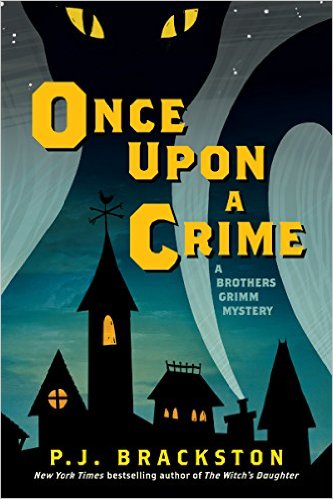
But there is nothing, absolutely nothing, that compares to P. J. Brackston's marvelous "Brothers Grimm Mysteries" featuring, in 18th-century Bavaria, the amazing Gretel (yes, that Gretel) and her eating-disordered but charming brother Hans, still sorting out their PTSD from that disastrous episode with the witch and the gingerbread house. Gretel is a very successful private investigator herself, weaving deftly among the political realities of kings, princesses, and "Kingsmen" (the police) -- but even with her local background in Jack (the one who planted the beans and climbed the beanstalk) and his family, she's had no preparation for coping with what this particular investigation demands, in ONCE UPON A CRIME.

It sounds simple enough at first -- Frau Hapsburg swears three of her cats (among more than two dozen) have been kidnapped and she has plenty of money to pay Gretel to take the case of tracking them down, even rescuing them. But after accepting a hefty deposit, Gretel checks in with a fortune-telling friend who's pretty accurate with a Tarot deck. The mention of a tall handsome stranger in the reading is something she figures is a put-on; it's the mention of a troll that has her worried. Good thinking.

I delayed several serious chores, in order to stick with Gretel in her perils. Is the king's executioner really going to take off her head? What was that about torture on the rack? Is that tall, dark stranger really interested in her? And how on earth did Hans come up with some real skills to assist Gretel in her work?

Come on, let go of any prejudice against a fairy-tale environment -- if you've read Jasper Fforde, you already know it's great grounds for crime and crimesolving, and Brackston's writing won't demand the literary background of Fforde's; those half-remembered stories will do you just fine for case background. I promise the plot makes sense, the characters (when not covered with mud) are endearing, and the insights into Gretel's thinking are good detective work, no matter how the costumes appear. Consider this moment as Gretel gets a good massage to make up for a trying visit to said troll:
She now knew someone was snatching the cats, or, more accurately, having the cats snatched. She knew also that this person lived over the mountains one day hence. Furthermore, she knew that the troll knew who this person was. In addition, she had a rare insight into the life, habits, and singular desires of trolls, but she decided against counting this as a plus of any sort. She had also deduced that the troll was more involved than he was letting on, given the missing finger on the corpse ... the only way to discover the identity of the cat collector was to obtain a human finger and take it to said troll.

"Argh!" she cried, as the masseur found a particularly sensitive spot.

"Fraulein, you have been overworking these muscles. It is important to build up stamina before attempting any serious activity."

Gretel groaned. "Needs must. Besides, I'm not sure what the recommended training would be before encountering trolls."
 Oh, I know, you're still skeptical. I can't blame you -- if Pegasus Books hadn't started me on Brackston's series with Gretel and the Missing Frog Prints (not a typo) last winter,  I might have missed out. This series sounds more than a little crazy, right?

But Brackston's books are fun, lively, well-written, inventive -- and they honor all the expectations for a well-knitted mystery, with a great balance of red herrings (or capes, or shoes) and useful clues and entertaining distractions. Didn't you promise yourself that you wouldn't take life so seriously? Here's a great way to start!


Saturday, July 18, 2015

Humor, History, and Very Very Human: DEATH EX MACHINA, Gary Corby

Sure, I was skeptical at the start -- this is the fifth Athenian mystery set by Australian Gary Corby in "Classical Athens" and it involves a group of actors, as well as the husband-and-wife investigative team of Nicolaos and Diotima. And a ghost!

But it didn't even take a chapter for Corby's breezy and quick-paced style to draw me into this 459 BC mystery. And although each chapter brings more revelations about "real life" in Athens and its surroundings, the information is deftly tucked (with smiles) into what Nico and his wife discover. There are some notes at the end of the book, and it turned out that the quirks that most raised my eyebrows came directly from Corby's research (yes, I peeked), so I relaxed and went with this very entertaining and just-complicated-enough romp through murder and mayhem.

Anyone who's heard of the way Shakespeare performers refer to Macbeth  as "the Scottish Play" already knows actors tend to be superstitious. So it's no big stretch to assume the ones in Ancient Athens would refuse to work if convinced that their performance space is haunted -- especially if accidents keep happening. When Nico and Diotima accept the task of exorcising the ghost in the city's grand theater, Nico at least is matter-of-face enough to rephrase the assignment to himself as "catch the killer," and figure out who's working to sabotage the show before the grand Dionysius festival begins.

The motives for murder turn out to hinge on employment and immigration, issues I never would have guessed were crucial in Athens "back then." As Nico and Diotima interview the newly promoted second lead actor for the show, Romanos, it's clear the actor is an eager and imperiled immigrant, and Nico assesses the situation and the actor:
I tried to estimate the age of Romanos, but it wasn't easy. He was one of those men who could be an old-looking twenty-five or a young-looking thirty-five. There were lines of experience about his eyes, but I guessed that he'd had a hard life and he could have acquired those at an early age.

Romanos looked out from our shelter, into the pouring rain.

He said, "I would like to be a citizen of Athens one day." ...

I asked, "Would it help you?"

Romanos looked surprised. "Of course it would. Citizens get all the best parts."
But what seems to be theater-motivated crime takes a new twist when Nico follows some leads into the surrounding countryside, and sniffs the trail of both beer and wine, as well as scandal.

I had a great time reading DEATH EX MACHINA and I'll be scooping up Corby's earlier work, as well. It''s a great treat for summer vacation, and reading the series will fit any time there's good reason to take a break -- for a challenge to preconceptions, a good plot, enjoyable characters, and a sense of fresh discovery. No need to read the earlier books before this one, but I'm sure I won't be the only reader who decides to invest in the whole series! From Soho Crime, and a dandy mix of caper crime fiction and amateur sleuth.

Sunday, July 12, 2015

Food, Fun, and Crime Solving in FATAL RESERVATIONS, Lucy Burdette

On the cover of the new paperback mystery from Lucy Burdette, number six in her Key West Food Critic series, are many of the enticing elements of this enjoyable summer "cozy" -- Tarot cards, yummy meals, a cat (there are three on the houseboat this time!), and a fabulous Key West (Florida) sunset.

What you don't see in this image though (and by the way, Lucy Burdette, have you thought of producing it as a jigsaw puzzle? the details are darling!) is the tangled situation Hayley Snow confronts as the action opens: her new boss's uncomfortable expectations at the local newspaper (not just urban-level writing style but also classier outfits!), the prolonged absence and odd reactions of her boyfriend (and old boss), and her uneasy relationship with members of the local police force. In FATAL RESERVATIONS, that relationship is strained by the usual problems facing an amateur sleuth -- the police aren't thrilled to have Hayley snooping into a sudden death that they're labeling murder. Why can't she just step back and let them arrest her fortune-telling friend Lorenzo?

But there's another ongoing issue for Hayley as she pulls on her crime-solving heels once again: She's drawn to those smart and decisive characters on the local police force, even when they're trying to evict her from the scene. And having at least one of them decide to be protective of her is making it tough for her to hide Lorenzo in her houseboat home, even with the willing help of her octagenarian housemate Miss Gloria.
"I'm sorry we were a bother, Officers," I said. "I'm a friend of Officer Torrence, and he's always telling me, 'Call the police even if you're not sure you need help.' I have a little reputation for trying to do things myself." I pasted on a silly grin and bobbled my head.

"You may very well have had an intruder in here," said the big cop, his face looking fierce. "You ladies need to be more careful about locking your door."

"We need to get the latch fixed," said Miss Gloria, fibbing so quickly my head was spinning. "It just gave out this week."
Miss Gloria also adds great expressions to the conversations, from "case the joint" to "Sheesh" and "Coast is clear." She's a marvelous houseboat roommate, even with her current passion for exploring and talking about burials at the cemetery. But that too may come in helpful.

Burdette is clearly on a roll here -- like her most recent two books in the series, Death With All the Trimmings  and Murder With Ganache, FATAL RESERVATIONS is tightly plotted, quick-paced, and full of unforgettable characters, dead and alive. Don't wait to get the other books in the series before reading this one. Hayley's interactions and quick recaps fill in what you need to know from her past, and there's so much going on that you might as well leap right into the bay ... err, book.

Of course, a big part of the pleasure of this series is the foodie chat, from the meals Hayley is preparing or reviewing, to the recipes packed into the back of the book. This time, the one I want to taste-test is "Once in a Blue Moon Blue Cornmeal Blueberry Pancakes with Cinnamon Butter"; I've just adjusted my shopping list accordingly! Strain lines for Hayley this time around include how to review a less-than-great meal at a new floating restaurant, and whether her printed words could be responsible for the owner's loss of control.

I had a lot of fun reading my copy -- which I was delighted to "win" by a drawing that the author provided (thanks, Lucy! aka Roberta Isleib). I won't be able to lend it around the neighborhood, though ... I am still considering another of the recipes in the back!

PS - Visiting the Lucy Burdette website is always fun (click here), but I also enjoy keeping up with this author's food chat on Facebook and at the Mystery Lovers Kitchen blog. Hope you'll have a chance to check them out.

British Police Procedural: Peter Diamond #14, DOWN AMONG THE DEAD MEN, Peter Lovesey

In the various series of British police investigation novels spinning now, a generous proportion draw their appeal from the team aspect: an investigator we focus on, and a second detective who helps outline the proportions of character and plot. Consider Reginal Hill's Dalziel and Pascoe; you can think of more (and are invited to comment on them here!).

Peter Lovesey's reliably intriguing Peter Diamond series, in which DOWN AMONG THE DEAD MEN is the 14th, now leaves behind Superintendent Diamond's pairing with DS Ingeborg Smith, and send Diamond out on a politically risky investigation with his own boss -- Georgina Dallymore, Assistant Chief Constable of Bath, always able to overlook a genuine clue in favor of her own suppositions and her imagined potential fame as a crimesolver. Her obvious certainty that Peter and others find her fatally alluring adds more complication to her insistence that Peter must assist on this hush-hush assignment. (And share a room at their lodgings?!!) And it's soon clear that Peter's not the only one who realizes Georgina is a stunningly poor pick for figuring out whether another city's police force is corrupt.

Lovesey's multiple plot lines here are a delight, and he's back to the strong, forward-moving crime fiction that's won him so many steady readers. Consider Danny, the petty criminal whose car thefts involved him with a murder, years ago; or the gutsy but rash teenage girls at a local prep school whose art teacher has gone missing, with nobody paying attention, and whose new art teacher is not only a "hot" young man but also willing to lead the girls into the Bohemian lifestyle he and his friends can afford. Readers from earlier in the series will perk up when one of the suspected investigators turns out to be Peter's former colleague, Henrietta "Hen" Mallin -- quite a contrast to powerful and clueless Georgina! And floundering in the loss of her own command, Hen's still not able to resist clashing with Peter's boss:
"I don't know about pride," Hen said. ... "I said at the beginning I messed up. You've got your views about policing,  I've got mine. What else do you want to hear from me?"

"I haven's heard a single 'ma'am,'" Georgina said. "That would be a start."

Diamond's flesh prickled.

Hen rose to it, as he knew she would. "God help us. Is that what you mean by respect? There I was thinking you were a fellow human being come to listen to my grubby little story when the truth is that you only came to hear me call you ma'am, and I missed all those opportunities. Well, I can put that right, ma'am, ma'am, ma'am, ma'am, ma'am--"

"Hen!"

She stopped.

Diamond couldn't let her destroy herself in front of him. "Get a grip."
As usual, Diamond's ability to solve the crime -- at first a matter of a body in a trash bag, but soon revealed as much larger and more sinister -- depends on his "read" of the people around him, and in this case it's also a matter of whether he can keep Hen and Georgina far enough apart to prevent open warfare within the force.

As Diamond deftly turns the investigation and takes over the lead in spite of Georgina's repeated moves of subterfuge and manipulation, it turns out he is indeed the right person for this one.

Lovesey and Soho Crime have given us a great summer read, one that will stay on my shelf for midwinter refreshment as well. If you're a British crime reader, this book's a great addition to the collection. In 2000 Lovesey won the Cartier Diamond Dagger for excellence in crime writing -- it's clear he has a long career still ahead.

Saturday, July 04, 2015

Perfect for Beach Reading: THE LONGEST YARD SALE, Sherry Harris

The second tag sale/yard sale mystery from Sherry Harris just came out, and it's a terrific summer read! THE LONGEST YARD SALE follows up on Sarah Winston's debut crime-solving effort in Tagged for Death. Glad to say right away that you don't need to read these in sequence -- because Sherry Harris is a gifted storyteller, with plenty of twists and adventures for her smart and stubborn protagonist.

Sarah Winston has one of those jobs that could provide access to things people wish you didn't know -- she's a newspaper columnist. But instead of investigating crimes in her Massachusetts neighborhood, she gives advice on organizing yard sales, and her column's popular enough to run in both the local paper and some of the others around. Of course she checks out plenty of sales herself. Her eagle eyes catch some great bargains, as well as solid fixer-uppers; she's been a cash-strapped military wife, and now she's cash-strapped and divorced, so she's well motivated to make the most of her expertise, even consulting for a fee for those who want the best sales.

As THE LONGEST YARD SALE opens, Sarah's donning an earpiece and microphone to keep her in touch with her boss-for-the-day, town manager Nancy Elder. Sarah's own casual suggestion about a way to draw tourist attention to the town of Ellington, Mass., by throwing a record-breaking "New England's Longest Yard Sale," not only caught on with Nancy and the town leaders -- it got Sarah the job of coaching the sale into existence. Now it's time to see how the town's already narrow roads will handle the influx of shoppers for the day!

And that's raising the tension for Sarah too, because the police force struggling to manage the surge of traffic and tourists is headed by her ex, now the police chief -- and he's willing to blame her for problems, while at the same time expecting her to get back together with him, since in the previous book (no, I won't spoil it!) she's had to admit he's not as bad as she thought. And she clearly still cares about him.  Still, she's got other possibilities, very pleasant ones, if also confusing!

If you're a fan of "cozy" mysteries -- the traditional small-town ones where the characters usually have known each other for a while, and life's frictions begin to add up to "I wish that person were dead" -- the quick piling up of suspicious circumstances in the first few chapters here will be like a candy store of goodies to choose from: the demanding and sometimes missing-in-action town manager Nancy Elder; Sarah's two suitors; the wealthy town resident who asks Sarah to appraise her things for an estate-type sale but also is clearly hiding things and circumstances; and the small but dangerous crimes that arrive during the yard sale itself, from arson to theft to threat.

Turn off the phone, make a tall cold pitcher of iced tea, put your feet up -- or if you indeed pack this one for the beach, take a good swim BEFORE you open the book. It's lively, quickly paced, tense and twisty enough to keep the pages turning eagerly, while being very much about women, their friendships and life paths, and how they work out problems that are scary and intense. There wasn't a single point in the book where I felt like putting it down!

Harris proves that her first good book was the start of a strong series, by adding THE LONGEST YARD SALE. Sarah Winston is starting to feel like a friend "from away" who just can't stay away from investigating for her neighbors and trying to find justice for them. I can hardly wait for the next book -- Sherry Harris (with Kensington Publishing) clearly will give us more good reads for summer and other vacations to come!

***
A little local note: Last summer my neighbor Marsha and I collaborated with some of Marsha's friends to hold a fund-raising yard sale for her dog Abby, who needed help to resume walking after an accident. This year Abby's doing well -- thank you all! -- but Marsha's loyal laying hens are in trouble for liberating themselves into the garden, and a couple hundred dollars of more secure fencing are needed, to prevent "the girls" from being turned into Sunday supper. So ... you guessed it ... we're prepping for another yard sale. I'm keeping track of the tips that Harris's books offer in the text and at the end. Onward!

Tuesday, June 02, 2015

New World War I Thriller Series from Robert Goddard: THE WAYS OF THE WORLD

US cover
How have I missed out on Robert Goddard's British thrillers until now? His website proclaims him "master of the clever twist," and Grove Atlantic released today his 24th book -- and the first in a World War I-era trilogy: THE WAYS OF THE WORLD. Max Maxted -- well, his family calls him James, but everyone else uses Max -- was a flying ace during the Great War, and finished the conflict as a prisoner of war. He's still very reactive to enclosed spaces, especially damp, dark ones. But with the enthusiastic partnership of his former sergeant Sam, who still refers to him as the lieutenant, Max is about to put his Flying Ace skills to glorious work: starting his own flying school in green and peaceful England.

Or he was. Because at the start of THE WAYS OF THE WORLD, Max's cleverer-than-she-looks mother has just tracked him to a hangar of aircraft he plans to purchase. And with one blunt announcement, she turns his priorities her way: "It's your father, James," said Lady Maxted. "He's been killed, I'm afraid."

There's no reason to think the death is anything other than an unfortunate -- perhaps embarrassing -- accident. After all, Sir Henry Maxted, 2nd Baronet, had a long diplomatic career most definitely on the wane after the war, and his "work" in Paris was probably just a formality, a chance to put an old man out on display for something not very important. Max and, especially, his older brother Ashley know that; so does Lady Maxted.

But Max's newly widowed mother is placing her confidence in her younger son, not in the new Baronet, as the brothers pack for a rapid journey to Paris, the scene of Sir Henry's death. She takes Max aside and says Ashley is obedient and reliable, but:
"I know I can rely on him to protect your father's memory at all costs. Whereas you ..."

"Whereas I?"

"Will go in search of the truth . . . wherever it is to be found. ... All I ask is this: if you discover your father was the victim of something other than an accident and if you discover what that something was ..."

"Yes?"

"I should like to hear of it before you proclaim it to the world."

Max felt the full force of his mother's gaze as he stood before her.
What Max would never have guessed was that his mother didn't just suspect her husband of a routine French affaire. She's the one who senses that he's been up to more than a routine diplomatic mission, too.

But as Max begins to peel back the layers of his complicated father's life abroad, first he gets in trouble with the French police himself. Then he finds the deep waters of espionage, intrigue, and criminal enterprise. The old diplomat was doing all this? Max doesn't have time to marvel much -- he's running too hard to catch up, in terms of expertise, daring, investigation skills, and a quickly rising awareness of danger and risk that makes him very glad his sergeant Sam turns up in time to help out.

It's hard not to race into this book as a reader, too: Goddard's clearly at the top of his form, writing swift action scenes and intense character-changing conflicts. THE WAYS OF THE WORLD is a prime page-turner. Released in the United Kingdom in 2013, it's a new release today for American readers. I'm hoping Globe Atlantic will provide the second book of the trilogy quickly, as The Corners of the Globe is already in print across the ocean. Good reading!

And for me, good to know there are also 23 other Robert Goddard thrillers to track down while I'm waiting for the next installment of Max Maxted's death-defying investigation!